
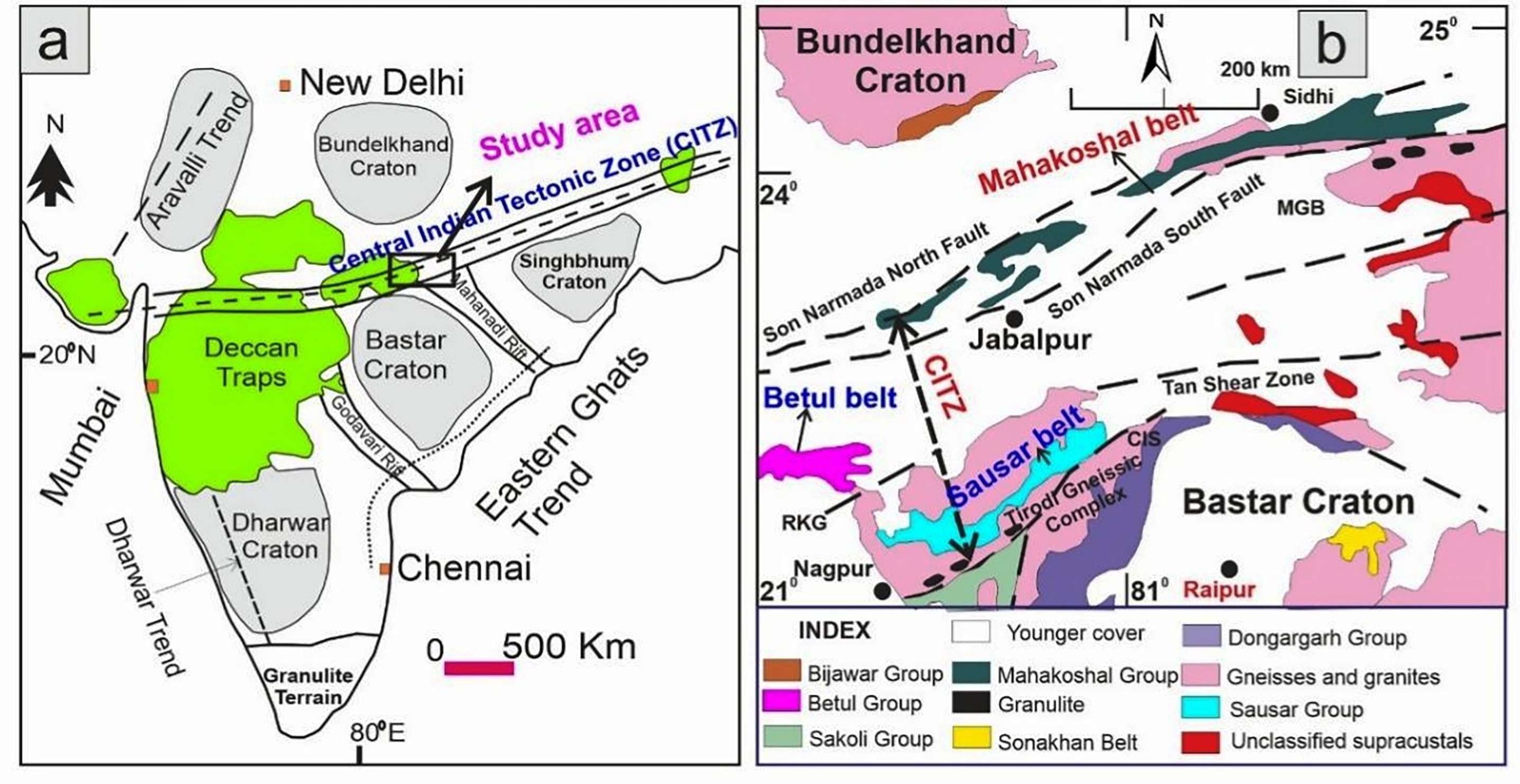
This work presents a synthesis of mineral deposits formed during the evolution of the Central Indian Tectonic Zone (CITZ). The CITZ is situated between the Bundelkhand and Bastar cratons, representing a major Proterozoic orogenic suture that preserves a complex record of tectonic, magmatic, metamorphic, and metallogenic (M3) events during the ~2.4–0.9 Ga period. The CITZ encompasses a diverse tectonic belt, represented by the Mahakoshal in the north, the Betul in the central sector, and the Sausar belt in the south. The tectonic evolution of the CITZ records a protracted history of intraplate magmatism, rifting, oceanic crust generation, arc-back-arc development, and continental-margin accretion, and culminated with the final collision of the two Archean cratons of Peninsular India. This convergence-driven evolution (2.1–1.6 Ga) is reflected in distinct mineralization events that define the metallogeny of the CITZ. The earliest metallogenic phase is marked by Fe-graphite-orogenic gold mineralization in the Mahakoshal belt and graphite in the Betul belt, linked to the initial collision of the Bundelkhand and Bastar cratons (1.95–1.80 Ga). Subsequently, volcanogenic massive sulfide (Zn–Pb ± Cu) deposits were formed during 1.80–1.70 Ga in the Betul belt, associated with multiple stages of arc-rifting. The Sausar belt evolved into a world-class manganese metallogenic province, reflecting basin-scale sedimentary and diagenetic processes operating during the Paleoproterozoic and Neoproterozoic. The waning stages of intraoceanic arc development were accompanied by emplacement of voluminous mafic–ultramafic flows and sills, hosting Ni–Cu–PGE prospects at Padhar complex in the Betul belt. Later, the phase is associated with alkali magmatism, which led to REE mineralization.
- Open Access
- Article
Metallogeny vis-à-vis Proterozoic Tectonics of the Central Indian Tectonic Zone (CITZ): An Overview
Author Information
Received: 30 Sep 2025 | Revised: 10 Oct 2025 | Accepted: 19 Oct 2025 | Published: 24 Oct 2025
Abstract
Graphical Abstract
Keywords
Central Indian Tectonic Zone (CITZ) | Metallogeny | Proterozoic geodynamics | Supercontinents
References
- 1.Rogers, J.J.W.; Santosh, M. Tectonics and surface effects of the supercontinent Columbia. Gondwana Res. 2009, 15, 373–380. https://doi.org/10.1016/j.gr.2008.06.008
- 2.Wang, Z.; Zhang, J.; Zong, K.; et al. Plate tectonics: The stabilizer of Earth’s habitability. J. Earth Sci. 2023, 34, 1645–1662. https://doi.org/10.1007/s12583-023-1864-9
- 3.Anbar, A.D.; Knoll, A.H. Proterozoic ocean chemistry and evolution: A bioinorganic bridge? Science 2002, 297, 1137–1142. https://doi.org/10.1126/science.1069651
- 4.Santosh, M. Habitable Planet Earth: Secular evolution and sustainable future. Habitable Planet 2025, 1, 286–297. https://doi.org/10.63335/j.hp.2025.0021
- 5.Sharma, A.; Chakraborty, P.P.; Pandey, A.K.; et al. A tale of evolution of the Central Indian Tectonic Zone (CITZ) with glimpses on pre-suture plate margin depositional history. Geol. J. 2025, 60, 404–430. https://doi.org/10.1002/gj.5087
- 6.Dora, M.L.; Meshram, T.; Baswani, S.R.; et al. Geological evolution of the Proterozoic Betul belt (∼2.16–0.95 Ga) of the Central Indian Tectonic Zone: Its linkage to the assembly and dispersal of Columbia and Rodinia supercontinents. Gondwana Res. 2023, 116, 168–197. https://doi.org/10.1016/j.gr.2022.11.017
- 7.Mohanty, S.P.; Li, Q.; Zhai, M.; et al. Geochronology of post-tectonic granite and gneiss of the Central Indian Tectonic zone: Implications on the time of amalgamation of the North and South Indian Blocks. J. Asian Earth Sci. 2025, 2025, 106799. https://doi.org/10.1016/j.jseaes.2025.
- 8.Bhowmik, S.K. The current status of orogenesis in the Central Indian Tectonic Zone: A view from its Southern Margin. Geol. J. 2019, 54, 2597–2620. https://doi.org/10.1002/gj.3456
- 9.Chattopadhyay, A.; Bhowmik, S.K.; Roy, A. Tectonothermal evolution of the Central Indian Tectonic Zone and its implications for Proterozoic supercontinent assembly: The current status. Episodes 2020, 43, 132–144. https://doi.org/10.18814/epiiugs/2020/020008
- 10.Naganjaneyulu, K.; Santosh, M. The Central India Tectonic Zone: A geophysical perspective on continental amalgamation along a Meso-Proterozoic suture. Gond. Res. 2010, 18, 547–564.
- 11.Deshmukh, T.; Naraga, P.; Bhattacharya, A. Proterozoic HT–LP metamorphism in the Mahakoshal Belt, Central Indian Tectonic Zone (India): Structure, metamorphism, U–Th–Pb monazite geochronology and tectonic implications. J. Geol. 2021, 129, 455–480. https://doi.org/10.1086/715772
- 12.Giri, R.; Chalapathi Rao, N.V.; Rahaman, W.; et al. Paleoproterozoic calc-alkaline lamprophyres from the Sidhi Gneissic complex, India: Implications for plate tectonic evolution of the Central Indian Tectonic Zone. Precambrian Res. 2021, 362, 106316. https://doi.org/10.1016/j.precamres.2021.106316
- 13.Mahakud, S.P.; Raut, P.K.; Hansda, C.; et al. Sulfide Mineralization in the Central Part of the Betul Belt around Ghisi-Mouriya-Koparpani Area, Betul District, Madhya Pradesh; Geological Survey of India: Kolkata, India, 2001; Volume 64, pp. 377–385.
- 14.Tripathi, S.; Deb, M. Decoding imprints of hydrothermal alteration around Imalia polymetallic sulphide deposit, Central Indian Tectonic Zone, and its implications on ore genesis. Geol. Mag. 2025, 162, 12–30. https://doi.org/10.1017/S0016756825000056
- 15.Misra, P.S.; Singh, V.; Tripathi, U.; et al. Gold Mineralization in Eastern Mahakoshal Belt of Central India: A Reappraisal Based on Mineral System. J. Geol. Soc. India 2023, 97, 985–992. https://doi.org/10.1007/s12594-021-1813-0
- 16.Baswani, S.R.; Hazarika, P.; Meshram, T.; et al. Genesis of Greenockite (CdS) and associated sulfide-gold mineralization from Mahakoshal Belt, Central Indian Tectonic Zone. Geol. J. 2023, 58, 1623–1643. https://doi.org/10.1002/gj.4681
- 17.Golani, P.R.; Dora, M.L.; Bandyopadhyay, B.K. Base metal mineralization associated with hydrothermal alteration in felsic volcanic rocks in Proterozoic Betul Belt at Bhuyari, Chhindwara district, Madhya Pradesh. J. Geol. Soc. India 2006, 68, 797–808.
- 18.Roy, S. Possible VMS-type base metal mineralization at Pastalaimal and associated alteration features: Implications for identification of future targets in Betul belt, Madhya Pradesh, India. J. Geol. Soc. India 2011, 77, 459–464. https://doi.org/10.1007/s12594-011-0104-5
- 19.Praveen, M.N.; Nambiar, C.G.; Huston, D.L. Geochemistry and petrogenesis of Paleoproterozoic rhyolite-hosted zinc-rich metamorphosed volcanogenic massive sulfide deposits in the eastern Betul Belt, central India. Ore Geol. Rev. 2021, 131, 103918. https://doi.org/10.1016/j.oregeorev.2020.103918
- 20.Sharma, R.K.; Lenka, B.; Ahmed, S. Genesis of Graphite in Betul Belt, Madhya Pradesh, India: Inferences Based on Petrographic and Other Studies. Open J. Geol. 2022, 12, 983–1012. https://doi.org/10.4236/ojg.2022.1211047
- 21.Patel, V.V.; Sahu, P.K.; Talwar, A.K. Graphite within Carbonaceous Phyllite, Mahakoshal Group, Central Indian Tectonic Zone. Curr. Sci. 2021, 121, 192–195. https://doi.org/10.18520/cs/v121/i2/192-195
- 22.Patro, P.K.; Vijaya Kumar, P.V.; Abhirami, S.G.; et al. Integrated subsurface investigation for magmatic sulfide mineralization in Betul Fold Belt, central India. J. Appl. Geophys. 2023, 211, 104974. https://doi.org/10.1016/j.jappgeo.2023.104974
- 23.Meshram, R. R.; Mohamed, S. Geology and Genesis of pegmatites of Parseoni areas in Sausar Mobile Belt, Nagpur district, Central India. Indian J. Geosci. 2019, 73, 119–130.
- 24.Naqvi, S.M.; Rogers, J.J.W. Precambrian Geology of India; Oxford University Press: Oxford, UK, 1987; 233p.
- 25.Roy, A.; Prasad, M.H. Tectonothermal events in Central Indian Tectonic Zone (CITZ) and its implications in Rodinian crustal assembly. J. Asian Earth Sci. 2003, 22, 115–129. https://doi.org/10.1016/S1367-9120(02)00180-3
- 26.GSI. Geology and Mineral Resources of Madhya Pradesh (3rd ed.); GSI Misc Pub, No 30, Part-XI; GSI: Kolkata, India, 2014.
- 27.GSI. Geology and Mineral Resources of Maharashtra (3rd ed.); GSI Misc Pub, No 30, Part-II; GSI: Kolkata, India, 2016.
- 28.Wani, H.; Mondal, M. Geochemical evidence for the Paleoproterozoic arc–back arc basin association and its importance in understanding the evolution of the Central Indian Tectonic Zone. Tectonophysics 2016, 690, 57–67. https://doi.org/10.1016/j.tecto.2016.10.001
- 29.Bhandari, A.; Pant, N.C.; Bhowmik, S.K.; et al. 1.6 Ga ultrahigh-temperature granulite metamorphism in the Central Indian Tectonic Zone: Insights from metamorphic reaction history, geothermobarometry and monazite chemical ages. Geol. J. 2011, 46, 198–216. https://doi.org/10.1002/gj.1244
- 30.Yedekar, D.B.; Jain, S.C.; Nair, K.K.K.; et al. 1990. The Central Indian Collision Suture; Special Publication 28, 1–Acharyya; Geological Survey of India: Kolkata, India, 2003.
- 31.Acharyya, S.K. The nature of Mesoproterozoic Central Indian Tectonic Zone with exhumed and reworked older granulites. Gondwana Res. 2003, 6, 197–214. https://doi.org/10.1016/S1342-937X(05)70970-9
- 32.Bhowmik, S.K.; Chakraborty, S. Sequential kinetic modelling: A new tool decodes pulsed tectonic patterns in early hot orogens of Earth. Earth Planet. Sci. Lett. 2017, 460, 171–179. https://doi.org/10.1016/j.epsl.2016.12.018
- 33.Nair, K.; Jain, S.; Yedekar, D. Stratigraphy, structure and geochemistry of the Mahakoshal greenstone belt. Mem. Geol. Soc. India 1995, 37, 403–432.
- 34.Roy, A.; Devarajan, M.K. Appraisal of the stratigraphy and tectonics of the Proterozoic Mahakoshal supracrustals belt, central India. Geol. Surv. India Spl. Pub 2000, 57, 79–97
- 35.Khan, M.A. Gold mineralization in Son Valley Gold Belt, Parts of Sidhi and Sonbhadra Districts, Madhya Pradesh and Uttar Pradesh; Bulletin Series-A, No. 61; Geological Survey of India: Kolkata, India, 2013
- 36.Giri, R.K.; Pandit, D.; Chalapathi Rao, N.V. Cobaltoan pyrite in a lamprophyre from the Sidhi Gneissic complex, Mahakoshal belt, Central India. J Geol Soc India 2018, 91, 5–8. https://doi.org/10.1007/s12594-018-0813-1
- 37.Srivastava, R.K.; Chalapathi Rao, N.V. Petrology, geochemistry and tectonic significance of Palaeoproterozoic alkaline lamprophyres from the Jungel Valley, Mahakoshal Supracrustal Belt, Central India. Mineral. Petrol. 2007, 89, 189–215.
- 38.Parvez, K.; Mondal, M.E.A.; Ahmad Iftikhar Rahaman, W.; et al. Mineralogical, Geochemical and Nd Isotopic Study of the Meta-Clastic Rocks of the Paleoproterozoic Mahakoshal Basin, Central Indian Tectonic Zone: Implications for Provenance Characterization, Paleoweathering Conditions and Tectonic Setting. Geochem. Int. 2024, 62, 1378–1404. https://doi.org/10.1134/S0016702924700472
- 39.Khanna, T.; Rao, D.V.; Sai, V.V.; et al. ca. 2.1 Ga Mahakoshal Supracrustal Belt: An allochthonous terrain in Central India Tectonic Zone. Lithos 2020, 374–375, 105705. https://doi.org/10.1016/j.lithos.2020.105705
- 40.Chakrabarty, A.; Shreya, K.; Subham, M.; et al. Neoproterozoic reworking of a Mesoproterozoic magmatic arc from the north-eastern part of the Central Indian Tectonic Zone: Implication for the growth and disintegration of the Indian shield in the Proterozoic supercontinental cycles. Precambrian Res. 2022, 378, 106758. https://doi.org/10.1016/j.precamres.2022.106758
- 41.Radhakrishna, B.P.; Naqvi, S.M. Precambrian continental crust of India and its evolution. J. Geol. 1986, 94, 145–166. https://doi.org/10.1086/629018
- 42.Yadav, B.; Ahmad, T.; Kaulina, T.; et al. Origin of post-collisional A-type granites in the Mahakoshal Supracrustal Belt, Central Indian Tectonic Zone, India:Zircon U–Pb ages and geochemical evidences. J. Asian Earth Sci. 2020, 191, 104274. https://doi.org/10.1016/j.jseaes.2020.104274
- 43.Bora, S.; Kumar, S. Geochemistry of biotites and host granitoid plutons from the Proterozoic Mahakoshal Belt, central India tectonic zone: Implication for nature and tectonic setting of magmatism. Int. Geol. Rev. 2015, 57, 1686–1706. https://doi.org/10.1080/00206814.2015.103
- 44.Chaturvedi, R.K. A review of the Geology, Tectonic features and tectono-lithostratigraphy of Betul Belt. Geol. Surv. India Spec. Publ. 2001, 64, 299–315.
- 45.Chore, S.A.; Chakraborty, S.; Vishwakarma, L.L.; et al. Petrology of base metal bearing volcano sedimentary litho assemblages of the Betul Belt of Central India and its possible significance in the evolutionary history of the Central Indian Tectonic Zone. Surv. Rec. 2002, 135, 16–17.
- 46.Roy, A.; Chakraborti, K.Precambrian Mafic-Ultramafic Magmatism in Central Indian Suture Zone. J. Geol. Soc. India 2008, 72, 123–140.
- 47.Dora, M.L.; Helmy, H.M.; Meshram, R.; et al. Proterozoic arc magmatism from the Padhar mafic-ultramafics in Betul Belt, Central India Tectonic Zone: Insight from petrography, bulk rock and in-situ trace element geochemistry. Geosyst. Geoenviron. 2025, 100383. https://doi.org/10.1016/j.geogeo.2025.100383
- 48.Ghosh, B.; Praveen, M.N. Indicator minerals as guides to base metal sulfide mineralization in Betul Belt, central India. J. Earth Syst. Sci. 2008, 117, 521–536. https://doi.org/10.1007/s12040-008-0050-x
- 49.Raza, M.A.; Shareef, M.; Naidu, B.V.S.S.A.; et al. Multiple sulfur sources for the volcanic hosted massive sulfides in Betul Belt, Central India: Evidence from the sulfide ore chemistry and sulfur isotope geochemistry. Geochemistry 2020, 80, 125632. https://doi.org/10.1016/j.chemer.2020.125632
- 50.Sharma, A.; Das, K.; Chakraborty, P.P.; et al. U–Pb zircon geochronology of a pyroclastic rock from the Parsoi Formation, Mahakoshal Group: Implications towards age and tectonics of the Basin in Central Indian Tectonic Zone. Geol. J. 2022, 57, 4122–4138. https://doi.org/10.1002/gj.4533
- 51.Baswani, S.R.; Mishra, B.P.; Mahapatro, S.N.; et al. Petrochemical evaluation of gahnite from volcanogenic massive sulfide deposits in Betul belt, Central India: Insight from petrography and in-situ trace element geochemistry. Geol. J. 2022, 57, 4508–4528. https://doi.org/10.1002/gj.4555
- 52.Narayanaswami, S.; Chakravarty, S.C.; Vemban, N.A.; et al. The Geology and Manganese Ore Deposits of the Manganese Belt in Madhya Pradesh and Adjoining Parts of Maharashtra; Bulletin Geological Survey of India, Series A; GSI: Kolkata, India, 1963.
- 53.Dasgupta, S.; Roy, S.; Fukuoka, M. Depositional models for manganese oxide and carbonate deposits of the Precambrian Sausar Group, India. Econ. Geol. 1992, 87, 1412–1418. https://doi.org/10.2113/gsecongeo.87.5.1412
- 54.Chattopadhyay, A.; Khan, S.; Huin, A.K.; et al. Reinterpretation of stratigraphy and structure of Sausar Group in Ramtek–Mansar–Kandri area, Maharashtra, central India. J. Geol. Soc. India 2003, 6, 75–89
- 55.Mohanty, S.P. Spatio-temporal evolution of the Satpura Mountain Belt of India: A comparison with the Capricorn Orogen of Western Australia and implication for evolution of the supercontinent Columbia. Geosci. Front. 2012, 3, 241–267. https://doi.org/10.1016/j.gsf.2011.12.004
- 56.Jawed, T.; Siddiquie, F.N. Mineragraphic Study of Manganese Ore Deposits of Kandri, Mansar, Beldongri and Satak Mines, Nagpur District (Maharashtra), Central India. Int. J. Geosci. 2014, 5, 710–727. https://doi.org/10.4236/ijg.2014.57064
- 57.Devarajan, M.K.; Prasad, M.H.; Prasad, K.A.V.; et al. Gold mineralization in the Mahakoshal Greenstone Belt, Central India: A preliminary study. J. Geol. Soc. India 1998, 52, 147–152.
- 58.Tripathi, U.; Deb, M. Mineralogy of the Imalia Au-Sn-bearing polymetallic sulfide deposit, Mahakoshal belt, Central India. J. Asian Earth Sci. X 2022, 8, 100117. https://doi.org/10.1016/j.jaesx.2022.100117
- 59.Yousuf, I.; Ahmad, T.; Subba Rao, D.V.; et al. Geochemistry, geochronology and petrogenesis of the Proterozoic Betul–Chhindwara bimodal volcanics: Constraints on the evolution of the Central Indian Tectonic Zone. Geol. J. 2025, 60, 1701–1720. https://doi.org/10.1002/gj.5154
- 60.Raut, P.K.; Mahakud, S.P. Geology, geochemistry and tectonic setting of the volcanosedimentary sequence of Betul belt, Madhya Pradesh and genesis of zinc and copper sulfide mineralization. Geol. Surv. India Spl. Pub 2004, 72, 133–146.
- 61.Praveen, M.N.; Ghosh, B.; Shrivastava Dora, M.L.; et al. Sulfide mineralization in Betul Bel: Classification and general characteristics. Geol. Soc. India 2007, 69, 85–91.
- 62.Mishra, B.P.; Pati, P.; Dora, M.L.; et al. Trace-element systematics and isotopic characteristics of sphalerite–pyrite from volcanogenic massive sulfide deposits of Betul belt, Central Indian Tectonic Zone: Insight of ore genesis to exploration. Ore Geol. Rev. 2021, 134, 104149. https://doi.org/10.1016/j.oregeorev.2021.104149
- 63.Rao, D.S.; Satyanarayanan, M.; Sarma, D.S.; et al. Geochemistry of the unusual mafic intrusions in Betul Fold Belt, Central India: Implications for Ni–Cu–Au–PGE metallogeny. Curr. Sci. 2015, 108, 713–722.
- 64.Dhillon, S.; Balaram, V.; Kishore, N.; et al. Petrography and geochemistry of padhar mafic-ultramafic suite rocks, Betul Belt, Central Indian Tectonic Zone, India: Plausible arc type magmatism. IOSR J. Appl. Geol. Geophy. 2017, 5, 53–61.
- 65.Kanungo, D.R.; Malpe, D.B.; Leake, B.E. Manganocummingtonite from the Mesoproterozoic, Sausar Fold Belt, Central India. J. Geol. Soc. India 2014, 83, 93–99. https://doi.org/10.1007/s12594-014-0011-8
- 66.Chattopadhyay, A.; Chatterjee, A.; Das, K.; et al. Neoproterozoic transpression and granite magmatism in the Gavilgarh–Tan Shear Zone, central India: Tectonic significance of U-Pb zircon and U-Th-total Pb monazite ages. J. Asian Earth Sci. 2017, 147, 485–501. https://doi.org/10.1016/j.jseaes.2017.08.018
- 67.Meshram, R.R.; Rao, N.R.; Chore, S.; et al. The Alaskan-type mafic-ultramafic complex at Padhar, Betul Belt, Central India. Curr. Sci. 2018, 114–113, 671–678.
- 68.Roy, A.; Kagami, H.; Yoshida, M.; et al. Rb–Sr and Sm–Nd dating of different metamorphic events from the Sausar mobile belt, central India: Implications for Proterozoic crustal evolution. J. Asian Earth Sci. 2006, 26, 61–76. https://doi.org/10.1016/j.jseaes.2004.09.010
- 69.Singh, P.K.; Verma, S.K.; Singh, V.K.; et al. Geochronology and petrogenesis of the TTG gneisses and granitoids from the Central Bundelkhand granite–greenstone terrane, Bundelkhand Craton, India: Implications for Archean crustal evolution and cratonization. Precambrian Res. 2021, 359, 106210. https://doi.org/10.1016/j.precamres.2021.106210
- 70.Mandal, B.; Sen, M.K.; Vijaya Rao, V. New seismic images of the Central Indian Suture Zone and its tectonic implications. Tectonics 2013, 32, 908–921.
- 71.Santosh, M.; Groves, D.I. Global metallogeny in relation to secular evolution of the Earth and supercontinent cycles. Gondwana Res. 2022, 106, 1–24. https://doi.org/10.1016/j.gr.2022.06.001
- 72.Groves, D.I.; Vielreicher, R.M.; Goldfarb, R.J.; et al. Controls on the heterogeneous distribution of mineral deposits through time. In Mineral Deposits and Earth Evolution; McDonald, I, Boyce, A.J., Butler, I.B., et al., Eds.; Geological Society of London: London, UK, 2005; Volume 248, pp. 71–102.
- 73.Goldfarb, R.J.; Baker, T.; Dubé, B; et al. Distribution, character, and genesis of gold deposits in metamorphic terranes. In One Hundredth Anniversary Volume; Society of Economic Geologists: Littleton, CO, USA, 2005; pp. 407–450.
- 74.Goldfarb, R.J.; André-Mayer, A.-S.; Jowitt, S.; et al. West Africa: The world’s premier Paleoproterozoic gold province. Econ. Geol. 2017, 112, 121–143. https://doi.org/10.2113/econgeo.112.1.121
- 75.Dhopeshwar, S.V.; Khare, M.S.; Shrivastava, J. A behavioral analysis of iron and silica in iron ore deposits of parts of Mahakoshal & Bijawar region, Madhya Pradesh. Int. J. Adv. Res. 2017, 5, 614–629. https://doi.org/10.21474/IJAR01/4457
- 76.Franklin, J.M.; Gibson, H.L.; Jonasson, I.R.; et al. Volcanogenic massive sulfide deposits. In Economic Geology 100th Anniversary Volume; Hedenquist, J.W., Thompson, J.F.H., Goldfarb, R.J., et al., Eds.; Society of Economic Geologists: Littleton, CO, USA, 2005; pp. 523–560. https://doi.org/10.5382/AV100.17
- 77.Schaefer, M.O.; Gutzmer, J.; Beukes, N.J. Late Paleoproterozoic Mn-rich oncoids: Earliest evidence for microbially mediated Mn precipitation. Geology 2001, 29, 835–838.
- 78.Srivastava, R.K.. Petrogenesis and tectonic significance of the mafic volcanic rocks of the Mahakoshal Belt, Central India. J. Geol. Soc. India 2006, 68, 369–386
- 79.Rogers, J.J.W.; Santosh, M. Configuration of Columbia, a Mesoproterozoic supercontinent. Gondwana Res. 2002, 5, 5–22. https://doi.org/10.1016/S1342-937X(05)70883-2
- 80.Kusky, T.M.; Santosh, M. The Columbia connection in North China; Geological Society of London: London, UK, 2009; Volume 323, pp. 49–71. https://doi.org/10.1144/SP323.3
- 81.Pirajno, F. Metallogeny in the Capricorn Orogen, Western Australia, the result of multiple ore-forming processes. Precambrian Res. 2004, 128, 411–439. https://doi.org/10.1016/j.precamres.2003.09.010
- 82.Kasturi Rangan, K.; Santosh, M. Tectonics and metallogeny of Proterozoic orogens: A global perspective. Gondwana Res. 2010, 18, 167–188.
- 83.Granseth, A.; Slagstad, T.; Roberts, N.M.W.; et al. Multi-isotope tracing of the 1.3–0.9 Ga evolution of Fennoscandia; crustal growth during the Sveconorwegian orogeny. Gondwana Res. 2021, 91, 31–39. https://doi.org/10.1016/j.gr.2020.10.019
- 84.Bose, S.; Das, K.; Torimoto, J.; et al. Evolution of the Chilka Lake granulite complex, northern Eastern Ghats Belt, India: First evidence of ∼780 Ma decompression of the deep crust and its implication on the India–Antarctica correlation. Lithos 2016, 263, 161–189. https://doi.org/10.1016/j.lithos.2016.01.017
- 85.Sangster, D.F.; Franklin, J.M.; Lydon, J.W. Volcanogenic massive sulfide deposits. In Geology of Canadian Mineral Deposit Types; Paper 88 21; Geological Survey of Canada: Ottawa, ON, Canada, 1992; pp. 125–140.
- 86.Goodenough, K.M.; Wall, F.; Merriman, D. The Rare Earth Elements: Demand, Global Resources, and Challenges for Resourcing Future Generations. Nat. Resour. Res. 2018, 27, 201–216. https://doi.org/10.1007/s11053-017-9336-5
How to Cite
Dora, M. L., Rath , R., & Randive , K. (2026). Metallogeny vis-à-vis Proterozoic Tectonics of the Central Indian Tectonic Zone (CITZ): An Overview. Habitable Planet, 2(1), 14–28. https://doi.org/10.63335/j.hp.2025.0023
RIS
BibTex
Copyright & License

Copyright (c) 2025 by the authors.
This work is licensed under a Creative Commons Attribution 4.0 International License.
Article Metrics
555
Article Views
1
Citations
Contents
References

 Suite 4002 Level 4, 447 Collins Street, Melbourne, Victoria 3000, Australia
 General Inquiries: info@sciltp.com