
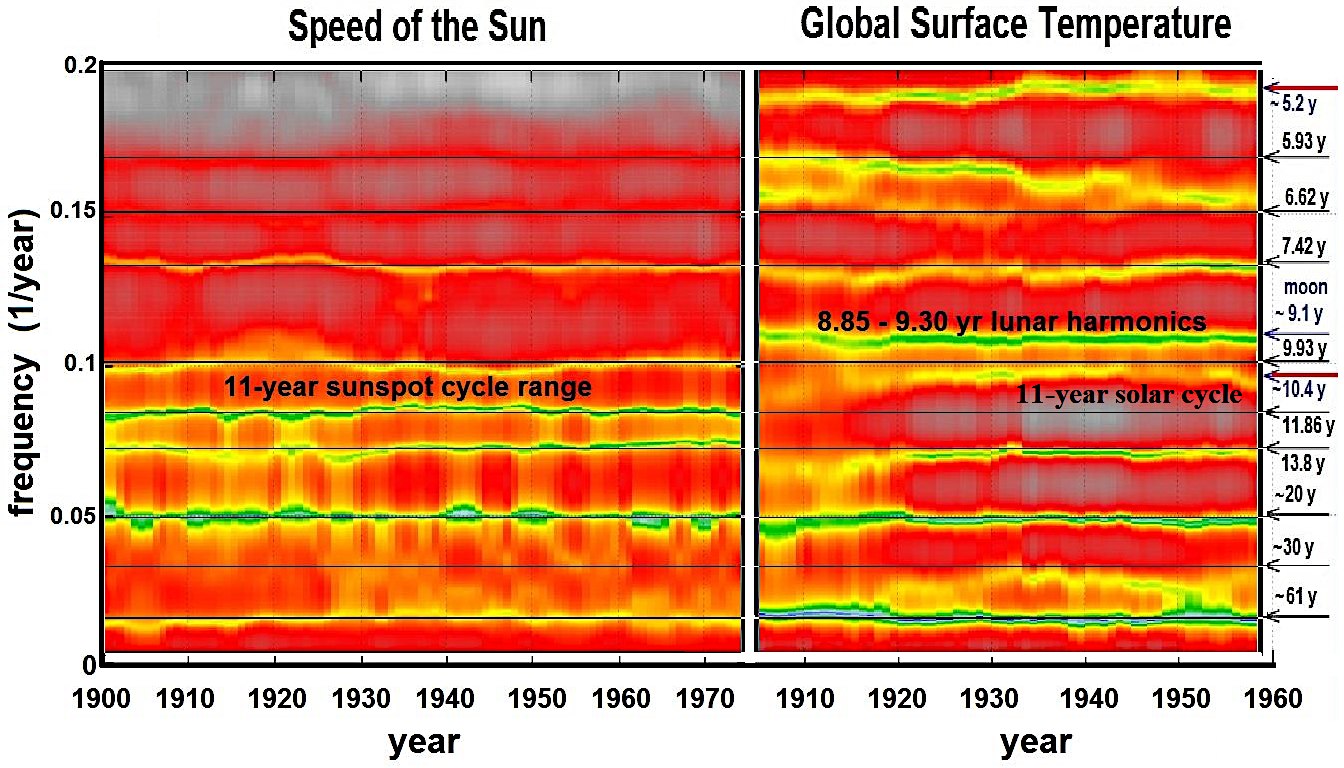
Recent studies show that solar activity exhibits a complex array of oscillatory behaviors spanning from monthly to millennial scales. Among these, the 11-year Schwabe cycle stands out as the most widely recognized solar oscillation. A number of solar oscillations appear to influence Earth's climate and offer promising avenues for understanding and forecasting climate variability. The origin of this array of solar cycles is still debated within the scientific community. One prevailing view links solar cycles entirely to internal magnetic dynamo processes operating inside the Sun. An alternative hypothesis suggests that plan- etary gravitational interactions and orbital configurations may modulate the solar dynamo itself, introducing specific periodic solar oscillations. This study examines key observational findings that support the planetary hypothesis of the connection of solar variability with climate dynamics. It is shown that planetary-induced spectral features closely align with the dominant solar and climate cycles across a broad range of temporal scales.
- Open Access
- Review
Planetary Modulation of Solar and Climate Oscillations
Author Information
Received: 19 Oct 2025 | Revised: 30 Oct 2025 | Accepted: 07 Nov 2025 | Published: 11 Nov 2025
Abstract
Graphical Abstract
Keywords
Planetary systems | Orbital synchronization | Solar cycles | Tidal forces | Mechanisms of solar and climate cyclical variability
References
- 1.Eddy, J.A. Climate and the changing Sun. Clim. Change 1977, 1, 173 190. https://doi.org/10.1007/BF01884410
- 2.Wolf, R. Extract of a letter to Mr. Carrington. Mon. Not. R. Astron. Soc. 1859, 19, 85 86. https://doi.org/10.1093/mnras/19.3.85
- 3.Malburet, J. Sur la priode des maxima d'activit solaire. Acad. Sci. Paris. Republished in C. R. Geosci. 2019, 351, 351 354. https://doi.org/10.1016/j.crte.2019.04.001
- 4.
Malburet, J. Sur la cause de la priodicit des taches solaires. L’Astronomie 1925, 39, 503. https://gallica.bnf.fr/ark:/12148/bpt6k9628963x/f369.item
- 5.Wood, K. Physical sciences: Sunspots and planets. Nature 1972, 240, 91 93. https://doi.org/10.1038/240091a0
- 6.Charbonneau, P. The planetary hypothesis revived. Nature 2013, 493, 613 614. https://doi.org/10.1038/493613a
- 7.Scafetta, N.; Bianchini, A. The planetary theory of solar activity variability: A review. Front. Astron. Space Sci. 2022, 9, 937930. https://doi.org/10.3389/fspas.2022.937930
- 8.Scafetta, N.; Bianchini, A. Overview of the spectral coherence be- tween planetary resonances and solar and climate oscillations. Cli- mate 2023, 11, 77. https://doi.org/10.3390/cli11040077
- 9.Neff, U.; Burns, S.J.; Mangini, A.; et al. Strong coherence between solar variability and the monsoon in Oman between 9 and 6 kyr ago. Nature 2001, 411, 290 293. https://doi.org/10.1038/35077048
- 10.Kirkby, J. Cosmic rays and climate. Surv. Geophys. 2007, 28, 333 375. https://doi.org/10.1007/s10712-008-9030-6
- 11.Scafetta, N. Multi-scale harmonic model for solar and cli- mate cyclical variation throughout the Holocene based on Jupiter-Saturn tidal frequencies plus the 11-year solar dy- namo cycle. J. Atmos. Sol.-Terr. Phys. 2012, 80, 296 311. https://doi.org/10.1016/j.jastp.2012.02.016
- 12.Scafetta, N. Detection, attribution, and modeling of cli- mate change: Key open issues. Gondwana Res. 2025. https://doi.org/10.1016/j.gr.2025.05.001
- 13.Steinhilber, F.; Abreu, J.A.; Beer, J.; et al. 9,400 years of cosmic radiation and solar activity from ice cores and tree rings. Proc. Natl. Acad. Sci. USA 2012, 109, 5967 5971. https://doi.org/10.1073/pnas.1118965109
- 14.Scafetta, N. Does the Sun work as a nuclear fusion amplifier of planetary tidal forcing? A proposal for a physical mechanism based on the mass-luminosity relation. J. Atmos. Sol.-Terr. Phys. 2012, 81–82, 27 40. https://doi.org/10.1016/j.jastp.2012.04.002
- 15.Scafetta, N. Discussion on the spectral coherence be- tween planetary, solar and climate oscillations: A reply to some critiques. Astrophys. Space Sci. 2014, 354, 275 299. https://doi.org/10.1007/s10509-014-2111-8
- 16.Scafetta, N. Empirical assessment of the role of the Sun in climate change using balanced multi-proxy solar records. Geosci. Front. 2023, 14, 101650. https://doi.org/10.1016/j.gsf.2023.101650
- 17.Scafetta, N. Impacts and risks of “realistic” global warming pro- jections for the 21st century. Geosci. Front. 2024, 15, 101774. https://doi.org/10.1016/j.gsf.2023.101774
- 18.Bendandi, R. Un principio fondamentale dell’Universo; Osservatorio Bendandi: Faenza, Italy, 1931. See also http://daltonsminima.altervista.org/2011/01/10/il-ciclo-undecennale- del-sole-secondo-bendandi/
- 19.Hung, C.-C. Apparent relations between solar activity and solar tides caused by the planets, NASA Tech. Memo. TM-2007-214817, 2007. Available at: http://ntrs.nasa.gov/search.jsp?R=20070025111
- 20.Wilson, I.R.G. The Venus-Earth-Jupiter spin-orbit cou-this Journal and was not involved in the editorial review or pling model. Pattern Recogn. Phys. 2013, 1, 147 158. the decision to publish this article. https://doi.org/10.5194/prp-1-147-2013
- 21.Tattersall, R. The Hum: Lognormal distribution of planetary- solar resonance. Pattern Recogn. Phys. 2013, 1, 185 198. https://doi.org/10.5194/prp-1-185-2013
- 22.Stefani, F.; Giesecke, A.; Weber, N.; et al. Synchronized helicity oscillations: A link between planetary tides and the solar cycle? Sol. Phys. 2016, 291, 2197 2212. https://doi.org/10.1007/s11207-016-0968-0
- 23.Stefani, F.; Giesecke, A.; Weber, N.; et al. On the synchronizability of Tayler-Spruit and Babcock-Leighton type dynamos. Sol. Phys. 2018, 293, 12. https://doi.org/10.1007/s11207-017-1232-y
- 24.Stefani, F.; Giesecke, A.; Weier, T. A model of a tidally synchronized solar dynamo. Sol. Phys. 2019, 294, 60. https://doi.org/10.1007/s11207-019-1447-1
- 25.Stefani, F.; Horstmann, G.M.; Klevs, M.; et al. Rieger, Schwabe, Suess-de Vries: The sunny beats of resonance. Sol. Phys. 2024, 299, 51. https://doi.org/10.1007/s11207-024-02295-x
- 26.Okhlopkov, V.P. 11-Year index of linear configurations of Venus, Earth, and Jupiter and solar activity. Geomagn. Aeron. 2020, 60, 381 390. https://doi.org/10.1134/S0016793220030147
- 27.Scafetta, N. Solar oscillations and the orbital invariant in- equalities of the solar system. Sol. Phys. 2020, 295, 33. https://doi.org/10.1007/s11207-020-01599-y
- 28.Scafetta, N.; Milani, F. Spectral structure of the solar inertial mo- tion from 12999 BC to 16998 AD. Publ. Astron. Soc. Pac. 2025, 137, 054402. https://doi.org/10.1088/1538-3873/add37a
- 29.Scafetta, N. Reconstruction of the interannual to millennial scale pat- terns of the global surface temperature. Atmosphere 2021, 12, 147. https://doi.org/10.3390/atmos12010147
- 30.Tan, B.; Cheng, Z. The mid-term and long-term solar quasiperiodic cycles and the possible relationship with plane- tary motions. Astrophys. Space Sci. 2013, 343, 511 521. https://doi.org/10.1007/s10509-012-1272-6
- 31.Ogurtsov, M.G.; Nagovitsyn, Y.A.; Kocharov, G.E.; et al. Long- period cycles of the Sun's activity recorded in direct so- lar data and proxies. Sol. Phys. 2002, 211, 371 394. https://doi.org/10.1023/a:1022411209257
- 32.Steinhilber, F.; Beer, J.; Frohlich, C. Total solar irradiance dur- ing the Holocene. Geophys. Res. Lett. 2009, 36, L19704. https://doi.org/10.1029/2009GL040142
- 33.McCracken, K.G. Beer, J.; Steinhilber, F.; et al. A phenomenological study of the cosmic ray variations over the past 9400 years, and their implications regarding solar activity and the solar dynamo. Sol. Phys. 2013, 286, 609 627. https://doi.org/10.1007/s11207-013-0265-0
- 34.McCracken, K.G.; Beer, J.; Steinhilber, F. Evidence for plane- tary forcing of the cosmic ray intensity and solar activity through- out the past 9400 years. Sol. Phys. 2014, 289, 3207 3229. https://doi.org/10.1007/s11207-014-0510-1
- 35.Charvtov, I. Can origin of the 2400-year cycle of solar activity be caused by solar inertial motion? Ann. Geophys. 2000, 18, 399 405. https://doi.org/10.1007/s00585-000-0399-x
- 36.Abreu, J.A.; Beer, J.; Ferriz-Mas, A.; et al. Is there a planetary influence on solar activity? Astron. Astrophys. 2012, 548, A88. https://doi.org/10.1051/0004-6361/201219997
- 37.Scafetta, N.; Milani, F.; Bianchini, A.; et al. On the astronomical origin of the Hallstatt oscillation found in radiocarbon and climate records throughout the Holocene. Earth-Sci. Rev. 2016, 162, 24 43. https://doi.org/10.1016/j.earscirev.2016.09.004
- 38.Kutschera, W.; Patzelt, G.; Steier, P.; et al. The Tyrolean Iceman and his glacial environment during the Holocene. Radiocarbon 2017, 59, 395 405. https://doi.org/10.1017/RDC.2016.70
- 39.Alley, R.B.; et al. GISP2 Ice Core Temperature and Ac- cumulation Data. In IGBP PAGES/World Data Center for Paleoclimatology Data Contribution Series #2004-013; NOAA/NGDC Paleoclimatology Program: Boulder, CO, USA, 2004. https://www.ncei.noaa.gov/access/paleo-search/study/6080
- 40.Cauquoin, A.; Raisbeck, G.M.; Jouzel, J.; et al. No evidence for planetary influence on solar activity 330,000 years ago. As-tron. Astrophys. 2014, 561, A132. https://doi.org/10.1051/0004- 6361/201322879
- 41.Smythe, C.M.; Eddy, J.A. Planetary tides during Maunder sunspot. Nature 1977, 266, 434 435. https://doi.org/10.1038/266434a0
- 42.Poluianov, S.; Usoskin, I. Critical analysis of a hypothesis of the planetary tidal influence on solar activity. Sol. Phys. 2014, 289, 2333 2342. https://doi.org/10.1007/s11207-014-0475-0
- 43.Abreu, J.A.; Albert, C.; Beer, J.; et al. Response to: “Critical Analysis of a Hypothesis of the Planetary Tidal Influence on Solar Activity”. Sol. Phys. 2014, 289, 2343 2344. https://doi.org/10.1007/s11207- 014-0473-2
- 44.Bard, E.; Raisbeck, G.; Yiou, F.; et al. Solar irradiance during the last 1200 years based on cosmogenic nuclides. Tellus B 2000, 52, 985 992. https://doi.org/10.1034/j.1600-0889.2000.d01-7.x
- 45.Ljungqvist, F.C. A new reconstruction of temperature variability in the extra-tropical Northern Hemisphere during the last two mil- lennia. Geogr. Ann. Ser. A Phys. Geogr. 2010, 92, 339 351. https://doi.org/10.1111/j.1468-0459.2010.00399.x
- 46.Moberg, A.; Sonechkin, D.M.; Holmgren, K.; et al. Highly vari- able Northern Hemisphere temperatures reconstructed from low- and high-resolution proxy data. Nature 2005, 433, 613 617. https://doi.org/10.1038/nature03265
- 47.Reimer, P.J.; Baillie, M.G.L.; Bard, E.; et al. Intcal04 terrestrial ra- diocarbon age calibration, 0 26 cal kyr BP. Radiocarbon 2004, 46, 1029 1058. https://doi.org/10.1017/S0033822200032999
- 48.Usoskin, I.; Gallet, Y.; Lopes, F.; et al. Solar activity dur- ing the Holocene: The Hallstatt cycle and its consequence for grand minima and maxima. Astron. Astrophys. 2016, 587, A150. https://doi.org/10.1051/0004-6361/201527295
- 49.Bray, J. Glaciation and solar activity since the Fifth Cen- tury BC and the solar cycle. Nature 1968, 220, 672 674. https://doi.org/10.1038/220672a0
- 50.Vasiliev, S.S.; Dergachev, V.A. The 2400-year cycle in at- mospheric radiocarbon concentration: Bispectrum of 14C data over the last 8000 years. Ann. Geophys. 2002, 20, 115 120. https://doi.org/10.5194/angeo-20-115-2002
- 51.Charvtov, I. Can origin of the 2400-year cycle of solar activity be caused by solar inertial motion? Ann. Geophys. 2000, 18, 399 405. https://doi.org/10.1007/s00585-000-0399-x
- 52.Cionco, R.G.; Pavlov, D.A. Solar barycentric dynamics from a new solar-planetary ephemeris. Astron. Astrophys. 2018, 615, A153. https://doi.org/10.1051/0004-6361/201732349
- 53.Fairbridge, R.W.; Shirley, J.H. Prolonged minima and the 179-yr cycle of the solar inertial motion. Sol. Phys. 1987, 110, 191 210. https://doi.org/10.1007/BF00148211
- 54.Bertolucci, S.; Zioutas, K.; Hofmann, S.; et al. The Sun and its plan- ets as detectors for invisible matter. Phys. Dark Univ. 2017, 17, 13. https://doi.org/10.1016/j.dark.2017.06.001
- 55.Petrakou, E. Planetary statistics and forecasting for solar flares. Adv. Space Res. 2021, 68, 2963 2973. https://doi.org/10.1016/j.asr.2021.05.034
- 56.Scafetta, N.; Willson, R.C. Planetary harmonics in the historical Hungarian aurora record (1523 1960). Planet. Space Sci. 2013, 78, 38 44. https://doi.org/10.1016/j.pss.2013.01.005
- 57.Sharp, G.J. Are Uranus & Neptune responsible for solar grand min- ima and solar cycle modulation? Int. J. Astron. Astrophys. 2013, 3, 260 273. https://doi.org/10.4236/ijaa.2013.33031
- 58.Abreu, J.A.; Beer, J.; Ferriz-Mas, A.; et al. Is there a planetary influence on solar activity? Astron. Astrophys. 2012, 548, A88. https://doi.org/10.1051/0004-6361/201219997
- 59.
Lopes, F.; Le Moul, J.L.; Courtillot, V.; et al. On the shoulders of Laplace. Phys. Earth Planet. Inter. 2021, 316, 106693. https://doi.org/10.1016/j.pepi.2021.106693
- 60.Brohan, P.; Kennedy, J.J.; Harris, I.; et al. Uncertainty esti- mates in regional and global observed temperature changes: A new dataset from 1850. J. Geophys. Res. 2006, 111, D12106. https://doi.org/10.1029/2005JD006548
- 61.Scafetta, N. Empirical evidence for a celestial origin of the climate oscillations and its implications. J. Atmos. Sol.-Terr. Phys. 2010, 72, 951 970. https://doi.org/10.1016/j.jastp.2010.04.015
- 62.Keeling, C.D.; Whorf, T.P. The 1,800-year oceanic tidal cycle: A possible cause of rapid climate change. Proc. Natl. Acad. Sci. USA 2000, 97, 3814 3819. https://doi.org/10.1073/pnas.97.8.3814
- 63.Wood, K. Physical sciences: Sunspots and planets. Nature 1972, 240, 91 93. https://doi.org/10.1038/240091a0
- 64.Connolly, R.; Soon, W.; Connolly, M.; et al. How much has the Sun influenced Northern Hemisphere temperature trends? An ongoing debate. Res. Astron. Astrophys. 2021, 21, 131. https://doi.org/10.1088/1674-4527/21/6/131
- 65.Eyring, V.; Bony, S.; Meehl, G.A.; et al. Overview of the Coupled Model Intercomparison Project Phase 6 (CMIP6) experimental de- sign and organization. Geosci. Model Dev. 2016, 9, 1937 1958. https://doi.org/10.5194/gmd-9-1937-2016
- 66.
Morice, C.P.; Kennedy, J.J.; Rayner, N.A.; et al. Quantifying uncer-tainties in global and regional temperature change using an ensemble of observational estimates: The HadCRUT4 dataset. J. Geophys. Res. 2012, 117, D08101. https://doi.org/10.1029/2011JD017187
- 67.Morice, C.P.; Kennedy, J.J.; Rayner, N.A.; et al. An updated as- sessment of near-surface temperature change from 1850: The HadCRUT5 data set. J. Geophys. Res. Atmos. 2021, 126, e2019JD032361. https://doi.org/10.1029/2019JD032361
- 68.Scafetta, N.; Mazzarella, A. Spectral coherence between climate os- cillations and the M ≥ 7 earthquake historical worldwide record. Nat. Hazards 2015, 76, 1807 1829. https://doi.org/10.1007/s11069-014- 1571-z
- 69.Bragato, P.L. Italian seismicity and Vesuvius' eruptions synchronize on a quasi 60-year oscillation. Earth Space Sci. 2015, 2, 453 467. https://doi.org/10.1002/2014EA000030
- 70.Wolff, C.L.; Patrone, P.N. A new way that planets can affect the Sun. Sol. Phys. 2010, 266, 227 246. https://doi.org/10.1007/s11207-010-9628-y


This work is licensed under a Creative Commons Attribution 4.0 International License.

 Suite 4002 Level 4, 447 Collins Street, Melbourne, Victoria 3000, Australia
 General Inquiries: info@sciltp.com