
- Mineralrents, biodiversity, protected areas, and water-sanitationpartnerships are examined.
- Depletion occurs when aresourceis extracted over time.
- Diverse plant andanimal speciesmake up biodiversity.
- Public-private partnerships can greatly enhance biodiversityconservationin China.
- Open Access
- Article
Linking Mineral Rents, Resource Depletion, Biodiversity Conservation, and Public–Private Partnerships in Water and Sanitation Management
Author Information
Received: 29 Oct 2025 | Revised: 15 Nov 2025 | Accepted: 30 Nov 2025 | Published: 01 Jan 2026
Highlights
Abstract
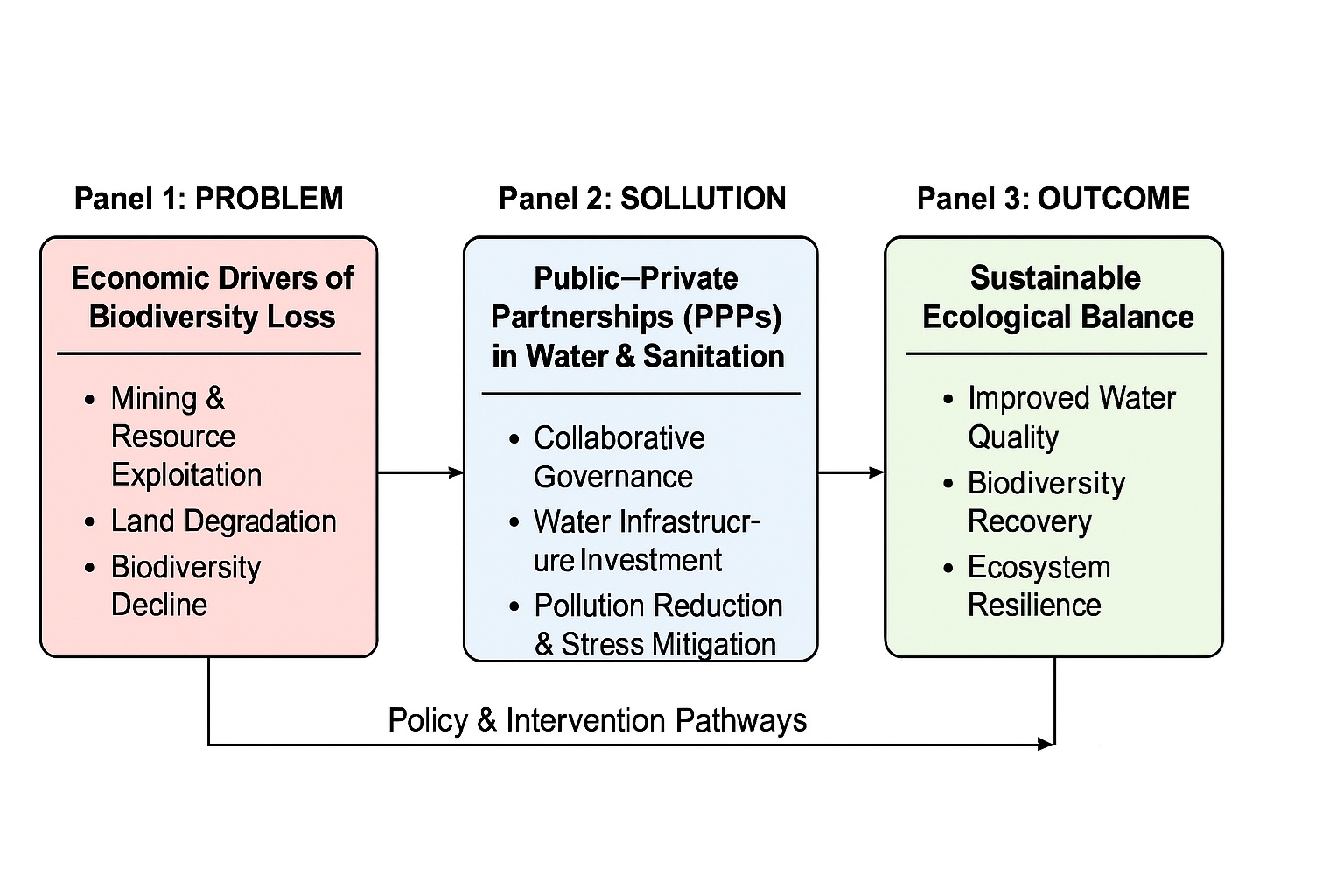
Natural resources remain central to economic growth and social welfare, yet managing them sustainably continues to be a major challenge for countries striving to balance development with environmental protection. This study examines how mineral rents, mineral depletion, total natural resource rents, and public–private partnership (PPP) investment in water and sanitation interact and influence biodiversity conservation in China between 1980 and 2022. The results show that PPP investment in water and sanitation plays a positive role in biodiversity protection by improving water quality, easing environmental pressure, and promoting better management of ecological resources. In contrast, mineral rents and overall natural resource rents are negatively associated with biodiversity, highlighting the ecological risks that arise when resource exploitation intensifies. Mineral depletion also affects biodiversity loss, although its interaction with PPP investment suggests that coordinated efforts between public and private sectors can help soften some of the environmental costs linked to extraction. Overall, the findings point to the need for China to build a more integrated policy framework that links mineral rent management, depletion control, and biodiversity conservation. Such a framework should include mechanisms for evaluating the environmental and economic trade-offs of resource extraction and for promoting strategies that protect biodiversity while supporting long-term sustainable development.
Graphical Abstract
Keywords
Mineral rents | Mineral depletion | Biodiversity conservation | Public-private partnerships | China
References
- 1.
Ndiam, D,; Marotta, D.; de Melo, J. Natural Resource Abundance, Growth, and Diversification in the Middle East and North Africa: The Effects of Natural Resources and the Role of Policies ; World Bank Publications: Washington, D.C., USA, 2012; Volume 228.
- 2.
Ashraf, M.Z.; Wei, W.; Usman, M.; et al. How can natural resource dependence, environmental-related technologies and digital trade protect the environment: Redesigning SDGs policies for sustainable environment? Resour. Policy 2024, 88, 1–30. https://doi.org/10.1016/j.resourpol.2023.104456
- 3.
Khan, Z.; Badeeb, R.A.; Nawaz, K. Natural resources and economic performance: Evaluating the role of political risk and renewable energy consumption. Resour. Policy 2022, 78, 1–20. https://doi.org/10.1016/j.resourpol.2022.102890
- 4.
Ahmed, Z.; Asghar, M.M.; Malik, M.N.; et al. Moving towards a sustainable environment: The dynamic linkage between natural resources, human capital, urbanization, economic growth, and ecological footprint in China. Resour. Policy 2020, 67, 19–21. https://doi.org/10.1016/j.resourpol.2020.101677
- 5.
Sachs affery, D.; Warner, A.M. Natural resource abundance and economic growth. Ann. Econ. Financ. 2025, 26, 891–931.
- 6.
Cui, L.; Weng, S.; Kirikkaleli, D.; et al. Exploring the role of natural resources, natural gas and oil production for economic growth of China. Resour. Policy 2021, 74, 1–23. https://doi.org/10.1016/j.resourpol.2021.102429
- 7.
Pimentel, D.; Huang, X.; Cordova, A.; et al. Impact of a growing population on natural resources: The challenge for environmental management. Front. Interdiscip. J. Study Abroad 1997, 3, 105–131. https://doi.org/10.36366/frontiers.v3i1.48
- 8.
Liu, H.; Mansoor, M.; Al-Faryan, M.A.S.; et al. Impact of governance and globalization on natural resources volatility: The role of financial development in the Middle East North Africa countries. Resour. Policy 2022, 78, 102881. https://doi.org/10.1016/j.resourpol.2022.102881
- 9.
Bai, Y.; Tang, S.; Lu, C.; et al. Economic policy uncertainty and natural resource policy in the United States. Resour. Policy 2023, 83, 1–23. https://doi.org/10.1016/j.resourpol.2023.103598
- 10.
Li, R.; Wang, Q.; Li, L.; et al. Do natural resource rent and corruption governance reshape the environmental Kuznets curve for ecological footprint? Evidence from 158 countries. Resour. Policy 2023, 85, 103890. https://doi.org/10.1016/j.resourpol.2023.103890
- 11.
Topcu, E.; Altinoz, B.; Aslan, A.; Global evidence from the link between economic growth, natural resources, energy consumption, and gross capital formation. Resour. Policy 2020, 66, 101622. https://doi.org/10.1016/j.resourpol.2020.101622
- 12.
Magazzino, C.; Mele, M.; Schneider, N. A D2C algorithm on the natural gas consumption and economic growth: Challenges faced by Germany and Japan. Energy 2021, 219, 119586. https://doi.org/10.1016/j.energy.2020.119586
- 13.
Xiong, Y.; Guo, H.; Nor, D.D.M.M.; et al. Mineral resources depletion, environmental degradation, and exploitation of natural resources: COVID-19 aftereffects. Resour. Policy 2023, 85, 103907. https://doi.org/10.1016/j.resourpol.2023.103907
- 14.
Liu, H.; Chau, K.Y.; Duong, N.T.; et al. Fintech, financial inclusion, mineral resources and environmental quality. An economic advancement perspective from China and Vietnam. Resour. Policy 2024, 89, 1–35. https://doi.org/10.1016/j.resourpol.2024.104636
- 15.
Wang, Y.; Wang, R. Mineral resource rent and sustainable transition: The mediating role of financial development. Resour. Policy 2024, 89, 1–25. https://doi.org/10.1016/j.resourpol.2023.104527
- 16.
Lei, Y.; Cui, N.; Pan, D. Economic and social effects analysis of mineral development in China and policy implications. Resour. Policy 2013, 38, 448–457. https://doi.org/10.1016/j.resourpol.2013.06.005
- 17.
Kgerl, M.T.; Endl, A.; Tost, M.; et al. Exploring frame conflicts in the development of a new mineral resource policy in Austria using Q-methodology. Ambio 2023, 52, 210–228. https://doi.org/10.1007/s13280-022-01761-9
- 18.
Theis, T.; Tomkin, J. (Eds.). Mineral resources: formation, mining, environmental impact. In Sustainability: A Comprehensive Foundation ; OpenStax CNX: Cham, Switzerland, 2022; pp. 1–23. https://courses.lumenlearning.com/suny-sustainability-a-comprehensive-foundation/chapter/mineral-resources-formation- mining-environmental-impact/
- 19.
Hao, L.; Meng, Q.; Umar, M.; et al. Mineral resources and intellectual capital: Asymmetrical impacts and sustainable development outcomes. Resour. Policy 2024, 91, 104936. https://doi.org/10.1016/j.resourpol.2024.104936
- 20.
Auty, R.M. Maximising the Positive Socio-economic Impact of Mineral Extraction on Regional Development in Rransition Economies: A Review of the Literature; The European Bank for Reconstruction and Development: London, UK, 2004; pp. 1–51.
- 21.
Alariqi, M.; Long, W.; Singh, P.R.; et al. Modelling dynamic links among energy transition, technological level and economic development from the perspective of economic globalisation: Evidence from MENA economies. Energy Rep. 2023, 9, 3920–3931. https://doi.org/10.1016/j.egyr.2023.02.089
- 22.
Abbas, E.; Abbas, A.; Xiuwu, Z.; et al. Decoupling or dependency? Investigating the joint effects of natural gas consumption and economic growth on carbon dioxide emissions in gulf cooperation council countries. J. Clean. Prod. 2025, 522, 146285. https://doi.org/10.1016/j.jclepro.2025.146285
- 23.
Abbas, E.; Abbas, A.; Mohammed, E.; et al. Exploring the link between natural resources, urbanization, human capital, and ecological footprint: A case of GCC countries. Ecol. Indic. 2022, 144, 109556. https://doi.org/10.1016/j.ecolind.2022.109556
- 24.
Zhai, T.; Wang, J.; Jin, Z.; et al. Did improvements of ecosystem services supply-demand imbalance change environmental spatial injustices? Ecol. Indic. 2020, 111, 106068. https://doi.org/10.1016/j.ecolind.2020.106068
- 25.
Ghermandi, A.; Nunes, P.A.L.D.; Portela, R.; et al. Recreational, cultural, and aesthetic services from estuarine and coastal ecosystems. In Treatise on Estuarine and Coastal Science, Volume 12: EcologicalEconomics of Estuaries and Coasts; Wolanski, E.; McLusky, D.S., Eds.; Elsevier: Amsterdam, The Netherlands, 2012; pp. 217–237. https://doi.org/10.1016/B978-0-12-374711-2.01212-2
- 26.
Alahuhta, J.; Tukiainen, H.; Toivanen, M.; et al. Acknowledging geodiversity in safeguarding biodiversity and human health. Lancet Planet. Health 2022, 6, e987–e992. https://doi.org/10.1016/S2542- 5196(22)00259-5
- 27.
OpenStax. Threats to biodiversity, habitat loss and sustainability. In Boundless Biology; 2016; pp. 1–18. https://courses.lumenlearning.com/boundless-biology/chapter/ threats-to-biodiversity/
- 28.
Schrodt, F.; Bailey, J.J.; Daniel Kissling, W.; et al. To advance sustainable stewardship, we must document not only biodiversity but geodiversity. Proc. Natl. Acad. Sci. USA 2019, 116, 16155–16158. https://doi.org/10.1073/pnas.1911799116
- 29.
Wallace, K.J.; Beecham, B.C.; Bone, B.H. Managing Natural Biodiversity in the Western Australian Wheatbelt ; Department of Conservation and Land Management: Crawley, Australia, 2003; Volume 64.
- 30.
Morton, S.; Sheppard, A.; Lonsdale, M. Explainer: What is biodiversity and why does it matter? The Conversation 2012, 1–12.
- 31.
Huggett, A.J. The concept and utility of “ecological thresholds” in biodiversity conservation. Biol. Conserv. 2005, 124, 301–310. https://doi.org/10.1016/j.biocon.2005.01.037
- 32.
Weiskopf, S.R.; Rubenstein, M.A.; Crozier, L.G.; et al. Climate change effects on biodiversity, ecosystems, ecosystem services, and natural resource management in the United States. Sci. Total Environ. 2020, 733, 1–50. https://doi.org/10.1016/j.scitotenv.2020.137782
- 33.
Fu, H.; Alariqi, M. Geoscience Frontiers Critical mineral supply chains and the economics of energy transition: A carbon decomposition perspective of growth and decoupling. Geosci. Front. 2026, 17, 102181. https://doi.org/10.1016/j.gsf.2025.102181
- 34.
Abbas, E.; Abbas, A.; Xiuwu, Z.; et al. Balancing progress and sustainability: Exploring the joint influences of oil consumption and economic growth on CO2 emissions: An empirical study of GCC countries. J. Environ. Manage. 2025, 394, 127340. https://doi.org/10.1016/j.jenvman.2025.127340
- 35.
Iqbal, S.; Tian, H.; Muneer, S.; et al. Mineral resource rents, fintech technological innovation, digital transformation, and environmental quality in BRI countries: An insight using panel NL-ARDL. Resour. Policy 2024, 93, 105074.
- 36.
Levin, S.A. Encyclopedia of Biodiversity, 2nd ed.; Elsevier: Amsterdam, The Netherlands, 2013; pp. 1–5504.
- 37.
Peterson, E.W.F. The role of population in economic growth. SAGE Open 2017, 7, 1–15. https://doi.org/10.1177/2158244017736094
- 38.
Jacob, T; Pedersen, R.H. New resource nationalism? Continuity and change in Tanzania’s extractive industries. Extr. Ind. Soc. 2018, 5, 287–292. https://doi.org/10.1016/j.exis.2018.02.001
How to Cite
Alariqi, M. (2026). Linking Mineral Rents, Resource Depletion, Biodiversity Conservation, and Public–Private Partnerships in Water and Sanitation Management. Habitable Planet, 2(1), 81–93. https://doi.org/10.63335/j.hp.2026.0027
RIS
BibTex
Copyright & License

Copyright (c) 2026 by the authors.
This work is licensed under a Creative Commons Attribution 4.0 International License.
Article Metrics
261
Article Views
0
Citations
Contents
References

 Suite 4002 Level 4, 447 Collins Street, Melbourne, Victoria 3000, Australia
 General Inquiries: info@sciltp.com