
- First report of trace fossil Furculosus from the Nagaur Sandstone of the Marwar Supergroup.
- Insights into the behavioral and ecological strategies of early benthic infauna inhabiting shallow-marine substrates.
- The associated ichnoassemblage indicate a low- to moderate-energy, well-oxygenated foreshore environment conducive to deposit-feeding activity.
- Open Access
- Article
First Record of Ichnogenus Furculosus from Western India: Clues to Early Cambrian Behavioral Evolution
- S. Ahmad *,
- S. K. Pandey *
Author Information
Received: 03 Dec 2025 | Revised: 23 Dec 2025 | Accepted: 07 Jan 2026 | Published: 14 Jan 2026
Highlights
Abstract
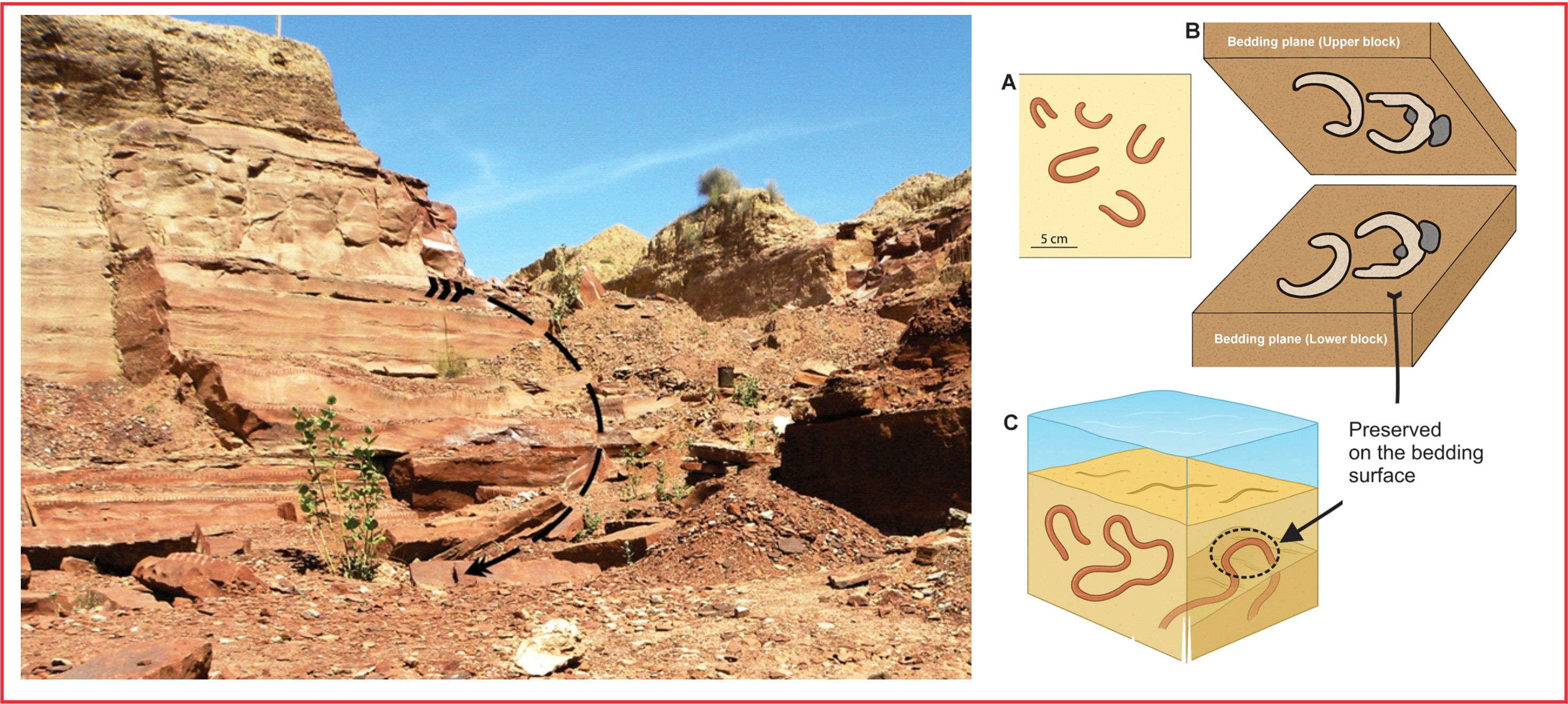
This paper documents the occurrence of the trace fossil Furculosus from the Nagaur Sandstone of the Marwar Supergroup, exposed near Dulmera village, Bikaner District, Western India for the first time. The ichnofossils occur within fine- to medium-grained ferruginous sandstone beds displaying well-developed ripple lamination and moderate bioturbation. The specimens of Ichnogenus Furculosus are characterized by gently curved, bifurcating, bilobate burrows commonly considered as passive burrow consistent with the diagnosis of Furculosus carpathicus previously known from the Lower Cambrian of Europe. The occurrence of Ichnogenus Furculosus in the Nagaur Sandstone expands its palaeogeographic range into the Indian subcontinent and provides new insights into the behavioral and ecological strategies of early benthic infauna inhabiting shallow-marine substrates during the onset of the Cambrian Substrate Revolution (CSR). The associated ichnoassemblage, comprising Furculosus, Planolites, Palaeophycus, and Diplocraterion, represents a Cruziana Ichnofacies indicative of a low- to moderate-energy, well-oxygenated foreshore environment conducive to deposit-feeding activity.
Graphical Abstract
Keywords
Furculosus | Nagaur Sandstone | Marwar Supergroup | Early Cambrian | India
References
- 1.
Buatois, L.A.; Mangano, M.G. Ichnology: Organism–Substrate Interactions in Space and Time; Cambridge University Press: Cambridge, UK, 2011.
- 2.
Seilacher, A. Trace Fossil Analysis; Springer-Verlag: Berlin, Germany, 2007.
- 3.
Ahmad, S.; Kumar, S. Trace fossil assemblage from the Nagaur Group, western India. J. Palaeontol. Soc. India 2014, 59, 231–246. https://doi.org/10.1177/0971102320140208
- 4.
Ahmad, S.; Pandey, S.K.; Sharma, M.; et al., The early cambrian (series 2, stage 3) burrows from the Nagaur Sandstone, Marwar Supergroup, Rajasthan, India: Palaeoenvironmental and Palaeoecological considerations. J. Palaeontol. Soc. India 2021, 66, 271–289. https://doi.org/10.1177/0971102320210212
- 5.
Kumar, S.; Pandey, S. K. Trace fossils from the Nagaur Sandstone, Marwar Supergroup, Dulmera area, Bikaner District, Rajasthan, India. J. Asian Earth Sci. 2010, 38, 77–85. https://doi.org/10.1016/j.jseaes.2009.10.003
- 6.
Srivastava, P. Treptichnus pedum: An Ichnofossil representing Ediacaran–Cambrian boundary in the Nagaur group, the Marwar supergroup, Rajasthan, India. Proc. Natl. Acad Sci. USA 2012, 78, 161–169.
- 7.
Roniewicz, P.; Pie´nkowski, G. Trace fossils of the Podhale Flysch Basin. In Trace Fossils 2; Crimes, T.P., Harper, J.C., Eds.; Geological Journal Special Issue 9; Seel House Press: Liverpool, UK, 1977; pp. 273–288.
- 8.
Bottjer, D.J.; Hagadorn, J.W.; Dornbos, S.Q. The Cambrian Substrate Revolution. GSA Today 2000, 10, 1–7.
- 9.
Pareek, H. S. Pre-Quaternary Geology and Mineral Resources of Northwestern Rajasthan; Memoirs of the Geological Survey of India 115; Geological Survey of India: India, 1984; pp. 1–99.
- 10.
Kumar, S. Stratigraphy and correlation of the Neoproterozoic deposits of central and western India: An overview. Geol. Soc. Spec. Publ. 2012, 366, 75–90. https://doi.org/10.1144/SP366.6.
- 11.
Sharma, M.; Ahmad, S.; Pandey, S.K.; et.al., On the Ichnofossil Treptichnus pedum: Inferences from the Nagaur Sandstone, Marwar Supergroup, India. Bull. Geosci. 2018, 93, 305–325. https://doi.org/10.3140/bull.geosci.1666.
- 12.
Kumar, S.; Pandey, S.K. Discovery of trilobite trace fossils from the Nagaur Sandstone, the Marwar Supergroup, Dulmera area, Bikaner district, Rajasthan. Curr. Sci. 2008, 95, 1081–1085.
- 13.
Hughes, N.C. The Cambrian Palaeontological record of the Indian subcontinent. Earth-Sci. Rev. 2016, 159, 428–461. https://doi.org/10.1016/j.earscirev.2016.06.004
- 14.
Buck, S.G.; Goldring, R. Conical sedimentary structures, trace fossils or not? Observations, experiments, and review. J. Sediment. Res. 2003, 73, 338–353. https://doi.org/10.1306/091602730338
- 15.
Pratt, B.R. Syneresis cracks: Subaqueous shrinkage in argillaceous sediments caused by earthquake-induced dewatering. Sediment. Geol. 1998, 117, 1–10. https://doi.org/10.1016/S0037-0738(98)00023-2
- 16.
Knaust, D.; Bromley, R.G., Eds. Trace Fossils as Indicators of Sedimentary Environments; Developments in Sedimentology, Volume 64; Elsevier: Amsterdam, The Netherlands, 2012; pp. 79–101.
- 17.
Chen, Z.-Q.; Tong, J.; Fraiser, M.L. Trace fossil evidence for restoration of marine ecosystems following the end-Permian mass extinction in the Lower Yangtze region, South China. Palaeogeogr. Palaeoclimatol. Palaeoecol. 2011, 299, 449–474. https://doi.org/10.1016/j.palaeo.2010.11.023
- 18.
Giannetti, A.; McCann, T. The upper Paleocene of the Zumaya section (Northern Spain): Review of the ichnological content and preliminary palaeoecological interpretation. Ichnos 2010, 17, 137–161. https://doi.org/10.1080/10420941003659550
- 19.
Pemberton, S.G.; Frey, R.W. Quantitative methods in ichnology: Spatial distribution among populations. Lethaia 1984, 17, 33–49. https://doi.org/10.1111/j.1502-3931.1984.tb00663.x
- 20.
Knaust, D. The enigmatic trace fossil Tisoa de Serres, 1840. Earth-Sci. Rev. 2019, 188, 123–147. https://doi.org/10.1016/j.earscirev.2018.11.001
- 21.
Paliwal, B.S. The Marwar Supergroup: An appraisal of its stratigraphy, sedimentology and basin evolution. J. Geol. Soc. India 2008, 72, 327–338. https://doi.org/10.1016/10.17491/jgsi/2008/720132
- 22.
Mangano, M.G.; Buatois, L.A. The rise and early evolution of animals: Where do we stand from a trace-fossil perspective? Interface Focus 2020, 10, 20190103. https://doi.org/10.1098/rsfs.2019.0103
How to Cite
Ahmad, S., & Pandey, S. K. (2026). First Record of Ichnogenus Furculosus from Western India: Clues to Early Cambrian Behavioral Evolution. Habitable Planet, 2(1), 149–158. https://doi.org/10.63335/j.hp.2026.0031
RIS
BibTex
Copyright & License

Copyright (c) 2026 by the authors.
This work is licensed under a Creative Commons Attribution 4.0 International License.
Article Metrics
202
Article Views
0
Citations
Contents
References

 Suite 4002 Level 4, 447 Collins Street, Melbourne, Victoria 3000, Australia
 General Inquiries: info@sciltp.com