
- Pacific-type convergent margins are main loci of crustal growth and erosion.
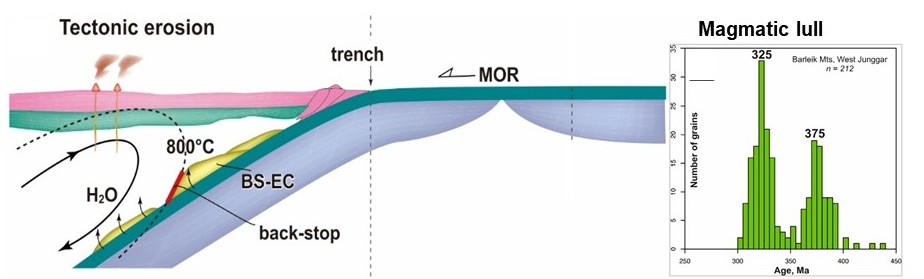
- Subduction erosion is responsible for destruction of juvenile crust in Circum-Pacific.
- Evidence of subduction erosion can be found in fossil Pacific-type orogenic belts.
- Signs of subduction erosion found in the Central Asian Orogenic Belt formed by the suturing of the Paleo-Asian Ocean.
- Open Access
- Review
A Reappraisal of Pacific-type Orogeny and Subduction Erosion
Author Information
Received: 19 Nov 2025 | Revised: 30 Dec 2025 | Accepted: 15 Jan 2026 | Published: 23 Jan 2026
Highlights
Abstract
The accepted concept of orogeny is based on the Theory of Plate Tectonics and implies two types of orogeny: collision-type (C-type) and Pacific-type (P-type). Pacific-type orogenic belts are directly linked with Pacific-type convergent margins (PCM) existing over subduction zones, where oceanic lithosphere is submerged under intra-oceanic arcs or active continental margins. PCMs are major sites of new crustal growth through juvenile arc magmatism and accretion of upper strata of the subducting oceanic lithosphere and destruction by subduction erosion. The subduction erosion destroys formerly formed magmatic arcs and accretionary prisms. Related Pacific-type orogenic belts thus keep records of both juvenile crustal growth and subduction erosion. There have been found many sites of ongoing subduction erosion in the Circum-Pacific, but it is harder to find evidence for that of fossil Pacific-type orogenic belts. Recent studies of several accretionary complexes in the Central Asian Orogenic Belt (CAOB), the largest in the world Paleozoic to Mesozoic accretionary foldbelt, have found several probable cases of subduction erosion once happened at active margins of the Paleo-Asian Ocean, an old analogue of the modern Pacific Ocean. Evidence for that comes from magmatic lulls as recorded in U–Pb detrital zircon age distributions of arc-derived greywacke sandstone. The modern and fossil cases of subduction erosion are still waiting for their quantitative estimations in order to contribute to our knowledge about the global balance of crust gains and losses.
Graphical Abstract
Keywords
Orogeny | Pacific-type convergent margin | Juvenile crustal growth | Subduction erosion | Paleo-Asian Ocean | Central Asian Orogenic Belt
References
- 1.
Dewey, J.F.; Bird, J.M. Mountain belts and the new global tectonics. J. Geophys. Res. 1970, 75, 2625–2647. https://doi.org/10.1029/JB075i014p02625
- 2.
Bally, A. Thoughts on the tectonics of folded belts. Geol. Soc. Spec. Publ. 1981, 9, 13–32. https://doi.org/10.1144/GSL.SP.1981.009.01.0
- 3.
Maruyama, S.; Liou, J.G.; Terbayashi, M. Blueschist and eclogites of the world, and their exhumation. Int. Geol. Rev. 1996, 38, 485–594. https://doi.org/10.1080/00206819709465347
- 4.
Maruyama, S.; Omori, S.; Senshu, H.; et al. Pacific-type orogens: New concepts and variations in space and time from present to past. J. Geogr. 2011, 120, 115–223. https://doi.org/10.5026/jgeography.120.115
- 5.
Maruyama, S. Pacific-type orogeny revisited: Miyashiro-type orogeny proposed. Isl. Arc 1997, 6, 91–120. https://doi.org/10.1111/j.1440-1738.1997.tb00042.x
- 6.
Santosh, M.; Maruyama, S.; Sato, K. Anatomy of a Cambrian suture in Gondwana: Pacific–type orogeny in southern India. Gondwana Res. 2009, 16, 321–341. https://doi.org/10.1016/j.gr.2008.12.012
- 7.
Ernst, R.E.; Bell, K. Large Igneous Provinces (LIPs) and carbonatites. Miner. Petrol. 2010, 98, 55–76. https://doi.org/10.1007/s00710-009-0074-1
- 8.
Groves, D.I.; Goldfarb, R.J.; Gebre-Mariam, M.; et al. Orogenic gold deposits: A proposed classification in the context of their crustal distribution and relationship to other gold deposit types. Ore Geol. Rev. 1998, 13, 7–27. https://doi.org/10.1016/S0169-1368(97)00012-7
- 9.
Safonova, I. Juvenile versus recycled crust in the Central Asian Orogenic Belt: Implications from ocean plate stratigraphy, blueschist belts and intra-oceanic arcs. Gondwana Res. 2017, 47, 6–27. https://doi.org/10.1016/j.gr.2016.09.003
- 10.
Franc¸ois, C.; Pubellier, M.; Robert, C.; et al. Temporal and spatial evolution of orogens: A guide for geological mapping. Episodes J. Int. Geosci. 2022, 45, 265–283. https://doi.org/10.18814/epiiugs/2021/021025
- 11.
Komiya, T.; Maruyama, S.; Masuda, T.; et al. Plate tectonics at 3.8–3.7 Ga. Field evidence from the Isua accretionary complex, Southern West Greenland. J. Geol. 1999, 107, 515–554. https://doi.org/10.1086/314371
- 12.
Maruyama, S.; Kawai, T.; Windley, B.F. Ocean plate stratigraphy and its imbrication in an accretionary orogen: The Mona complex, Anglesey-Lleyn, Wales, UK. Geol. Soc. Spec. Publ. 2010, 338, 55–75. https://doi.org/10.1144/SP338.4
- 13.
Zhang, J.; Xiao, W.; Luo, J.; et al. Collision of the Tacheng block with the Mayile-Barleik-Tangbale accretionary complex in Western Junggar, NW China: Implication for Early-Middle Paleozoic architecture of the western Altaids. J. Asian Earth Sci. 2018, 159, 259–278. https://doi.org/10.1016/j.jseaes.2017.03.023
- 14.
Safonova, I.; Savinskiy, I.; Perfilova, A.; et al. A new tectonic model for the Itmurundy Zone, Central Kazakhstan: Linking ocean plate stratigraphy, timing of accretion and subduction polarity. Geosci. Front. 2024, 15, 101814. https://doi.org/10.1016/j.gsf.2024.101814
- 15.
Isozaki, Y.; Maruyama, S.; Fukuoka, F. Accreted oceanic materials in Japan. Tectonophysics 1990, 181, 179–205. https://doi.org/10.1016/0040-1951(90)90016-2
- 16.
Mizutani, S.; Kojima, S. Mesozoic radiolarian biostratigraphy of Japan and collage tectonics along the eastern continental margin of Asia. Palaeogeogr. Palaeoclimatol. Palaeoecol. 1992, 96, 3–22. https://doi.org/10.1016/0031-0182(92)90056-B
- 17.
Kusky, T.; Windley, B.; Safonova, I.; et al. Recognition of Ocean Plate Stratigraphy in accretionary orogens through Earth history: A record of 3.8 billion years of sea floor spreading, subduction, and accretion. Gondwana Res. 2013, 24, 501–547. https://doi.org/10.1016/j.gr.2013.01.004
- 18.
Andji, G.; Zhou, R.; Buchs, D.M.; et al. Paleozoic ocean plate stratigraphy unraveled by calcite U-Pb dating of basalt and biostratigraphy. Commun. Earth Environ. 2022, 3, 113. https://doi.org/10.1038/s43247-022-00446-1
- 19.
Rino, S.; Komiya, T.; Windley, B.F.; et al. Major episodic increases of continental crustal growth determined from zircon ages of river sands; Implications for mantle overturns in the Early Precambrian. Phys. Earth Planet. Inter. 2004, 146, 369–394. https://doi.org/10.1016/j.pepi.2003.09.024
- 20.
Isozaki, Y.; Aoki, K.; Nakama, T.; et al. New insight into a subductionrelated orogeny: Re-appraisal on geotectonic framework and evolution of the Japanese Islands. Gondwana Res. 2010, 18, 82–105. https://doi.org/10.1016/j.gr.2010.02.015
- 21.
Voice, P.J.; Kowalewski, M.; Eriksson, K.A. Quantifying the timing and rate of crustal evolution: Global compilation of radiometrically dated detrital zircon grains. J. Geol. 2011, 119, 109–126. https://doi.org/10.1086/658295
- 22.
Wang, C.Y.; Campbell, I.H.; Stepanov, A.S.; et al. Growth rate of the preserved continental crust: II. Constraints from Hf and O isotopes in detrital zircons from Greater Russian Rivers. Geochim. Cosmochim. Acta 2011, 75, 1308–1345. https://doi.org/10.1016/j.gca.2010.12.010
- 23.
Spear, F.S.; Selverstone, J.; Hickmott, D.; et al. P-T paths from garnet zoning: A new technique for deciphering tectonic processes in crystalline terranes. Geology 1984, 12, 87–90. https://doi.org/10.1130/0091-7613
- 24.
Dasgupta, R.; Hirschmann, M.M.; Withers, A.C. Deep global cycling of carbon constrained by the solidus of anhydrous, carbonated eclogite under upper mantle conditions. Earth Planet. Sci. Lett. 2004, 227, 73–85. https://doi.org/10.1016/j.epsl.2004.08.004
- 25.
Martin, A.J.; Ganguly, J.; DeCelles, P.G. Metamorphism of Greater and Lesser Himalayan rocks exposed in the Modi Khola valley, central Nepal. Contrib. Mineral. Petrol. 2009, 159, 203–225. https://doi.org/10.1007/s00410-009-0424-3
- 26.
Ota, T.; Kaneko, Y. Blueschists, eclogites, and subduction zone tectonics: Insights from a review of Late Miocene blueschists and eclogites, and related young high-pressure metamorphic rocks. Gondwana Res. 2010, 18, 167–188. https://doi.org/10.1016/j.gr.2010.02.013
- 27.
Foley, S.F.; Andronikov, A.V.; Melzer, S. Petrology of ultramafic lamprophyres from the Beaver Lake area of Eastern Antarctica and their relation to the breakup of Gondwanaland. Mineral. Petrol. 2002, 74, 361–384. https://doi.org/10.1007/s007100200011
- 28.
Rapp, R.P.; Shimizu, N.; Norman, M.D. Growth of early continental crust by partial melting of eclogite. Nature 2003, 425, 605–609. https://doi.org/10.1038/nature02031
- 29.
Clift, P.D.; Vannucchi P.; Morgan J.P. Crustal redistribution, crust-mantle recycling and Phanerozoic evolution of the continental crust. Earth Sci. Rev. 2009, 97, 80–104. https://doi.org/10.1016/j.earscirev.2009.10.003
- 30.
Safonova, I.; Seltmann, R.; Krner, A.; et al. A new concept of continental construction in the Central Asian Orogenic Belt (compared to actualistic examples from the Western Pacific). Episodes 2011, 34, 186–194. https://doi.org/10.18814/epiiugs/2011/v34i3/005
- 31.
Johnson, T.; Brown, M.; Gardiner, N.; et al. Earth’s first stable continents did not form by subduction. Nature 2017, 543, 239–242. https://doi.org/10.1038/nature21383
- 32.
Rozel, A.B.; Golabek, G.J.; Jain, C.; et al. Continental crust formation on early Earth controlled by intrusive magmatism. Nature 2017, 545, 332–335. https://doi.org/10.1038/nature22042
- 33.
Stern, R.J.; Scholl, D.W., Yin and yang of continental crust creation and destruction by plate tectonic processes. Int. Geol. Rev. 2010, 52, 1–31. https://doi.org/10.1080/00206810903332322
- 34.
Brandon, M.T.; Calderwood, A.R. High-pressure metamorphism and uplift of the Olympic subduction complex. Geology 1990, 18, 1252–1255. https://doi.org/10.1130/0091-7613(1990)018<1252: HPMAUO>2.3.CO;2
- 35.
Kaneko, Y.; Maruyama, S.; Kadarusman, A.; et al. Ongoing orogeny in the outer-arc of the Timor–Tanimbar region, eastern Indonesia. Gondwana Res. 2007, 11, 218–233. https://doi.org/10.1016/j.gr.2006.04.013
- 36.
Ichikawa, A.; Kaneko, Y.; Ota, T.; et al. Ophiolites in the non-volcanic Banda outer arc of east Indonesia: Field occurrence and petrological variety of the world’s youngest ophiolite. J. Geogr. (Chigaku Zasshi) 2011, 120, 52–64. https://doi.org/10.5026/jgeography.120.52. (In Japanese)
- 37.
Miyashiro, A.; Aki, K.; Sengr, A.M.C. Orogeny; John Wiley and Sons: Chichester, UK, 1982; p. 242.
- 38.
Maruyama, S.; Santosh, M.; Zhao, D. Superplume, supercontinent, and post-perovskite: Mantle dynamics and anti-plate tectonics on the Core–Mantle Boundary. Gondwana Res. 2007, 11, 7–37. https://doi.org/10.1016/j.gr.2006.06.003
- 39.
Stern, R.J. The anatomy and ontogeny of modern intra-oceanic arc systems. In The Evolving Continents: Understanding Processes of Continental Growth; Kusky, T.M., Zhai, M.G., Xiao W., Eds; Geol. Soc. Spec. Publ.; Geological Society of London: London, UK, 2010; pp. 7–34. https://doi.org/10.1144/SP338.2
- 40.
Vanucchi, P.; Morgan, J.P.; Balestrieri, M.L. Subduction erosion, and the de-construction of continental crust: The Central America case and its global implications. Gondwana Res. 2016, 40, 184–198. https://doi.org/10.1016/j.gr.2016.10.001
- 41.
Clift, P.D.; Vannucchi, P. Controls on tectonic accretion versus erosion in subduction zones: Implications for the origin and recycling of the continental crust. Rev. Geophys. 2004, 42, RG2001. https://doi.org/10.1029/2003RG000127
- 42.
Scholl, D.; von Huene, R. Crustal recycling at modern subduction zones applied to the past. Issues of growth and preservation of continental basement crust, mantle geochemistry, and supercontinent reconstruction. J. Geol. Soc. Memoir 2007, 200, 9–32. https://doi.org/10.1130/2007.1200(02)
- 43.
Suzuki, K.; Maruyama, S.; Yamamoto, S.; et al. Have the Japanese Islands grown?: Five “Japans” were born, and four “Japans” subducted into the mantle. J. Geogr. Sci. 2010, 119, 1173–1196. https://doi.org/10.5026/jgeography.119.1173. (In Japanese)
- 44.
Kojima, S.; Kemkin, I.V.; Kametaka, M.; et al. A correlation of accretionary complexes between southern Sikhote-Alin of Russia and Inner Zone of Southwest Japan. Geosci. J. 2000, 4, 175–185. https://doi.org/10.1007/BF02910136
- 45.
Wang, T.; Xiao, W.; Collins, W.J.; et al. Quantitative characterization of orogens through isotopic mapping. Commun. Earth Environ. 2023, 4, 110. https://doi.org/10.1038/s43247-023-00779-5
- 46.
Safonova, I.; Perfilova, A. Survived and disappeared intra-oceanic arcs of the paleo-Asian Ocean: Evidence from Kazakhstan. Natl. Sci. Rev. 2023, 10, nwac215. https://doi.org/10.1093/nsr/nwac215
- 47.
Alexeiev, D.V.; Krner, A.; Hegner, E.; et al. Middle to Late Ordovician arc system in the Kyrgyz Middle Tianshan: From arc-continent collision to subsequent evolution of a Palaeozoic continental margin. Gondwana Res. 2016, 39, 261–291. https://doi.org/10.1016/j.gr.2016.02.003
- 48.
Savinskiy, I.; Safonova, I.; Perfilova, A.; et al. A story of Devonian ocean plate stratigraphy hosted by the Ulaanbaatar accretionary complex, northern Mongolia: implications from geological, structural and U–Pb detrital zircon data. Int. J. Earth Sci. 2022, 111, 2469–2492. https://doi.org/10.1007/s00531-021-02150-5
- 49.
Penkina, V.A.; Kotler, P.D.; Safonova, I.Yu.; et al. Evolution of the northeastern margin of the Kazakhstan Paleocontinent: Results of a petro-geochemical study of sedimentary and volcanogenic-sedimentary rocks of the ZharmaSaur Island Arc Zone. Geotectonics 2024, 58, 321–343. https://doi.org/10.1134/S0016852124700274
- 50.
Jicha, B.; Key, S.M., Quantifying arc migration and the role of forearc subduction erosion in the central Aleutians. J. Volcanol. Geotherm. Res. 2018, 360, 84–99. https://doi.org/10.1016/j.jvolgeores.2018.06.016
- 51.
Wakita K.; Nakagawa T.; Sakata M.; et al. Phanerozoic accretionary history of Japan and the western Pacific margin. Geol. Mag. 2018, 158, 13–29. https://doi.org/10.1017/S0016756818000742
- 52.
Liu, B.; Han, B.-F.; Chen, J.-F.; et al. Closure time of the Junggar-Balkhash ocean: Constraints from late Paleozoic volcano-sedimentary sequences in the Barleik mountains, west Junggar, NW China. Tectonics 2017, 36, 2823–2845. https://doi.org/10.1002/2017TC004606
How to Cite
Safonova, I. (2026). A Reappraisal of Pacific-type Orogeny and Subduction Erosion. Habitable Planet, 2(1), 159–169. https://doi.org/10.63335/j.hp.2026.0032
RIS
BibTex
Copyright & License

Copyright (c) 2026 by the authors.
This work is licensed under a Creative Commons Attribution 4.0 International License.
Article Metrics
230
Article Views
0
Citations
Contents
References

 Suite 4002 Level 4, 447 Collins Street, Melbourne, Victoria 3000, Australia
 General Inquiries: info@sciltp.com