
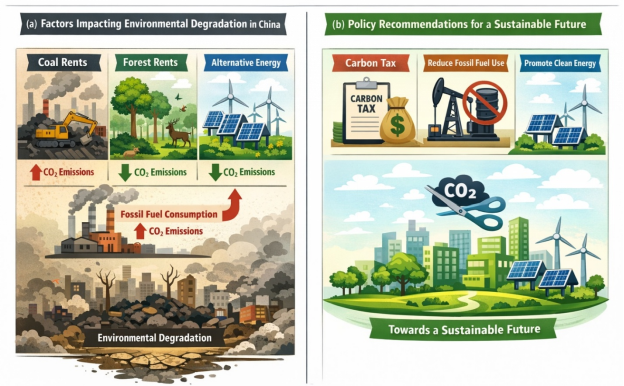
- The Impact of coal, forest rents, and alternative energy on CO2 emissions checked.
- Natural resources are under constant threat from environmental degradation.
- Forest rent and alternative energy are negatively correlated with CO2 emissions.
- Coal rents and fossil fuel energy consumption deteriorate the environment.
- Forest rents and alternative energy sources improve the environment.
- Open Access
- Article
Coal Rents, Forest Rents, and Alternative Energy: Assessing Their Combined Impact on Environmental Degradation in China
- Muhammad Irfan Latif
Author Information
Received: 28 Nov 2025 | Revised: 16 Jan 2026 | Accepted: 03 Feb 2026 | Published: 10 Feb 2026
Highlights
Abstract
Environmental degradation is posing a permanent threat on the natural resources of our planet. It has been degraded by various factors that increased because of the impact could cause permanent harm to our world. Exploitation of natural resources such as coal, forests and other sources of energy is one of the most notable causes of this degradation. This paper adopts fossil fuel energy consumption as a moderating variable to determine the effects of coal rents, forest rents as well as alternative energy sources in China between 1971 and 2023. The outcome justifies that forest rents and alternative energy sources have negative associations with the CO2 emission, whereas coal rents, alternative energy sources and fossil fuel energy consumption have positive associations with the CO2 emission in China. Forest rents and coal rents are 5% significant, while alternative energy sources and fossil fuel energy consumption are 1% significant. Moreover, forest rents and alternative energy sources improve the environment, while coal rents and fossil fuel energy consumption deteriorate the environment in China. China should consider implementing a carbon tax, discouraging fossil fuel use, and reducing emissions. Finally, coal rent rise can trigger a radical increase in CO2 emission in China and active action should be undertaken to reduce the effects of the rise. It is possible to have China take a step to lower its emissions and move towards a more sustainable energy future by enacting government policies and financial incentives as well as introducing a carbon tax.
Graphical Abstract
Keywords
Coal rents | Forest rents | Alternative energy | Fossil fuel energy consumption | CO2 emissions | China
References
- 1.
Ullah, S.; Lin, B. Clean energy initiatives in Pakistan: Driving sustainable development and lowering carbon emissions through environmental innovation and policy optimization. J. Environ. Manag. 2025, 373, 123647. https://doi.org/10.1016/j.jenvman. 2024.123647
- 2.
Balsalobre-Lorente, D.; Ibez-Luzn, L.; Usman, M.; et al., The environmental Kuznets curve, based on the economic complexity, and the pollution haven hypothesis in PIIGS countries. Renew. Energy 2022, 185, 1441–1455. https://doi.org/10.1016/j.renene.2021.10.059
- 3.
Tsani. S. Natural resources, governance and institutional quality: The role of resource funds. Resour. Policy 2013, 38, 181–195. https://doi.org/10.1016/j.resourpol.2012.11.001
- 4.
Zhang, J.; Khan, I. Energy use, energy access, and oil price fluctuations as new determinants of environmental quality in APEC countries. Gondwana Res. 2024, 132, 309–322. https://doi.org/10.1016/j.gr.2024.04.015
- 5.
Zhou. D.Q.; Meng, F.Y.; Bai, Y.; et al. Energy efficiency and congestion assessment with energy mix effect: The case of APEC countries. J. Clean. Prod. 2017, 142, 819–828. https://doi.org/10.1016/j.jclepro.2016.08.166
- 6.
Ullah, S.; Lin, B. An environmental assessment through load capacity factor: The dynamic effects of technological cooperation grants and energy depletion in Pakistan. Front. Sustain. Energy Policy 2025, 3, 1438573. https://doi.org/10.3389/fsuep.2024.1438573
- 7.
Perera, F. Pollution from fossil-fuel combustion is the leading environmental threat to global pediatric health and equity: Solutions exist. Int. J. Environ. Res. Public Health 2018, 15, 16. https://doi.org/10.3390/ijerph15010016
- 8.
Ullah, S.; Lin, B. Unveiling the green path: The role of green finance and just energy transition in environmental sustainability. Gondwana Res. 2025, 148, 348–367. https://doi.org/10.1016/j.gr.2025.07.024
- 9.
Rath, B.N.; Akram, V.; Bal, D.P.; et al. Do fossil fuel and renewable energy consumption affect total factor productivity growth? Evidence from cross-country data with policy insights. Energy Policy 2019, 127, 186–199. https://doi.org/10.1016/j.enpol.2018.12.014
- 10.
Ullah, S.; Lin, B. Unpacking the role of green supply chain and renewable energy innovation in advancing environmental sustainability: A Quantile-Based approach. Renew. Sustain. Energy Rev. 2025, 218, 115810. https://doi.org/10.1016/j.rser.2025.115810
- 11.
Khurshid, N.; Fiaz, A.; Khurshid, J.; et al. Impact of climate change shocks on economic growth: A new insight from non-linear analysis. Front. Environ. Sci. 2022, 10, 1039128. https://doi.org/10.3389/fenvs.2022.1039128
- 12.
Mllera, D.; Rogersb, P.; Scafettac, N.; et al. Energy, climate and sustainability from a geoscience perspective. Gondwana Res. 2025, 152, 1–3. https://doi.org/10.1016/j.gr.2025.11.001
- 13.
Satrovic, E.; Khan, I.; Zafar, M.W.; et al. Moderating role of biocapacity in the fiscal decentralization–environment nexus. Energy Environ. 2025, 25, 1–35. https://doi.org/10.1177/0958305X251392868
- 14.
Schober, A.; imunovi, N.; Darabant, A.; et al. Identifying sustainable forest management research narratives: A text mining approach. J. Sustain. For. 2018, 37, 537–554. https://doi.org/10.1080/10549811.2018.1437451
- 15.
Huang, Y.; Raza, S.M.F.; Hanif, I.; et al. The role of forest resources, mineral resources, and oil extraction in economic progress of developing Asian economies. Resour. Policy 2020, 69, 101878. https://doi.org/10.1016/j.resourpol.2020.101878
- 16.
Mayer, A. Fossil fuel dependence and energy insecurity. Energy Sustain. Soc. 2022, 12, 27. https://doi.org/10.1186/s13705-022-00353-5
- 17.
Khan, I.; Xin, C. The intersection of energy transition and urban planning for sustainable development: Enhancing energy efficiency and sustainability. Gondwana Res. 2025, 152, 142–156. https://doi.org/10.1016/j.gr.2025.08.018
- 18.
Wang, H.; Wang, G.; Qi, J.; et al. Scarcity-weighted fossil fuel footprint of China at the provincial level. Appl. Energy 2020, 258, 114081. https://doi.org/10.1016/j.apenergy.2019.114081
- 19.
Kartal, M.T.; Pata, U.K.; Alola, A.A. Energy security risk and financial development nexus: Disaggregated level evidence from South Korea by cross-quantilogram approach. Appl. Energy 2024, 363, 123135. https://doi.org/10.1016/j.apenergy.2024.123135
- 20.
Leonard, M.D.; Michaelides, E.E.; Michaelides, D.N. Energy storage needs for the substitution of fossil fuel power plants with renewables. Renew. Energy 2020, 145, 951–962. https://doi.org/10.1016/j.renene.2019.06.066
- 21.
Kartal, M.T.; Ali, U.; Nurgazina, Z. Asymmetric effect of electricity consumption on CO2 emissions in the USA: Analysis of end-user electricity consumption by nonlinear quantile approaches. Environ. Sci. Pollut. Res. 2022, 29, 83824–83838. https://doi.org/10.1007/s11356-022-21715-8
- 22.
Taghizadeh-Hesary, F.; Chang, Y.; Yoshino, N.; et al. Energy insecurity, renewable energy and economic growth. Sing. Econ. Rev. 2021, 66, 313–322. https://doi.org/10.1142/S0217590821020021
- 23.
Zhao, J.; Zhao, Z.; Zhang, H. The impact of growth, energy and financial development on environmental pollution in China: New evidence from a spatial econometric analysis. Energy Econ. 2021, 93, 104506. https://doi.org/10.1016/j.eneco.2019.104506
- 24.
Adedoyin, F.F.; Gumede, M.I.; Bekun, F.V.; et al. Modelling coal rent, economic growth and CO2 emissions: Does regulatory quality matter in BRICS economies? Sci. Total Environ. 2020, 710, 19–21. https://doi.org/10.1016/j.scitotenv.2019.136284
- 25.
Xiong, Y.; Guo, H.; Nor, D.D.M.M.; et al. Mineral resources depletion, environmental degradation, and exploitation of natural resources: COVID-19 aftereffects. Resour. Policy 2023, 85, 103907. https://doi.org/10.1016/j.resourpol.2023.103907
- 26.
Liu, H.; Chau, K.Y.; Duong, N.T.; et al. Fintech, financial inclusion, mineral resources and environmental quality. An economic advancement perspective from China and Vietnam. Resour. Policy 2024, 89, 104636. https://doi.org/10.1016/j.resourpol.2024.104636
- 27.
Huang, Y.; Raza, S.M.F.; Hanif, I.; et al. The role of forest resources, mineral resources, and oil extraction in economic progress of developing Asian economies. Resour. Policy 2020, 69, 19–21. https://doi.org/10.1016/j.resourpol.2020.101878
- 28.
Huang, Y.; Raza, S.M.F.; Hanif, I.; et al. The role of forest resources, mineral resources, and oil extraction in economic progress of developing Asian economies. Resour. Policy 2020, 69, 101878. https://doi.org/10.1016/j.resourpol.2020.101878
- 29.
Fugeray-Scarbel, A.; Irz, X.; Lemari, S. Innovation in forest tree genetics: A comparative economic analysis in the European context. Forest Policy Econ. 2023, 155, 103030. https://doi.org/10.1016/j.forpol.2023.103030
- 30.
Meo-Filho, P.; Berndt, A.; Pezzopane, J.R.M.; et al. Can intensified pasture systems reduce enteric methane emissions from beef cattle in the Atlantic forest biome? Agronomy 2022, 12, 2738. https://doi.org/10.3390/agronomy12112738
- 31.
Ansari, A.S. Influence of forests on ozone. Nature 1876, 15, 188.
- 32.
Yao, S.; Zhang, S.; Zhang, X. Renewable energy, carbon emission and economic growth: A revised environmental Kuznets Curve perspective. J. Clean. Prod. 2019, 235, 1338–1352. https://doi.org/10.1016/j.jclepro.2019.07.069
- 33.
Waheed, R.; Sarwar, S.; Wei, C. The survey of economic growth, energy consumption and carbon emission. Energy Rep. 2019, 5, 1103–1115. https://doi.org/10.1016/j.egyr.2019.07.006
- 34.
International Energy Agency I. Innovation Needs in the Sustainable Development Scenario; International Energy Agency: Paris, France, 2020.
- 35.
Amin, S.B.; Chang, Y.; Khan, F.; et al. Energy security and sustainable energy policy in Bangladesh: From the lens of 4As framework. Energy Policy 2022, 161, 112719. https://doi.org/10.1016/j.enpol.2021.112719
- 36.
Wahlund, M.; Hansen, T. Exploring alternative economic pathways: A comparison of foundational economy and Doughnut economics. Sustain. Sci. Pract. Policy 2022, 18, 171–186. https://doi.org/10.1080/15487733.2022.2030280
- 37.
Nazir, U. The winds of change are blowing: Globalization’s impact on renewable energy and environmental challenges. Arch. Soc. Sci. J. Collab. Mem. 2023, 2, 78–93.
- 38.
Assi, A.F.; Isiksal, A.Z.; Tursoy, T. Renewable energy consumption, financial development, environmental pollution, and innovations in the ASEAN+3 group: Evidence from (P-ARDL) model. Renew. Energy 2021, 165, 689–700. https://doi.org/10.1016/j.renene.2020.11.052
- 39.
Mahjabeen, A.; Shah, S.Z.A.; Chughtai, S.; et al. Renewable energy, institutional stability, environment and economic growth nexus of D-8 countries. Energy Strategy Rev. 2020, 29, 100484. https://doi.org/10.1016/j.esr.2020.100484
- 40.
Luo, H.; Li, L.; Lei, Y.; et al. Decoupling analysis between economic growth and resources environment in Central Plains Urban Agglomeration. Sci. Total Environ. 2021, 752, 142284. https://doi.org/10.1016/j.scitotenv.2020.142284
- 41.
Zhang, Q.; Zhang, S.; Ding, Z.; et al. Does government expenditure affect environmental quality? Empirical evidence using Chinese city-level data. J. Clean. Prod. 2017, 161, 143–152. https://doi.org/10.1016/j.jclepro.2017.05.096
- 42.
Dickey, D.A.; Fuller, W.A. Distribution of the estimators for autoregressive time series with a unit root. J. Am. Stat. Assoc. 1997, 74, 427–431. https://doi.org/10.1080/01621459.1979.10482531
- 43.
Jordan, S.; Philips, A.Q. Cointegration testing and dynamic simulations of autoregressive distributed lag models. Stata J. 2018, 18, 902–923. https://doi.org/10.1177/1536867x1801800409
How to Cite
Latif, M. I. (2026). Coal Rents, Forest Rents, and Alternative Energy: Assessing Their Combined Impact on Environmental Degradation in China. Habitable Planet, 2(1), 190–204. https://doi.org/10.63335/j.hp.2026.0034
RIS
BibTex
Copyright & License

Copyright (c) 2026 by the authors.
This work is licensed under a Creative Commons Attribution 4.0 International License.
Article Metrics
399
Article Views
0
Citations
Contents
References

 Suite 4002 Level 4, 447 Collins Street, Melbourne, Victoria 3000, Australia
 General Inquiries: info@sciltp.com