
- Comprehensive review of geological processes in terrestrial impact craters.
- Crater morphology reflects impact energy and target properties.
- Earth’s active geology causes a strong bias in crater preservation.
- Impact craters record crustal, environmental, and biological change.
- Impacts shape regolith, satellites, and surface chronologies at planetary scales.
- Open Access
- Review
The Geology of Hypervelocity Collisions
- Sachana Sathyan 1,
- Sadeeda Marjan 1,
- Arya Nandakumar 1,
- Shefana Mahin 1,
- V. R. Rani 1,2,
- Sangeeth Sundaresan 1,
- Praseetha Sugathan 1,3,
- S. James 4,
- J. Aswathi 1,
- Saranya R. Chandran 5,
- S. Keerthy 6,
- G. K. Indu 7,
- V. Aneeshkumar 2,
- K. S. Sajinkumar 1,8,*
Author Information
Received: 25 Jan 2026 | Revised: 20 Feb 2026 | Accepted: 08 Mar 2026 | Published: 16 Mar 2026
Highlights
Abstract
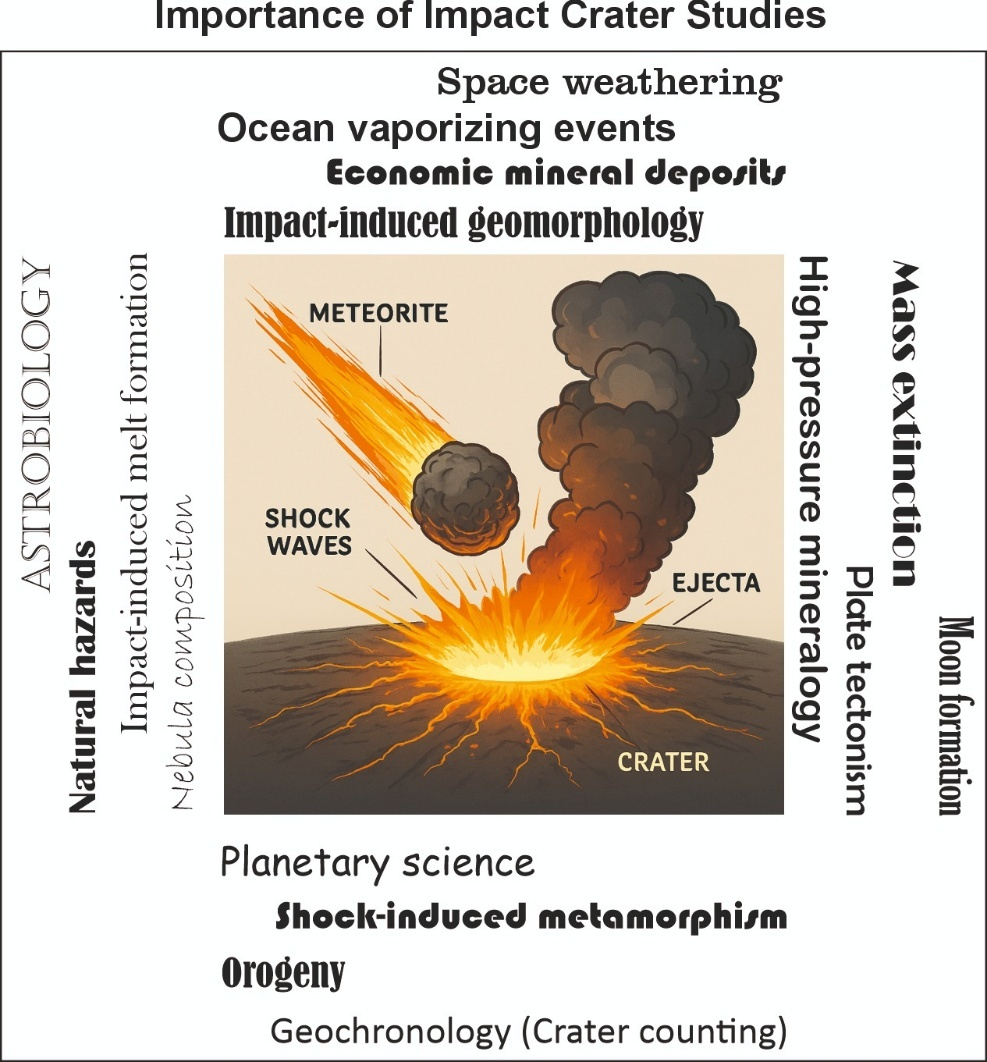
Hypervelocity impact cratering remains one of the fundamental geological processes that has profoundly shaped planetary surfaces and influenced the structural, chemical, and biological evolution of Earth and other bodies in the Solar System. Impacts by asteroids and comets at velocities of several tens of kilometres per second generate extreme pressures and temperatures, producing diagnostic shock-metamorphic features and lithologies, often unattainable through any other geological processes. This review synthesizes our current understanding of the geology of terrestrial hypervelocity collisions, including impact mechanics, crater-forming stages, morphological classification, diagnostic field and petrographic criteria, mineralogical transformations, and geochemical signatures for impact recognition. The sequential stages of crater formation: contact and compression, excavation, modification, and post-impact geological evolution are explained, with emphasis on simple, complex, peak-ring, and multi-ring craters. The global inventory and uneven distribution of confirmed terrestrial impact structures are evaluated in the context of preservation bias imposed by Earth’s active geological processes. Unequivocal indicators of impact origin, including shatter cones, impactites, planar deformation features (PDFs), high-pressure mineral polymorphs, and meteoritic geochemical signatures such as platinum group elements (PGE) and isotopic systems, are examined in detail. The broader geological and planetary implications of impact events are also discussed, encompassing large-scale crustal modification, hydrothermal system development, environmental perturbations, mass extinctions, and the potential of early-life habitability. By integrating geological, mineralogical, geochemical, and planetary perspectives, this review underscores impact cratering as a fundamental planetary process and impact craters as a powerful natural laboratory for understanding extreme conditions and the evolution of Earth and other planetary bodies.
Graphical Abstract
References
- 1.
Melosh, H.J. The physics of very large landslides. Acta Mech. 1986, 64, 89–99. https://doi.org/10.1007/bf01180100
- 2.
French, B.M. Traces of Catastrophe: A Handbook of Shock-Metamorphic Effects in Terrestrial Meteorite Impact Structures; LPI Contribution No. 954; Lunar and Planetary Institute: Houston, TX, USA, 1998; p. 120.
- 3.
Osinski, G.R.; Grieve, R.A.; Ferri ´ere, L.; et al. Impact earth: A review of the terrestrial impact record. Earth-Sci. Rev. 2022, 232, 104112. 10.1016/j.earscirev.2022.104112
- 4.
Tagle, R.; Schmitt, R.T.; Erzinger, J. Identification of the projectile component in the impact structures Rochechouart, France and Saaksjarvi, Finland: Implications for the impactor population for the earth. Geochim. Cosmochim. Acta 2009, 73, 4891–4906. https://doi.org/10.1016/j.gca.2009.05.044
- 5.
Ormo, J.; Lindstrom, M. When a cosmic impact strikes the sea bed. Geol. Mag. 2000, 137, 67–80. https://doi.org/10.1017/S0016756800003538
- 6.
Alvarez, L.W.; Alvarez, W.; Asaro, F.; et al. Extraterrestrial cause for the Cretaceous-Tertiary extinction. Science 1980, 208, 1095–1108. https://doi.org/10.1126/science.208.4448.1095
- 7.
French, B.M.; Koeberl, C. The convincing identification of terrestrial meteorite impact structures: What works, what doesn’t, and why. Earth-Sci. Rev. 2010, 98, 123–170. https://doi.org/10.1016/j.earscirev.2009.10.009
- 8.
Barringer, D.M. Coon Mountain and its crater. Proc. Acad. Nat. Sci. Phila. 1905, 57, 861–886.
- 9.
Dietz, R.S. Vredefort ring structure: meteorite impact scar? J. Geol. 1961, 69, 499–516. https://doi.org/10.1086/626768
- 10.
Shoemaker, E.M. Impact mechanics at Meteor Crater ; Princeton University: Princeton, NJ, USA, 1960. https://doi.org/10.3133/ofr59108
- 11.
Schmieder, M.; Kring, D.A. Earth’s impact events through geologic time: A list of recommended ages for terrestrial impact structures and deposits. Astrobiology 2020, 20, 91–141. https://doi.org/10.1089/ast.2019.2085
- 12.
Grieve, R.A.F.; Masaitis, V.L. The economic potential of terrestrial impact craters. Int. Geol. Rev. 1994, 36, 105–151. https://doi.org/10.1080/00206819409465452
- 13.
Grieve, R. Economic natural resource deposits at terrestrial impact structures. Geol. Soc. Spec. Publ. 2005, 248, 1e29. https://doi.org/10.1144/GSL.SP.2005.248.01.01
- 14.
Kring, D.A.; Melosh, H.J.; Hunten, D.M. Impact-induced perturbations of atmospheric sulfur. Earth Planet. Sci. Lett. 1996, 140, 201–212. https://doi.org/10.1016/0012-821X(96)00050-7
- 15.
Hansen, V.L. Geologic mapping of tectonic planets. Earth Planet. Sci. Lett. 2000, 176, 527–542. https://doi.org/10.1016/S0012-821X(00)00017-0
- 16.
Aswathi, J.; James, S.; Keerthy, S.; et al. Spatio-temporal interpolation of ∼ 530 Ma paleo-DEM to quantify denudation of a terrestrial impact crater. Geomorphology 2025, 474, 109644. https://doi.org/10.1016/j.geomorph.2025.109644
- 17.
Pieters, C.M.; Noble, S.K. Space weathering on airless bodies. J. Geophys. Res. Planets 2016, 121, 1865–1884. https://doi.org/10.1002/2016JE005128
- 18.
Morgan, J.V.; Gulick, S.P.; Bralower, T.; et al. The formation of peak rings in large impact craters. Science 2016, 354, 878–882. https://doi.org/10.1126/science.aah6561
- 19.
Ivanov, B.A. Numerical modeling of the largest terrestrial meteorite craters. Sol. Syst. Res. 2005, 39, 381–409. https://doi.org/10.1007/s11208-005-0051-0
- 20.
Gomes, R.; Levison, H.; Tsiganis, K.; et al. Origin of the cataclysmic Late Heavy Bombardment period of the terrestrial planets. Nature 2005, 435, 466–469. https://doi.org/10.1038/nature03676
- 21.
Morgan, J.W. and Wandless, G.A. Strangways Crater, Northern Territory, Australia: Siderophile element enrichment and lithophile element fractionation. J. Geophys. Res. Solid Earth 1983, 88, A819–A829. https://doi.org/10.1029/JB088iS02p0A819
- 22.
Kenkmann, T. The terrestrial impact crater record: A statistical analysis of morphologies, structures, ages, lithologies, and more. Meteorit. Planet. Sci. 2021, 56, 1024–1070. https://doi.org/10.1111/maps.13657
- 23.
Planetary and Space Science Centre. Earth Impact Database; University of New Brunswick: Fredericton, New Brunswick, Canada, 2020. http://www.passc.net/EarthImpactDatabase/Newwebsite 05-2018/Index.html
- 24.
Osinski, G.R.; Cockell, C.S.; Pontefract, A.; et al. The role of meteorite impacts in the origin of life. Astrobiology 2020, 20, 1121–1149. https://doi.org/10.1089/ast.2019.2203
- 25.
Reimold, W.U.; Koeberl, C. Impact structures in Africa: A review. J. Afr. Earth Sci. 2014, 93, 57–175. https://doi.org/10.1016/j.jafrearsci.2014.01.008
- 26.
Ivanov, B.A.; Neukum, G.; Bottke, W.; et al. The comparison of size frequency distributions of impact craters and asteroids and the planetary cratering rate. In Asteroids III; Bottke, W., Cellino, P., Paolicchi, P., Binzel, R.P., Eds.; University of Arizona Press: Tucson, AZ, USA, 2003; pp. 89–101. https://doi.org/10.2307/j.ctv1v7zdn4.13
- 27.
Becker, L.; Poreda, R.J.; Basu, A.R.; et al. A possible end-Permian impact crater offshore of northwestern Australia. Science 2004, 304, 1469–1476. https://doi.org/10.1126/science.1093925
- 28.
Montanari, A.; Koeberl, C. Impact Stratigraphy: The Italian Record; Lecture Notes in Earth Sciences 93; Springer-Verlag: Heidelberg, Germany, 2000; p. 364.
- 29.
Koeberl, C.; Claeys, P.; Hecht, L.; et al. Geochemistry of impactites. Elements 2012, 8, 37–42. https://doi.org/10.2113/gselements.8.1.37
- 30.
Moser, D.E.; Cupelli, C.L.; Barker, I.R.; et al. New zircon shock phenomena and their use for dating and reconstruction of large impact structures revealed by electron nanobeam (BSD, CL, EDS) and isotopic U–Pb and (U–Th)/He analysis on the Vredefort Dome. Can. J. Earth Sci. 2011, 48, 117–139. https://doi.org/10.1139/e11-011
- 31.
Horz, F. Statistical measurements of deformation structures and refractive indices in experimentally shockloaded quartz. J. Geophys. Res. 1968, 73, 6019–6038. https://doi.org/10.1029/JB073i018p06019
- 32.
Goltrant, O.; Leroux, H.; Doukhan, J-C.; et al. Formation mechanisms of planar deformation features in naturally shocked quartz. Phys. Earth Planet. Inter. 1992, 74, 219–240. https://doi.org/10.1016/0031-9201(92)90012-K
- 33.
Kumar, P.S.; Head, J.W.; Kring, D.A. Erosional modification and gully formation at Meteor Crater, Arizona: Insights into crater degradation processes on Mars. Icarus 2010, 208, 608–620. https://doi.org/10.1016/j.icarus.2010.03.032
- 34.
Ferriere, L.; Koeberl, C.; Brandstatter, F.; et al. Geochemistry of basement rocks and impact breccias from the central uplift of the Bosumtwi crater, Ghana—Comparison of proximal and distal impactites. In: Large Meteorite Impacts and Planetary Evolution IV ; Geological Society of America Special Paper, Volume 465; Geological Society of America: Boulder. CO, USA, 2010. https://doi.org/10.1130/2010.2465(22)
- 35.
Ferriere1, L.; Koeberl, C.; Reimold, W.U.; et al. Ballen quartz and cristobalite in impact breccias: Types, occurrence, and possible origin. In Large Meteorite Impacts and Planetary Evolution IV ; LPI Contribution No. 1423; Lunar and Planetary Institute: Houston, TX, USA, 2008. (Abstract #3011)
- 36.
Ferriere, L.; Koeberl, C.; Reimold, W.U. Characterization of ballen quartz and cristobalite in impact breccias: New observations and constraints on ballen formation. Eur. J. Mineral. 2009, 21, 203–217. https://doi.org/10.1127/0935-1221/2009/0021-1898
- 37.
Tsikalas, F.; Faleide, J.I.; Werner, S.C.; et al. The Mølnir impact event and its consequences. In Geology and Geophysics of a Late Jurassic/Early Cretaceous Marine Impact Event; Tsikalas, F., Dypvik, H., Smelror, M., Eds.; Geological Society of London: London, UK, 2010; pp. 75–137.
- 38.
Dressler, B.O.; Crabtree, D.; Schuraytz, B.C. Incipient melt formation and devitrification at the Wanapitei impact structure, Ontario, Canada. Meteorit. Planet. Sci. 1997, 32, 249–258. https://doi.org/10.1111/J.1945-5100.1997.TB01263.X
- 39.
Palme, H.; Janssens, M.J.; Takahashi, H.; et al. Meteoritic material at five large impact craters. Geochim. Cosmochim. Acta 1978, 42, 313–323. https://doi.org/10.1016/0016-7037(78)90184-9
- 40.
Whitehead, J.; Grieve, R.A.F.; Spray, G. Mineralogy and petrology of melt rocks from the Popigai impact structure, Siberia. Meteorit. Planet. Sci. 2002, 37, 623–647. http://dx.doi.org/10.1111/j.1945-5100.2002.tb00844.x
- 41.
Koeberl, C.; Holland, H.D.; Turekian, K.K. The geochemistry and cosmochemistry of impacts. In Radioactive Geochronometry from the Treatise on Geochemistry; Elsevier: Oxford, UK, 2014; pp. 73–118. https://doi.org/10.1016/B978-008043751-4/00228-5
- 42.
Koeberl, C. Mineralogical and geochemical aspects of impact craters. Mineral. Mag. 2002, 66, 745–768. https://doi.org/10.1180/0026461026650059
- 43.
Koeberl, C.; Reimold, W.U.; Cooper, G.; et al. Aorounga and Gweni Fada impact structures, Chad: Remote sensing, petrography, and geochemistry of target rocks. Meteorit. Planet. Sci. 2005, 40, 1455–1471. http://dx.doi.org/10.1111/j.1945-5100.2005.tb00412.x
- 44.
O’Brien, D.P.; Izidoro, A.; Jacobson, S.A.; et al. The delivery of water during terrestrial planet formation. Space Sci. Rev. 2018, 214, 47. https://doi.org/10.1007/s11214-018-0475-8
- 45.
Gilmour, I.; French, B.M.; Franchi, I.A.; et al. Geochemistry of carbonaceous impactites from the Gardnos impact structure, Norway. Geochim. Cosmochim. Acta 2003, 67, 3889–3903. https://doi.org/10.1016/S0016-7037(03)00213-8
- 46.
Chandran, S.R.; James, S.; Santosh, M.; et al. Geochemical and geochronological evidence of meteorite impact excavating the Archean basement at Lonar Crater, Central India. Lithos 2021, 404, 106479. https://doi.org/10.1016/j.lithos.2021.106479
- 47.
Chen, M.; Koeberl, C.; Xiao, W.; et al. Planar deformation features in quartz from impact-produced polymict breccia of the Xiuyan crater, China. Meteorit. Planet. Sci. 2011, 46, 729–736. https://doi.org/10.1111/j.1945-5100.2011.01186.x
- 48.
Palme, H.; Grieve, R.A.; Wolf, R. Identification of the projectile at the Brent crater, and further considerations of projectile types at terrestrial craters. Geochim. Cosmochim. Acta 1981, 45, 2417–2424. https://doi.org/10.1016/0016-7037(81)90095-8
- 49.
Pati, J.K.; Reimold, W.U.; Koeberl, C.; et al. The Dhala structure, bhundelkand craton, Central India-eroded remnant of a large Paleoproterozoic impact structure. Meteorit. Planet. Sci. 2008, 43, 1383–1398. http://dx.doi.org/10.1111/j.1945-5100.2008.tb00704.x
- 50.
McDonald, I.; Andreoli, M.A.G.; Hart, R.J.; et al. Platinum-group elements in the Morokweng impact structure, South Africa: Evidence for the impact of a large ordinary chondrite projectile at the Jurassic-Cretaceous boundary. Geochim. Cosmochim. Acta 2001, 65, 299–309. https://doi.org/10.1016/S0016-7037(00)00527-5
- 51.
McDonough, W.F.; Sun, S.S. The composition of the Earth. Chem. Geol. 1995, 120, 223–253. https://doi.org/10.1016/0009-2541(94)00140-4
- 52.
Anders, E.; Grevesse, N. Abundances of the elements: Meteoritic and solar. Geochim. Cosmochim. Acta 1989, 53, 197–214. https://doi.org/10.1016/0016-7037(89)90286-X
- 53.
Tagle, R.; Erzinger, J.; Hecht, L.; et al. Platinum group elements in impactites of the ICDP Chicxulub drill core Yaxcopoil-1: Are there traces of the projectile? Meteorit. Planet. Sci. 2004, 39, 1009–1016. https://doi.org/10.1111/j.1945-5100.2004.tb00942.x
- 54.
Tagle, R.; Claeys, P. An ordinary chondrite impactor for the Popigai crater, Siberia. Geochim. Cosmochim. Acta 2005, 69, 2877–2889. https://doi.org/10.1016/j.gca.2004.11.024
- 55.
Sturkell, E.F.; Orm¨ o, J. Magnetometry of the marine, Ordovician Lockne impact structure, J¨amtland, Sweden. J. Appl. Geophys. 1998, 38, 195–207. https://doi.org/10.1016/S0926-9851(97)00031-1
- 56.
Masaitis, V.L. The middle Devonian Kaluga impact crater (Russia): New interpretation of marine setting. Deep-Sea Res. Part II Top. Stud. Oceanogr. 2002, 49, 1157–1169. https://doi.org/10.1016/S0967-0645(01)00142-4
- 57.
Milne, D.H.; McKay, C.P. Response of marine plankton communities to a global atmospheric darkening. In Geological Implications of Impacts of Large Asteroids and Comets on the Earth; Silver, L.T., Schultz, P.H., Eds.; GSA: Boulder, CO, USA, 1982.
- 58.
Sajinkumar, K.S.; James, S.; Indu, G.K.; et al. The Luna structure, India: A probable impact crater formed by an iron bolide. Planet. Space Sci. 2024, 240, 105826. https://doi.org/10.1016/j.pss.2023.105826
- 59.
Goderis, S.; Kalleson, E.; Tagle, R.; et al. A non-magmatic iron projectile for the Gardnos impact event. Chem. Geol. 2009, 258, 145–156. https://doi.org/10.1016/j.chemgeo.2008.09.025
- 60.
Mittlefehldt, D.W.; Horz, F.; See, T.H.; et al. Geochemistry of target rocks, impact-melt particles, and metallic spherules from Meteor Crater, Arizona: Empirical evidence on the impact process. In Large Meteorite Impacts III; Kenkmann, T., H¨ orz, F., Deutsch, A., Eds.; GSA: Boulder, CO, USA, 2005. https://doi.org/10.1130/0-8137-2384-1.367
- 61.
Gulick, S.P.; Barton, P.J.; Christeson, G.L.; et al. Importance of pre-impact crustal structure for the asymmetry of the Chicxulub impact crater. Nat. Geosci. 2008, 1, 131–135. https://doi.org/10.1038/ngeo103
- 62.
Deutsch, A.; Lakomy, R.; Buhl, D. Strontium- and neodymiumisotopic characteristics of a heterolithic breccia in the basement of the Sudbury impact structure, Canada. Earth Planet. Sci. Lett. 1989, 93, 359–370. https://doi.org/10.1016/0012-821X(89)90035-6
- 63.
Walker, R.J.; Morgan, J.W.; Naldrett, A.J.; et al. Re-Os isotope systematics of Ni-Cu sulfide ores, Sudbury Igneous Complex, Ontario: Evidence for a major crustal component. Earth Planet. Sci. Lett. 1991, 105, 416–429. https://doi.org/10.1016/0012-821X(91)90182-H
- 64.
Trinquier, A.; Birck, J.L.; All `egre, C.J. The nature of the KT impactor. A 54Cr reappraisal. Earth Planet. Sci. Lett. 2006, 241, pp. 780–788. https://doi.org/10.1016/j.epsl.2005.11.006
- 65.
Hodych, J.P.; Dunning, G.R. Did the Manicouagan impact trigger end-of-Triassic mass extinction? Geology 1992, 20, 51–54. https://doi.org/10.1016/j.epsl.2005.11.006
- 66.
Koeberl, C.; Shirey, S.B. Detection of a meteoritic component in Ivory Coast tektites with rhenium-osmium isotopes. Science 1993, 261, 595–598. https://doi.org/10.1126/science.261.5121.595
- 67.
Koeberl, C.; Shirey, S.B. Re–Os isotope systematics as a diagnostic tool for the study of impact craters and distal ejecta. Palaeogeogr. Palaeoclimatol. Palaeoecol. 1997, 132, 25–46. https://doi.org/10.1016/S0031-0182(97)00045-X
- 68.
Tagle, R.; Hecht, L. Geochemical identification of projectiles in impact rocks. Meteorit. Planet. Sci. 2006, 41, 1721–1735. https://doi.org/10.1111/j.1945-5100.2006.tb00448.x
- 69.
Kyte, F.T.; Shukolyukov, A.; Lugmair, G.W.; et al. Early Archean spherule beds: Chromium isotopes confirm origin through multiple impacts of projectiles of carbonaceous chondrite type. Geology 2003, 31, 283–286. https://doi.org/10.1130/0091-7613(2003)031%3C0283:EASBCI%3E2.0.CO;2
- 70.
Lugmair, G.W.; Shukolyukov, A. Early solar system timescales according to 53Mn-53Cr systematics. Geochim. Cosmochim. Acta 1998, 62, 2863–2886. https://doi.org/10.1016/S0016-7037(98)00189-6
- 71.
Artemieva, N.; Morgan, J. Global K-Pg layer deposited from a dust cloud. Geophys. Res. Lett. 2020, 47, e2019GL086562. https://doi.org/10.1029/2019GL086562
- 72.
Meier, R.; Owen, T.C.; Matthews, H.E.; et al. A determination of the HDO/H2O ratio in Comet C/1995 O1 (Hale-Bopp). Science 1998, 279, 842–844. https://doi.org/10.1126/science.279.5352.842
- 73.
O’Neill, C.; Marchi, S.; Bottke, W.; et al. The role of impacts on Archaean tectonics. Geology 2020, 48, 174–178. https://doi.org/10.1130/G46533.1
- 74.
Pernicka, E.; Kaether, D.; Koeberl, C. Siderophile element concentrations in drill core samples from the Manson crater. In The Man-son Impact Structure, Iowa; Anatomy of an Impact Crater ; Koeberl, C., Anderson, R.R., Eds.; Geological Society of America: Boulder, CO, USA, 1996. https://doi.org/10.1130/0-8137-2302-7.325
- 75.
Arens, N.C.; Jahren, A.H. Carbon isotope excursion in atmospheric CO2 at the Cretaceous-Tertiary boundary: Evidence from terrestrial sediments. Palaios 2000, 15, 314–322. https://doi.org/10.2307/3515539
- 76.
James, S.; Chandran, S.R.; Santosh, M.; et al. Meteorite impact craters as hotspots for mineral resources and energy fuels: A global review. Energy Geosci. 2022, 3, 136–146. https://doi.org/10.1016/j.engeos.2021.12.006
- 77.
Luck, J.M.; Turekian, K.K. Osmium-187/Osmium-186 in manganese nodules and the Cretaceous-Tertiary boundary. Science 1983, 222, 613–615. https://doi.org/10.1126/science.222.4624.613
- 78.
Kring, D.A. The Chicxulub impact event and its environmental consequences at the Cretaceous–Tertiary boundary. Palaeogeogr. Palaeoclimatol. Palaeoecol. 2007, 255, 4–21. https://doi.org/10.1016/j.palaeo.2007.02.037
- 79.
Indu, G.K.; James, S.; Chandran, S.R.; et al. Deriving a denudation index for terrestrial meteorite impact craters using drainages as proxies. Geomorphology 2022, 397, 108007. http://doi.org/10.1016/j.geomorph.2021.108007
- 80.
Neukum, G. Meteoritenbombardement und datierung planetarer oberflachen. Habilitation Dissertation for Faculty Membership, Ludwig-Maximilians-Univ, Munich, Germany, 1983.
- 81.
Trigo-Rodr´ıguez, J.M. Craters and Extinctions in the Geological Record. In Asteroid Impact Risk: Impact Hazard from Asteroids and Comets; Springer International Publishing: Cham, Switzerland, 2022; pp. 107–126. https://doi.org/10.1007/978-3-030-95124-5 6
- 82.
Platz, T.; Michael, G.G.; Neukum, G. Confident thickness estimates for planetary surface deposits from concealed crater populations. Earth Planet. Sci. Lett. 2010, 293, 388–395. https://doi.org/10.1111/maps.12924
- 83.
Marty, B. Meteoritic noble gas constraints on the origin of terrestrial volatiles. Icarus 2022, 381, 115020. https://doi.org/10.1016/j.icarus.2022.115020
- 84.
Milne, D. H.; McKay, C.P. Response of marine plankton communities to a global atmospheric darkening. In Geological Implications of Impacts of Large Asteroids and Comets on the Earth; Silver, L.T., Schultz, P.H. Eds.; GSA: Boulder, CO, USA, 1982.
- 85.
Nandakumar, A.; Mohan, S.; Sathyan, S.; et al. Crater Ray Explorer (CRAYEX): Toolkit to evaluate the spallation expanse of rayed craters on lunar surface. Meteorit. Planet. Sci. 2026, 61, 300–312. https://doi.org/10.1111/maps
- 86.
Hiral, P.B.; Anbazhagan, S.; Rahul, S.; et al. Reconstructing the geological and geomorphological history of Morella Crater, Mars. Geomorphology 2025, 479, 109740. https://doi.org/10.1016/j.geomorph.2025.109740
- 87.
Rampino, M.R. Relationship between impact-crater size and severity of related extinction episodes. Earth-Sci. Rev. 2020, 201, 102990. https://doi.org/10.1016/j.earscirev.2019.102990
- 88.
Chapman, C.R. The hazard of near-Earth asteroid impacts on earth. Earth Planet. Sci. Lett. 2004, 222, 1–15. https://doi.org/10.1016/j.epsl.2004.03.004
- 89.
Canup, R.M.; Righter, K. Origin of the Earth and Moon; University of Arizona Press: Tucson, AZ, USA, 2000; Volume 30.
- 90.
Pieters, C.M.; Taylor, L.A.; Noble, S.K.; et al. Space weathering on airless bodies: Resolving a mystery with lunar samples. Meteorit. Planet. Sci. 2000, 35, 1101–1107. https://doi.org/10.1002/2016JE005128
- 91.
Chapman, C.R. Space weathering of asteroid surfaces. Annu. Rev. Earth Planet. Sci. 2004, 32, 539–567. https://doi.org/10.1146/annurev.earth.32.101802.120453
- 92.
Hartung, J.B.; Horz, F.; Gault, D.E. The origin and significance of lunar microcraters. In Abstracts of the Lunar and Planetary Science Conference; Lunar and Planetary Science Institute: Houston, TX, USA, 1972; Volume 3, p. 363.
- 93.
Pierazzo, E.; Hahmann, A.N.; Sloan, L.C. Chicxulub and climate: Radiative perturbations of impactproduced S-bearing gases. Astrobiology 2003, 3, 99–118. https://doi.org/10.1089/153110703321632453
- 94.
Deutsch, A.N.; Neumann, G.A.; Kreslavsky, M.A.; et al. Temperature-related variations of 1064 nm surface reflectance on mercury: Implications for space weathering. Planet. Sci. J. 2024, 5, 8. https://doi.org/10.3847/PSJ/ad0e6d
- 95.
Shoemaker, E.M. Impact mechanics at Meteor Crater, Arizona; Princeton University: Princeton, NJ, USA, 1960. https://doi.org/10.3133/ofr59108
- 96.
Keller, L.P.; Thompson, M.S.; Seifert, L.B.; et al. Space weathering effects in Bennu asteroid samples. Nat. Geosci. 2025, 18, 825–831. https://doi.org/10.1038/s41561-025-01745-w
- 97.
Hartmann, W.K. Martian cratering 8. Isochron refinement and the history of Martian geologic activity. Icarus 2005, 174, 294–320. https://doi.org/10.1016/j.icarus.2004.11.023
- 98.
Neish, C.D.; Molaro, J.L.; Lora, J.M.; et al. Fluvial erosion as a mechanism for crater modification on Titan. Icarus 2016, 270, 114–129. https://doi.org/10.1016/j.icarus.2015.07.022
- 99.
Fassett, C.I.; Kadish, S.J.; Head, J.W.; et al. The global population of large craters on Mercury and comparison with the Moon. Geophys. Res. Lett. 2011, 38, L10201. https://doi.org/10.1029/2011GL047294
- 100.
Bougher, S.W., Hunten, D.M., Phillips, R.J., Eds.; Venus II: Geology, Geophysics, Atmosphere, and Solar wind Environment; University of Arizona Press: Tucson, AZ, USA, 2022.
- 101.
Robertson, P.B. Zones of shock metamorphism at the Charlevoix impact structure, Quebec. Bull. Geol. Soc. Am. 1975, 86, 1630–1638. https://doi.org/10.1130/0016-7606(1975)86<1630:ZOSMAT>2.0.CO;2
- 102.
Hiesinger, H.; Marchi, S.; Schmedemann, N.; et al. Cratering on Ceres: Implications for its crust and evolution. Science 2016, 353, aaf4759. https://doi.org/10.1126/science.aaf4759
- 103.
Pike, R.J. Control of crater morphology by gravity and target type. In Proceedings of the 11th Lunar and Planetary Science Conference; Lunar and Planetary Institute (LPI): Houston, TX, USA, 1980; pp. 2159–2189.
- 104.
Poulet, F.; Cruikshank, D.P.; Cuzzi, J.N.; et al. Compositions of Saturn’s rings A, B, and C from high-resolution near-infrared spectroscopic observations. Astron. Astrophys. 2003, 412, 305–316. https://doi.org/10.1051/0004-6361:20031123
- 105.
Melosh, H.J.; Schneider, N.M.; Zahnle, K.J.; et al. Ignition of global wildfires at the Cretaceous/Tertiary boundary. Nature 1990, 343, 251–254. https://doi.org/10.1038/343251a0
- 106.
Mittlefehldt, D.W.; See, T.H.; H¨ orz, F. Dissemination and fractionation of projectile materials in the impact melts from Wabar Crater, Saudi Arabia. Meteoritics 1992, 27, 361–370. https://doi.org/10.1111/j.1945-5100.1992.tb00217.x
- 107.
Fortezzo, C.M.; Spudis, P.D.; Harrel, S.L. Unified Geologic Map of the Moon; U.S. Geological Survey: Reston, VA, USA, 2020.
- 108.
Nicholson, U.; Powell, W.; Gulick, S.; et al. 3D anatomy of the Cretaceous–Paleogene age Nadir Crater. Commun. Earth Environ. 2024, 5, 547. https://doi.org/10.21203/rs.3.rs-4363378/v1
- 109.
Poag, C.W.; Plescia, J.B.; Molzer, P.C. Ancient impact structures on modern continental shelves: The Chesapeake Bay, Montagnais, and Toms Canyon craters, Atlantic margin of North America. Deep-Sea Res. II Top. Stud. Oceanogr. 2002, 49, 1081–1102. https://doi.org/10.1016/S0967-0645(01)00144-8
- 110.
Canup, R.M. A giant impact origin of Pluto-Charon. Science 2005, 307, 546–550. https://doi.org/10.1126/science.1106818
- 111.
Cuzzi, J.N.; Estrada, P.R. Compositional evolution of Saturn’s rings due to meteoroid bombardment. Icarus 1998, 132, 1–35. https://doi.org/10.1006/icar.1997.5863
- 112.
Bussmann, M.; Reinhardt, C.; Gillmann, C.; et al. The possibility of a giant impact on Venus (accepted). Astron. Astrophys. 2025, 702, A106. https://doi.org/10.1051/0004-6361/202555802
- 113.
Coleman, E.; Nottingham, T.; Robinson, S.; et al. Explaining Venus’ retrograde rotation. Phys. Spec. Top. 2018, 17, 1–4.
- 114.
Chatterjee, S.; Yadav, S. The origin of the prebiotic information system in the peptide/RNA world: A simulation model of the evolution of translation and the genetic code. Life 2019, 9, 25. https://doi.org/10.3390/life9010025
- 115.
Osinski, G.R.; Tornabene, L.L.; Banerjee, N.R.; et al. Impactgenerated hydrothermal systems on Earth and Mars. Icarus 2013, 224, 347–363. https://doi.org/10.1016/j.icarus.2012.08.030
- 116.
Mangold, N.; Adeli, S.; Conway, S.; et al. A chronology of early Mars climatic evolution from impact crater degradation. J. Geophys. Res. Planets 2012, 117, E04003. https://doi.org/110.1029/2011JE004005
- 117.
Hallis, L.J. D/H ratios of the inner Solar System. Philos. Trans. R. Soc. A 2017, 375, 20150390. https://doi.org/10.1098/rsta.2015.0390
- 118.
McDonough, W.F.; Sun, S.S. The composition of the Earth. Chem. Geol. 1995, 120, 223–253. https://doi.org/10.1016/0009-2541(94)00140-4
- 119.
Lightfoot, P.C. Nickel Sulfide Ores and Impact Melts: Origin of the Sudbury Igneous Complex; Elsevier Inc.: Amsterdam, The Netherlands, 2017.
- 120.
Cordiner, M.A.; Roth, N.X.; Kelley, M.S.P.; et al. JWST detection of a carbon dioxide dominated gas coma surrounding interstellar object 3I/ATLAS. Astrophys. J. Lett. 2025, 991, L43. https://doi.org/10.48550/arXiv.2508.18209
- 121.
Bond, D.P.; Grasby, S.E. On the causes of mass extinctions. Palaeogeogr. Palaeoclimatol. Palaeoecol. 2017, 478, 3–29. https://doi.org/10.1016/j.palaeo.2016.11.005
- 122.
Racki, G. Big 5 mass extinctions. In Encyclopedia of Geology; Elsevier: Oxford, UK, 2021.
- 123.
Longrich, N.R.; Tokaryk, T.; Field, D.J. Mass extinction of birds at the Cretaceous–Paleogene (K–Pg) boundary. Proc. Natl. Acad. Sci. USA 2011, 108, 15253–15257. https://doi.org/10.1073/pnas.1110395108
- 124.
Milne, D.H.; McKay, C.P. Response of Marine Plankton Communities to a Global Atmospheric Darkening; National Aeronautics and Space Administration: Washington, DC, USA, 1982.
- 125.
Kaiho, K.; Oshima, N.; Adachi, K.; et al. Global climate change driven by soot at the K-Pg boundary as the cause of the mass extinction. Sci. Rep. 2016, 6, 28427. https://doi.org/10.1038/srep28427
- 126.
Li, S.S.; Keerthy, S.; Santosh, M.; et al. Anatomy of impactites and shocked zircon grains from Dhala reveals Paleoproterozoic meteorite impact in the Archean basement rocks of central India. Gondwana Res. 2018, 54, 81–101. http://doi.org/10.1016/j.gr.2018.03.018
How to Cite
Sathyan, S., Marjan, S., Nandakumar, A., Mahin, S., Rani, V. R., Sundaresan, S., Sugathan, P., James, S., Aswathi, J., Chandran, S. R., Keerthy, S., Indu, G. K., Aneeshkumar, V., & Sajinkumar, K. S. (2026). The Geology of Hypervelocity Collisions. Habitable Planet, 2(1), 234–267. https://doi.org/10.63335/j.hp.2026.0037
RIS
BibTex
Copyright & License

Copyright (c) 2026 by the authors.
This work is licensed under a Creative Commons Attribution 4.0 International License.
Article Metrics
443
Article Views
0
Citations
Contents
References

 Suite 4002 Level 4, 447 Collins Street, Melbourne, Victoria 3000, Australia
 General Inquiries: info@sciltp.com