
- Internal hinterland thrust sheets are dominant structural elements for explaining large-scale FTB evolution.
- Large-scale FTB evolution has lateral variations in terms of passive vs. active behavior of dominant internal thrust sheets.
- The mechanical behavior of internal thrust sheets is governed by multiple factors affecting the orogenic wedge.
- Open Access
- Article
Lateral Variations in Evolution of a Fold-thrust Belt Hinterland: Passive versus Active Behavior of Dominant Internal Thrust Sheets
- Gautam Mitra 1,
- Steven E. Boyer 2,
- Sanghoon Kwon 3,*,
- Malay Mukul 4,
- Zeshan Ismat 5,
- Aviva Sussman 6
Author Information
Received: 24 Dec 2025 | Revised: 01 Apr 2026 | Accepted: 06 May 2026 | Published: 12 May 2026
Highlights
Abstract
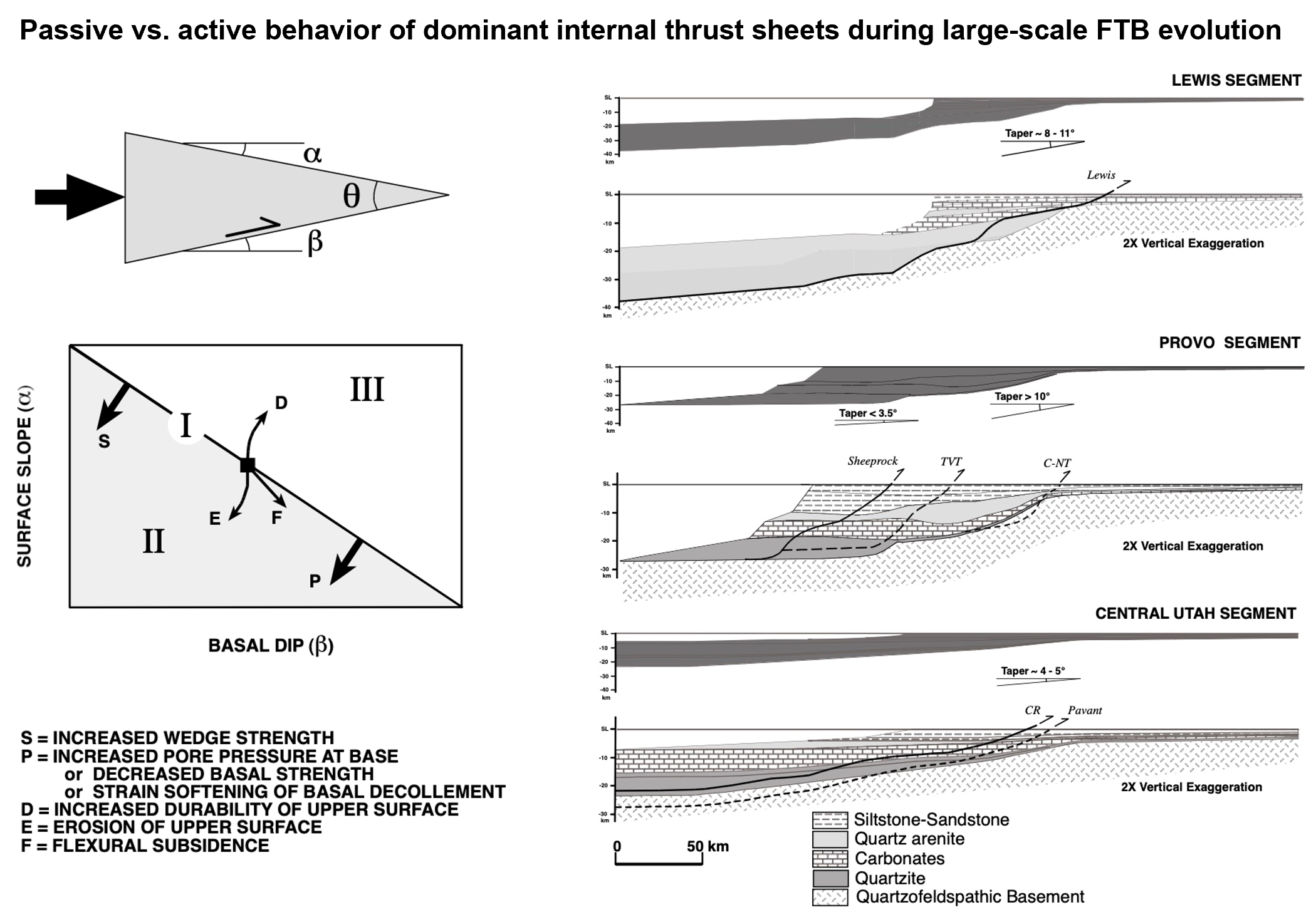
Critical wedge theory (CWT) explains the large-scale architecture, kinematic evolution and strain distribution of fold-thrust belts (FTBs) for both plastic and Coulomb wedges. During progressive deformation in an FTB wedge, the taper tends to decrease due to a variety of causes. CWT requires continued deformation in the back of the wedge to maintain critical taper in the wedge as a whole. Since the overall taper of the FTB wedge is typically determined by the geometry of a dominant thrust sheet in the hinterland of the FTB, it is the deformation behavior of such a sheet that defines wedge behavior as a whole. After initial emplacement of a dominant hinterland sheet, deformation in the back of the wedge may result in passive uplift and/or translation of the dominant sheet, or it may result in active deformation of the entire back of the wedge. The Sevier fold–thrust belt (FTB) provides an excellent natural example for evaluating these CWT-predicted behaviors based on three decades of structural studies. In summary, the Lewis segment (initial taper ∼9◦), the Central Utah segment (initial taper ∼6◦) and the Provo segment (initial taper ∼3◦) of the Sevier FTB have different initial sedimentary prism geometries and lithotectonic configurations, providing contrasting examples that are end-case scenarios of dominant hinterland sheet behavior both during initial emplacement and during late stage deformation of the back of the wedge as an FTB evolves. Strain data from these three areas are compatible with the interpretive models.
Graphical Abstract
References
- 1.
Price, R.A. Large-scale gravitational flow of supracrustal rocks, southern Canadian Rockies. In Gravity and Tectonics; DeJong, K.A., Scholten, R., Eds.; Wiley: New York, NY, USA, 1973; pp. 491–502.
- 2.
Price, R.A. The Cordilleran foreland thrust and fold belt in the southern Canadian Rocky Mountains. In Thrust and Nappe Tectonics; Mc-Clay, K.R., Price, N.J., Eds.; Geological Society Special Publication 9; The Geological Society of London: London, UK, 1981; pp. 427–448.
- 3.
Ismat, Z.; Mitra, G. Fold-thrust belt evolution expressed in an internal thrust sheet, Sevier orogen: The role of cataclastic flow. Geol. Soc. Am. Bull. 2005, 117, 764–782. https://doi.org/10.1130/B25514.1
- 4.
Yonkee,W.A. Basement–cover relations, Sevier orogenic belt, Northern Utah. Geol. Soc. Am. Bull. 1992, 104, 280–302. https://doi.org/10.1130/0016-7606(1992)104<0280:BCRSOB>2.3.CO;2
- 5.
Yonkee, W.A.; Parry, W.T.; Bruhn, R.L. Relations between progressive deformation and fluid–rock interaction during shear-zone growth in a basement-cored thrust sheet, Sevier orogenic belt, Utah. Am. J. Sci. 2003, 303, 1–59. https://doi.org/10.2475/ajs.303.1.1
- 6.
DeCelles, P.G.; Mitra, G. History of the Sevier orogenic wedge in terms of critical taper models, northeast Utah and southwest Wyoming. Geol. Soc. Am. Bull. 1995, 107, 454–462. https://doi.org/10.1130/0016-7606(1995)107<0454:HOTSOW>2.3.CO;2
- 7.
Chapple, W.M. Mechanics of thin-skinned fold-and-thrust belt. Geol. Soc. Am. Bull. 1978, 89, 1189–1198. https://doi.org/10.1130/0016-7606(1978)89<1189:MOTFB>2.0.CO;2
- 8.
Davis, D.; Suppe, J.; Dahlen, F.A. Mechanics of fold-and-thrust belts and accretionary wedges. J. Geophys. Res. 1983, 88, 1153–1172. https://doi.org/10.1029/JB088iB02p01153
- 9.
Williams, C.A.; Conners, C.; Dahlen, F.A.; et al. Effect of the brittle – ductile transition on the topography of compressional mountain belts on Earth and Venus. J. Geophys. Res. 1994, 99, 19947–19974. https://doi.org/10.1029/94JB01407
- 10.
Woodward, N.B. Geological applicability of critical-wedge thrust-belt models. Geol. Soc. Am. Bull. 1987, 99, 827–832. https://doi.org/10.1130/0016-7606(1987)99<827:GAOCTM>2.0.CO;2
- 11.
Mitra, G. Evolution of salients in a fold-and-thrust belt: The effects of sedimentary basin geometry, strain distribution and critical taper.
In Evolution of Geological Structures from Macro- to Micro-scales; Sengupta, S., Ed.; Chapman and Hall: London, UK, 1997; pp. 59–90. - 12.
DeCelles, P.G. Late Cretaceous–Paleocene synorogenic sedimentation and kinematic history of the Sevier thrust belt, northeast Utah and southwest Wyoming. Geol. Soc. Am. Bull. 1994, 106, 32–56. https://doi.org/10.1130/0016-7606(1994)106<0032:LCPSSA>2.3.CO;2
- 13.
Lawton, T.F. Lithofacies correlations within the Upper Cretaceous Indianola Group. In Overthrust Belt of Utah; Nielson, D. L., Ed.; Utah Geological Association Publication 10; Utah Geological Association: Salt Lake City, UT, USA, 1982; pp. 199–213.
- 14.
Lawton, T.F. Style and timing of the frontal structures, Sevier thrust belt, central Utah. AAPG Bull. 1985, 69, 1145–1159. https://doi.org/10.1306/AD462B6F-16F7-11D7-8645000102C1865D
- 15.
Mitra, G.; Sussman, A.J. Structural evolution of connecting splay duplexes and their implications for critical taper: An example based on geometry and kinematics of the Canyon Range culmination, Sevier Belt, central Utah. J. Struct. Geol. 1997, 19, 503–521. https://doi.org/10.1016/S0191-8141(96)00093-4
- 16.
Naeser, C.W.; Bryant, B.; Crittenden, M.D. Jr.; et al. Fission-track ages of apatite in the Wasatch mountains. In Tectonic and Stratigraphic Studies in the Eastern Great Basin; Miller, D.M., Todd, V.R., Howard, K.R., Eds.; Geological Society of America Memoir 157; Geological Society of America: Boulder, CO, USA, 1983; pp. 29–36.
- 17.
Boyer, S.E. Geometric evidence for synchronous thrusting in the southern Alberta and northwest Montana thrust belts. In Thrust Tectonics; McClay, K.R., Ed.; Chapman and Hall: London, UK, 1992; pp. 377–390.
- 18.
Crider, J.G. Kinematic and Geometric Analysis of Meso-scale and Macro-scale Brittle Structures: Evolution of the Northern Sawtooth Range, Montana. M.S. Thesis, University of Washington, Seattle, USA, 1993.
- 19.
Crider, J.G.; Boyer, S.E. Evidence for synchronous thrusting in the northern Sawtooth Range, Montana. Abstr. Programs - Geol. Soc. Am. 1993, 25, 25.
- 20.
Boyer, S.E.; Mitra, G. Deformation of the basement-cover transition zone of the Appalachian Blue Ridge Province. In Geometry and Mechanisms of Thrusting; Mitra, G., Wojtal, S., Eds.; Geological Society of America Special Paper 222; Geological Society of America: Boulder, CO, USA, 1988; pp. 119–136.
- 21.
Rodgers, J. The Tectonics of the Appalachians; Wiley-Interscience: New York, NY, USA, 1970; p. 271.
- 22.
Gwinn, V.E. Kinematic patterns and estimates of lateral shortening, Valley and Ridge and Great Valley Provinces, Central Appalachians, South-Central Pennsylvania. In Studies of Appalachian Geology, Central and Southern; Fisher, G.W., Pettijohn, F.J., Reed, J.C., Jr., et al., Eds.; Geological Society of America: Boulder, CO, USA, 1970; pp. 127–146.
- 23.
Mulugeta, G.; Koyi, H. Three-dimensional geometry and kinematics of experimental piggyback thrusting. Geology 1987, 15, 1052–1056. https://doi.org/10.1130/0091-7613(1987)15<1052:TGAKOE>2.0.CO;2
- 24.
Colletta, B.; Letouzey, J.; Pinedo, R.; et al. Computerized x-ray tomography analysis of sandbox models: Examples of thin-skinned thrust systems. Geology 1991, 19, 1063–1067. https://doi.org/10.1130/0091-7613(1991)019<1063:CXRTAO>2.3.CO;2
- 25.
Marshak, S.; Wilkerson, M.S. Effect of overburden thickness on thrust belt geometry and development. Tectonics 1992, 11, 560–566. https://doi.org/10.1029/92TC00175
- 26.
Kwon, S.; Mitra, G.; Perucchio, R. Effect of predeformational basin geometry in the kinematic evolution of a thin-skinned orogenic wedge: Insights from three-dimensional finite element modeling of the Provo salient, Sevier fold-thrust belt, Utah. J. Geophys Geophys. Res. Solid Earth 2007, 112, B02403. https://doi.org/10.1029/2006JB004376
- 27.
Mulugeta, G. Modelling the geometry of Coulomb thrust wedges. J. Struct. Geol. 1988, 10, 847–859. https://doi.org/10.1016/0191-8141(88)90099-5
- 28.
Huiqi, L.; McClay, K.R.; Powell, D. Physical models of thrust wedges. In Thrust Tectonics; McClay, K.R., Ed.; Chapman & Hall: London, UK, 1992; pp. 71–81.
- 29.
Graveleau, F.; Malavieille, J; Dominguez, F. Experimental modelling of orogenic wedges: A review. Tectonophysics 2012, 538–540, 1–66. https://doi.org/10.1016/j.tecto.2012.01.027
- 30.
Boyer, S.E. Sedimentary basin taper as a factor controlling the geometry and advance of thrust belts. Am. J. Sci. 1995, 295, 1220–1254. https://doi.org/10.2475/ajs.295.10.1220
- 31.
Sibson, R.H. Fault rocks and fault mechanisms. J. Geol. Soc. Lond. 1977, 133, 191–213. https://doi.org/10.1144/gsjgs.133.3.0191
- 32.
Elliott, D. The motion of thrust sheets. J. Geophys. Res. 1976, 81, 949–963. https://doi.org/10.1029/JB081i005p00949
- 33.
Remitti, F.; Festa, A.; Nirta, G.; et al. Role of folding-related deformation in the seismicity of shallow accretionary prisms. Nat. Geosci. 2024, 17, 600–607. https://doi.org/10.1038/s41561-024-01474-6
- 34.
Nickelsen, R.P. Sequence of structural stages of the Alleghany orogeny at the Bear Valley Stripe Mine, Shamokin, Pennsylvania. Am. J. Sci. 1979, 279, 225–271. https://doi.org/10.2475/ajs.279.3.225
- 35.
Geiser, P.A. Mechanisms of thrust propagation: Examples and implications for the analysis of overthrust terranes. J. Struct. Geol. 1988, 10, 829–845. https://doi.org/10.1016/0191-8141(88)90098-3
- 36.
Oxburgh, E.R.; Turcotte, D.L. Thermal gradients and regional metamorphism in overthrust terranes with special reference to the Eastern Alps. Schweiz. Mineral. Petrogr. Mitt. 1974, 54, 641–662.
- 37.
Lawton, T.F.; Boyer, S.E.; Schmitt, J.G. Influence of inherited taper on structural variability and conglomerate distribution, Cordilleran fold and thrust belt, western United States. Geology 1994, 22, 339–342. https://doi.org/10.1130/0091-7613(1994)022<0339:IOITOS>2.3.CO;2
- 38.
Douglas, R.J.W. Preliminary Map, Waterton, Alberta; Canada Geological Survey Paper; Geological Survey of Canada: Ottawa, ON, Canada, 1952; pp. 51–22.
- 39.
Spratt, D.A.; Simony, P.S.; Price, R.A.; et al. Fault-related folding in the Foothills and Front Ranges of Southern Alberta. In Geological Society of America Penrose Conference Field Trip Guidebook; Geological Society of America: Boulder, CO, USA, 1995; p. 95.
- 40.
Heimgartner, D. Structural Geology of the Southern Termination of the Lewis Thrust Fault, Northwestern Montana. M.S. Thesis, University of Rochester, Rochester, NY, USA, 1997.
- 41.
Constenius, K.N. Late Paleogene extensional collapse of the Cordilleran foreland fold and thrust belt. Geol. Soc. Am. Bull. 1996, 108, 20–39. https://doi.org/10.1130/0016-7606(1996)108<0020:LPECOT>2.3.CO;2
- 42.
Price, R.A.; Sears, J.W. A preliminary palinspastic map of the Mesoproterozoic Belt-Purcell Supergroup, Canada and USA: Implications for the tectonic setting and structural evolution of the Purcell anticlinorium and the Sullivan deposit. In The Geological Environment of the Sullivan Deposit, British Columbia; Lydon, J.W., H¨oy, T., Slack, J.F., et al., Eds.; Geological Association of Canada, Mineral Deposits Division, Special Publication 1; Geological Association of Canada: Ottawa, ON, Canada, 2000; pp. 61–81.
- 43.
Sears, J. Emplacement and denudation history of the Lewis-Eldorado-Hoadley thrust slab in the northern Montana Cordillera, USA: Implications for steady-state orogenic processes. Am. J. Sci. 2001, 301, 359–373. https://doi.org/10.2475/AJS.301.4-5.359
- 44.
Ross, C.P. Geology of Glacier National Park and the Flathead Region, Northwestern Montana; U.S. Geological Survey Professional Paper 296; United States Geological Survey: Washington, DC, USA, 1959; p. 125.
- 45.
Willis, B. Stratigraphy and structure, Lewis and Livingston Ranges, Montana. Geol. Soc. Am. Bull. 1902, 13, 305–352.
- 46.
Ruhle, G.C. Guide to Glacier National Park, Campbell-Methun, Inc: Minneapolis, MN, USA, 1949; p. 189.
- 47.
Yin, A.; Kelty, T.K.; Davis, G.A. Duplex abandonment and development during the evolution of the Lewis thrust system, Glacier National Park, Montana. Geology 1989, 17, 806–810. https://doi.org/10.1130/0091-7613(1989)017<0806:DDAADE>2.3.CO;2
- 48.
Yin, A.; Kelty, T.K. Structural evolution of the Lewis thrust system, southern Glacier National Park: Implications for the regional tectonic development. Geol. Soc. Am. Bull. 1991, 103, 1073–1089. https://doi.org/10.1130/0016-7606(1991)103<1073:SEOTLP>2.3.C O;2
- 49.
Dahlstrom, C.D.A. Structural geology in the eastern margin of the Canadian Rocky Mountains. Bull. Can. Pet. Geol. 1970, 18, 332–406. https://doi.org/10.1306/5D25CA81-16C1-11D7-8645000102C1865D
- 50.
Fermor, P.R.; Price, R.A. Imbricate Structures in the Lewis Thrust Sheet Around Cate Creek and Haig Brook Windows, Southeast British Columbia; Canada Geological Survey Paper 76-1B; Geological Survey of Canada: Ottawa, ON, Canada, 1976; pp. 7–10.
- 51.
Fry, N. Random point distributions and strain measurement in rocks. Tectonophysics 1979, 60, 89–105. https://doi.org/10.1016/0040-1951(79)90135-5
- 52.
Erslev, E.A.; Ge, H. Least-squares center-to-center and mean object ellipse fabric analysis. J. Struct. Geol. 1990, 12, 201–209. https://doi.org/10.1016/0191-8141(90)90100-D
- 53.
McNaught, M.A. Modifying the normalized Fry method for aggregates of non-elliptical grains. J. Struct. Geol. 1994, 18, 573–583. https://doi.org/10.1016/0191-8141(94)90043-4
- 54.
Mukul, M.; Mitra, G. Finite strain and strain variation analysis in the Sheeprock thrust sheet, an internal thrust sheet in the Provo salient of the Sevier fold-and-thrust belt, central Utah. J. Struct. Geol. 1998, 20, 385–406. https://doi.org/10.1016/S0191-8141(97)00087-4
- 55.
DeCelles, P.G.; Coogan, J.C. Regional structure and kinematic history of the Sevier fold-and-thrust belt, central Utah. Geol. Soc. Am. Bull. 2006, 118, 841–864. https://doi.org/10.1130/B25759.1
- 56.
Ismat, Z.; Mitra, G. Folding by cataclastic flow: Evolution of controlling factors during deformation. J. Struct. Geol. 2005, 27, 2181–2203. https://doi.org/10.1016/j.jsg.2005.08.005
- 57.
Royse, F., Jr. Detachment fold train, Reed Wash area, west flank San Rafael swell: An example of limb lengthening, roll-through folding process on the eastern margin of the Sevier thrust belt. The rocky Mountain Association of Geologists. Mt. Geol. 1996, 33, 45–64.
- 58.
Boyer, S.E.; Mitra, G. Fold duplexes. J. Struct. Geol. 2019, 125, 202–212. https://doi.org/10.1016/j.jsg.2018.07.008
- 59.
Hintze, L.F. Geologic History of Utah; Brigham Young University Geology Studies Special Publication 7; Brigham Young University: Provo, UT, USA, 1988; p. 202.
- 60.
Burchfiel, B.C.; Hickox, C.W. Structural development of central Utah. In Plateau–Basin and Range Transition Zone, Central Utah; Baer, J.L., Callaghan, E., Eds.; Geological Association Publication 2; Utah Geological Association: Salt Lake City, UT, USA, 1972; pp. 55–66.
- 61.
Villien, A.; Kligfield, R.M. Thrusting and synorogenic sedimentation in central Utah. In Paleotectonics and Sedimentation in the Rocky Mountain Region, United States; Peterson, J.A., Ed.; Memoir 41; American Association of Petroleum Geologists: Tulsa, OK, USA, 1986; pp. 281–308.
- 62.
Allmendinger, R.W.; Sharp, J.W.; Von Tish, D.; et al. Cenozoic and Mesozoic structure of the eastern Basin and Range province, Utah, from COCORP seismic reflection data. Geology 1983, 11, 532–536. https://doi.org/10.1130/0091-7613(1983)11<532:CAMSOT>2.0.CO;2
- 63.
Coogan, J.C.; DeCelles, P.G. Extensional collapse along the Sevier Desert reflection, northern Sevier Desert basin, western United States. Geology 1996, 24, 933–936. https://doi.org/10.1130/0091-7613(1996)024<0933:ECATSD>2.3.CO;2
- 64.
Standlee, L.A. Structure and stratigraphy of Jurassic rocks in central Utah: Their influence on tectonic development of the Cordilleran foreland thrust belt. In Geologic Studies of the Cordilleran Foreland Thrust Belt; Powers, R.B., Ed.; Rocky Mountain Association of Geologists: Denver, CO, USA, 1982; pp. 357–382.
- 65.
Kwon, S.; Mitra, G. Strain distribution, strain history and kinematic evolution associated with the formation of arcuate salients in foldthrust belts: The example of the Provo salient, Sevier orogen, Utah. In Orogenic Curvature; Sussman, A., Weil, A., Eds.; Geological Society of America Special Paper 383; Geological Society of America: Boulder, CO, USA, 2004; pp. 205–223.
- 66.
Christie-Blick, N.H. Structural geology of the southern Sheeprock Mountains, Utah: Regional significance. In Tectonics and Stratigraphic Studies in the Eastern Great Basin; Miller, D.M., Todd, R., Howard, K.A., Eds.; Geological Society of America Memoir 157; Geological Society of America: Boulder, CO, USA, 1983; pp. 101–124.
- 67.
Mukul, M.; Mitra, G. Geology of the Sheeprock Thrust Sheet, Central Utah -New Insights; Utah Geological Survey Miscellaneous Publications 98-1; Utah Geological Survey: Salt Lake City, UT, USA, 1998; p. 56.
- 68.
Kwon, S.; Mitra, G. Three-dimensional finite-element modeling of a thin-skinned fold-thrust belt wedge: Provo salient, Sevier belt, Utah. Geology 2004, 32, 561–564. https://doi.org/10.1130/G20415.1
- 69.
Strine, M.; Mitra, G. Preliminary kinematic data from a salient-recess pair along the Moine thrust, northwest Scotland. In Orogenic Curvature; Sussman, A., Weil, A., Eds.; Geological Society of America Special Paper 383-14; Geological Society of America: Boulder, CO, USA, 2004; pp. 87–107.
- 70.
Kwon, S.; Mitra, G. Three-dimensional kinematic history at an oblique ramp: The Leamington Zone of the Sevier FTB as an example. J. Struct. Geol. 2006, 28, 474–493. https://doi.org/10.1016/j.jsg.2005.12.011
- 71.
Paulsen, T.; Marshak, S. Origin of the Uinta recess, Sevier fold-thrust belt, Utah: Influence of basin architecture on fold-thrust belt geometry. Tectonophysics 1999, 312, 203–216. https://doi.org/10.1016/S0040-1951(99)00182-1

How to Cite
Mitra, G., Boyer , S. E., Kwon, S., Mukul , M., Ismat , Z., & Sussman , A. (2026). Lateral Variations in Evolution of a Fold-thrust Belt Hinterland: Passive versus Active Behavior of Dominant Internal Thrust Sheets. Habitable Planet, 2(2), 303–324. https://doi.org/10.63335/j.hp.2026.0040
RIS
BibTex
Copyright & License

Copyright (c) 2026 by the authors.
This work is licensed under a Creative Commons Attribution 4.0 International License.
Article Metrics
166
Article Views
3
Citations
Contents
References

 Suite 4002 Level 4, 447 Collins Street, Melbourne, Victoria 3000, Australia
 General Inquiries: info@sciltp.com