
- Systematically reviews controls on initial Sn–W enrichment during partial melting.
- Identifies key controversies in source composition, pre-enrichment, and melting conditions.
- Proposes the integration of in situ analysis and modeling to study disequilibrium melting.
- Open Access
- Review
Magma-Source Controls on Initial Sn–W Enrichment in Granites: A Review
Author Information
Received: 25 Mar 2026 | Revised: 20 May 2026 | Accepted: 08 Jun 2026 | Published: 10 Jun 2026
Highlights
Abstract
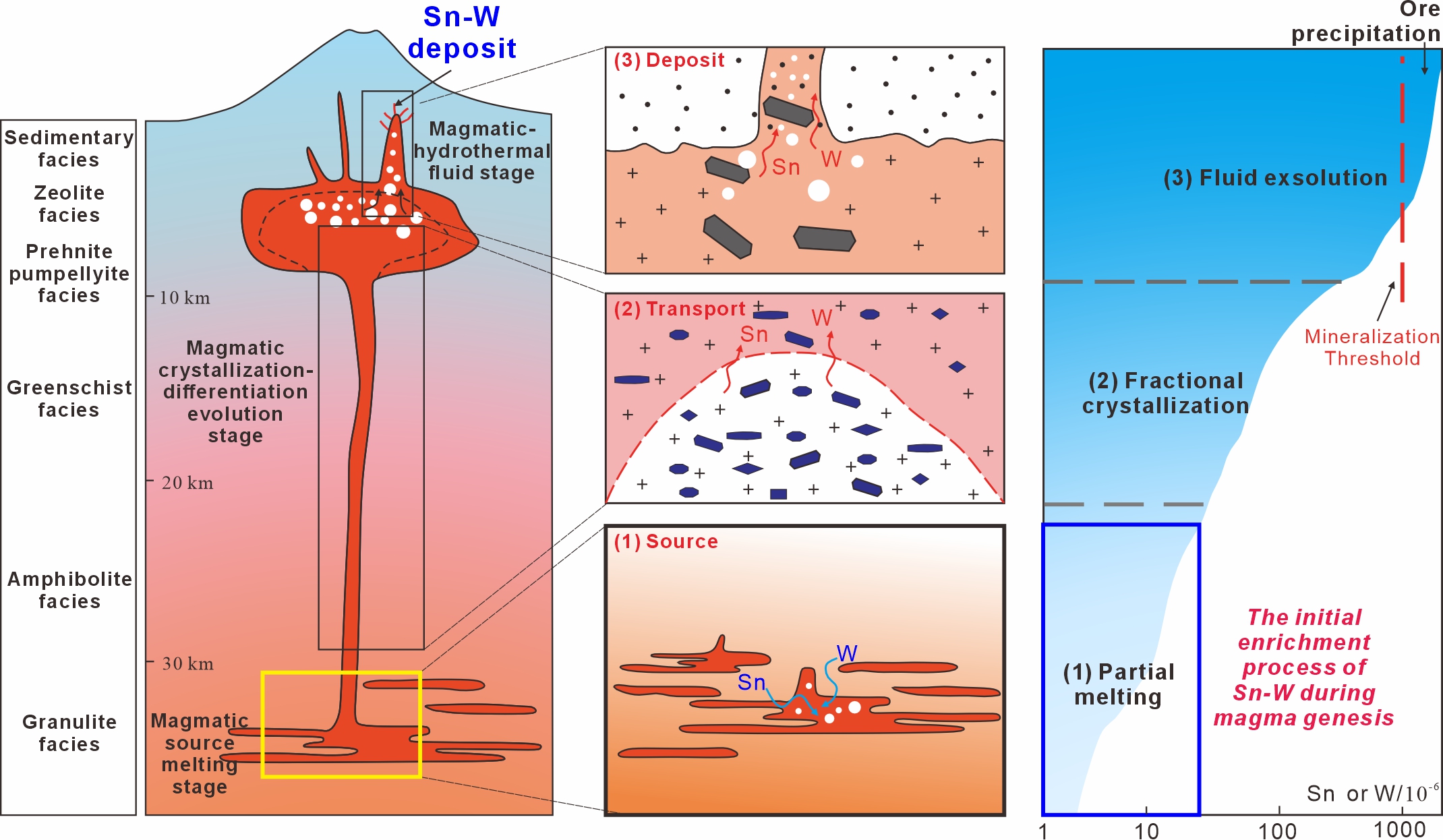
Tin and tungsten are strategic critical metals, and understanding the mechanisms responsible for their extraordinary enrichment is a frontier research topic in economic geology. The formation of granite-hosted Sn–W deposits involves three successive stages: source enrichment, magmatic transport, and metal precipitation. Partial melting of metasedimentary rocks in the middle–lower crust represents the starting point for the initial enrichment of ore-forming metals, yet the role of this stage in mineralization has long been insufficiently recognized. This review focuses on the controls exerted by magma-source processes on the initial enrichment of Sn and W during granite petrogenesis. It systematically summarizes research progress concerning source-rock composition, the degree of pre-enrichment of ore-forming elements, anatectic conditions, including temperature and oxygen fugacity, the types of minerals involved in melting reactions, and the stability of accessory minerals. Key scientific controversies remain, including the respective contributions of metapelites versus metagreywackes to mineralization, the mechanisms controlling Sn–W coupling and decoupling, and the fractionation behavior of elements and isotopes during disequilibrium melting. Future research should integrate in situ microanalysis, phase-equilibrium modeling, and isotopic tracing, using recently exhumed orogens such as the Himalaya as natural laboratories, to elucidate the mechanisms of Sn–W mobilization and initial enrichment during partial melting and thereby advance theories of granite-related Sn–W metallogeny.
Graphical Abstract
Keywords
Sn–W mineralization | magma origin | partial melting | initial enrichment | granite
References
- 1.
Zheng, Y.F. A revisit to continental collision between India and Asia. Earth Sci. Rev. 2025, 264, 105087. https://doi.org/10.1016/j.earscirev.2025.105087
- 2.
Weber, S.; Legler, C.; Kallmeier, E.; et al. Metamorphic origin of stratiform cassiterite mineralization in the Schwarzenberg – Aue district – Clues to the metamorphic history and pre-orogenic Sn enrichment of the Erzgebirge (Germany). Lithos 2023, 454–455, 107273. https://doi.org/10.1016/j.lithos.2023.107273
- 3.
Zhao, P.; Yuan, S.; Williams-Jones, A.E.; et al. Temporal separation of W and Sn mineralization by temperature-controlled incongruent melting of a single protolith: Evidence from the wangxianling area, nanling region, South China. Econ. Geol. 2022, 117, 667–682. https://doi.org/10.5382/econgeo.4902
- 4.
Song, S.; Mao, J.; Yuan, S.; et al. Decoupling of Sn and W mineralization in a highly fractionated reduced granitic magma province: A case study from the Youjiang basin and Jiangnan tungsten belt. Miner. Depos. 2022, 57, 1251–1267. https://doi.org/10.1007/s00126-022-01094-3
- 5.
Liu, Y.; Schmidt, C.; Li, J.; et al. The role of protolith composition in the formation of tin-enriched granitic melts: A modeling study using the example of the southwest China tin province. Ore Geol. Rev. 2024, 169, 106094. https://doi.org/10.1016/j.oregeorev.2024.106094
- 6.
Mao, J.W.; Ouyang, H.G.; Song, S.W.; et al. Geology and metallogeny of tungsten and Tin deposits in China, in Mineral Deposits of China; Chang, Z.; Goldfarb, R.J., Eds.; Society of Economic Geologists Special Publication 22; Society of Economic Geologists: Littleton, CO, USA, 2019; pp. 411–482. https://doi.org/10.5382/SP.22.10
- 7.
Romer, R.L.; Pichavant, M. Rare metal granites and pegmatites. In Encyclopedia of Geology, 2nd ed.; Alderton, D., Elias, S.A., Eds.; Academic Press: Oxford, UK, 2021; pp. 840–846. https://doi.org/10.1016/B978-0-08-102908-4.00003-5
- 8.
Romer, R.L.; F¨ orster, H.J.; Glodny, J. Role of fractional crystallization, fluid-melt separation, and alteration on the Li and B isotopic composition of a highly evolved composite granite pluton: The case of the Eibenstock granite, Erzgebirge, Germany. Lithos 2022, 422–423, 106722. https://doi.org/10.1016/j.lithos.2022.106722
- 9.
Yu, J.; Cai, Y.; Sun, T.; et al. Distribution and enrichment of rare metal elements in the basement rocks of South China: Controls on rare-metal mineralization. Ore Geol. Rev. 2023, 163, 105797. https://doi.org/10.1016/j.oregeorev.2023.105797
- 10.
Michaud, J.A.S.; Schmidt, C.; Naumova, M.A. Revisiting redoxdriven pathways of tin cycle from source to economic deposit. Sci. Rep. 2025, 15, 34476. https://doi.org/10.1038/s41598-025-21389-5
- 11.
Mei, Y.; Liu, W.; Guan, Q.; et al. Tungsten speciation in hydrothermal fluids. Geochim. Cosmochim. Acta 2025, 406, 262–284. https://doi.org/10.1016/j.gca.2024.06.030
- 12.
Rasmussen, K.L.; Falck, H.; Elongo, V.; et al. The source of tungsten-associated magmas in the northern Canadian Cordillera and implications for the basement. Geology 2023, 51, 657–662. https://doi.org/10.1130/G51042.1
- 13.
Losantos, E.; Borrajo, I.; Losada, I.; et al. Sn and W mineralisation in the Iberian Peninsula. Ore Geol. Rev. 2025, 106542. https://doi.org/10.1016/j.oregeorev.2025.106542
- 14.
Stepanov, A.S. A review of the geochemical changes occurring during metamorphic devolatilization of metasedimentary rocks. Chem. Geol. 2021, 568, 120080. https://doi.org/10.1016/j.chemgeo.2021.120080
- 15.
Wolf, M.; Romer, R.L.; Franz, L.; et al. Tin in granitic melts: The role of melting temperature and protolith composition. Lithos 2018, 310–311, 20–30. https://doi.org/10.1016/j.lithos.2018.04.004
- 16.
Spear, F.S.; Pyle, J.M. Apatite, monazite, and xenotime in metamorphic rocks. Rev. Mineral. Geochem. 2002, 48, 293–335. https://doi.org/10.2138/rmg.2002.48.7
- 17.
Yakymchuk, C.; Acosta-Vigil, A. Geochemistry of phosphorus and the behavior of apatite during crustal anatexis: Insights from melt inclusions and nanogranitoids. Am. Mineral. 2019, 104, 1765–1780. https://doi.org/10.2138/am-2019-7054
- 18.
Schwindinger, M.; Weinberg, R.F.; White, R.W. The fate of accessory minerals and key trace elements during anatexis and magma extraction. J. Petrol. 2020, 61, egaa031. https://doi.org/10.1093/petrology/egaa031
- 19.
Volante, S.; Blereau, E.; Guitreau, M.; et al. Current applications using key mineral phases in igneous and metamorphic geology: Perspectives for the future. In Minor Minerals, Major Implications: Using Key Mineral Phases to Unravel the Formation and Evolution of Earth’s Crust; van Schijndel, V., Cutts, K., Pereira, I., et al., Eds.; Geological Society, London, Special Publications, Vol. 537; Geological Society of London: London, UK, 2024; pp. 57–121. https://doi.org/10.1144/SP537-2022-254
- 20.
Yuan, S.; Williams-Jones, A.E.; Romer, R.L.; et al. Protolith-related thermal controls on the decoupling of Sn and W in Sn-W Metallogenic Provinces: Insights from the Nanling Region, China. Econ. Geol. 2019, 114, 1005–1012. https://doi.org/10.5382/econgeo.4669
- 21.
Gardiner, N.J.; Palin, R.M.; Koopmans, L.; et al. On tin and lithium granite systems: A crustal evolution perspective. Earth Sci. Rev. 2024, 258, 104947. https://doi.org/10.1016/j.earscirev.2024.104947
- 22.
Lehmann, B. Formation of tin ore deposits: A reassessment. Lithos 2021, 402–403, 105756. https://doi.org/10.1016/j.lithos.2020.105756
- 23.
Schuiling, R.D. Tin belts on the continents around the Atlantic Ocean. Econ. Geol. 1967, 62, 540–550. https://doi.org/10.2113/gsecongeo.62.4.540
- 24.
Romer, R.L.; Kroner, U., Provenance control on the distribution of endogenic Sn-W, Au, and U mineralization within the Gondwana-Laurussia plate boundary zone. In New Developments in the Appalachian–Caledonian–Variscan Orogen; Kuiper, Y.D., et al., Eds.; Geological Society of America: Boulder, CO, USA, 2022; Volume 554. https://doi.org/10.1130/2021.2554(02)
- 25.
Romer, R.L.; Kroner, U.; Schmidt, C.; et al. Mobilization of tin during continental subduction-accretion processes. Geology 2022, 50, 1361–1365. https://doi.org/10.1130/G50466.1
- 26.
Elongo, V.; Falck, H.; Rasmussen, K.L.; et al. Ancient roots of tungsten in western North America. Geology 2022, 55, 791–795. https://doi.org/10.1130/G49801.1
- 27.
Tang, G.-J.; Wyman, D.A.; Wang, Q.; et al. Large-scale rare-metal pegmatite deposit formation driven by supercontinent assembly. Geology 2023, 51, 880–884. https://doi.org/10.1130/G51454.1
- 28.
Ishihara, S. The redox state of granitoids relative to tectonic setting and earth history: The magnetite–ilmenite series 30 years later. Earth Environ. Sci. Trans. R. Soc. Edinb. 2004, 95, 23–33. https://doi.org/10.1130/0-8137-2389-2.23
- 29.
Sato, K.; Kovalenko, S.V.; Romanovsky, N.P.; et al. Crustal control on the redox state of granitoid magmas: Tectonic implications from the granitoid and metallogenic provinces in the circum-Japan Sea Region. Earth Environ. Sci. Trans. R. Soc. Edinb. 2004, 95, 319–337. https://doi.org/10.1130/0-8137-2389-2.319
- 30.
Sato, K. Sedimentary crust and metallogeny of granitoid affinity: Implications from the geotectonic histories of the Circum-Japan sea region, Central Andes and Southeastern Australia. Resour. Geol. 2012, 62, 329–351. https://doi.org/10.1111/j.1751-3928.2012.00200.x
- 31.
Pati ˜no Douce, A.E.; Johnston, A.D. Phase equilibria and melt productivity in the pelitic system: Implications for the origin of peraluminous granitoids and aluminous granulites. Contrib. Mineral. Petrol. 1991, 107, 202–218. https://doi.org/10.1007/BF00310707
- 32.
Song, S., Mao, J., Zhang, Z., et al. Lamprophyre magmatism triggering the formation of the Zhuxi granites related to the world-largest scheelite skarn deposit in South China. Lithos 2023, 444–445, 107106. https://doi.org/10.1016/j.lithos.2023.107106
- 33.
Blevin, P.L. Metallogeny of granitic rocks. In The Ishihara Symposium: Granites and Associated Metallogenesis; Geoscience Australia: Canberra, Australia, 2003; pp. 1–4.
- 34.
Thompson, J.; Sillitoe, R.; Baker, T.; et al. Intrusion-related gold deposits associated with tungsten-tin provinces. Miner. Depos. 1999, 34, 323–334. https://doi.org/10.1007/s001260050207
- 35.
Romer, R.L.; Kroner, U. Sediment and weathering control on the distribution of Paleozoic magmatic tin–tungsten mineralization. Miner. Depos. 2015, 50, 327–338. https://doi.org/10.1007/s00126-014-0540-5
- 36.
Romer, R.L.; Kroner, U. Phanerozoic tin and tungsten mineralization—Tectonic controls on the distribution of enriched protoliths and heat sources for crustal melting. Gondwana Res. 2016, 31, 60–95. https://doi.org/10.1016/j.gr.2015.11.002
- 37.
Zhao, P.; Chu, X.; Williams-Jones, A.E.; et al. The role of phyllosilicate partial melting in segregating tungsten and tin deposits in W-Sn metallogenic provinces. Geology 2022, 50, 121–125. https://doi.org/10.1130/G49248.1
- 38.
Yang, J.H.; Wu, J.H.; Zhou, M.F.; et al. Mantle contributions to global tungsten recycling and mineralization. Commun. Earth Environ. 2025, 6, 510. https://doi.org/10.1038/s43247-025-02471-2
- 39.
Michaud, J.A.S.; Pichavant, M.; Villaros, A. Rare elements enrichment in crustal peraluminous magmas: Insights from partial melting experiments. Contrib. Mineral. Petrol. 2021, 176, 96. https://doi.org/10.1007/s00410-021-01855-9
- 40.
Yin, R.; Huang, X.L.; Wang, R.C.; et al. Rare-metal enrichment and Nb–Ta fractionation during magmatic–hydrothermal processes in rare-metal granites: Evidence from zoned micas from the Yashan pluton, South China. J. Petrol. 2022, 63, egac093. https://doi.org/10.1093/petrology/egac093
- 41.
Liu, M.; Zhao, P.; Hong, W.; et al. Assessing the W-Sn ore formation potential of large granite batholiths: Insights from zircon U-Pb and muscovite Ar-Ar geochronology of the Tianmuchong W-Sn deposit in the Nanling region, South China. Ore Geol. Rev. 2024, 106311. https://doi.org/10.1016/j.oregeorev.2024.106311
- 42.
Lehmann, B., Metallogeny of Tin. Springer-Verlag: Berlin, Heidelberg, 1990; pp. 1–211.
- 43.
Lu, H.Z.; Liu, Y.; Wang, C.; et al. Mineralization and fluid inclusion study of the shizhuyuan W-Sn-Bi-Mo-F skarn deposit, Hunan Province, China. Econ. Geol. 2003, 98, 955–974. https://doi.org/10.2113/gsecongeo.98.5.955
- 44.
Blevin, P.L.; Chappell, B.W. The role of magma sources, oxidation states and fractionation in determining the granite metallogeny of eastern Australia. Earth Environ. Sci. Trans. R. Soc. Edinb. 1992, 83, 305–316. https://doi.org/10.1130/SPE272-p305
- 45.
Cheng, Y.; Spandler, C.; Kemp, A.; et al. Controls on cassiterite (SnO2) crystallization: Evidence from cathodoluminescence, traceelement chemistry, and geochronology at the Gejiu Tin District. Am. Mineral. 2019, 104, 118–129. https://doi.org/10.2138/am-2019-6466
- 46.
Huang, W.Q.; Pan, J.Y.; Ni, P.; et al. Recognition of Neogene tin mineralization in the Southeast Asian tin belt. GSA Bull. 2024, 136, 5300–5312. https://doi.org/10.1130/B37541.1
- 47.
Wei, C.; Xiong, X.; Wang, J.; et al. Partitioning of tin between mafic minerals, Fe-Ti oxides and silicate melts: Implications for tin enrichment in magmatic processes. Geochim. Cosmochim. Acta 2024, 372, 81–100. https://doi.org/10.1016/j.gca.2024.03.011
- 48.
Linnen, R.L.; Pichavant, M.; Holtz, F. The combined effects of fO2 and melt composition on SnO2 solubility and tin diffusivity in haplogranitic melts. Geochim. Cosmochim. Acta 1996, 60, 4965–4976. https://doi.org/10.1016/S0016-7037(96)00295-5
- 49.
Schmidt, C.; Gottschalk, M.; Zhang, R.; et al. Oxygen fugacity during tin ore deposition from primary fluid inclusions in cassiterite. Ore Geol. Rev. 2021, 139, 104451. https://doi.org/10.1016/j.oregeorev.2021.104451
- 50.
Wu, J.; Li, H.; Mathur, R.; et al. Compositional variation and Sn isotope fractionation of cassiterite during magmatichydrothermal processes. Earth Planet. Sci. Lett. 2023, 613, 118186. https://doi.org/10.1016/j.epsl.2023.118186
- 51.
Ma, X.; Wang, H.; Lehmann, B.; et al. Control of magmatic halogen composition and redox state on the zonation of metal mineralization across active continental margins: Perspectives from the worldclass South China metallogenic province. Chem. Geol. 2024, 669, 122363. https://doi.org/10.1016/j.chemgeo.2024.122363
- 52.
Simons, B.; Andersen, J.C.Ø.; Shail, R.K.; et al. Fractionation of Li, Be, Ga, Nb, Ta, In, Sn, Sb, W and Bi in the peraluminous early permian Variscan granites of the Cornubian Batholith: Precursor processes to magmatic-hydrothermal mineralisation. Lithos 2017, 278–281, 491–512. https://doi.org/10.1016/j.lithos.2017.02.007
- 53.
Borrajo, I.; Tornos, F.; Stein, H.; et al. Geochronology and decoupling controls of Sn-(Ta-Li) and W-(Sn) mineralization in the Iberian Variscan Massif, Spain and Portugal. Ore Geol. Rev. 2024, 173, 106253. https://doi.org/10.1016/j.oregeorev.2024.106253
- 54.
Cave, B.J.; Large, R.R.; White, C.E.; et al. Does tungsten availability control the presence of tungsten in turbidite-hosted orogenic gold mineralization? Evidence from the Meguma and Bendigo-ballarat Terranes. Can. Mineral. 2017, 55, 973–999. https://doi.org/10.3749/canmin.1600088
- 55.
Lefebvre, M.G.; Romer, R.L.; Glodny, J.; et al. Skarn formation and tin enrichment during regional metamorphism: The Hammerlein polymetallic skarn deposit. Lithos 2019, 348–349, 105171. https://doi.org/10.1016/j.lithos.2019.105171
- 56.
Kunz, B.E.; Warren, C.J.; Jenner, F.E.; et al. Critical metal enrichment in crustal melts: The role of metamorphic mica. Geology 2022, 50, 1219–1223. https://doi.org/10.1130/G50284.1
- 57.
Yakymchuk, C.; Clark, C.; White, R.W. Phase relations, reaction sequences and petrochronology. Rev. Mineral. Geochem. 2017, 83, 13–53. https://doi.org/10.2138/rmg.2017.83.2
- 58.
Cave, B.J.; Pitcairn, I.K.; Craw, D.; et al. A metamorphic mineral source for tungsten in the turbidite-hosted orogenic gold deposits of the Otago Schist, New Zealand. Miner. Depos. 2017, 52, 515–537. https://doi.org/10.1007/s00126-016-0677-5
- 59.
Carocci, E.; Marignac, C.; Cathelineau, M.; et al. Incipient wolframite deposition at Panasqueira (Portugal):WRutile and Tourmaline Compositions as Proxies for the early fluid composition. Econ. Geol. 2021, 116, 123–146. https://doi.org/10.5382/econgeo.4783
- 60.
Finch, E.G.; Tomkins, A.G. Fluorine and chlorine behaviour during progressive dehydration melting: Consequences for granite geochemistry and metallogeny. J. Metamorph. Geol. 2017, 35, 739–757. https://doi.org/10.1111/jmg.12253
- 61.
Zeng, L.; Saleeby, J.B.; Asimow, P. Nd isotope disequilibrium during crustal anatexis: A record from the Goat Ranch migmatite complex, southern Sierra Nevada batholith, California. Geology 2005, 33, 53–56. https://doi.org/10.1130/G20831.1
- 62.
Yang, L.; Wang, J.M.; Liu, X.C.; et al. Sr-Nd-Hf Isotopic disequilibrium during the partial melting of metasediments: Insight from Himalayan Leucosome. Front. Earth Sci. 2022, 10:891960. https://doi.org/10.3389/feart.2022.891960
- 63.
Wolf, M.; Romer, R.L.; Glodny, J. Isotope disequilibrium during partial melting of metasedimentary rocks. Geochim. Cosmochim. Acta 2019, 257, 163–183. https://doi.org/10.1016/j.gca.2019.05.008
- 64.
Mangler, M.F.; Gardiner, N.J.; Skeat, D.; et al. Apatite as a pathfinder to tin mineralisation: prospects and caveats. Miner. Depos. 2025, 60, 1397–1408. https://doi.org/10.1007/s00126-025-01350-2
- 65.
Spear, F.S.; Kohn, M.J.; Cheney, J.T. P-T paths from anatectic pelites. Contrib. Mineral. Petrol. 1999, 134, 17–32. https://doi.org/10.1007/s004100050466
- 66.
Liu, Y.; Romer, R.L.; Schmidt, C.; et al. Experimental melting of tin-enriched sedimentary protoliths: Implications for the formation of tin-specialized granites. Lithos 2025, 522–523, 108384. https://doi.org/10.1016/j.lithos.2025.108384
- 67.
Cao, H.W.; Pei, Q.M.; Yu, X.; et al. Discovery of the largescale Eocene Xiwu Pb–Zn–Ag deposit in the Tethyan Himalaya: Geochronology, geochemistry, and C–H–O–S–Pb–Sr–Nd isotopes. Gondwana Res. 2023, 124, 165–187. https://doi.org/10.1016/j.gr.2023.07.001
- 68.
Cao, H.W.; Pei, Q.M.; Yu, X.; et al. The long-lived partial melting of the Greater Himalayas in southern Tibet, constraints from the Miocene Gyirong anatectic pegmatite and its prospecting potential for rare element minerals. China Geol. 2023, 6, 303–321. https://doi.org/10.31035/cg2022061
- 69.
Cao, H.W.; Pei, Q.M.; Santosh, M.; et al. Himalayan leucogranites: A review of geochemical and isotopic characteristics, timing of formation, genesis, and rare metal mineralization. Earth Sci. Rev. 2022, 234, 104229. https://doi.org/10.1016/j.earscirev.2022.104229
- 70.
Wang, Q.; Zhu, R.; Li, W.C.; et al. The role of alkaline silicaterich fluids in Sn mineralization based on cassiterite solubility experiments. Geochim. Cosmochim. Acta 2024, 373, 169–176. https://doi.org/10.1016/j.gca.2024.04.001
- 71.
Koopmans, L.; Martins, T.; Linnen, R.; et al. The formation of lithiumrich pegmatites through multi-stage melting. Geology 2024, 52, 7–11. https://doi.org/10.1130/G51633.1
- 72.
Sun, X., Xu, H.C., Yang, Z.M.; et al. Crustal recycling and metamorphic dehydration govern the fertility of graniteassociated tin systems. Commun. Earth Environ. 2026, 7, 381. https://doi.org/10.1038/s43247-026-03538-4
How to Cite
Cao, H.-W. (2026). Magma-Source Controls on Initial Sn–W Enrichment in Granites: A Review. Habitable Planet, 2(2), 355–364. https://doi.org/10.63335/j.hp.2026.0043
RIS
BibTex
Copyright & License

Copyright (c) 2026 by the authors.
This work is licensed under a Creative Commons Attribution 4.0 International License.
Article Metrics
286
Article Views
5
Citations
Contents
References

 Suite 4002 Level 4, 447 Collins Street, Melbourne, Victoria 3000, Australia
 General Inquiries: info@sciltp.com