
Precipitation is the largest flux of the global land hydrological cycle and is widely regarded as the dominant contributor to catchment streamflow. For decades, it has been the primary basis for attributing streamflow variability at annual to decadal timescales. Yet, the relative importance of other hydrological processes in controlling streamflow across different timescales remains unclear. As a measure of the sensitivity of streamflow to changes in its driving variables, streamflow elasticity has been used to quantify streamflow sensitivity to environmental changes. Here, using data from 1628 catchments distributed across the globe, we show that the elasticity of streamflow to precipitation at monthly and seasonal scales is far smaller than the annual elasticity because groundwater storage substantially buffers streamflow variability at subannual timescales, especially in water-limited regions. Therefore, groundwater storage must be considered alongside precipitation and potential evaporation to provide a comprehensive understanding of streamflow responses to climate variability and change. Our results underscore the important need for improving modeling of groundwater storage variability for robust projections of hydrological impacts under a changing climate.
- Open Access
- Article
Groundwater Storage as a Key Driver of Subannual Streamflow Variability
- Yongqiang Zhang 1, *,
- Hongxing Zheng 2,
- Changming Liu 1,
- L. Ruby Leung 3,
- Chunmiao Zheng 4,
- Dongdong Kong 5 and
- Günter Blöschl 6
Author Information
Received: 04 August 2025 | Revised: 30 August 2025 | Accepted: 02 September 2025 | Published: 17 September 2025
Abstract
Graphical Abstract
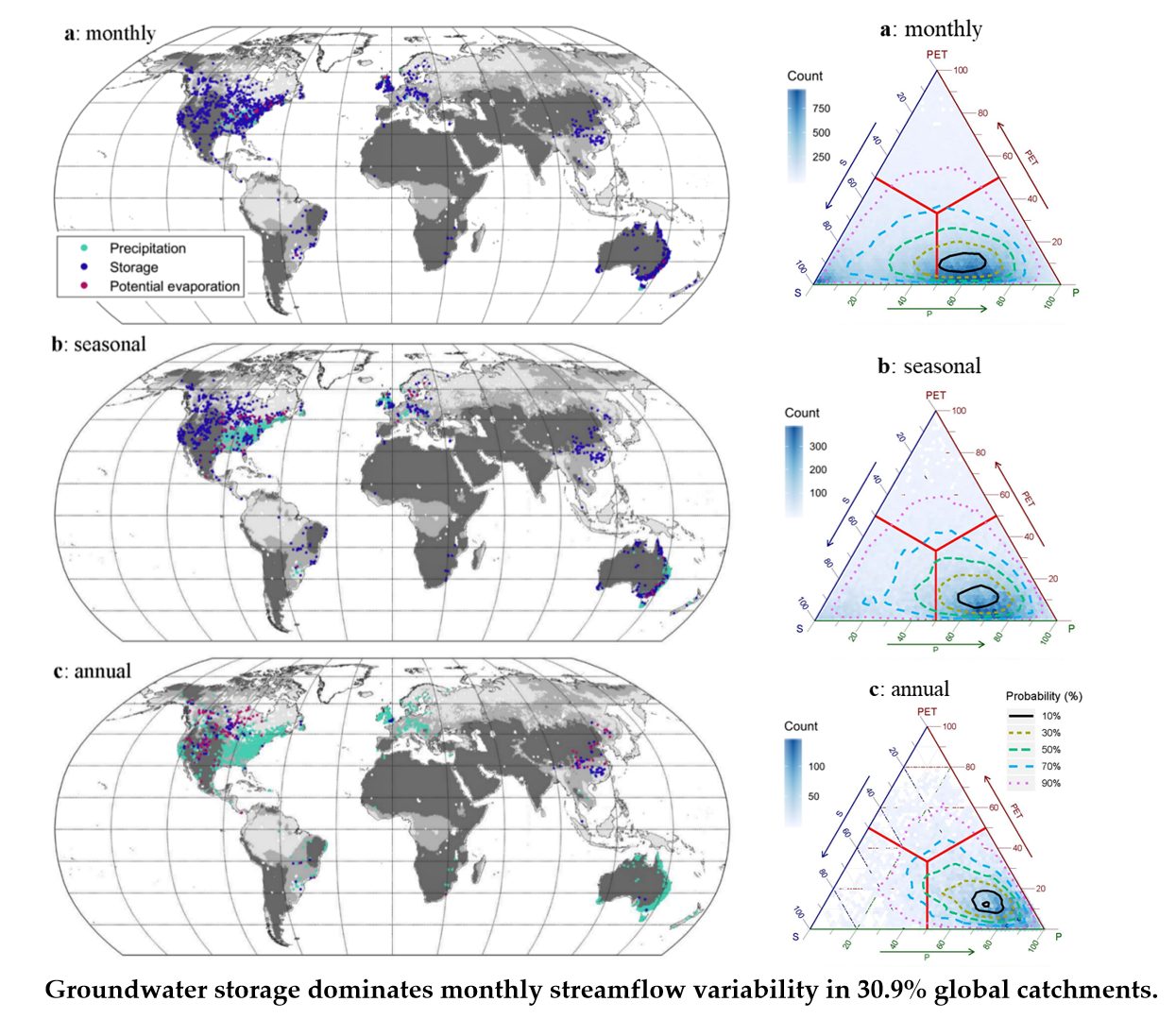
Keywords
streamflow | groundwater | storage | subannual variability | catchment
References
- 1.Berghuijs, W.R.; Woods, R.A.; Hrachowitz, M.; et al. A precipitation shift from snow towards rain leads to a decrease in streamflow. Nat. Clim. Chang. 2014, 4, 583–586.
- 2.Blöschl, G.; Hall, J.; Parajka, J.; et al. Changing climate shifts timing of European floods. Science 2017, 357, 588–590.
- 3.Haddeland, I.; et al. Global water resources affected by human interventions and climate change. Proc. Natl. Acad. Sci. USA 2014, 111, 3251–3256.
- 4.Mekonnen, M.M.; Hoekstra, A.Y. Four billion people facing severe water scarcity. Sci. Adv. 2016, 2, e1500323.
- 5.Milly, P.C.D.; Betancourt, J.; Falkenmark, M.; et al. Climate change - Stationarity is dead: Whither water management? Science 2008, 319, 573–574.
- 6.Munoz, S.E.; Giosan, L.; Therrell, M.D.; et al. Climatic control of Mississippi River flood hazard amplified by river engineering. Nature 2018, 556, 95–98.
- 7.Zhang, Y.; Li, C.; Chiew, F.H.S.; et al. Southern Hemisphere dominates recent decline in global water availability. Science 2023, 382, 579–584.
- 8.Griggs, D.; Stafford-Smith, M.; Gaffney, O.; et al. Sustainable development goals for people and planet. Nature 2013, 495, 305.
- 9.Arheimer, B.; Donnelly, C.; Lindstrom, G.; et al. Regulation of snow-fed rivers affects flow regimes more than climate change. Nat. Commun. 2017, 8, 62.
- 10.Dai, A.G. Increasing drought under global warming in observations and models. Nat. Clim. Chang. 2013, 3, 52–58.
- 11.Milly, P.C.D.; Dunne, K.A.; Vecchia, A.V.; et al. Global pattern of trends in streamflow and water availability in a changing climate. Nature 2005, 438, 347–350.
- 12.Stocker, B.D.D.; Tumber-Davila, S.J.; Konings, A.G.G.; et al. Global patterns of water storage in the rooting zones of vegetation. Nat. Geosci. 2023, 16, 250–256.
- 13.Zhou, G.; Wei, X.; Chen, X.; et al. Global pattern for the effect of climate and land cover on water yield. Nat. Commun. 2015, 6, 5918. https://doi.org/10.1038/ncomms6918.
- 14.Ahlstrom, A.; Canadell, J.G.; Schurgers, G.; et al. Hydrologic resilience and Amazon productivity. Nat. Commun. 2017, 8, 387.
- 15.Botter, G.; Basso, S.; Rodriguez-Iturbe, I.; et al. Resilience of river flow regimes. Proc. Natl. Acad. Sci. USA 2013, 110, 12925–12930.
- 16.Fu, G.; Charles, S.P.; Chiew, F.H.S.; et al. A two-parameter climate elasticity of streamflow index to assess climate change effects on annual streamflow. Water Resour. Res. 2007, 43, W11419. https://doi.org/10.1029/2007WR005890.
- 17.Sankarasubramanian, A.; Vogel, R.M.; Limbrunner, J.F.; et al. Climate elasticity of streamflow in the United States. Water Resour. Res. 2001, 37, 1771–1781.
- 18.Zheng, H.; Zhang, L.; Zhu, R.; et al. Responses of streamflow to climate and land surface change in the headwaters of the Yellow River Basin. Water Resour. Res. 2009, 45, W00A19. https://doi.org/10.1029/2007WR006665.
- 19.Ukkola, A.M.; Prentice, I.C.; Keenan, T.F.; et al. Reduced streamflow in water-stressed climates consistent with CO2 effects on vegetation. Nat. Clim. Chang. 2016, 6, 75–78.
- 20.Andermann, C.; Longuevergne, L.; Bonnet, S.; et al. Impact of transient groundwater storage on the discharge of Himalayan rivers. Nat. Geosci. 2012, 5, 127–132.
- 21.Berghuijs, W.R.; Hartmann, A.; Woods, R.A.; et al. Streamflow sensitivity to water storage changes across Europe. Geophys. Res. Lett. 2016, 43, 1980–1987.
- 22.Condon, L.E.; Maxwell, R.M. Simulating the sensitivity of evapotranspiration and streamflow to large-scale groundwater depletion. Sci. Adv. 2019, 5, eaav4574.
- 23.de Graaf, I.E.M.; Gleeson, T.; van Beek, L.P.H.; et al. Environmental flow limits to global groundwater pumping. Nature 2019, 574, 90–94.
- 24.Maxwell, R.M.; Condon, L.E. Connections between groundwater flow and transpiration partitioning. Science 2016, 353, 377–380.
- 25.Scanlon, B.R.; Levitt, D.G.; Reedy, R.C.; et al. Ecological controls on water-cycle response to climate variability in deserts. Proc. Natl. Acad. Sci. USA 2005, 102, 6033–6038.
- 26.Scanlon, B.R.; Zhang, Z.; Save, H.; et al. Global models underestimate large decadal declining and rising water storage trends relative to GRACE satellite data. Proc. Natl. Acad. Sci. USA 2018, 115, E1080–E1089.
- 27.Sheffield, J.; Goteti, G.; Wood, E.F.; et al. Development of a 50-year high-resolution global dataset of meteorological forcings for land surface modeling. J. Clim. 2006, 19, 3088–3111.
- 28.Schellekens, J.; Dutra, E.; Martínez-de La Torre, A.; et al. A global water resources ensemble of hydrological models: the eartH2Observe Tier-1 dataset. Earth Syst. Sci. Data 2017, 9, 389–413.
- 29.Priestley, C.; Taylor, R. On the assessment of surface heat flux and evaporation using large-scale parameters. Mon. Weather Rev. 1972, 100, 81–92.
- 30.Penman, H.L. Evaporation: an introductory survey. Neth. J. Agric. Sci. 1956, 4, 9–29.
- 31.Morton, F.I. Operational estimates of lake evaporation. J. Hydrol. 1983, 66, 77–100.
- 32.Beck, H.E.; van Dijk, A.I.J.M.; de Roo, A.; et al. Global-scale regionalization of hydrologic model parameters. Water Resour. Res. 2016, 52, 3599–3622.
- 33.Zhang, Y.; Peña-Arancibia, J.L.; McVicar, T.R.; et al. Multi-decadal trends in global terrestrial evapotranspiration and its components. Sci. Rep. 2016, 6, 19124. https://doi.org/10.1038/srep19124.
- 34.Falcone, J.A.; Carlisle, D.M.; Wolock, D.M.; et al. GAGES: A stream gage database for evaluating natural and altered flow conditions in the conterminous United States. Ecology 2010, 91, 621–621.
- 35.Lehner, B.; et al. High-resolution mapping of the world’s reservoirs and dams for sustainable river-flow management. Front. Ecol. Environ. 2011, 9, 494–502.
- 36.Beck, H.E.; Dijk, A.I.J.M.; Miralles, D.G.; et al. Global patterns in base flow index and recession based on streamflow observations from 3394 catchments. Water Resour. Res. 2013, 49, 7843–7863.
- 37.Chiew, F.H.S.; Peel, M.C.; Western, A.W.; et al. Mathematical Models of Small Watershed Hydrology and Applications; Singh, V.P., Frevert, D.K., Eds.; Water Resources Publication: St. John’s, NL, Canada, 2022; pp. 335–367.
- 38.Chapman, T. A comparison of algorithms for stream flow recession and baseflow separation. Hydrol. Process. 1999, 13, 701–714.
- 39.Van Dijk, A.I.J.M.; Peña-Arancibia, J.L.; Wood, E.F.; et al. Global analysis of seasonal streamflow predictability using an ensemble prediction system and observations from 6192 small catchments worldwide. Water Resour. Res. 2013, 49, 2729–2746.
- 40.Fenicia, F.; Savenije, H.H.G.; Matgen, P.; et al. Is the groundwater reservoir linear? Learning from data in hydrological modelling. Hydrol. Earth Syst. Sci. 2006, 10, 139–150.
- 41.Gustard, A.; Roald, L.A.; Demuth, S.; et al. Flow Regimes from Experimental and Network Data (FREND); Volume I: Hydrological Studies; IAHS Press: Wallingford, UK, 1989.
- 42.Lyne, V.; Hollick, M. Stochastic Time-Variable Rainfall-Runoff Modeling. Inst. Eng. Aust. Natl. Conf. 1979, 79, 89–93.
- 43.Boughton, W.C. A Hydrograph-Based Model for Estimating the Water Yield of Ungauged Catchments, Hydrology and Water Resources Symposium; IEAust: Newcastle, UK, 1993.
- 44.Eckhardt, K. How to construct recursive digital filters for baseflow separation. Hydrol. Process. 2005, 19, 507–515.
- 45.Nathan, R.J.; McMahon, T.A. Evaluation of automated techniques for base flow and recession analyses. Water Resour. Res. 1990, 26, 1465–1473.
- 46.Lindström, G.; Johansson, B.; Persson, M.; et al. Development and test of the distributed HBV-96 hydrological model. J. Hydrol. 1997, 201, 272–288.
- 47.Van Der Knijff, J.M.; Younis, J.; De Roo, A.P.J.; et al. LISFLOOD: A GIS-based distributed model for river basin scale water balance and flood simulation. Int. J. Geogr. Inf. Sci. 2010, 24, 189–212.
- 48.Sutanudjaja, E.H.; Van Beek, R.; Wanders, N.; et al. PCR-GLOBWB 2: A 5 arcmin global hydrological and water resources model. Geosci. Model Dev. 2018, 11, 2429–2453.
- 49.Decharme, B.; Alkama, R.; Douville, H.; et al. Global Evaluation of the ISBA-TRIP Continental Hydrological System. Part II: Uncertainties in River Routing Simulation Related to Flow Velocity and Groundwater Storage. J. Hydrometeorol. 2010, 11, 601–617.
- 50.Hamilton, N.E.; Ferry, M. ggtern: Ternary Diagrams Using ggplot2. J. Stat. Sofrware 2018, 87, 1–17. https://doi.org/10.18637/jss.v087.c03.
- 51.Buttle, J.M. Mediating stream baseflow response to climate change: The role of basin storage. Hydrol. Process. 2018, 32, 363–378.
- 52.Price, K. Effects of watershed topography, soils, land use, and climate on baseflow hydrology in humid regions: A review. Prog. Phys. Geogr. 2011, 35, 465–492.
- 53.Gudmundsson, L.; et al. Comparing Large-Scale Hydrological Model Simulations to Observed Runoff Percentiles in Europe. J. Hydrometeorol. 2011, 13, 604–620.
- 54.Humphrey, V.; Zscheischler, J.; Ciais, P.; et al. Sensitivity of atmospheric CO2 growth rate to observed changes in terrestrial water storage. Nature 2018, 560, 628–631.
- 55.Betts, R.A.; Boucher, O.; Collins, M.; et al. Projected increase in continental runoff due to plant responses to increasing carbon dioxide. Nature 2007, 448, 1037–1041.
- 56.Taylor, R.G.; Scanlon, B.; Döll, P.; et al. Ground water and climate change. Nat. Clim. Chang. 2013, 3, 322–329.
- 57.Reager, J.T.; Gardner, A.S.; Famiglietti, J.S.; et al. A decade of sea level rise slowed by climate-driven hydrology. Science 2016, 351, 699–703.
- 58.Rodell, M.; Famiglietti, J.S.; Wiese, D.N.; et al. Emerging trends in global freshwater availability. Nature 2018, 557, 650–658.
- 59.Zhang, L.; Dawes, W.R.; Walker, G.R.; et al. Response of mean annual evapotranspiration to vegetation changes at catchment scale. Water Resour. Res. 2001, 37, 701–708.
- 60.Huggins, X.; Gleeson, T.; Serrano, D.; et al. Overlooked risks and opportunities in groundwatersheds of the world’s protected areas. Nat. Sustain. 2023, 6, 855–864.
- 61.Mohan, C.; Gleeson, T.; Forstner, T.; et al. Quantifying Groundwater’s Contribution to Regional Environmental-Flows in Diverse Hydrologic Landscapes. Water Resour. Res. 2023, 59, e2022WR033153.
- 62.Xingxing Kuang et al. The changing nature of groundwater in the global water cycle. Science 2024, 383, eadf0630.
- 63.Bai, X.M.; Shi, P.J.; Liu, Y.S.; et al. Realizing China’s urban dream. Nature 2014, 509, 158–160.
- 64.Larsen, T.A.; Hoffmann, S.; Luthi, C.; et al. Emerging solutions to the water challenges of an urbanizing world. Science 2016, 352, 928–933.
- 65.Song, X.P.; Hansen, M.C.; Stehman, S.V.; et al. Global land change from 1982 to 2016. Nature 2018, 560, 639–643.
- 66.Good, S.P.; Noone, D.; Bowen, G.; et al. Hydrologic connectivity constrains partitioning of global terrestrial water fluxes. Science 2015, 349, 175–177.
- 67.Remesan, R.; Bellerby, T.; Holman, I.; et al. WRF model sensitivity to choice of parameterization: a study of the ‘York Flood 1999’. Theor. Appl. Climatol. 2015, 122, 229–247.

How to Cite
Zhang, Y.; Zheng, H.; Liu, C.; Leung, L. R.; Zheng, C.; Kong, D.; Blöschl, G. Groundwater Storage as a Key Driver of Subannual Streamflow Variability. Hydrology and Water Resources 2026, 1 (1), 2. https://doi.org/10.53941/hwr.2026.100002.
RIS
BibTex
Copyright & License

Copyright (c) 2025 by the authors.
This work is licensed under a Creative Commons Attribution 4.0 International License.
Article Metrics
1,189
Article Views
1
Citations
Contents
References
