
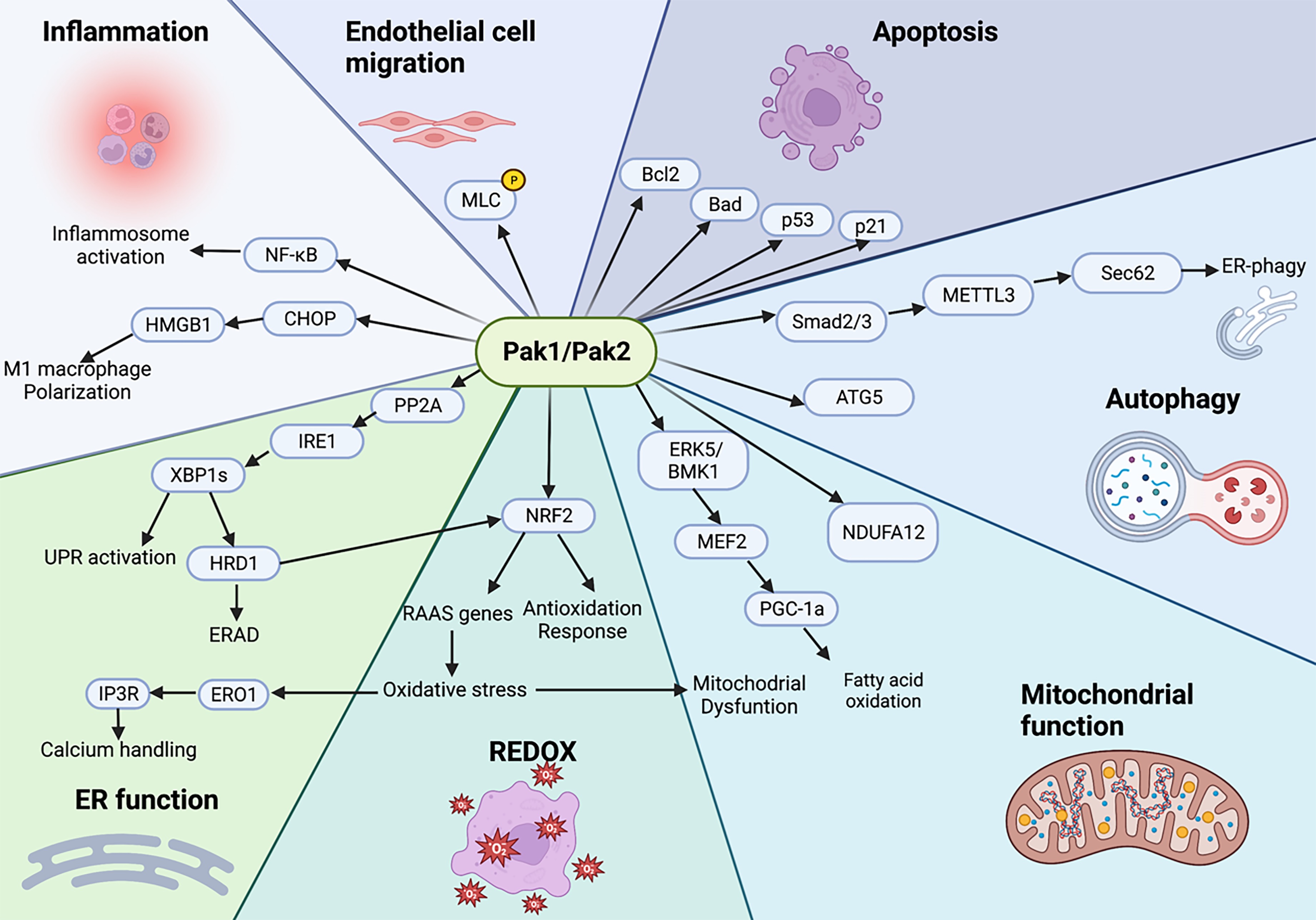
Group I p21-activated kinases (Paks) are members of the serine/threonine protein kinase family. Paks are encoded by three genes (Pak 1‒3) and are involved in the regulation of various biological processes. Pak1 and Pak2 are key members, sharing 91% sequence identity in their kinase domains. Recent studies have shown that Pak1/2 protect the heart from various types of stresses. Activated Pak1/2 participate in the maintenance of cellular homeostasis and metabolism, thus enhancing the adaptation and resilience of cardiomyocytes to stress. The structure, activation and function of Pak1/2 as well as their protective roles against the occurrence of cardiovascular disease are described in this review. The values of Pak1/2 as therapeutic targets are also discussed.
- Open Access
- Review
The P21-Activated Kinase 1 and 2 As Potential Therapeutic Targets for the Management of Cardiovascular Disease
- Honglin Xu,
- Dingwei Wang,
- Chiara Ramponi,
- Xin Wang,
- Hongyuan Zhang *
Author Information
Received: 20 Oct 2022 | Accepted: 16 Nov 2022 | Published: 21 Dec 2022
Abstract
Graphical Abstract
References
- 1.Manser E.; Leung T.; Salihuddin H.; et al. A brain serine/threonine protein kinase activated by Cdc42 and Rac1. Nature, 1994, 367(6458): 40-46.
- 2.Abo A.; Qu J.; Cammarano M.S.; et al. PAK4, a novel effector for Cdc42Hs, is implicated in the reorganization of the actin cytoskeleton and in the formation of filopodia. EMBO J., 1998, 17(22): 6527-6540.
- 3.Dan C.; Nath N.; Liberto M.; et al. PAK5, a new brain-specific kinase, promotes neurite outgrowth in N1E-115 cells. Mol. Cell. Biol., 2002, 22(2): 567-577.
- 4.Yang F.; Li X.; Sharma M.; et al. Androgen receptor specifically interacts with a novel p21-activated kinase, PAK6. J. Biol. Chem., 2001, 276(18): 15345-15353.
- 5.Sells M.A.; Chernoff J. Emerging from the Pak: the p21-activated protein kinase family. Trends Cell Biol., 1997, 7(4): 162-167.
- 6.Liu W.; Zi M.; Naumann R.; et al. Pak1 as a novel therapeutic target for antihypertrophic treatment in the heart. Circulation, 2011, 124(24): 2702-2715.
- 7.Binder P.; Wang S.; Radu M.; et al. Pak2 as a novel therapeutic target for cardioprotective endoplasmic reticulum stress response. Circ. Res., 2019, 124(5): 696-711.
- 8.Jaffer Z.M.; Chernoff J. p21-activated kinases: three more join the Pak. International Journal of Biochemistry & Cell Biology, 2002, 34(7): 713-717.
- 9.Manser E.; Chong C.; Zhao Z.S.; et al. Molecular cloning of a new member of the p21-Cdc42/Rac-activated kinase(PAK)family. J. Biol. Chem., 1995, 270(42): 25070-25078.
- 10.Jakobi R.; Chen C.J.; Tuazon PT.; et al. Molecular cloning and sequencing of the cytostatic G protein-activated protein kinase PAK I. J. Biol. Chem., 1996, 271(11): 6206-6211.
- 11.Rennefahrt U.E.; Deacon S.W.; Parker S.A.; et al. Specificity profiling of Pak kinases allows identification of novel phosphorylation sites. J. Biol. Chem., 2007, 282(21): 15667-15678.
- 12.Manser E.; Loo T.H.; Koh C.G.; et al. PAK kinases are directly coupled to the PIX family of nucleotide exchange factors. Molecular Cell, 1998, 1(2): 183-192.
- 13.Chou M.M.; Hanafusa H. A novel ligand for SH3 domains. The Nck adaptor protein binds to a serine/threonine kinase via an SH3 domain. J. Biol. Chem., 1995, 270(13): 7359-7364.
- 14.Lei M.; Lu W.; Meng W.; et al. Structure of PAK1 in an autoinhibited conformation reveals a multistage activation switch. Cell, 2000, 102(3): 387-397.
- 15.Wang J.; Wu J.W.; Wang Z.X. Mechanistic studies of the autoactivation of PAK2: a two-step model of cis initiation followed by trans amplification. J. Biol. Chem., 2011, 286(4): 2689-2695.
- 16.Bokoch G.M. Regulation of cell function by Rho family GTPases. Immunology Research, 2000, 21(2/3):139-148.
- 17.Kumar R.; Gururaj A.E.; Barnes C.J. p21-activated kinases in cancer. Nat. Rev. Cancer, 2006, 6(6): 459-471.
- 18.Ohori S.; Mitsuhashi S.; Ben-Haim R.; et al. A novel PAK1 variant causative of neurodevelopmental disorder with postnatal macrocephaly. J. Hum. Genet., 2020, 65(5): 481-485.
- 19.Bokoch G.M.; Reilly A.M.; Daniels R.H.; et al. A GTPase-independent mechanism of p21-activated kinase activation. Regulation by sphingosine and other biologically active lipids. J. Biol. Chem., 1998, 273(14): 8137-8144.
- 20.Bokoch G.M.; Wang Y.; Bohl B.P.; et al. Interaction of the Nck adapter protein with p21-activated kinase(PAK1). J. Biol. Chem., 1996, 271(42): 25746-25749.
- 21.Li W.; Hu P.; Skolnik E.Y.; et al. The SH2 and SH3 domain-containing Nck protein is oncogenic and a common target for phosphorylation by different surface receptors. Mol. Cell. Biol., 1992, 12(12): 5824-5833.
- 22.Cargnello M.; Roux P.P. Activation and function of the MAPKs and their substrates, the MAPK-activated protein kinases. Microbiol. Mol. Biol. Rev., 2011, 75(1): 50-83.
- 23.Tang Y.; Chen Z.; Ambrose D.; et al. Kinase-deficient Pak1 mutants inhibit Ras transformation of Rat-1 fibroblasts. Mol. Cell. Biol., 1997, 17(8): 4454-4464.
- 24.Herskowitz I. MAP kinase pathways in yeast: for mating and more. Cell, 1995, 80(2): 187-197.
- 25.Zhang S.; Han J.; Sells MA.; et al. Rho family GTPases regulate p38 mitogen-activated protein kinase through the downstream mediator Pak1. J. Biol. Chem., 1995, 270(41): 23934-23936.
- 26.Beeser A.; Jaffer Z.M.; Hofmann C.; et al. Role of group A p21-activated kinases in activation of extracellular-regulated kinase by growth factors. J. Biol. Chem., 2005, 280(44): 36609-36615.
- 27.Li F.; Adam L.; Vadlamudi R.K.; et al. p21-activated kinase 1 interacts with and phosphorylates histone H3 in breast cancer cells. EMBO Rep., 2002, 3(8): 767-773.
- 28.Zhao Z.S.; Lim J.P.; Ng Y.W.; et al. The GIT-associated kinase PAK targets to the centrosome and regulates Aurora-A. Molecular Cell, 2005, 20(2): 237-249.
- 29.Frost J.A.; Swantek J.L.; Stippec S.; et al. Stimulation of NFkappa B activity by multiple signaling pathways requires PAK1. J. Biol. Chem., 2000, 275(26): 19693-19699.
- 30.Feng X.; Zhang H.; Meng L.; et al. Hypoxia-induced acetylation of PAK1 enhances autophagy and promotes brain tumorigenesis via phosphorylating ATG5. Autophagy, 2021. 17(3): 723-742.
- 31.Jin S.; Zhuo Y.; Guo W.; et al. p21-activated kinase 1 (Pak1)-dependent phosphorylation of Raf-1 regulates its mitochondrial localization, phosphorylation of BAD, and Bcl-2 association. J. Biol. Chem., 2005, 280(26): 24698-24705.
- 32.Schürmann A.; Mooney A.F.; Sanders L.C.; et al. p21-activated kinase 1 phosphorylates the death agonist bad and protects cells from apoptosis. Mol. Cell. Biol., 2000, 20(2): 453-461.
- 33.Zhang Z.L.; Liu G.C.; Peng L.; et al . Effect of PAK1 gene silencing on proliferation and apoptosis in hepatocellular carcinoma cell lines MHCC97-H and HepG2 and cells in xenograft tumor. Gene Ther., 2018, 24(4): 284-296.
- 34.Ahn M.; Oh E.; McCown E.M.; et al. A requirement for PAK1 to support mitochondrial function and maintain cellular redox balance via electron transport chain proteins to prevent beta-cell apoptosis. Metabolism, 2021, 115: 154431.
- 35.King H.; Nicholas N.S.; Wells C.M. Role of p-21-activated kinases in cancer progression. Int. Rev. Cell Mol. Biol., 2014, 309: 347-387.
- 36.Hsu R.M.; Tsai M.H.; Hsieh Y.J.; et al. Identification of MYO18A as a novel interacting partner of the PAK2/betaPIX/GIT1 complex and its potential function in modulating epithelial cell migration. Mol. Biol. Cell, 2010, 21(2): 287-301.
- 37.Ling J.; Corneillie S.; Cottell C.; et al. Activation of PAK2 by serum starvation sensitizes its response to insulin treatment in adipocyte 3T3-L1 cells. Biochem. Anal. Biochem., 2016, 5(2): 1000277.
- 38.Roig J.; Traugh J.A. p21-activated protein kinase gamma-PAK is activated by ionizing radiation and other DNA-damaging agents. J. Biol. Chem., 1999, 274(44): 31119-31122.
- 39.Roig J.; Huang Z.; Lytle C.; et al. p21-activated protein kinase gamma-PAK is translocated and activated in response to hyperosmolarity. Implication of Cdc42 and phosphoinositide 3-kinase in a two-step mechanism for gamma-PAK activation. J. Biol. Chem., 2000, 275(22): 16933-16940.
- 40.Huang J.; Huang A.; Poplawski A.; et al. PAK2 activated by Cdc42 and caspase 3 mediates different cellular responses to oxidative stress-induced apoptosis. Biochim. Biophys. Acta, Mol. Cell Res., 2020, 1867(4): 118645.
- 41.Jakobi R.; Moertl E.; Koeppel M.A. p21-activated protein kinase gamma-PAK suppresses programmed cell death of BALB3T3 fibroblasts. J. Biol. Chem., 2001, 276(20): 16624-16634.
- 42.Eron S.J.; Raghupathi K.; Hardy J.A. Dual site phosphorylation of caspase-7 by PAK2 blocks apoptotic activity by two distinct mechanisms. Structure, 2017, 25(1): 27-39.
- 43.Walter B.N.; Huang Z.; Jakobi R.; et al. Cleavage and activation of p21-activated protein kinase gamma-PAK by CPP32(caspase 3). Effects of autophosphorylation on activity. J. Biol. Chem., 1998, 273(44): 28733-28739.
- 44.Van Eyk J.E.; Arrell D.K.; Foster D.B.; et al. Different molecular mechanisms for Rho family GTPase-dependent, Ca2+-independent contraction of smooth muscle. J. Biol. Chem., 1998, 273(36): 23433-23439.
- 45.Dechert M.A.; Holder J.M.; Gerthoffer W.T. p21-activated kinase 1 participates in tracheal smooth muscle cell migration by signaling to p38 Mapk. Am. J. Physiol., 2001, 281(1): C123-C132.
- 46.Goeckeler Z.M.; Masaracchia R.A.; Zeng Q.; et al. Phosphorylation of myosin light chain kinase by p21-activated kinase PAK2. J. Biol. Chem., 2000, 275(24): 18366-18374.
- 47.Zhang W.; Huang Y.; Gunst S.J. p21-Activated kinase (Pak) regulates airway smooth muscle contraction by regulating paxillin complexes that mediate actin polymerization. Journal of physiology, 2016, 594(17): 4879-4900.
- 48.Chew T.L.; Masaracchia R.A.; Goeckeler Z.M.; et al. Phosphorylation of non-muscle myosin II regulatory light chain by p21-activated kinase(gamma-PAK). J. Muscle Res. Cell Motil., 1998, 19(8): 839-854.
- 49.Varshney P.; Dey C.S. P21-activated kinase 2 (PAK2) regulates glucose uptake and insulin sensitivity in neuronal cells. Mol. Cell. Endocrinol., 2016, 429: 50-61.
- 50.Radu M.; Lyle K.; Hoeflich K.P.; et al. p21-Activated kinase 2 regulates endothelial development and function through the Bmk1/Erk5 pathway. Mol. Cell. Biol., 2015, 35(23): 3990-4005.
- 51.Liu W.; Ruiz-Velasco A.; Wang S.; et al. Metabolic stress-induced cardiomyopathy is caused by mitochondrial dysfunction due to attenuated Erk5 signaling. Nat. Commun., 2017, 8(1): 494.
- 52.Yan X.; Zhang J.; Sun Q.; et al. p21-Activated kinase 2(PAK2)inhibits TGF-beta signaling in Madin-Darby canine kidney(MDCK)epithelial cells by interfering with the receptor-Smad interaction. J. Biol. Chem., 2012, 287(17): 13705-13712.
- 53.Zeng C.; Huang W.; Li Y.; et al. Roles of METTL3 in cancer: mechanisms and therapeutic targeting. J. Hematol. Oncol., 2020, 13(1): 117.
- 54.Fumagalli F.; Noack J.; Bergmann T.J.; et al. Translocon component Sec62 acts in endoplasmic reticulum turnover during stress recovery. Nat. Cell Biol., 2016, 18(11): 1173-1184.
- 55.Kaur N.; Ruiz-Velasco A.; Raja R.; et al. Paracrine signal emanating from stressed cardiomyocytes aggravates inflammatory microenvironment in diabetic cardiomyopathy. iScience, 2022, 25(3): 103793.
- 56.Singh N.K.; Kotla S.; Dyukova E.; et al. Disruption of p21-activated kinase 1 gene diminishes atherosclerosis in apolipoprotein E-deficient mice. Nat. Commun., 2015, 6: 7450.
- 57.Cheng W.L.; Zhang Q.; Li B.; et al. PAK1 Silencing Attenuated Proinflammatory Macrophage Activation and Foam Cell Formation by Increasing PPARγ Expression. Oxid. Med. Cell. Longevity, 2021, 2021: 6957900.
- 58.Orr A.W.; Hahn C.; Blackman B.R.; et al. p21-activated kinase signaling regulates oxidant-dependent NF-kappa B activation by flow. Circ. Res., 2008, 103(6): 671-679.
- 59.Hahn C.; Orr A.W.; Sanders J.M.; et al. The subendothelial extracellular matrix modulates JNK activation by flow. Circ. Res., 2009, 104(8): 995-1003.
- 60.Jhaveri K.A.; Debnath P.; Chernoff J.; et al. The role of p21-activated kinase in the initiation of atherosclerosis. BMC Cardiovasc. Disord., 2012, 12: 55.
- 61.Taglieri D.M.; Ushio-Fukai M.; Monasky M.M. P21-activated kinase in inflammatory and cardiovascular disease. Cell. Signalling, 2014, 26(9): 2060-2069.
- 62.Violi F.; Basili S.; Nigro C.; et al. Role of NADPH oxidase in atherosclerosis. Future Cardiol., 2009, 5(1):83-92.
- 63.Wang R.; Wang Y.; Lin W.K.; et al. Inhibition of angiotensin II-induced cardiac hypertrophy and associated ventricular arrhythmias by a p21 activated kinase 1 bioactive peptide. PLoS One, 2014, 9(7): e101974.
- 64.Taglieri D.M.; Monasky M.M.; Knezevic I.; et al. Ablation of p21-activated kinase-1 in mice promotes isoproterenol-induced cardiac hypertrophy in association with activation of Erk1/2 and inhibition of protein phosphatase 2A. J. Mol. Cell. Cardiol., 2011, 51(6): 988-996.
- 65.Liu W.; Chen C.; Gu X.; et al. AM1241 alleviates myocardial ischemia-reperfusion injury in rats by enhancing Pink1/Parkin-mediated autophagy. Life Sciences, 2021, 272:119228.
- 66.Murphy E.; Steenbergen C. Mechanisms underlying acute protection from cardiac ischemia-reperfusion injury. Physiol. Rev., 2008, 88(2): 581-609.
- 67.Egom E.E.; Ke Y.; Musa H.; et al. FTY720 prevents ischemia/reperfusion injury-associated arrhythmias in an ex vivo rat heart model via activation of Pak1/Akt signaling. J. Mol. Cell. Cardiol., 2010, 48(2): 406-414.
- 68.Hofmann U.; Burkard N.; Vogt C.; et al. Protective effects of sphingosine-1-phosphate receptor agonist treatment after myocardial ischaemia-reperfusion. Cardiovasc. Res., 2009, 83(2): 285-293.
- 69.Menard R.E.; Mattingly R.R. Cell surface receptors activate p21-activated kinase 1 via multiple Ras and PI3-kinase-dependent pathways. Cell. Signalling, 2003, 15(12): 1099-1109.
- 70.Monasky M.M.; Taglieri D.M.; Patel B.G.; et al. p21-activated kinase improves cardiac contractility during ischemia-reperfusion concomitant with changes in troponin-T and myosin light chain 2 phosphorylation. Am. J. Physiol.: Heart Circ. Physiol., 2012, 302(1): H224-H230.
- 71.Landstrom A.P.; Dobrev D.; Wehrens X.H.T. Calcium signaling and cardiac arrhythmias. Circ. Res., 2017, 120(12): 1969-1993.
- 72.Wang Y.; Wang S.; Lei M.; et al. The p21-activated kinase 1(Pak1)signalling pathway in cardiac disease:from mechanistic study to therapeutic exploration. Br. J. Pharmacol., 2018, 175(5): 1362-1374.
- 73.DeSantiago J.; Bare D.J.; Ke Y.; et al. Functional integrity of the T-tubular system in cardiomyocytes depends on p21-activated kinase 1. J. Mol. Cell. Cardiol., 2013, 60: 121-128.
- 74.Wang Y.; Tsui H.; Ke Y.; et al. Pak1 is required to maintain ventricular Ca(2)(+)homeostasis and electrophysiological stability through SERCA2a regulation in mice. Circ.: Arrhythmia Electrophysiol., 2014, 7(5): 938-948.
- 75.Ke Y.; Sheehan K.A.; Egom E.E.; et al. Novel bradykinin signaling in adult rat cardiac myocytes through activation of p21-activated kinase. Am. J. Physiol.: Heart Circ. Physiol., 2010, 298(4): H1283-H1289.
- 76.Sheehan K.A.; Ke Y.; Wolska B.M.; et al. Expression of active p21-activated kinase-1 induces Ca2+ flux modification with altered regulatory protein phosphorylation in cardiac myocytes. Am. J. Physiol.: Cell Physiol., 2009, 296(1): C47-C58.
- 77.DeSantiago J.; Bare D.J.; Xiao L.; et al. p21-Activated kinase1(Pak1)is a negative regulator of NADPH-oxidase 2 in ventricular myocytes. J. Mol. Cell. Cardiol., 2013, 67: 77-85.
- 78.DeSantiago J.; Bare D.J.; Varma D.; et al. Loss of p21-activated kinase 1(Pak1)promotes atrial arrhythmic activity. Heart Rhythm, 2018, 15(8): 1233-1241.
- 79.Yang B., Jiang Q., He S.; et al. Ventricular SK2 upregulation following angiotensin II challenge:Modulation by p21-activated kinase-1. J. Mol. Cell. Cardiol., 2022, 164: 110-125.
- 80.Lee C.H.; MacKinnon R. Activation mechanism of a human SK-calmodulin channel complex elucidated by cryo-EM structures. Science, 2018, 360(6388): 508-513.
- 81.Adelman J.P.; Maylie J.; Sah P. Small-conductance Ca2+-activated K+ channels: form and function. Annu. Rev. Physiol., 2012, 74: 245-269.
- 82.Terentyev D.; Rochira J.A.; Terentyeva R.; et al. Sarcoplasmic reticulum Ca(2)(+)release is both necessary and sufficient for SK channel activation in ventricular myocytes. Am. J. Physiol.: Heart Circ. Physiol., 2014, 306(5): H738-H746.
- 83.Binder P.; Nguyen B.; Collins L.; et al. Pak2 regulation of Nrf2 serves as a novel signaling nexus linking ER stress response and oxidative stress in the heart. Front. Cardiovasc. Med., 2022, 9: 851419.
- 84.Buchner D.A.; Su F.; Yamaoka J.S.; et al. pak2a mutations cause cerebral hemorrhage in redhead zebrafish. Proc. Natl. Acad. Sci. U. S. A., 2007, 104(35): 13996-14001.
- 85.Schwarz D.S.; Blower M.D. The endoplasmic reticulum: structure, function and response to cellular signaling. Cell. Mol. Life Sci., 2016, 73(1): 79-94.
- 86.Wang S.; Binder P.; Fang Q.; et al. Endoplasmic reticulum stress in the heart: insights into mechanisms and drug targets. Br. J. Pharmacol., 2018, 175(8): 1293-1304.
- 87.Ren J.; Bi Y.; Sowers J.R.; et al. Endoplasmic reticulum stress and unfolded protein response in cardiovascular diseases. Nat. Rev. Cardiol., 2021, 18(7): 499-521.
- 88.Wang S.; Bian W.; Zhen J.; et al. Melatonin-Mediated Pak2 activation reduces cardiomyocyte death through suppressing hypoxia reoxygenation Injury-Induced endoplasmic reticulum stress. J. Cardiovasc. Pharmacol., 2019, 74(1): 20-29.
- 89.Chen Q.M.; Maltagliati J.J. Nrf2 at the heart of oxidative stress and cardiac protection. Physiol. Genomics, 2018, 50(2): 77-97.
- 90.Kannan S.; Muthusamy V.R.; Whitehead K.J.; et al. Nrf2 deficiency prevents reductive stress-induced hypertrophic cardiomyopathy. Cardiovasc. Res., 2013, 100(1): 63-73.
- 91.Erkens R.; Suvorava T.; Sutton T.R.; et al. Nrf2 deficiency unmasks the significance of nitric oxide synthase activity for cardioprotection. Oxid. Med. Cell. Longevity, 2018, 2018:8309698.
- 92.Qin Q.; Qu C.; Niu T.; et al. Nrf2-Mediated cardiac maladaptive remodeling and dysfunction in a setting of autophagy insufficiency. Hypertension, 2016, 67(1): 107-117.
- 93.Lei M.; Wu L.; Terrar D.A.; et al. Modernized classification of cardiac antiarrhythmic drugs. Circulation, 2018, 138(17): 1879-1896.
- 94.Goparaju S.K.; Jolly P.S.; Watterson K.R.; et al. The S1P2 receptor negatively regulates platelet-derived growth factor-induced motility and proliferation. Mol. Cell. Biol., 2005, 25(10): 4237-4249.
- 95.Jin Z.Q.; Zhang J.; Huang Y.; et al. A sphingosine kinase 1 mutation sensitizes the myocardium to ischemia/reperfusion injury. Cardiovasc. Res., 2007, 76(1): 41-50.
- 96.Jin Z.Q.; Zhou H.Z.; Zhu P.; et al. Cardioprotection mediated by sphingosine-1-phosphate and ganglioside GM-1 in wild-type and PKC epsilon knockout mouse hearts. Am. J. Physiol.: Heart Circ. Physiol., 2002, 282(6): H1970-H1977.
- 97.Egom E.E.; Mohamed T.M.; Mamas M.A.; et al. Activation of Pak1/Akt/eNOS signaling following sphingosine-1-phosphate release as part of a mechanism protecting cardiomyocytes against ischemic cell injury. Am. J. Physiol.: Heart Circ. Physiol., 2011, 301(4): H1487-H1495.
- 98.Liu W.; Zi M.; Tsui H.; et al. A novel immunomodulator, FTY-720 reverses existing cardiac hypertrophy and fibrosis from pressure overload by targeting NFAT(nuclear factor of activated T-cells)signaling and periostin. Circ.: Heart Failure, 2013, 6(4): 833-844.
- 99.Peng X.; He Q.; Li G.; et al. Rac1-PAK2 pathway is essential for zebrafish heart regeneration. Biochem. Biophys. Res. Commun., 2016, 472(4): 637-642.
- 100.Wang J.; Liu S.; Heallen T.; et al. The hippo pathway in the heart: pivotal roles in development, disease, and regeneration. Nat. Rev. Cardiol., 2018, 15(11): 672-684.
- 101.Zhou Q.; Li L.; Zhao B.; et al. The hippo pathway in heart development, regeneration, and diseases. Circ. Res., 2015, 116(8): 1431-1447.
- 102.McMurray J.J.V.; Ponikowski P.; Bolli G.B.; et al. Effects of vildagliptin on ventricular function in patients with type 2 diabetes mellitus and heart failure: a randomized Placebo-Controlled trial. JACC. Heart Failure, 2018, 6(1): 8-17.
- 103.Gao C.; Ma T.; Pang L.; et al. Activation of P21-activated protein kinase 2 is an Independent prognostic predictor for patients with gastric cancer. Diagn. Pathol., 2014, 9: 55.
- 104.Radu M.; Semenova G.; Kosoff R.; et al. PAK signalling during the development and progression of cancer. Nat. Rev. Cancer, 2014, 14(1): 13-25.
- 105.Flate E.; Stalvey J.R. Motility of select ovarian cancer cell lines: effect of extra-cellular matrix proteins and the involvement of PAK2. Int. J. Oncol., 2014, 45(4): 1401-1411.
- 106.Park J.; Kim J.M.; Park JK.; et al. Association of p21-activated kinase-1 activity with aggressive tumor behavior and poor prognosis of head and neck cancer. Head and Neck, 2015, 37(7): 953-963.
- 107.Hao S.; Luo C.; Abukiwan A.; et al. miR-137 inhibits proliferation of melanoma cells by targeting PAK2. Exp. Dermatol., 2015, 24(12): 947-952.
- 108.Deng W.W.; Wu L.; Bu L.L.; et al. PAK2 promotes migration and proliferation of salivary gland adenoid cystic carcinoma. Am. J. Transl. Res., 2016, 8(8): 3387-3397.
- 109.Siu M.K.; Wong E.S.; Chan H.Y.; et al. Differential expression and phosphorylation of Pak1 and Pak2 in ovarian cancer: effects on prognosis and cell invasion. Int. J. Cancer, 2010, 127(1): 21-31.
How to Cite
Xu, H.; Wang, D.; Ramponi, C.; Wang, X.; Zhang, H. The P21-Activated Kinase 1 and 2 As Potential Therapeutic Targets for the Management of Cardiovascular Disease. International Journal of Drug Discovery and Pharmacology 2022, 1 (1), 5. https://doi.org/10.53941/ijddp.v1i1.179.
RIS
BibTex
Copyright & License

Honglin Xu, Dingwei Wang, Xin Wang, Hongyuan Zhang
This work is licensed under a Creative Commons Attribution 4.0 International License.
Article Metrics
193
Article Views
9
Citations
Contents
References

 Suite 4002 Level 4, 447 Collins Street, Melbourne, Victoria 3000, Australia
 General Inquiries: info@sciltp.com