
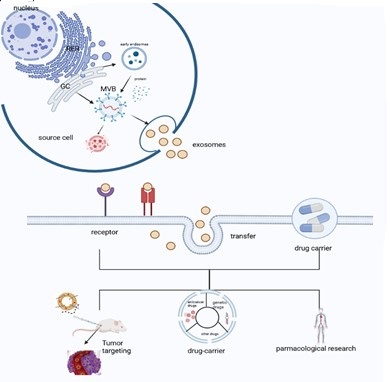
Exosomes have received increasing attention in recent years as an important substance for intercellular communication. Among the plethora of new research is their unique interaction with drugs is even more striking. Exosomes play essential roles in disease treatment either as extracellular vesicles to exert biological functions or as drug carriers to deliver therapeutic agents. We summarized the relationship between exosomes and drugs in the disease progression and treatment. Understanding how exosomes interact with drugs and exert their anti-inflammatory and pro-angiogenic effects, alongside a lipid peroxidation inhibitory result in different manners is essential for disease treatment.
- Open Access
- Review
Biological Functions and Applications of Exosomes in Drug Research
- Mengmeng Fu 1,
- Jiapeng Li 1,
- Tungalag Battulga 2,
- Xiaoxue Li 3, *,
- Ming Xu 1, *
Author Information
Received: 09 Oct 2022 | Accepted: 12 Nov 2022 | Published: 11 Jan 2023
Abstract
Graphical Abstract
Keywords
References
- 1.Min Y.Z.; Caster J.M.; Eblan M.J.; et al. Clinical translation of nanomedicine. Chem. Rev., 2015, 115(19): 11147-11190.
- 2.Théry C.; Zitvogel L.; Amigorena S. Exosomes: composition, biogenesis and function. Nat. Rev. Immunol., 2002, 2(8): 569-579.
- 3.Syn N.L.; Wang L.Z.; Chow E.K.H.; et al. Exosomes in cancer nanomedicine and immunotherapy: prospects and challenges. Trends Biotechnol., 2017, 35(7): 665-676.
- 4.Shao H.L.; Im H.; Castro C.M.; et al. New technologies for analysis of extracellular vesicles. Chem. Rev., 2018, 118(4): 1917-1950.
- 5.Lindenbergh M.F.S.; Stoorvogel W. Antigen presentation by extracellular vesicles from professional antigen-presenting cells. Annu. Rev. Immunol., 2018, 36: 435-459.
- 6.Pegtel D.M.; Gould S.J. . Exosomes. Annu. Rev. Biochem.,2019, 88: 487-514.
- 7.Anderson H.C. Vesicles associated with calcification in the matrix of epiphyseal cartilage. J. Cell Biol., 1969, 41(1): 59-72.
- 8.Li Y.Z.; Wan S.M.; Liu G.; et al. Netrin-1 promotes inflammation resolution to achieve endothelialization of small-diameter tissue engineering blood vessels by improving endothelial progenitor cells function in situ. Adv. Sci. (Weinheim, Ger.), 2017, 4(12): 1700278.
- 9.Li M.Y.; Liu L.Z.; Dong M. Progress on pivotal role and application of exosome in lung cancer carcinogenesis, diagnosis, therapy and prognosis. Mol. Cancer, 2021, 20(1): 22.
- 10.Zhu L.Y.; Kalimuthu S.; Gangadaran P.; et al. Exosomes derived from natural killer cells exert therapeutic effect in melanoma. Theranostics, 2017, 7(10): 2732-2745.
- 11.Zhou Y.; Li P.F.; Goodwin A.J.; et al. Exosomes from endothelial progenitor cells improve outcomes of the lipopolysaccharide-induced acute lung injury. Crit. Care, 2019, 23(1): 44.
- 12.Li Y.C.; Wang J.J.; Chen S.Z.; et al. miR-137 boosts the neuroprotective effect of endothelial progenitor cell-derived exosomes in oxyhemoglobin-treated SH-SY5Y cells partially via COX2/PGE2 pathway. Stem Cell Res. Ther., 2020, 11(1): 330.
- 13.Hu H.; Wang B.S.; Jiang C.Y.; et al. Endothelial progenitor cell-derived exosomes facilitate vascular endothelial cell repair through shuttling miR-21-5p to modulate Thrombospondin-1 expression. Clin. Sci., 2019, 133(14): 1629-1644.
- 14.Zhang C.; Wang J.J.; Ma X.T.; et al. ACE2-EPC-EXs protect ageing ECs against hypoxia/reoxygenation-induced injury through the miR-18a/Nox2/ROS pathway. J. Cell. Mol. Med., 2018, 22(3): 1873-1882.
- 15.Cui Y.G.; Fu S.L.; Sun D.; et al. EPC-derived exosomes promote osteoclastogenesis through LncRNA-MALAT1. J. Cell. Mol. Med., 2019, 23(6): 3843-3854.
- 16.Sun C.K.; Chen C.H.; Chang C.L.; et al. Melatonin treatment enhances therapeutic effects of exosomes against acute liver ischemia-reperfusion injury. Am. J. Transl. Res., 2017, 9(4): 1543-1560.
- 17.Xing C.H.; Arai K.; Lo E.H.; et al. Pathophysiologic cascades in ischemic stroke. Inter. J. Stro., 2012, 7(5): 378-385.
- 18.Gutiérrez M.; Merino J.J.; Alonso De Leciñana M.; et al. Cerebral protection, brain repair, plasticity and cell therapy in ischemic stroke. Cerebrovasc. Dis., 2009, 27(Suppl 1): 177-186.
- 19.Tian Y.H.; Li S.P.; Song J.; et al. A doxorubicin delivery platform using engineered natural membrane vesicle exosomes for targeted tumor therapy. Biomaterials, 2014, 35(7): 2383-2390.
- 20.Lathwal S.; Yerneni S.S.; Boye S.; et al. Engineering exosome polymer hybrids by atom transfer radical polymerization. Proc. Natl. Acad. Sci. U. S. A., 2021, 118(2): e2020241118.
- 21.Ma L.Y.; Shan Y.; Bai R.; et al. A therapeutically targetable mechanism of BCR-ABL-independent imatinib resistance in chronic myeloid leukemia. Sci. Transl. Med., 2014, 6(252): 252ra121.
- 22.Bellavia D.; Raimondo S.; Calabrese G.; et al. Interleukin 3-receptor targeted exosomes inhibit in vitro and in vivo Chronic Myelogenous Leukemia cell growth. Theranostics, 2017, 7(5): 1333-1345.
- 23.Shtam T.A.; Kovalev R.A.; Varfolomeeva E.Y.; et al. Exosomes are natural carriers of exogenous siRNA to human cells in vitro. Cell Commun. Signaling, 2013, 11: 88.
- 24.Liu Y.C.; Zhao L.M.; Li D.M.; et al. Microvesicle-delivery miR-150 promotes tumorigenesis by up-regulating VEGF, and the neutralization of miR-150 attenuate tumor development. Protein Cell, 2013, 4(12): 932-941.
- 25.Alvarez-Erviti L.; Seow Y.; Yin H.F.; et al. Delivery of siRNA to the mouse brain by systemic injection of targeted exosomes. Nat. Biotechnol., 2011, 29(4): 341-345.
- 26.Lv L.H.; Wan Y.L.; Lin Y.; et al. Anticancer drugs cause release of exosomes with heat shock proteins from human hepatocellular carcinoma cells that elicit effective natural killer cell antitumor responses in vitro. J. Biol. Chem., 2012,287(19): 15874-15885.
- 27.Paradee N.; Utama-Ang N.; Uthaipibull C.; et al. Extracts of Thai perilla frutescens nutlets attenuate tumour necrosis factor-α-activated generation of microparticles, ICAM-1 and IL-6 in human endothelial cells. Biosci. Rep., 2020, 40(5): BSR20192110.
- 28.Crenshaw B.J.; Kumar S.; Bell C.R.; et al. Alcohol modulates the biogenesis and composition of microglia-derived exosomes. Biology, 2019, 8(2): 25.
- 29.Ibáñez F.; Montesinos J.; Ureña-Peralta J.R.; et al. TLR4 participates in the transmission of ethanol-induced neuroinflammation via astrocyte-derived extracellular vesicles. J. Neuroinflammation, 2019, 16(1): 136.
- 30.Datta A.; Kim H.; Lal M.; et al. Manumycin A suppresses exosome biogenesis and secretion via targeted inhibition of Ras/Raf/ERK1/2 signaling and hnRNPH1 in castration-resistant prostate cancer cells. Cancer Lett., 2017, 408: 73-81.
How to Cite
Fu, M.; Li, J.; Battulga, T.; Li, X.; Xu, M. Biological Functions and Applications of Exosomes in Drug Research. International Journal of Drug Discovery and Pharmacology 2023, 2 (1), 85–90. https://doi.org/10.53941/ijddp.0201008.
RIS
BibTex
Copyright & License

Mengmeng Fu, Jiapeng Li, Tungalag Battulga, Xiaoxue Li, Ming Xu
This work is licensed under a Creative Commons Attribution 4.0 International License.
Article Metrics
106
Article Views
1
Citations
Contents
References
