
2609005180
  • Open Access
  • Article

Direct Field Observation of Aggressive Behavior by a Rabid Big Brown Bat (Eptesicus fuscus) toward a Conspecific in Northern Arizona

  • Carol L. Chambers 1,*,   
  • José G. Martínez-Fonseca 1,   
  • David L. Bergman 2

Received: 05 Jun 2026 | Revised: 11 Sep 2026 | Accepted: 15 Sep 2026 | Published: 23 Sep 2026

Abstract

Although aggressive behavior is a recognized manifestation of furious rabies, direct observations of aggressive interactions among free-ranging bats are uncommon because bats are nocturnal, highly mobile, and difficult to observe continuously. We report a direct observation of agonistic behavior by a male big brown bat (Eptesicus fuscus) towards another big brown bat during daylight hours on 30 June 2009 in northern Arizona, USA. The aggressive bat vocalized audibly while flying, then chased and attacked another big brown bat, attaching to the non-aggressive bat and maintaining a bite to its lower jaw during the interaction. The bats landed on the bole of a ponderosa pine tree (Pinus ponderosa), after which both bats fell to the ground. The attacking bat remained grounded and was captured and euthanized because of its unusual behavior and inability to fly. Brain tissue from this bat subsequently tested positive for rabies virus antigen using direct fluorescent antibody (dFA) testing. The event occurred during the maternity period and at a water source supporting high numbers of bats, conditions that can increase contact rates among individuals. This observation documents prolonged aggressive biting between two free-ranging big brown bats, one of which was laboratory-confirmed rabid, and illustrates how concentrated resources may provide opportunities for contact and rabies transmission. These observations suggest that seasonal aggregation and resource concentration may influence opportunities for rabies transmission and spillover in arid environments.
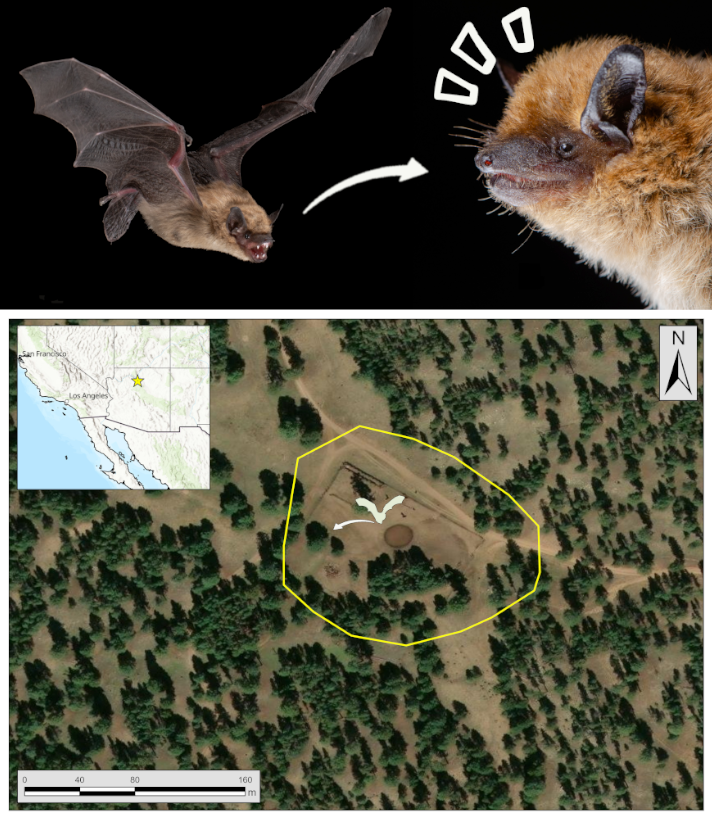
 

Graphical Abstract

References 

  • 1.

    Bonwitt, J.; Oltean, H.; Lang, M.; et al. Bat Rabies in Washington State: Temporal-Spatial Trends and Risk Factors for Zoonotic Transmission (2000–2017). PLoS ONE 2018, 13, e0205069. https://doi.org/10.1371/journal.pone.0205069.

  • 2.

    Rupprecht, C.E.; Hanlon, C.A.; Hemachudha, T. Rabies Re-Examined. Lancet Infect. Dis. 2002, 2, 327–343. https://doi.org/10.1016/s1473-3099(02)00287-6.

  • 3.

    Streicker, D.G.; Banyard, A.C.; Touzalin, F.; et al. Bat Rabies. In Rabies, 5th ed.; Academic Press: New York, NY, USA, 2025; pp. 283–330. https://doi.org/10.1016/b978-0-443-29979-7.00022-2.

  • 4.

    Wyatt, J. Rabies—Update on a Global Disease. Pediatr. Infect. Dis. J. 2007, 26, 351–352. https://doi.org/10.1097/01.inf.0000258776.47697.97.

  • 5.

    Calisher, C.; Childs, J.; Field, H.; et al. Bats: Important Reservoir Hosts of Emerging Viruses. Clin. Microbiol. Rev. 2006, 19, 531–545. https://doi.org/10.1128/cmr.00017-06.

  • 6.

    Fenton, M.B.; Jackson, A.C.; Faure, P.A. Bat Bites and Rabies: The Canadian Scene. FACETS 2020, 5, 367–380. https://doi.org/10.1139/facets-2019-0066.

  • 7.

    Hemachudha, T.; Laothamatas, J.; Rupprecht, C.E. Human Rabies: A Disease of Complex Neuropathogenetic Mechanisms and Diagnostic Challenges. Lancet Neurol. 2002, 1, 101–109. https://doi.org/10.1016/s1474-4422(02)00041-8.

  • 8.

    Johnson, N.; Aréchiga-Ceballos, N.; Aguilar-Setien, A. Vampire Bat Rabies: Ecology, Epidemiology and Control. Viruses 2014, 6, 1911–1928. https://doi.org/10.3390/v6051911.

  • 9.

    Velasco-Villa, A.; Orciari, L.; Juárez-Islas, V.; et al. Molecular Diversity of Rabies Viruses Associated with Bats in Mexico and Other Countries of the Americas. J. Clin. Microbiol. 2006, 44, 1697–1710. https://doi.org/10.1128/jcm.44.5.1697-1710.2006.

  • 10.

    Gilbert, A.T.; Van Pelt, L.I.; Hastings, L.A.; et al. Reemergence of a Big Brown Bat Lyssavirus Rabies Variant in Striped Skunks in Flagstaff, Arizona, USA, 2021–2023. Vector-Borne Zoonotic Dis. 2024, 24, 552–562. https://doi.org/10.1089/vbz.2023.0126.

  • 11.

    Fisher, C.R.; Streicker, D.G.; Schnell, M.J. The Spread and Evolution of Rabies Virus: Conquering New Frontiers. Nat. Rev. Microbiol. 2018, 16, 241–255. https://doi.org/10.1038/nrmicro.2018.11.

  • 12.

    Jackson, A.C. Human Rabies: A 2016 Update. Curr. Infect. Dis. Rep. 2016, 18, 38. https://doi.org/10.1007/s11908-016-0540-y.

  • 13.

    Banyard, A.C.; Davis, A.; Gilbert, A.T.; et al. Bat Rabies. In Rabies, 4th ed.; Academic Press: New York, NY, USA, 2020; pp. 231–276. https://doi.org/10.1016/b978-0-12-818705-0.00007-8.

  • 14.

    Scott, T.P.; Nel, L.H. Lyssaviruses and the Fatal Encephalitic Disease Rabies. Front. Immunol. 2021, 12, 786953. https://doi.org/10.3389/fimmu.2021.786953.

  • 15.

    Fooks, A.R.; Jackson, A.C. Rabies: Scientific Basis of the Disease and Its Management, 4th ed.; Academic Press: New York, NY, USA, 2020.

  • 16.

    Abbott, R.C.; Saindon, L.; Falendysz, E.A.; et al. Rabies Outbreak in Captive Big Brown Bats (Eptesicus fuscus) Used in a White-Nose Syndrome Vaccine Trial. J. Wildl. Dis. 2020, 56, 197–202. https://doi.org/10.7589/2018-10-258.

  • 17.

    Shankar, V.; Bowen, R.A.; Davis, A.D.; et al. Rabies in a Captive Colony of Big Brown Bats (Eptesicus fuscus). J. Wildl. Dis. 2004, 40, 403–413. https://doi.org/10.7589/0090-3558-40.3.403.

  • 18.

    Jackson, F.R.; Turmelle, A.S.; Farino, D.M.; et al. Experimental Rabies Virus Infection of Big Brown Bats (Eptesicus fuscus). J. Wildl. Dis. 2008, 44, 612–621. https://doi.org/10.7589/0090-3558-44.3.612.

  • 19.

    Cárdenas-Canales, E.M.; Stockmaier, S.; Cronin, E.; et al. Social Effects of Rabies Infection in Male Vampire Bats (Desmodus rotundus). Biol. Lett. 2022, 18, 20220298. https://doi.org/10.1098/rsbl.2022.0298.

  • 20.

    Sasse, D.B.; Weinstein, S.; Saugey, D.A. Interspecific Aggression by a Rabid Eastern Red Bat (Lasiurus borealis). J. Wildl. Dis. 2014, 50, 694–695. https://doi.org/10.7589/2013-06-131.

  • 21.

    Bell, G.P. A Possible Case of Interspecific Transmission of Rabies in Insectivorous Bats. J. Mammal. 1980, 61, 528–530. https://doi.org/10.2307/1379846.

  • 22.

    Brokaw, A.F.; Clerc, J.; Weller, T.J. Another Account of Interspecific Aggression Involving a Hoary Bat (Lasiurus cinereus). Northwestern Nat. 2016, 97, 130–134. https://doi.org/10.1898/nwn15-27.1.

  • 23.

    Krynak, T.; Riebe, J. An Apparent Attack on a Tricolored Bat (Perimyotis subflavus) by a Hoary Bat (Lasiurus cinereus) in Northern Ohio. Bat Res. News 2013, 54, 1–2.

  • 24.

    Ore, R.T. Unusual Behavior and Occurrence of a Hoary Bat. J. Mammal. 1950, 31, 456–457. https://doi.org/10.1093/jmammal/31.4.456.

  • 25.

    Wine, M.; Bowen, C.A.; Green, D.M. Interspecific Aggression between a Hoary Bat (Lasiurus cinereus) and a Tricolored Bat (Perimyotis subflavus) in Northern Arkansas. Southeast. Nat. 2019, 18, N37–N40. https://doi.org/10.1656/058.018.0407.

  • 26.

    Anderson, S. Macrotus Waterhousii. Mamm. Species 1969, 1–4. https://doi.org/10.2307/3503913.

  • 27.

    Martínez-Fonseca, J.G.; Mau, R.; Walker, F.M.; et al. Vampyrum spectrum (Phyllostomidae) Movement and Prey Revealed by Radio-Telemetry and DNA Metabarcoding. PLoS ONE 2022, 17, e0265968. https://doi.org/10.1371/journal.pone.0265968.

  • 28.

    Davis, A.D.; Jarvis, J.A.; Pouliott, C.; et al. Rabies Virus Infection in Eptesicus fuscus Bats Born in Captivity (Naïve Bats). PLoS ONE 2013, 8, e64808. https://doi.org/10.1371/journal.pone.0064808.

  • 29.

    Patyk, K.; Turmelle, A.; Blanton, J.; et al. Trends in National Surveillance Data for Bat Rabies in the United States: 2001–2009. Vector-Borne Zoonotic Dis. 2012, 12, 666–673. https://doi.org/10.1089/vbz.2011.0839.

  • 30.

    Pape, W.J.; Fitzsimmons, T.D.; Hoffman, R.E. Risk for Rabies Transmission from Encounters with Bats, Colorado, 1977–1996. Emerg. Infect. Dis. 1999, 5, 433–437. https://doi.org/10.3201/eid0503.990315.

  • 31.

    Moratelli, R.; Burgin, C.; Novaes, R.; et al. Family Vespertilionidae. In Handbook of the Mammals of the World; Lynx Edicions: Barcelona, Spain, 2019; Volume 9, pp. 716–982.

  • 32.

    Turmelle, A.S.; Kunz, T.H.; Sorenson, M.D. A Tale of Two Genomes: Contrasting Patterns of Phylogeographic Structure in a Widely Distributed Bat. Mol. Ecol. 2011, 20, 357–375. https://doi.org/10.1111/j.1365-294x.2010.04947.x.

  • 33.

    Parker, E.K.; Dowda, H.; Redden, S.E.; et al. Bat Rabies in South Carolina, 1970–1990. J. Wildl. Dis. 1999, 35, 557–564. https://doi.org/10.7589/0090-3558-35.3.557.

  • 34.

    Kuzmin, I.V.; Shi, M.; Orciari, L.A.; et al. Molecular Inferences Suggest Multiple Host Shifts of Rabies Viruses from Bats to Mesocarnivores in Arizona During 2001–2009. PLoS Pathog. 2012, 8, e1002786. https://doi.org/10.1371/journal.ppat.1002786.

  • 35.

    Mering, E.D.; Chambers, C.L. Artificial Roosts for Tree-Roosting Bats in Northern Arizona. Wildl. Soc. Bull. 2012, 36, 765–772. https://doi.org/10.1002/wsb.214.

  • 36.

    Walker, F.M.; Foster, J.T.; Drees, K.P.; et al. Spotted Bat (Euderma maculatum) Microsatellite Discovery Using Illumina Sequencing. Conserv. Genet. Resour. 2014, 6, 457–459. https://doi.org/10.1007/s12686-013-0125-0.

  • 37.

    Western Regional Climate Center. Grand Canyon Airways, Arizona (023586). Available online: https://wrcc.dri.edu/cgi-bin/cliMAIN.pl?az3586 (accessed on 30 Mar 2026).

  • 38.

    Adams, D.K.; Comrie, A.C. The North American Monsoon. Bull. Am. Meteorol. Soc. 1997, 78, 2197–2213. https://doi.org/10.1175/1520-0477(1997)078<2197:tnam>2.0.co;2.

  • 39.

    Rupprecht, C.; Fooks, A.; Abela-Ridder, B. Laboratory Techniques in Rabies, 5th ed.; World Health Organization: Geneva, Switzerland, 2018.

  • 40.

    Agosta, S.J. Habitat Use, Diet and Roost Selection by the Big Brown Bat (Eptesicus fuscus) in North America: A Case for Conserving an Abundant Species. Mammal Rev. 2002, 32, 179–198. https://doi.org/10.1046/j.1365-2907.2002.00103.x.

  • 41.

    Rabe, M.J.; Morrell, T.E.; Green, H.; et al. Characteristics of Ponderosa Pine Snag Roosts Used by Reproductive Bats in Northern Arizona. J. Wildl. Manag. 1998, 62, 612–621. https://doi.org/10.2307/3802337.

  • 42.

    De Serres, G.; Dallaire, F.; Côte, M.; et al. Bat Rabies in the United States and Canada from 1950 through 2007: Human Cases with and without Bat Contact. Clin. Infect. Dis. 2008, 46, 1329–1337. https://doi.org/10.1086/586745.

  • 43.

    Gregory, D.J.; Tinline, R. Taking the Bite out of Rabies: The Evolution of Rabies Management in Canada; University of Toronto Press: Toronto, ON, Canada, 2020. https://doi.org/10.3138/9781487519827.

  • 44.

    Mendonça, M.; Chernetsky, S.; Nester, K.; et al. Effects of Gonadal Sex Steroids on Sexual Behavior in the Big Brown Bat, Eptesicus fuscus, upon Arousal from Hibernation. Horm. Behav. 1996, 30, 153–161. https://doi.org/10.1006/hbeh.1996.0019.

  • 45.

    O’Shea, T.J.; Stanley, T.R.; Neubaum, D.J.; et al. Attendance of Adult Males at Maternity Roosts of Big Brown Bats (Eptesicus fuscus). J. Mammal. 2021, 102, 416–427. https://doi.org/10.1093/jmammal/gyaa136.

  • 46.

    Davis, W.H.; Barbour, R.W.; Hassell, M.D. Colonial Behavior of Eptesicus fuscus. J. Mammal. 1968, 49, 44–50. https://doi.org/10.2307/1377726.

  • 47.

    Kunz, T.H. Reproduction, Growth, and Mortality of the Vespertilionid Bat, Eptesicus fuscus, in Kansas. J. Mammal. 1974, 55, 1–13. https://doi.org/10.2307/1379252.

  • 48.

    Walker, F.M.; Sobek, C.J.; Platts-McPharlin, C.E.; et al. Relatedness and Genetic Structure of Big Brown Bats (Eptesicus fuscus) Maternity Colonies in an Urban-Wildland Interface with Periodic Rabies Virus Outbreaks. J. Wildl. Dis. 2021, 57, 303–312. https://doi.org/10.7589/jwd-d-20-00112.

  • 49.

    Cvikel, N.; Egert Berg, K.; Levin, E.; et al. Bats Aggregate to Improve Prey Search but Might Be Impaired when Their Density Becomes Too High. Curr. Biol. 2015, 25, 206–211. https://doi.org/10.1016/j.cub.2014.11.010.

  • 50.

    Müller, J.; Mehr, M.; Bässler, C.; et al. Aggregative Response in Bats: Prey Abundance versus Habitat. Oecologia 2012, 169, 673–684. https://doi.org/10.1007/s00442-011-2247-y.

  • 51.

    Stidsholt, L.; Tena, E.; Foskolos, I.; et al. Greater Noctule Bats Prey on and Consume Passerines in Flight. Science 2025, 390, 178–181. https://doi.org/10.1126/science.adr2475.

  • 52.

    Apurv, T.; Cai, X. Regional Drought Risk in the Contiguous United States. Geophys. Res. Lett. 2021, 48, e2020GL092200. https://doi.org/10.1029/2020gl092200.

  • 53.

    Hastings, L.A.; Chambers, C.L.; Bergman, D.L.; et al. Increased Bat Activity at Urban Water Sources: Implications for Cross-Species Transmission of Bat Rabies to Mesocarnivores. Urban Ecosyst. 2024, 27, 75–84. https://doi.org/10.1007/s11252-023-01413-0.

  • 54.

    Theimer, T.C.; Dyer, A.C.; Keeley, B.W.; et al. Ecological Potential for Rabies Virus Transmission via Scavenging of Dead Bats by Mesocarnivores. J. Wildl. Dis. 2017, 53, 382–385. https://doi.org/10.7589/2016-09-203.

Share this article:
How to Cite
Chambers, C. L.; Martínez-Fonseca, J. G.; Bergman, D. L. Direct Field Observation of Aggressive Behavior by a Rabid Big Brown Bat (Eptesicus fuscus) toward a Conspecific in Northern Arizona. International Journal of Wildlife Health & Conservation 2026, 1 (1), 1.
RIS
BibTex
Copyright & License
article copyright Image
Copyright (c) 2026 by the authors.
Article Metrics
8
Article Views
0
Citations
