
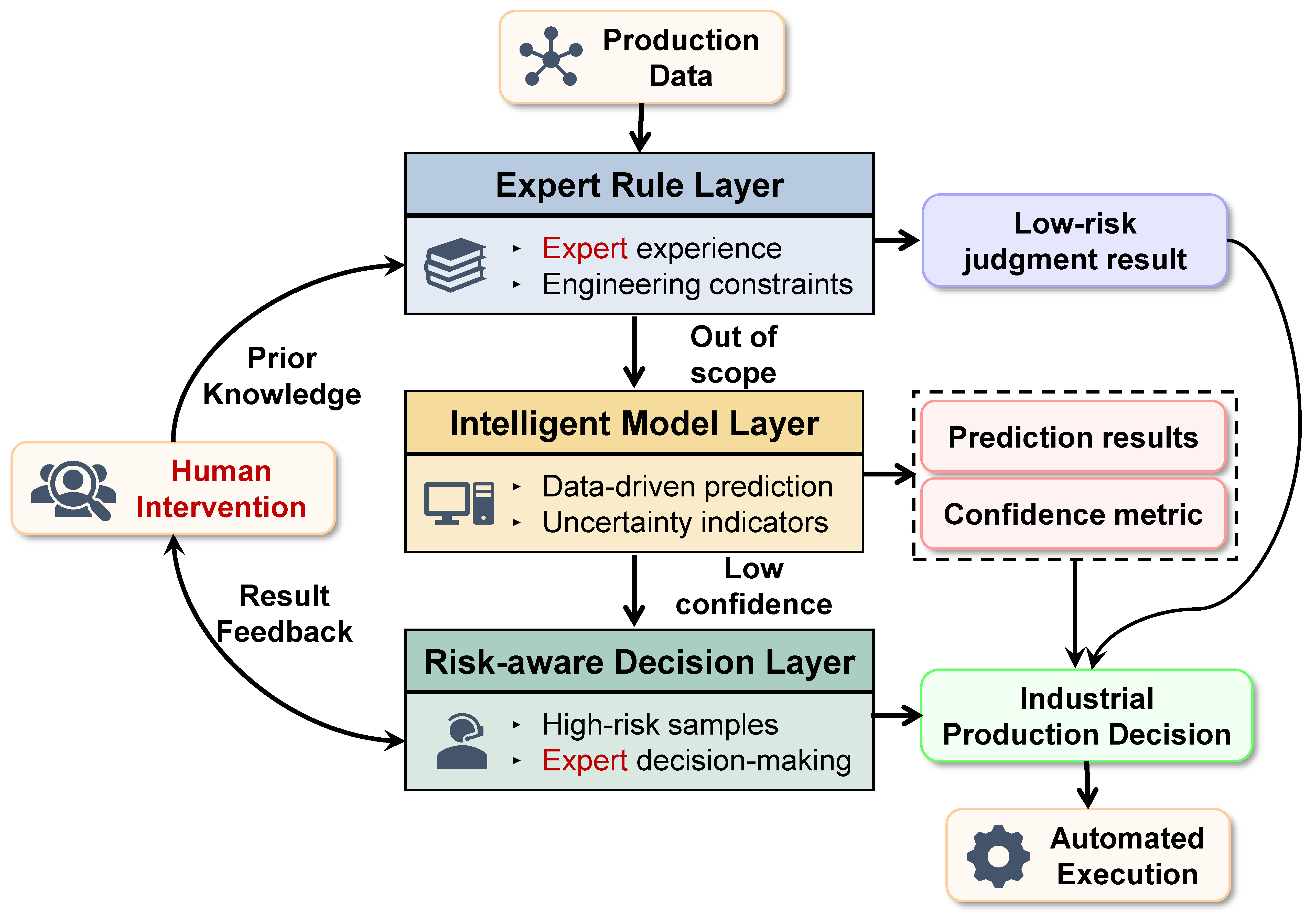
Intelligent decision-making in high-risk industrial scenarios is critical for maximizing production efficiency and ensuring operational safety. Strip flatness detection is a representative task because missed flattening decisions may lead to downstream quality defects. To address this problem, this paper proposes a Human-in-the-Loop Intelligent Decision Framework (HIL-IDF) and develops a Multimodal Hybrid Intelligent Strip Detection method (MHI-SD) as its task-specific implementation. The proposed framework consists of an expert-rule layer, an intelligent model layer, and a risk-aware decision layer. In MHI-SD, the expert-rule layer rapidly handles samples with deterministic characteristics, while the intelligent model layer combines a time-series branch and an image-based auxiliary branch. The time-series branch extracts segment-wise statistical features and performs weighted ensemble learning using k-nearest neighbors (KNN), random forest (RF), and Light Gradient Boosting Machine (LightGBM). The image branch converts paired bending-leveling curves into two-dimensional morphology images and uses a convolutional neural network (CNN) with a support vector machine (SVM) for auxiliary verification. The risk-aware decision layer is designed from a cost-sensitive perspective and implemented as a threshold-based sequential routing mechanism. Low-confidence samples, high-risk predictions, and samples with model disagreement are routed to auxiliary checking or manual verification. Based on historical production-line data, MHI-SD achieves 96.32% accuracy and 95.19% recall. Together with the ablation and threshold-sensitivity analyses, these results support the effectiveness of the proposed risk-aware decision design and suggest its practical potential for strip flatness decision support under the studied production conditions.
- Open Access
- Article
Human-in-the-Loop Hybrid Intelligent Decision for Automated Strip Steel Flatness Detection
Author Information
Received: 13 Feb 2026 | Revised: 16 Aug 2026 | Accepted: 29 Sep 2026 | Published: 14 Oct 2026
Abstract
Graphical Abstract
Keywords
strip shape detection | machine learning | expert rules | ensemble learning | multimodal fusion
References
- 1.
Zhong, R.Y.; Xu, X.; Klotz, E.; et al. Intelligent Manufacturing in the Context of Industry 4.0: A Review. Engineering 2017, 3, 616–630.
- 2.
Perez-Cerrolaza, J.; Abella, J.; Borg, M.; et al. Artificial Intelligence for Safety-Critical Systems in Industrial and Transportation Domains: A Survey. ACM Comput. Surv. 2024, 56, 1–40.
- 3.
Basora, L.; Viens, A.; Chao, M.A.; et al. A Benchmark on Uncertainty Quantification for Deep Learning Prognostics. Reliab. Eng. Syst. Saf. 2025, 253, 110513.
- 4.
Windmann, A.; Wittenberg, P.; Schieseck, M.; et al. Artificial Intelligence in Industry 4.0: A Review of Integration Challenges for Industrial Systems. In Proceedings of the 2024 IEEE 22nd International Conference on Industrial Informatics (INDIN), Porto, Portugal, 18–22 August 2024; IEEE: Piscataway, NJ, USA, 2024; pp. 1–8.
- 5.
Abdar, M.; Pourpanah, F.; Hussain, S.; et al. A Review of Uncertainty Quantification in Deep Learning: Techniques, Applications and Challenges. Inf. Fusion 2021, 76, 243–297.
- 6.
Zhou, H.; Chen, W.; Cheng, L.; et al. Trustworthy Fault Diagnosis with Uncertainty Estimation through Evidential Convolutional Neural Networks. IEEE Trans. Ind. Inform. 2023, 19, 10842–10852.
- 7.
Lin, Y.H.; Li, G.H. A Bayesian Deep Learning Framework for RUL Prediction Incorporating Uncertainty Quantification and Calibration. IEEE Trans. Ind. Inform. 2022, 18, 7274–7284.
- 8.
Yang, J.; Zhou, K.; Li, Y.; et al. Generalized Out-of-Distribution Detection: A survey. Int. J. Comput. Vis. 2024, 132, 5635–5662.
- 9.
Wang, X.; Zhang, H.; Qiao, X.; et al. Generalized Out-of-Distribution Fault Diagnosis (GOOFD) via Internal Contrastive Learning. IEEE Trans. Ind. Inform. 2024, 20, 9987–9996.
- 10.
Wei, D.; Zuo, M.; Tian, Z. Open-Set Fault Diagnosis for Industrial Rotating Machines Based on Trustworthy Deep Learning. IEEE Trans. Ind. Cyber-Phys. Syst. 2025, 3, 181–189.
- 11.
Wang, J.; Ma, Y.; Zhang, L.; et al. Deep Learning for Smart Manufacturing: Methods and Applications. J. Manuf. Syst. 2018, 48, 144–156.
- 12.
Yang, Y.; Zhang, Y.; Zou, W.; et al. Synthesizing Control Barrier Functions with Feasible Region Iteration for Safe Reinforcement Learning. IEEE Trans. Autom. Control 2023, 69, 2713–2720.
- 13.
Khan, Z.; Nasir, A.; Mekid, S. Fault-Tolerant Control Strategies for Industrial Robots: State of the Art and Future Perspective on AI-Based Fault Management. Artif. Intell. Rev. 2025, 58, 362.
- 14.
Chen, H.; Li, S.; Fan, J.; et al. Human-in-the-Loop Robot Learning for Smart Manufacturing: A Human-Centric Perspective. IEEE Trans. Autom. Sci. Eng. 2025, 22, 11062–11086.
- 15.
Hu, D.; Huang, C.; Wu, J.; et al. Toward Multi-Task Generalization in Autonomous Navigation: A Human-in-the-Loop Adversarial Reinforcement Learning with Diffusion Policy. IEEE Trans. Intell. Transp. Syst. 2025, 26, 19493–19507.
- 16.
Hu, D.; Zhou, G.; Wu, J.; et al. Trust-Calibrated Human-in-the-Loop Reinforcement Learning for Safe and Efficient Autonomous Navigation. IEEE Internet Things J. 2025, 12, 39029–39041.
- 17.
Wang, J.; Zhang, Z.; Huang, Y.; et al. Proactive Dispatch of Rail Maintenance Equipment under Weather-Induced Disruptions: An Optimization Framework Integrating Machine Learning-Driven Risk Assessment. Adv. Eng. Inform. 2026, 69, 103990.
- 18.
Zhang, X.; Yan, S.; Wang, C.; et al. Generalizable Fault Diagnosis under Distribution Shifts Induced by Unseen Working Conditions via Synthetic and Adversarial Sample Learning. IEEE Trans. Reliab. 2025, 74, 5517–5530.
- 19.
Alzarooni, A.; Iqbal, E.; Khan, S.U.; et al. Anomaly Detection for Industrial Applications: Challenges, Solutions, and Future Directions. arXiv 2025, arXiv:2501.11310.
- 20.
Wiggerthale, J.; Reich, C. Human-in-the-Loop Visual Inspection for Safety-Critical Systems. Preprints 2025, 2025112107. https://doi.org/10.20944/preprints202511.2107.v1.
- 21.
Geng, Y.F.; Zhao, C.L.; Zang, X.M.; et al. Feeding Steel Strip Technology in Continuous Casting Process: A Review. Steel Res. Int. 2021, 92, 2100051.
- 22.
Wang, Q.; Sun, J.; Hu, Y.; et al. Deep Learning-Based Flatness Prediction via Multivariate Industrial Data for Steel Strip During Tandem Cold Rolling. Expert Syst. Appl. 2024, 237, 121777.
- 23.
Hu, X.; Song, H.; Yang, K.; et al. Research on the Flatness Control Performance and Parameter Influence Law of Four-High Skin Pass Rolling Mill. J. Mater. Eng. Perform. 2025, 34, 8141–8151.
- 24.
Wu, C.; Zhang, L.; Qu, P.; et al. Effect of the Elastic Deformation of Rolls on the Surface Texture Transfer in Skin-Pass Rolling. Int. J. Mech. Sci. 2021, 198, 106358.
- 25.
Xu, Y.; Wang, D.; Liu, H.; et al. Intelligent Representation Method of Image Flatness for Cold Rolled Strip. J. Iron Steel Res. Int. 2024, 31, 1177–1195.
- 26.
Wang, Y.; Li, C.; Peng, L.; et al. Application of Convolutional Neural Networks for Prediction of Strip Flatness in Tandem Cold Rolling Process. J. Manuf. Process. 2021, 68, 512–522.
- 27.
Cui, D. Application of SOCP-SVM Algorithm on Strip Steel Surface Defect Recognition. Int. J. Comput. Intell. Syst. Appl. 2016, 4, 1–7.
- 28.
Hu, H.; Li, Y.; Liu, M.; et al. Classification of Defects in Steel Strip Surface Based on Multiclass Support Vector Machine. Multimed. Tools Appl. 2014, 69, 199–216.
- 29.
Zhang, X.W.; Ding, Y.Q.; et al. A Vision Inspection System for the Surface Defects of Strongly Reflected Metal Based on Multi-Class SVM. Expert Syst. Appl. 2011, 38, 5930–5939.
- 30.
Yang, W.; Zhao, Z.; Zhu, L.; et al. Strip Flatness Prediction of Cold Rolling Based on Ensemble Methods. J. Iron Steel Res. Int. 2024, 31, 237–251.
- 31.
Guo, G.; Wang, H.; Bell, D.; et al. KNN Model-Based Approach in Classification. In Proceedings of the OTM Confederated International Conferences: On the Move to Meaningful Internet Systems, Catania, Sicily, Italy, 3–7 November 2003; Springer: Berlin/Heidelberg, Germany, 2003.
- 32.
Salman, H.A.; Kalakech, A.; Steiti, A. Random Forest Algorithm Overview. Babylonian J. Mach. Learn. 2024, 2024, 69–79.
- 33.
Ke, G.; Meng, Q.; Finley, T.; et al. LightGBM: A Highly Efficient Gradient Boosting Decision Tree. Adv. Neural Inf. Process. Syst. 2017, 30, 1–9.
- 34.
Alzubaidi, L.; Zhang, J.; Humaidi, A.J.; et al. Review of Deep Learning: Concepts, CNN Architectures, Challenges, Applications, and Future Directions. J. Big Data 2021, 8, 53.
- 35.
Chandra, M.A.; Bedi, S.S. Survey on SVM and Their Application in Image Classification. Int. J. Inf. Technol. 2021, 13, 1–11.
- 36.
Wang, X.C.; Yang, Q.; Jiang, Z.Y.; et al. Research on the Improvement Effect of High Tension on Flatness Deviation in Cold Strip Rolling. Steel Res. Int. 2014, 85, 1560–1570.
- 37.
Usamentiaga, R.; Garcia, D.F.; Molleda, J.; et al. Vibrations in Steel Strips: Effects on Flatness Measurement and Filtering. In Proceedings of the 2013 IEEE Industry Applications Society Annual Meeting, Lake Buena Vista, FL, USA, 6–11 October 2013; IEEE: Piscataway, NJ, USA, 2013; pp. 1–10.
- 38.
Krauhausen, M.; Priem, R.; Claßen, R.; et al. Sub-Micron Inline Thickness Measurement of Cold-Rolled Metal Strips by Multi-Wavelength Interferometry and Laser Triangulation. Opt. Express 2023, 31, 43804–43820.
- 39.
Tang, B.; Chen, L.; Sun, W.; et al. Review of Surface Defect Detection of Steel Products Based on Machine Vision. IET Image Process. 2023, 17, 303–322.
- 40.
Yan, S.; Wang, X.; Yang, Q.; et al. Online Deviation Measurement System of the Strip in the Finishing Process Based on Machine Vision. Measurement 2022, 202, 111735.
- 41.
Chai, X.; Li, H.; Zhang, J.; et al. Flatness Analysis and Control of Strips with Different Thickness in 2250 mm Hot Tandem Rolling. Steel Res. Int. 2018, 89, 1800404.
- 42.
Shi, X.; Kang, Q.; An, J.; Zhou, M. Novel L1-Regularized Extreme Learning Machine for Soft-Sensing of an Industrial Process. IEEE Trans. Ind. Inform. 2022, 18, 1009–1017.
- 43.
Shi, X.; Kang, Q.; Zhou, M.; et al. Dual Attention-Aided Cooperative Deep Spatiotemporal Feature Extraction Network for Semi-Supervised Soft Sensing. IEEE Robot. Autom. Lett. 2025, 10, 2184–2190.
- 44.
Shi, X.; Kang, Q.; Bao, H.; et al. Principal Component-Based Semi-Supervised Extreme Learning Machine for Soft Sensing. IEEE Trans. Autom. Sci. Eng. 2024, 21, 3966–3976.
- 45.
Bi, J.; Wang, C.; Wang, Z.; et al. Dual-GNN-Driven Cooperative Optimization for Makespan-Minimized and Large-Scale 3C Dynamic Job-Shop Scheduling. IEEE Trans. Autom. Sci. Eng. 2026, 23, 4350–4364. https://doi.org/10.1109/TASE.2026.3661178.
- 46.
Zhang, M.; Bi, J.; Yuan, H.; et al. An Enhanced Hybrid Deep Neural Network Method for Adjusted Industrial Time Series Prediction with Variable Operating States. Expert Syst. Appl. 2026, 299, 130029. https://doi.org/10.1016/j.eswa.2025.130029.
- 47.
Luo, Q.; Fang, X.; Liu, L.; et al. Automated Visual Defect Detection for Flat Steel Surface: A Survey. IEEE Trans. Instrum. Meas. 2020, 69, 626–644. https://doi.org/10.1109/TIM.2019.2963555.
- 48.
Luo, Q.; Fang, X.; Sun, Y.; et al. Surface Defect Classification for Hot-Rolled Steel Strips by Selectively Dominant Local Binary Patterns. IEEE Access 2019, 7, 23488–23499. https://doi.org/10.1109/ACCESS.2019.2898215.
- 49.
Dong, J.; Yang, X.-Y.; Xu, Q.-Q.; et al. A Data-Driven Integrated Framework for Collaborative Prediction and Optimisation of Hot-Rolled Steel Strip Shape. Int. J. Prod. Res. 2026, 1–26. https://doi.org/10.1080/00207543.2026.2623538.
- 50.
Chen, Y.; Peng, L.; Wang, Y.; et al. Prediction of Tandem Cold-Rolled Strip Flatness Based on Attention-LSTM Model. J. Manuf. Process. 2023, 91, 110–121.
- 51.
Jiang, Z.; Ding, Z.; Liu, Y.; et al. A Data-Driven Based Decomposition–Integration Method for Remanufacturing Cost Prediction of End-of-Life Products. Robot. Comput. Integr. Manuf. 2020, 61, 101838.
- 52.
Kang, Q.; Chen, X.S.; Li, S.S.; et al. A Noise-Filtered Under-Sampling Scheme for Imbalanced Classification. IEEE Trans. Cybern. 2016, 47, 4263–4274.


This work is licensed under a Creative Commons Attribution 4.0 International License.

 Suite 4002 Level 4, 447 Collins Street, Melbourne, Victoria 3000, Australia
 General Inquiries: info@sciltp.com