
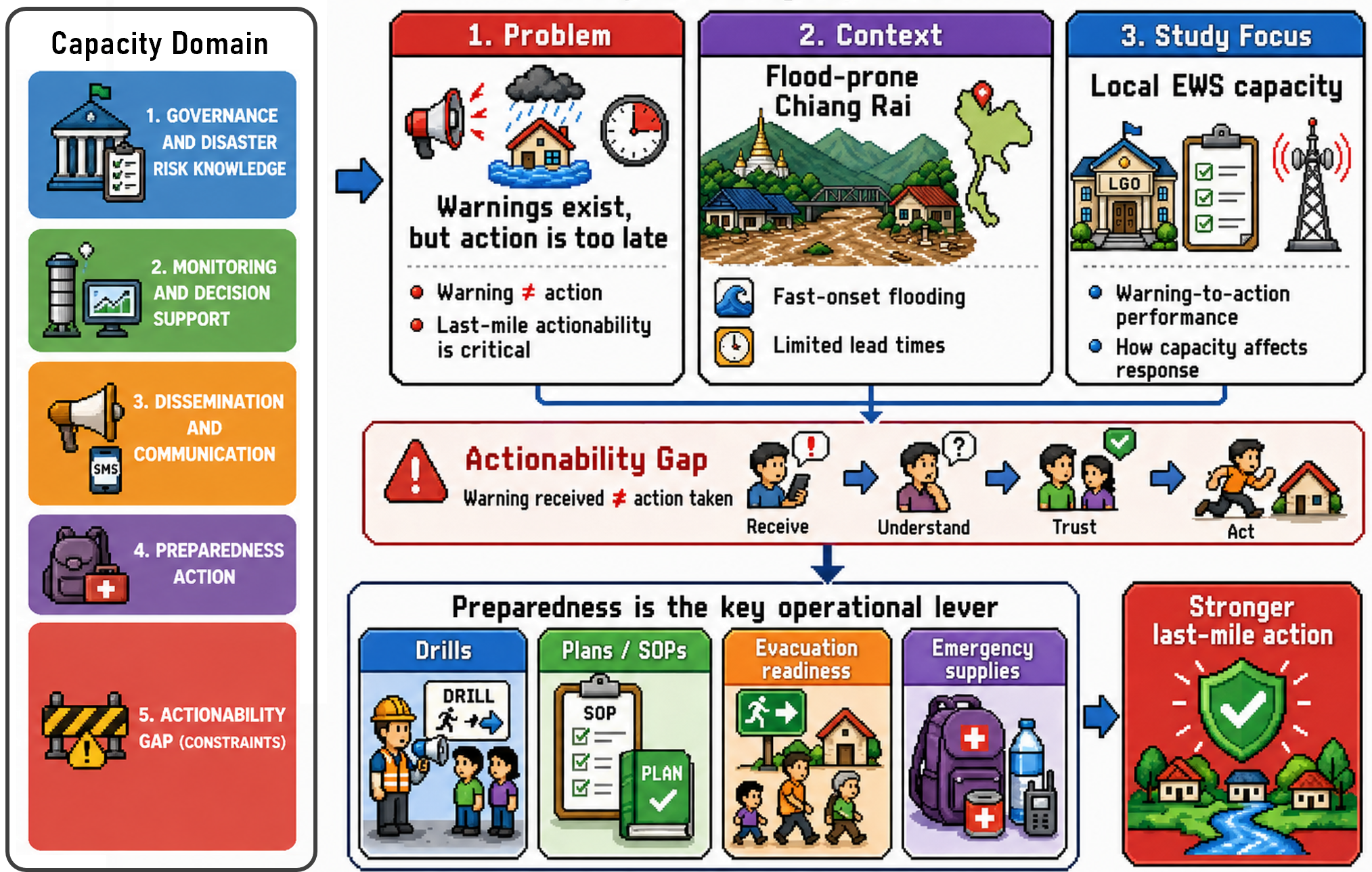
Last-mile early warning systems (EWS) often fall short not because warnings are missing, but because people cannot act on them in time. This study examines local EWS capacity and its relationship to warning-to-action performance in flood-prone Chiang Rai Province, Thailand, where fast-onset flooding and limited lead times make last-mile actionability especially critical. Using a cross-sectional survey of 50 local government organizations (LGOs) conducted between December 2025 and January 2026, the study assesses capacity across four EWS pillars—disaster risk knowledge and governance, monitoring, dissemination, and preparedness—and examines which enablers and barriers shape actionability along the Receive → Understand → Trust → Act chain. Overall capacity was moderate to high: governance and dissemination/communication were relatively stronger, monitoring/decision support was moderate, and preparedness/response was the weakest pillar. A covariance-based structural equation model suggests a cumulative pathway linking governance, monitoring, dissemination, and preparedness, with preparedness emerging as the most proximate factor associated with fewer warning-to-action constraints (β = −0.364). The model explains only a modest share of variance in the actionability gap (R2 = 0.109), indicating that effective last-mile EWS depends not only on warning delivery but also on feasible local response and contextual factors beyond institutional capacity. No statistically significant capacity differences were found across LGO types, although subdistrict administrative organizations reported higher average constraints. These findings highlight preparedness as the key operational lever for strengthening last-mile EWS through routine preparedness functions, clearer municipal–community roles, actionable guidance, redundant communication, and inclusive support for vulnerable groups.
- Open Access
- Article
From Warning to Action: Local Government Capacity Gaps in Last-Mile EWS in Flood-Prone Chiang Rai, Thailand
Author Information
Received: 20 February 2026 | Revised: 31 March 2026 | Accepted: 23 April 2026 | Published: 30 April 2026
Abstract
Graphical Abstract
Keywords
early warning systems | last-mile | local government capacity | preparedness | actionability | structural equation modeling | Thailand
References
- 1.
Basher, R. Global early warning systems for natural hazards: Systematic and people-centred. Philos. Trans. R. Soc. A Math. Phys. Eng. Sci. 2006, 364, 2167–2182. https://doi.org/10.1098/rsta.2006.1819.
- 2.
Parker, D.J.; Priest, S.J.; Tapsell, S.M. Understanding and enhancing the public’s behavioural response to flood warning information. Meteorol. Appl. 2009, 16, 103–114. https://doi.org/10.1002/met.119.
- 3.
Mowbray, F.; Mills, F.; Symons, C.; et al. A systematic review of the use of mobile alerting to inform the public about emergencies and the factors that influence the public response. J. Contingencies Crisis Manag. 2024, 32, e12499. https://doi.org/10.1111/1468-5973.12499.
- 4.
Tozier de la Poterie, A.; Villatoro, C.; Morinière, L.; et al. Strengthening Early Warning Systems for All: Evidence and Lessons from Last-Mile Communities; Global Disaster Preparedness Center: Washington, DC, USA, 2025. Available online: https://preparecenter.org/wp-content/uploads/2026/01/Full-Report-Strengthening-EWS-for-All.pdf (accessed on 10 February 2026).
- 5.
World Meteorological Organization. WMO Guidelines on Multi-Hazard Impact-Based Forecast and Warning Services (WMO-No.1150). 2015. Available online: https://etrp.wmo.int/pluginfile.php/42254/mod_page/content/18/WMO-1150_multihazard-guidelines_en.pdf (accessed on 10 February 2026).
- 6.
Miyake, Y. New challenges of flood management and resilience building at border communities: A case study of floods over the transboundary Sai River between Mae Sai, Thailand and Tachileik, Myanmar. In Managing Disruption and Developing Resilience for a Better Southeast Asia, Proceedings of the 4th SEASIA Biennial Conference 2022; Springer: Singapore, 2025; pp. 401–413. https://doi.org/10.1007/978-981-96-2116-3_28.
- 7.
Techaphanrattanakul, N.; Anorat, K.; Nanglae, S.; et al. Rainfall variability analysis using rolling statistics in Chiang Rai province. J. Curr. Sci. Technol. 2026, 16, Article 179. https://doi.org/10.59796/jcst.V16N2.2026.179.
- 8.
Chaiwino, W.; Chaisee, K.; Oonariya, C.; et al. Analysis of long-term rainfall trend and extreme in upper northern Thailand. Sci. Rep. 2025, 15, 33380. https://doi.org/10.1038/s41598-025-18217-1.
- 9.
Singkran, N. Flood risk management in Thailand: Shifting from a passive to a progressive paradigm. Int. J. Disaster Risk Reduct. 2017, 25, 92–100. https://doi.org/10.1016/j.ijdrr.2017.08.003.
- 10.
Nuntaboot, K.; Boonsawasdgulchai, P.; Bubpa, N.; et al. Investigating the experience of local community networks of disaster self-management: A qualitative study in Thailand. Indian J. Public Health 2020, 64, 381–385. https://doi.org/10.4103/ijph.IJPH_92_20.
- 11.
Yodsuban, P.; Nuntaboot, K. Community-based flood disaster management for older adults in southern of Thailand: A qualitative study. Int. J. Nurs. Sci. 2021, 8, 409–417. https://doi.org/10.1016/j.ijnss.2021.08.008.
- 12.
Lindell, M.K.; Perry, R.W. The protective action decision model: Theoretical modifications and additional evidence. Risk Anal. 2012, 32, 616–632. https://doi.org/10.1111/j.1539-6924.2011.01647.x.
- 13.
Weyrich, P.; Scolobig, A.; Patt, A. Effects of impact-based warnings and behavioral recommendations for extreme weather events. Weather Clim. Soc. 2018, 10, 781–796. https://doi.org/10.1175/WCAS-D-18-0038.1.
- 14.
Casteel, M.A. Communicating increased risk: An empirical investigation of the National Weather Service’s impact-based warnings. Weather Clim. Soc. 2016, 8, 219–232. https://doi.org/10.1175/WCAS-D-15-0044.1.
- 15.
United Nations Office for Disaster Risk Reduction. Disaster Resilience Scorecard for Cities: Multi-Hazard Early Warning Systems Addendum. 2024. Available online: https://mcr2030.undrr.org/media/103350 (accessed on 10 February 2026).
- 16.
Potter, S.H.; Harrison, S.E.; Kreft, P. The benefits and challenges of implementing impact-based severe weather warning systems: Perspectives of weather, flood, and emergency management personnel. Weather Clim. Soc. 2021, 13, 303–314. https://doi.org/10.1175/WCAS-D-20-0110.1.
- 17.
United Nations Office for Disaster Risk Reduction. Early Warnings for All. 2022. Available online: https://www.undrr.org/implementing-sendai-framework/sendai-framework-action/early-warnings-for-all (accessed on 10 February 2026).
- 18.
Mileti, D.S.; Sorensen, J.H. Communication of Emergency Public Warnings: A Social Science Perspective and State-of-the-Art Assessment (ORNL-6609). 1990. Available online: https://www.osti.gov/biblio/6137387 (accessed on 11 February 2026).
- 19.
National Academies of Sciences, Engineering, and Medicine. Emergency Alert and Warning Systems: Current Knowledge and Future Research Directions; The National Academies Press: Washington, DC, USA, 2018. https://doi.org/10.17226/24935.
- 20.
Shrestha, R.P.; Chaweewan, N.; Arunyawat, S. Adaptation to climate change by rural ethnic communities of Northern Thailand. Climate 2017, 5, 57. https://doi.org/10.3390/cli5030057.
- 21.
Manopkawee, P.; Mankhemthong, N. Landslide susceptibility assessment using the frequency ratio model in the Mae Chan River watershed, northern Thailand. Quat. Sci. Adv. 2025, 17, 100263. https://doi.org/10.1016/j.qsa.2024.100263.
- 22.
National Disaster Prevention and Mitigation Committee. National Disaster Prevention and Mitigation Plan, B.E. 2564–2570 (2021–2027). 2021. Available online: https://policy.disaster.go.th/policy/download?id=673 (accessed on 12 February 2026).
- 23.
Organisation for Economic Co-Operation and Development. OECD Integrity Review of Thailand 2021: Achieving Effective Integrity Policies and Sustained Reform; OECD Publishing: Paris, France, 2021. Available online: https://www.oecd.org/content/dam/oecd/en/publications/reports/2021/12/oecd-integrity-review-of-thailand-2021_b92692ae/e8949f1b-en.pdf (accessed on 12 February 2026).
- 24.
Putta, J.; Poboon, C. Public disaster prevention and mitigation of local administrative organizations in Thailand. Kasem Bundit J. 2018, 19, 31–44. Available online: https://so04.tci-thaijo.org/index.php/jkbu/article/download/127775/96502/ (accessed on 10 February 2026).
- 25.
Wichaipa, K. A study of disaster management competency and indicators in Thailand’s local administration. Asian Rev. 2020, 33, 3–33. https://doi.org/10.58837/CHULA.ARV.33.2.1.
- 26.
Organisation for Economic Co-Operation and Development. Disaster Early Warning Systems and Private Sector Participation in ASEAN; OECD Publishing: Paris, France, 2025. Available online: https://www.oecd.org/content/dam/oecd/en/publications/reports/2025/11/disaster-early-warning-systems-and-private-sector-participation-in-asean_4a161409/bc282563-en.pdf (accessed on 12 February 2026).
- 27.
Kim, S.H.; Kim, S. National Culture and Social Desirability Bias in Measuring Public Service Motivation. Adm. Soc. 2016, 48, 444–476. https://doi.org/10.1177/0095399713498749.
- 28.
Disaster Prevention and Mitigation Act, B.E. 2550 [A.D. 2007]. Available online: https://www.adrc.asia/documents/dm_information/thailand_law02.pdf (accessed on 12 February 2026).
- 29.
Ministry of Finance. Criteria, Procedures, and Conditions for the Use of Contingency Advances for Assistance to Emergency Disaster Victims, B.E. 2569 (2026). 2026. Available online: https://backofficeminisite.disaster.go.th/apiv1/apps/minisite_help/194/sitedownload/704/download?TypeMenu=MainMenu&filename=5cd3ebd7072c0ba0283e456c6d19d40a.pdf (accessed on 12 February 2026).
- 30.
Department of Local Administration. Official Circular on Local Budget Use for Public Assistance in Disaster Situations. 2025. Available online: https://www.banphet-mu.go.th/index/add_file/tBx19cqSun90954.pdf (accessed on 12 February 2026).
- 31.
Department of Disaster Prevention and Mitigation. National Disaster Prevention and Mitigation Plan 2021–2027. 2021. Available online: https://www.preventionweb.net/media/110528/download?startDownload=20260330 (accessed on 12 February 2026).
- 32.
Wachinger, G.; Renn, O.; Begg, C.; et al. The risk perception paradox—Implications for governance and communication of natural hazards. Risk Anal. 2013, 33, 1049–1065. https://doi.org/10.1111/j.1539-6924.2012.01942.x.
- 33.
Keller, C.; Siegrist, M.; Gutscher, H. The role of the affect and availability heuristics in risk communication. Risk Anal. 2006, 26, 631–639. https://doi.org/10.1111/j.1539-6924.2006.00773.x.
- 34.
Perreault, M.F.; Houston, J.B.; Wilkins, L. Does scary matter? Testing the effectiveness of new National Weather Service tornado warning messages. Commun. Stud. 2014, 65, 484–499. https://doi.org/10.1080/10510974.2014.956942.
- 35.
Wood, M.M.; Sutton, J.; Sorensen, J.H. Milling and public warnings: The effect of message content on information seeking and decision-making. Environ. Behav. 2018, 50, 535–566. https://doi.org/10.1177/0013916517709561.
- 36.
Morss, R.E.; Demuth, J.L.; Lazo, J.K.; et al. Understanding public hurricane evacuation decisions and responses to forecast and warning messages. Weather Forecast. 2016, 31, 395–417. https://doi.org/10.1175/WAF-D-15-0066.1.

This work is licensed under a Creative Commons Attribution 4.0 International License.
