
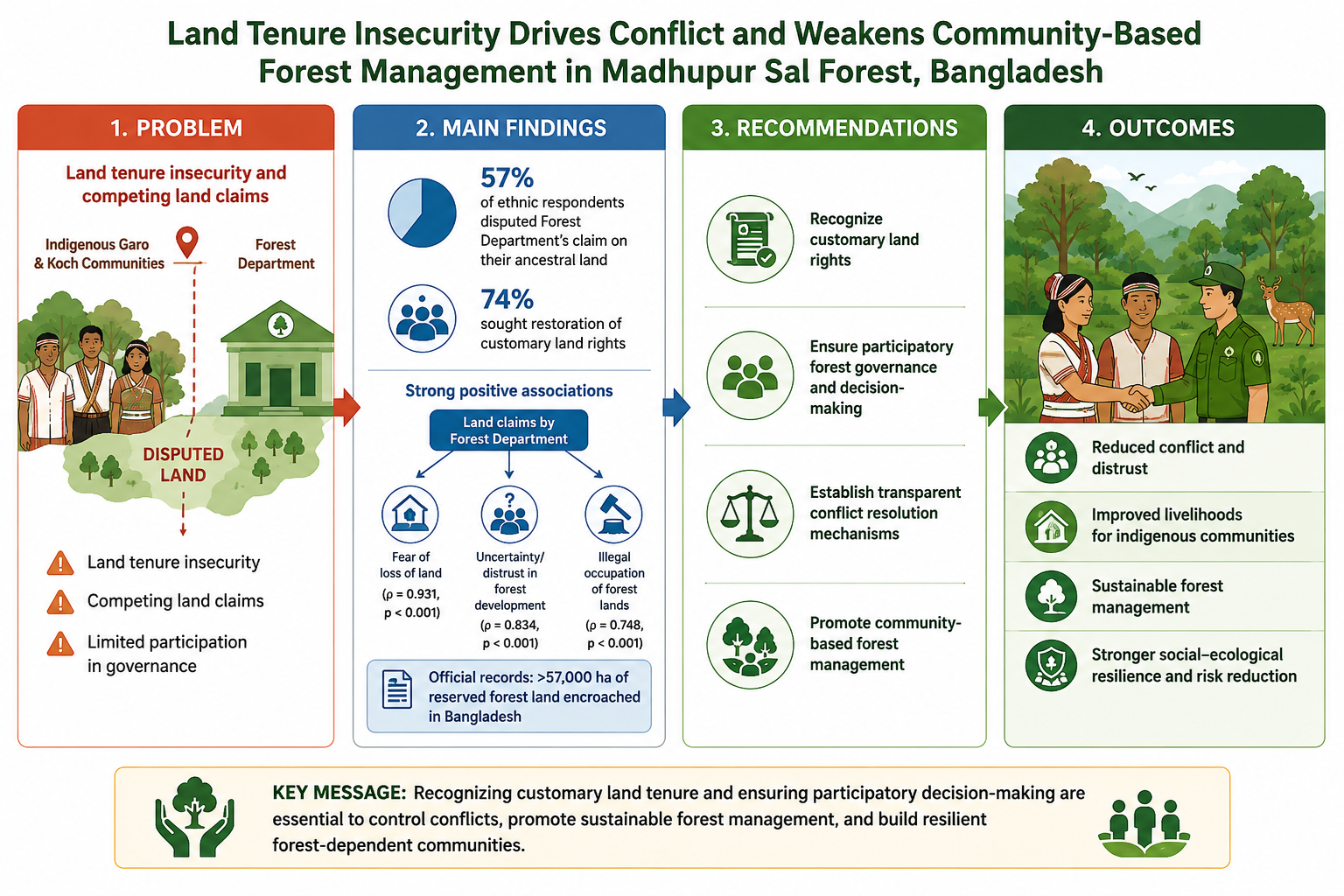
This research investigates the chronic struggle over land rights in a community-based forest management system. The Madhupur Sal Forest (MSF) of Bangladesh, inhabited by indigenous Garo and Koch communities. The aim of this research was to examine the determinants of conflicts over land rights for the case of community-based forest management in Bangladesh’s Madhupur Sal Forest. Both quantitative and qualitative data were gathered from 150 samples (75 each village of Magontinagor and Gachabaria) using semi-structured questionnaire. The results showed that over half (57%) of ethnic respondents disputed the Forest Department’s claim on their ancestral land, and three-quarters (74%) sought for customary rights to be reinstated. We found a statistically significant positive correlation between the amount of land claimed by the Forest Department and fear for loss of land (ρ = 0.931, p < 0.001) in being sure about forest development (ρ = 0.834, p < 0.001), regarding the illegal occupation of lands in forests (ρ = 0.748, p < 0.001). Official records indicate that more than 57,000 hectares of reserved forest land in Bangladesh have been encroached, reflecting broader governance and enforcement challenges related to forest management. These conflicts severely affect local livelihoods, foster distrust toward the Forest Department, and challenge conservation efforts. The findings emphasize that recognizing customary land tenure and ensuring participatory decision-making are essential to control conflicts and promoting sustainable forest management. These findings will help the policymakers to reform land tenure policies and integrate indigenous rights into national forest management strategies. This study also contributes to hazards and risk resilience by demonstrating how land tenure insecurity functions as a socio-institutional driver of risk, amplifying vulnerability and weakening community and ecosystem resilience in forest-dependent systems.
- Open Access
- Article
Unsettled Tenure: Indigenous Land Rights Conflicts in Madhupur Sal Forest of Bangladesh
- Md. Musfiq Al Mahadi 1,
- Nina Takashino 2,
- Md. Shamsuzzoha 3,
- Mohammad Golam Kibria 4 and
- Md. Anwarul Abedin 4,*
Author Information
Received: 06 February 2026 | Revised: 12 May 2026 | Accepted: 12 June 2026 | Published: 29 June 2026
Abstract
Graphical Abstract
Keywords
Bangladesh | conflict management | forestry | land rights | Madhupur Sal forest
References
- 1.
FAO. Trees Outside Forests: Towards a Better Awareness; Food and Agriculture Organization of the United Nations: Rome, Italy, 2001.
- 2.
Ongolo, S.; Kouassi, S.K.; Cherif, S.; et al. The tragedy of forestland sustainability in postcolonial Africa: Land development, cocoa, and politics in Côte d’Ivoire. Sustainability 2018, 10, 4611.
- 3.
Ahmed, A.I.M.U.; Mahbub, U.I. Underlying Causes of Deforestation and Forest Degradation in Bangladesh; A Report Submitted to the Global Forest Coalition (GFC), The Netherlands; The University of Dhaka: Dhaka, Bangladesh, 2008.
- 4.
Choudhury, J.K.; Hossain, M.A.A. Bangladesh forestry outlook study. In Asia-Pacific Forestry Sector Outlook Study II; Food and Agriculture Organization: Bangkok, Thailand, 2011.
- 5.
Zaman, S.; Siddiquee, S.U.; Al Faruq, M.A.; et al. Reckoning participatory forest management in Bangladesh: Study from its implementation perspective. J. Agric. Sci. 2011, 3, 233.
- 6.
Jashimuddin, M. Drivers of Land Use Change and Policy Analysis in Bangladesh: Theory and Policy Recommendations; LAP LAMBERT Academic Publishing: Saarbrücken, Germany, 2011.
- 7.
Mia, M.Y.; Hossain, M.U.; Farzana, S. Prospects and constraints of Madhupur National Park management. J. Environ. Sci. Nat. Resour. 2012, 5, 151–158.
- 8.
Hossain, M.N.; Rokanuzzaman, M.; Rahman, M.A.; et al. Causes of deforestation and conservation of Madhupur Sal Forest in Tangail Region. J. Environ. Sci. Nat. Resour. 2013, 6, 109–114.
- 9.
U.N. Dept. of Economic and Social Affairs—Population Division. World Population Prospects: The 2024 Revision; Medium-Fertility Variant; U.N. Dept. of Economic and Social Affairs—Population Division: New York, NY, USA, 2024.
- 10.
Drong, S. Eco-Park Project Threats to Evict 25,000 Garos; Indigenous People’s Forum: Dhaka, Bangladesh, 2004.
- 11.
Gain, P. The Endangered Forest of Bangladesh; Society for Environment and Human Development (SEHD): Dhaka, Bangladesh, 2005.
- 12.
Muhammed, N.; Hossain, M.; Chakma, S.; et al. Conflict and Corollaries on Forest and Indigenous People: Experience from Bangladesh. In Sustainable Forest Management—Case Studies; Books on Demand: Norderstedt, Germany, 2012.
- 13.
Pravat, P.S.; Humphreys, D. Using a multilevel approach to analyse the case of forest conflicts in the Terai, Nepal. For. Policy Econ. 2013, 33, 47–55.
- 14.
Nandwani, B. Community forestry and its implications for land related disputes: Evidence from India. Eur. J. Political Econ. 2022, 73, 102155.
- 15.
Aiken, S.R.; Leigh, C.H. In the Way of Development: Indigenous Land-Rights Issues in Malaysia. Geogr. Rev. 2011, 101, 471–496. https://doi.org/10.1111/j.1931-0846.2011.00113.x.
- 16.
Muhammed, N.; Chakma, S.; Masum, M.H.; et al. A case study on the Garo ethnic people of the Sal (Shorea robusta) forests in Bangladesh. Int. J. Soc. For. 2011, 4, 197–211.
- 17.
Dept. of Economic, & Permanent Forum on Indigenous Issues (United Nations). State of the World’s Indigenous Peoples; United Nations Publications: New York, NY, USA, 2009; Volume 9.
- 18.
Roy, R.D. Challenges for juridical pluralism and customary laws of indigenous peoples: The case of the Chittagong Hill Tracts, Bangladesh. Ariz. J. Int. Comp. Law 2004, 21, 113.
- 19.
Islam, K.K.; Hyakumura, K. The potential perils of Sal forests land grabbing in Bangladesh: An analysis of economic, social and ecological perspectives. Environ. Dev. Sustain. 2021, 23, 15368–15390.
- 20.
Saha, S.; Hasan, S.S.; Haque, M.E.; et al. Perception based assessment of ecosystem services of Madhupur Sal Forest in Bangladesh. Eur. J. Agric. Food Sci. 2021, 3, 39–44.
- 21.
FD (Forest Department). Management Plan for Madhupur National Park; Bangladesh Forest Department Publication: Dhaka, Bangladesh, 2015; pp. 5–11.
- 22.
Millat-e-Mustafa, M. The Ecology and Management of Traditional Home Gardens in Bangladesh; Bangor University: Bangor, UK, 1996.
- 23.
Gain, P. Bangladesh Environment: Facing the 21st Century; Society for Environment and Human Development (SEHD): Dhaka, Bangladesh, 1998.
- 24.
Dey, S. The commercialization of the indigenous economy and its impact on the environment of Modhupur Garh, Bangladesh. Int. J. Green Econ. 2007, 1, 465–477.
- 25.
Teklehaimanot, Z.; Millat-E-Mustafa, M.; Hall, J.B. Farmers’ ecological knowledge about home garden production systems in Bangladesh. For. Trees Livelihoods 2001, 11, 67–79.
- 26.
FD (Forest Department). Land and Forest Area 2021. Official Website of Bangladesh Forest Department. Available online: http://www.bforest.gov.bd/ (accessed on 24 November 2025).
- 27.
Islam, K.K.; Sato, N. Participatory forestry in Bangladesh: Has it helped to increase the livelihoods of Sal forests dependent people. South. For. A J. For. Sci. 2012, 74, 89–101.
- 28.
Alam, M.; Furukawa, Y.; Sarker, S.K.; et al. Sustainability of Sal (Shorea robusta) forest in Bangladesh: Past, present and future actions. Int. For. Rev. 2008, 10, 29–37.
- 29.
Salam, M.A.; Noguchi, T. Factors influencing the loss of forest cover in Bangladesh: An analysis from socioeconomic and demographic perspectives. J. For. Res. 1998, 3, 145–150.
- 30.
Ahmed, F. Practices of Poverty Measurement and Poverty Profile of Bangladesh; ERD Working Paper No. 54; Asian Development Bank Publication: Manila, Philippines, 2004.
- 31.
Salam, M.A.; Noguchi, T. On sustainable development of social forestry in Bangladesh: Experience from Sal (Shorea robusta) forests. Environ. Dev. Sustain. 2005, 7, 209–227.
- 32.
Islam, K.K.; Jose, S.; Tani, M.; et al. Does actor power impede outcomes in participatory agroforestry approach? Evidence from Sal forests area, Bangladesh. Agrofor. Syst. 2015, 89, 885–899.
- 33.
Islam, K.K.; Noriko, S. Deforestation, land conversion and illegal logging in Bangladesh: The case of the Sal forests. Iforest-Biogeosciences For. 2012, 5, 171–178.
- 34.
Rahman, M.M. Forest resources of Bangladesh with reference to conservation of biodiversity and wildlife in particular for poverty alleviation. In Proceedings of the Workshop on Forests for Poverty Reduction: Opportunities with Clean Development Mechanism, Environmental Services, and Biodiversity; FAO Regional Office for Asia and the Pacific (FAO-RAP): Bangkok, Thailand, 2004; pp. 139–148.
- 35.
BFD. Forest Type: Tropical Moist Deciduous Forests. Bangladesh Forestry Department, Government of the Peopleʼs Republic of Bangladesh. 2011.
- 36.
Burling, R. The strong women of Madhupur. In The Changing Garo Adivashi Culture of Bangladesh: A Case Study of Marriage Rituals; University of Tromso: Tromso, Norway, 2005.
- 37.
Zencham, S. Cultureand Society of Garos; Pratibeshi Prokashani: Dhaka, Bangladesh, 2015; pp. 1–2. (In Bengali)
- 38.
Islam, K.K. Participatory agroforestry for disadvantaged community development: Evidence from Madhupur Sal forests, Bangladesh. J. Agrofor. Environ. 2020, 13, 7–12.
- 39.
Kabir, K.H. Capacity development of tribal forest dwellers through Participatory Forest Management in Bangladesh. 2019. Available online: http://opus.uni-hohenheim.de/volltexte/2019/1628/ (accessed on 20 December 2025).
- 40.
Aminuzzaman, M.S. Governance at Grassroots-Rhetoric and Reality: A Study of the Union Parishad in Bangladesh. In Search of Better Governance in South Asia and Beyond: Public Administration, Governance and Globalization 3; Askvik, S., Jamil, I., Dhakal, T.N., Eds.; Springer: New York, NY, USA, 2013; pp. 201–221.
- 41.
ADB. Asian Development Bank Forest Policy; Asian Development Bank: Manila, Philippines, 2003.
- 42.
Gain, P. A Journey through a Dying Heritage: The Last Forest of Bangladesh; Society for Environment and Human Development: Dhaka, Bangladesh, 1998.
- 43.
Islam, K.K.; Sato, N. Protected Sal Forest and livelihoods of ethnic minorities: Experience from Bangladesh. J. Sustain. For. 2013, 32, 412–436.
- 44.
Islam, K.K. Efficacy of Participatory Forest Management on Poverty alleviation and Sustainable Livelihood: Findings from Sal Forests, Bangladesh. Ph.D. Thesis, Kyushu University, Fukuoka, Japan, 2012.
- 45.
Agrawal, A. Forests, governance, and sustainability: Common property theory and its contributions. Int. J. Commons 2007, 1, 111–136.
- 46.
Deka, S.; Tripathi, O.P.; Paul, A. Perception-based assessment of ecosystem services of Ghagra Pahar forest of Assam, Northeast India. Geol. Ecol. Landsc. 2019, 3, 197–209.
- 47.
Vinceti, B.; Eyzaguirre, P.; Johns, T. The nutritional role of forest plant foods for rural communities. In Human Health and Forests; Routledge: London, UK, 2012; pp. 63–96.
- 48.
Safa, M.S. The effect of participatory forest management on the livelihood of the settlers in a rehabilitation program of degraded forest in Bangladesh. Small-Scale For. 2004, 3, 223–238.
- 49.
Gain, P. The Last Forest of Bangladesh; Society for Environmental and Human Development (SEHD): Dhaka, Bangladesh, 2002; pp. 101–179.
- 50.
Mollick, A.S.; Rahman, M.K.; Khan, M.N.I.; et al. Evaluation of good governance in a participatory forestry program: A case study in Madhupur Sal forests of Bangladesh. For. Policy Econ. 2018, 95, 123–137.
- 51.
Nath, T.K.; Jashimuddin, M.; Inoue, M. Community-Based Forest Management (CBFM) in Bangladesh; Springer: Cham, Switzerland, 2016; Volume 22.
- 52.
Kaimowitz, D. Forest law enforcement and rural livelihoods. In Illegal logging; Routledge: London, UK, 2012; pp. 110–138.
- 53.
Tole, L. Reforms from the ground up: A review of community-based forest management in tropical developing countries. Environ. Manag. 2010, 45, 1312–1331.
- 54.
Ameen, M. Development of Guiding Principles for the Prevention of Impact of Alien Species. In Proceedings of the Preparatory Workshop for the 4th Meeting of SBSTTA to CBD, Bangladesh, Dhaka, 25 May 1999.
- 55.
Gain, P. Stolen Forest; Society for Environmental and Human Development (SEHD): Dhaka, Bangladesh, 2007.
- 56.
Islam, K.K.; Kimihiko, H.; Takahiro, F.; et al. Confronting people-oriented forest management realities in Bangladesh: An analysis of actors’ perspective. Int. J. Soc. For. 2011, 4, 153–179.
- 57.
Islam, K.K.; Rahman, G.M.; Fujiwara, T.; et al. People’s participation in forest conservation and livelihoods improvements: Experience from a forestry project in Bangladesh. Int. J. Biodivers. Sci. Ecosyst. Serv. Manag. 2013, 9, 30–43.
- 58.
Masum, K.M.; Islam, M.M.; Saha, N.; et al. Assessment of land grabbing from protected forest areas of Bhawal National Park in Bangladesh. Landsc. Res. 2017, 41, 330–343.
- 59.
Muhammed, N.; Koike, M.; Haque, F.; et al. Quantitative assessment of people-oriented forestry in Bangladesh: A case study in the Tangail forest division. J. Environ. Manag. 2008, 88, 83–92.
- 60.
Biswas, S.R.; Choudhury, J.K. Forest and forest management practices in Bangladesh: The question of sustainability. Int. For. Rev. 2007, 9, 627–640.
- 61.
Muhammed, N.; Koike, M.; Sajjaduzzaman, M.; et al. Reckoning social forestry in Bangladesh: Policy and plan versus implementation. Forestry 2005, 78, 373–383.
- 62.
Rahman, H.T.; Deb, J.C.; GM, H.; et al. Contrasting the financial efficiency of agroforestry practices in buffer zone management of Madhupur National Park. Bangladesh. J. For. Res. 2014, 19, 12–21.
- 63.
Salam, M.A.; Noguchi, T.; Koike, M. The causes of forest cover loss in the Hill Forests in Bangladesh. GeoJournal 1999, 47, 539–549.

This work is licensed under a Creative Commons Attribution 4.0 International License.
