
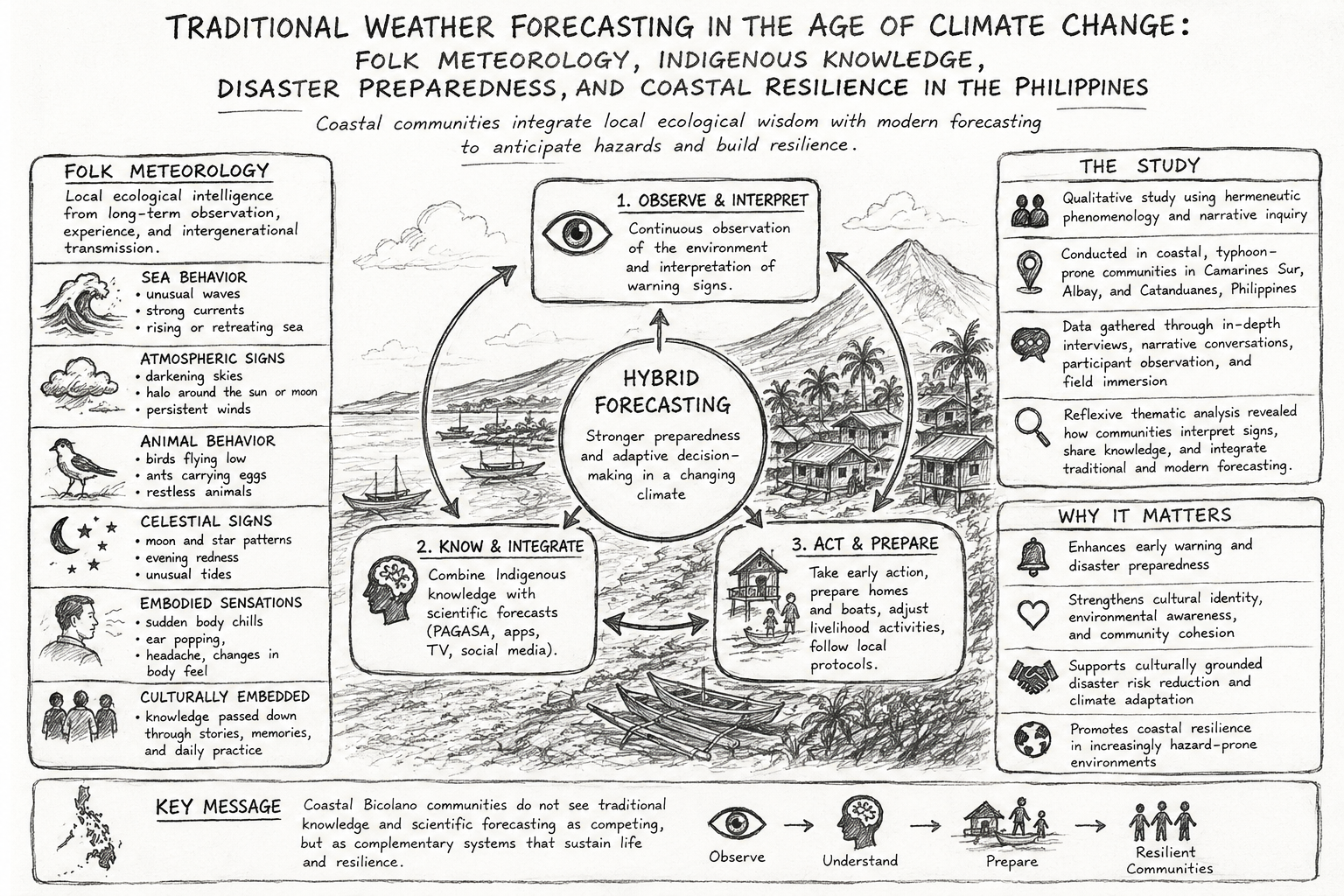
Despite increasing attention to disaster risk reduction and climate adaptation in the Philippines, limited research has examined folk meteorology as a culturally embedded system of local ecological intelligence among coastal communities. Existing studies often prioritize scientific forecasting technologies while overlooking how Indigenous environmental interpretation continues to shape preparedness and resilience in everyday life. Addressing this gap, the study explored how coastal Bicolano communities interpret environmental warning signs, transmit traditional forecasting knowledge, and integrate folk meteorology with modern disaster forecasting systems. Using a qualitative research design grounded in hermeneutic phenomenology and narrative inquiry, in-depth interviews, narrative conversations, participant observation, and field immersion were conducted among coastal residents, fisherfolk, and disaster survivors from typhoon-prone communities in Camarines Sur, Albay, and Catanduanes, Philippines. Reflexive thematic analysis revealed that folk meteorology remains deeply embedded within community life and disaster anticipation practices. Participants identified sea behavior, atmospheric conditions, celestial formations, animal movements, and embodied environmental sensations as important ecological indicators associated with approaching typhoons, floods, and storm surges. The findings further revealed that coastal communities do not perceive traditional ecological knowledge and scientific forecasting systems as competing forms of knowledge. Instead, respondents actively combine Indigenous ecological observations with official advisories, television forecasts, Facebook weather updates, and mobile weather applications to strengthen preparedness and adaptive decision-making. Beyond forecasting, folk meteorology also functions as a form of environmental hermeneutics shaping emotional resilience, cultural identity, and environmental awareness. The study emphasizes the importance of integrating local ecological intelligence into culturally grounded disaster risk reduction, climate adaptation, and community-based resilience planning in increasingly hazard-prone coastal environments.
- Open Access
- Article
Traditional Weather Forecasting in the Age of Climate Change: Folk Meteorology, Indigenous Knowledge, Disaster Preparedness, and Coastal Resilience in the Philippines
- Emmanuel A. Onsay
Author Information
Received: 24 May 2026 | Revised: 29 June 2026 | Accepted: 14 July 2026 | Published: 13 August 2026
Abstract
Graphical Abstract
Keywords
folk meteorology | local ecological intelligence | disaster preparedness | indigenous knowledge systems | coastal resilience | hybrid forecasting | climate adaptation
References
- 1.
Bankoff, G. Remaking the World in Our Own Image: Vulnerability, Resilience and Adaptation as Historical Discourses. Disasters 2019, 43, 221–239.
- 2.
Mercer, J.; Kelman, I.; Lloyd, K.; et al. Framework for Integrating Indigenous and Scientific Knowledge for Disaster Risk Reduction. Disasters 2010, 34, 214–239.
- 3.
Rudnev, V. Ethno-Meteorology: A Modern View about Folk Signs; Ibis Press: Paris, France, 2002.
- 4.
Lockhart, G. The Weather Companion: An Album of Meteorological History, Science, and Folklore; Turner Publishing Company: Nashville, TN, USA, 2008.
- 5.
Sharlanova, V. Folk Meteorology; FDK Publishing Agency: Sofia, Bulgaria, 1999.
- 6.
Berkes, F. Sacred Ecology, 3rd ed.; Routledge: New York, NY, USA, 2012.
- 7.
Hiwasaki, L.; Luna, E.; Syamsidik; et al. Local and Indigenous Knowledge on Climate-Related Hazards of Coastal and Small Island Communities in Southeast Asia. Clim. Chang. 2014, 128, 35–56.
- 8.
Toledo, V.M. Ethnoecology: A Conceptual Framework for the Study of Indigenous Knowledge of Nature. In Ethnobiology and Biocultural Diversity, Proceedings of the 7th International Congress of Ethnobiology, Athens, GA, USA, 23–27 October 2000; International Society of Ethnobiology, c/o University of Georgia Press: Athens, GA, USA, 2002.
- 9.
World Risk Report 2024; Bündnis Entwicklung Hilft: Berlin, Germany, 2024.
- 10.
Onsay, E.A. The Analysis of Green Growth Indicators in Predicting the Economic Development of Southeast Asian Countries. Rev. Socio-Econ. Perspect. 2021, 6, 1–15.
- 11.
PAGASA. Annual Tropical Cyclone Report; Philippine Atmospheric, Geophysical and Astronomical Services Administration: Quezon City, Philippines, 2024.
- 12.
Onsay, E.A.; Bulao, R.J.G.; Rabajante, J.F. Bagyong Kristine (TS Trami) in Bicol, Philippines: Flood Risk Forecasting, Disaster Risk Preparedness Predictions and Lived Experiences through Machine Learning (ML), Econometrics, and Hermeneutic Analysis. Nat. Hazards Res. 2025, 5, 644–677. https://doi.org/10.1016/j.nhres.2025.02.004.
- 13.
Sarmiento, R. The Catandunganons—Making and Seeing Selves through the Eye of the Typhoon. AghamTao 2011, 20, 68–86.
- 14.
UNDRR. Human Cost of Disasters: An Overview of the Last 20 Years 2000–2019; United Nations Office for Disaster Risk Reduction: Geneva, Switzerland, 2020.
- 15.
Gaillard, J.C.; Mercer, J. From Knowledge to Action: Bridging Gaps in Disaster Risk Reduction. Prog. Hum. Geogr. 2013, 37, 93–114.
- 16.
Onsay, E.A.; Rabajante, J.F. Combining Machine Learning (ML) and Participatory Rural Appraisal (PRA) for Disaster Risk Preparedness (DRP): Evidence from the Poorest Region of Luzon, Philippines. Int. J. Disaster Risk Reduct. 2024, 112, 104809. https://doi.org/10.1016/j.ijdrr.2024.104809.
- 17.
Onsay, E.A.; Velasco, J.M.; Sumaculub, G.B.; et al. When Artificial Intelligence Meets Cultural Knowledge: Forecasting Storm Surge Risks, Predicting Disaster Preparedness, and Building Resilient Coastal Communities in the Philippines. Nat. Hazards Res. 2026, in press. https://doi.org/10.1016/j.nhres.2026.02.005.18
- 18.
Onsay, E.A. Traditional Weather Forecasting in the Age of Climate Change: Folk Meteorology, Indigenous Knowledge, Disaster Preparedness, and Coastal Resilience in the Philippines. J. Hazards Risk Resil. 2026, Preprint. https://doi.org/10.5281/zenodo.21021858
- 19.
Onsay, E.A. Behavioral Economics of Disaster Risk Perception: Underestimating Flood Risks During a Non-Landfalling Tropical Cyclone and Acceptance of AI-Based Weather Forecasting in the Philippines' Typhoon Landfall Region. Econ. Disasters Clim. Chang. 2026, 10, 22
- 20.
IPCC. Climate Change 2023: Synthesis Report. Contribution of Working Groups I, II and III to the Sixth Assessment Report of the Intergovernmental Panel on Climate Change; Intergovernmental Panel on Climate Change: Geneva, Switzerland, 2023.
- 21.
Creswell, J.W.; Poth, C.N. Qualitative Inquiry and Research Design: Choosing Among Five Approaches; Sage Publications: Thousand Oaks, CA, USA, 2016.
- 22.
Narayan, K. How Native Is a “Native” Anthropologist? In Situated Lives; Routledge: London, UK, 2014; pp. 23–41.
- 23.
Bankoff, G. Cultures of Disaster: Society and Natural Hazard in the Philippines; Routledge: London, UK, 2003.
- 24.
Patton, M.Q. Qualitative Research & Evaluation Methods, 4th ed.; Sage Publications: Thousand Oaks, CA, USA, 2015.
- 25.
Denzin, N.K.; Lincoln, Y.S., Eds. The SAGE Handbook of Qualitative Research; Sage Publications: Thousand Oaks, CA, USA, 2011.
- 26.
Noy, C. Sampling Knowledge: The Hermeneutics of Snowball Sampling in Qualitative Research. Int. J. Soc. Res. Methodol. 2008, 11, 327–344.
- 27.
Riessman, C.K. Narrative Methods for the Human Sciences; Sage Publications: Thousand Oaks, CA, USA, 2008.
- 28.
Temple, B.; Young, A. Qualitative Research and Translation Dilemmas. Qual. Res. 2004, 4, 161–178.
- 29.
Musante, K.; DeWalt, B.R. Participant Observation: A Guide for Fieldworkers; Bloomsbury Publishing PLC: London, UK, 2010.
- 30.
Tracy, S.J. Qualitative Quality: Eight “Big-Tent” Criteria for Excellent Qualitative Research. Qual. Inq. 2010, 16, 837–851.
- 31.
Braun, V.; Clarke, V.; Hayfield, N.; et al. Doing Reflexive Thematic Analysis. In Supporting Research in Counselling and Psychotherapy: Qualitative, Quantitative, and Mixed Methods Research; Springer International Publishing: Cham, Switzerland, 2023; pp. 19–38.
- 32.
Lincoln, Y.; Guba, E. Naturalistic Inquiry; Sage Publications: Thousand Oaks, CA, USA, 1985.
- 33.
Shenton, A.K. Strategies for Ensuring Trustworthiness in Qualitative Research Projects. Educ. Inf. 2004, 22, 63–75.
- 34.
Berger, R. Now I See It, Now I Don’t: Researcher’s Position and Reflexivity in Qualitative Research. Qual. Res. 2015, 15, 219–234.
- 35.
Onsay, E. Untying Empirical Knots: Deterioration of Profitability, Economic Failure, and Financial Insolvency in the Philippines before COVID-19 Outbreak. J. Southeast Asian Stud. 2021, 26, 21–48.
- 36.
Orb, A.; Eisenhauer, L.; Wynaden, D. Ethics in Qualitative Research. J. Nurs. Scholarsh. 2001, 33, 93–96.
- 37.
Smith, L.T. Decolonizing Methodologies: Research and Indigenous Peoples; OTAGO UNIV PR: Dunedin, New Zealand, 1999.
- 38.
Kelman, I.; Mercer, J.; Gaillard, J.C. Indigenous Knowledge and Disaster Risk Reduction. Geography 2012, 97, 12–21.
- 39.
Nakashima, D.; Galloway McLean, K.; Thulstrup, H.; et al. Weathering Uncertainty: Traditional Knowledge for Climate Change Assessment and Adaptation; United Nations Educational Scientific and Cultural Organization (UNESCO): Paris, France, 2012.
- 40.
Aporta, C.; Higgs, E. Satellite Culture: Global Positioning Systems, Inuit Wayfinding, and the Need for a New Account of Technology. Curr. Anthropol. 2005, 46, 729–753.
- 41.
Johannes, R.E.; Freeman, M.M.; Hamilton, R.J. Ignore Fishers’ Knowledge and Miss the Boat. Fish Fish. 2000, 1, 257–271.
- 42.
Cruikshank, J. Do Glaciers Listen?: Local Knowledge, Colonial Encounters, and Social Imagination; UBC Press: Vancouver, BC, Canada, 2007.
- 43.
Krupnik, I.; Jolly, D. The Earth Is Faster Now: Indigenous Observations of Arctic Environmental Change; Arctic Research Consortium of the United States: Fairbanks, AK, USA, 2002.
- 44.
Fernández-Llamazares, Á.; Méndez-López, M.E.; Díaz-Reviriego, I.; et al. Links between Media Communication and Local Perceptions of Climate Change in an Indigenous Society. Clim. Chang. 2015, 131, 307–320.
- 45.
Shaw, R.; Uy, N.; Baumwoll, J., Eds. Indigenous Knowledge for Disaster Risk Reduction: Good Practices and Lessons Learned from Experiences in the Asia-Pacific Region; United Nations, International Strategy for Disaster Reduction: Paris, France, 2008.
- 46.
Leonard, S.; Parsons, M.; Olawsky, K.; et al. The Role of Culture and Traditional Knowledge in Climate Change Adaptation: Insights from East Kimberley, Australia. Global Environ. Chang. 2013, 23, 623–632.
- 47.
McMillen, H.L.; Ticktin, T.; Friedlander, A.; et al. Small Islands, Valuable Insights: Systems of Customary Resource Use and Resilience to Climate Change in the Pacific. Ecol. Soc. 2014, 19, 44.
- 48.
Ohmagari, K.; Berkes, F. Transmission of Indigenous Knowledge and Bush Skills among the Western James Bay Cree Women of Subarctic Canada. Hum. Ecol. 1997, 25, 197–222.
- 49.
Gómez-Baggethun, E.; Reyes-García, V. Reinterpreting Change in Traditional Ecological Knowledge. Hum. Ecol. 2013, 41, 643–647.
- 50.
McEwan, C. Postcolonialism and Development; Routledge: London, UK, 2008.
- 51.
Nyong, A.; Adesina, F.; Osman Elasha, B. The Value of Indigenous Knowledge in Climate Change Mitigation and Adaptation Strategies in the African Sahel. Mitig. Adapt. Strateg. Glob. Chang. 2007, 12, 787–797.
- 52.
Pfefferbaum, B.; Van Horn, R.L.; Pfefferbaum, R.L. A Conceptual Framework to Enhance Community Resilience Using Social Capital. Clin. Soc. Work J. 2017, 45, 102–110.
- 53.
Green, D.; Raygorodetsky, G. Indigenous Knowledge of a Changing Climate. Clim. Chang. 2010, 100, 239–242.
- 54.
Riedlinger, D.; Berkes, F. Contributions of Traditional Knowledge to Understanding Climate Change in the Canadian Arctic. Polar Rec. 2001, 37, 315–328. https://doi.org/10.1017/S0032247400017058.
- 55.
Adger, W.N.; Dessai, S.; Goulden, M.; et al. Are There Social Limits to Adaptation to Climate Change? Clim. Chang. 2009, 93, 335–354.
- 56.
Cunsolo, A.; Ellis, N.R. Ecological Grief as a Mental Health Response to Climate Change-Related Loss. Nat. Clim. Chang. 2018, 8, 275–281.
- 57.
Turner, N.J.; Clifton, H. “It’s So Different Today”: Climate Change and Indigenous Lifeways in British Columbia, Canada. Global Environ. Chang. 2009, 19, 180–190.
- 58.
Kirmayer, L.J.; Sehdev, M.; Whitley, R.; et al. Community Resilience: Models, Metaphors and Measures. Int. J. Indig. Health 2009, 5, 62–117.
- 59.
Berkes, F.; Colding, J.; Folke, C. Rediscovery of Traditional Ecological Knowledge as Adaptive Management. Ecol. Appl. 2000, 10, 1251–1262.
- 60.
World Meteorological Organization (WMO). State of the Global Climate 2023; World Meteorological Organization: Geneva, Switzerland, 2024.
- 61.
Cuaton, G.P.; Su, Y. Local-Indigenous Knowledge on Disaster Risk Reduction: Insights from the Mamanwa Indigenous Peoples in Basey, Samar after Typhoon Haiyan in the Philippines. Int. J. Disaster Risk Reduct. 2020, 48, 101596. https://doi.org/10.1016/j.ijdrr.2020.101596.
- 62.
Norris, F.H.; Stevens, S.P.; Pfefferbaum, B.; et al. Community Resilience as a Metaphor, Theory, Set of Capacities, and Strategy for Disaster Readiness. Am. J. Community Psychol. 2008, 41, 127–150.
- 63.
Pandey, R.S.; Liou, Y.-A. Typhoon Strength Rising in the Past Four Decades. Weather Clim. Extrem. 2022, 36, 100446. https://doi.org/10.1016/j.wace.2022.100446.
- 64.
UNDRR. Sendai Framework for Disaster Risk Reduction 2015–2030; United Nations Office for Disaster Risk Reduction: Geneva, Switzerland, 2015.

This work is licensed under a Creative Commons Attribution 4.0 International License.
