
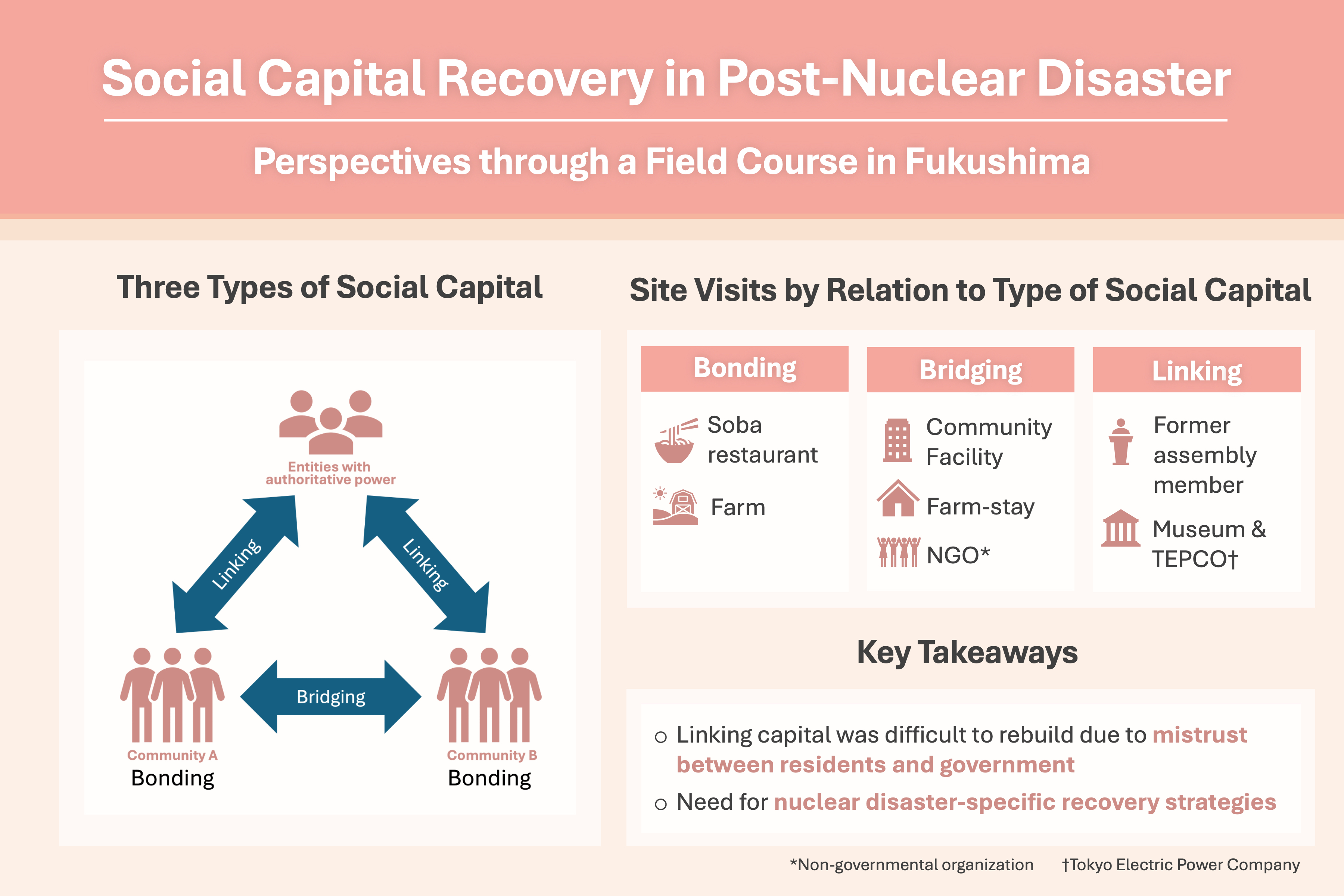
On 11 March 2011, the Great East Japan Earthquake and the Fukushima nuclear accident resulted in several detrimental consequences, including persistent stigmatization of disaster victims, disaster-related anxiety, and loss of trust for government authorities. Through a social capital lens, we aimed to share the perspectives of Fukushima residents who have lived through the post-disaster recovery process. Site visits and discussions with residents and local stakeholders were conducted during an 18-day field course in Fukushima organized by Harvard T.H. Chan School of Public Health. We evaluated current social capital recovery efforts using the definitions of bonding, bridging, and linking social capital. Bonding capital was built upon pre-existing cultural identity and ties to the community, sustained by individual community members who invest in the preservation of local traditions. Recovery of bridging capital highlighted the importance of community ownership and participation in local community initiatives. Linking capital was more difficult to rebuild due to mistrust between the residents and government. Implications for nuclear disaster risk reduction include supporting community-based leaders to help with sustainability of recovery efforts and improving accessibility and inclusivity to participating in community initiatives. Timely dissemination of information by the government in the acute phase of disaster is crucial to maintaining trust with the local people. This study concludes that exposure to nuclear radiation remains a concern in risk reduction planning for nuclear disaster, which calls for the need for nuclear disaster specific recovery strategies that focus on social capital and community recovery.
- Open Access
- Article
Social Capital Recovery in Post-Nuclear Disaster: Perspectives through a Field Course in Fukushima
Author Information
Received: 25 June 2026 | Revised: 21 July 2026 | Accepted: 28 August 2026 | Published: 14 September 2026
Abstract
Graphical Abstract
Keywords
disaster recovery | social capital | nuclear disaster | disaster risk reduction | Fukushima
References
- 1.
Thielen, H. The Fukushima Daiichi nuclear accident—An overview. Health Phys. 2012, 103, 169–174.
- 2.
Takahashi, S., Ed. Radiation Monitoring and Dose Estimation of the Fukushima Nuclear Accident; Springer: Cham, Switzerland, 2014.
- 3.
Do, X.B. Fukushima Nuclear Disaster displacement: How far people moved and determinants of evacuation destinations. Int. J. Disaster Risk Reduct. 2019, 33, 235–252.
- 4.
Kwesell, A. Trauma, self-stigma, and visual narrative: Participatory research in Shinchimachi, Fukushima, following Japan’s 2011 nuclear disaster. Vis. Commun. 2022, 21, 280–305. https://doi.org/10.1177/1470357220912458.
- 5.
Kwesell, A.; Jung, J.-Y. A multidimensional analysis of stigma: Findings from a qualitative study of Fukushima residents following Japan’s 2011 nuclear disaster. J. Int. Crisis Risk Commun. Res. 2019, 2, 233–258.
- 6.
Suzuki, Y.; Takebayashi, Y.; Yasumura, S.; et al. Changes in Risk Perception of the Health Effects of Radiation and Mental Health Status: The Fukushima Health Management Survey. Int. J. Environ. Res. Public Health 2018, 15, 1219. https://doi.org/10.3390/ijerph15061219.
- 7.
Bromet, E.J.; Havenaar, J.M.; Guey, L. A 25 year retrospective review of the psychological consequences of the Chernobyl accident. Clin. Oncol. 2011, 23, 297–305.
- 8.
Zhu, R.; Tao, Z.; Newman, G.; et al. Growth and shrinkage pre and post tsunami in Fukushima prefecture, Japan. Landsc. Res. Rec. 2020, 9, 132–147.
- 9.
Tateno, S.; Yokoyama, H.M. Public anxiety, trust, and the role of mediators in communicating risk of exposure to low dose radiation after the Fukushima Daiichi Nuclear Plant explosion. J. Sci. Commun. 2013, 12, A03.
- 10.
Prati, G.; Zani, B. The effect of the Fukushima nuclear accident on risk perception, antinuclear behavioral intentions, attitude, trust, environmental beliefs, and values. Environ. Behav. 2013, 45, 782–798.
- 11.
Dynes, R.R. The Importance of Social Capital in Disaster Response; Preliminary Paper 327; Disaster Research Center, University of Delaware: Newark, DE, USA, 2002.
- 12.
Uekusa, S.; Matthewman, S.; Lorenz, D.F. Conceptualising disaster social capital: What it is, why it matters, and how it can be enhanced. Disasters 2022, 46, 56–79.
- 13.
Nakagawa, Y.; Shaw, R. Social capital: A missing link to disaster recovery. Int. J. Mass Emerg. Disasters 2004, 22, 5–34.
- 14.
Iwasaki, K.; Sawada, Y.; Aldrich, D.P. Social capital as a shield against anxiety among displaced residents from Fukushima. Nat. Hazards 2017, 89, 405–421.
- 15.
Miller, D.S. Public trust in the aftermath of natural and na-technological disasters: Hurricane Katrina and the Fukushima Daiichi nuclear incident. Int. J. Sociol. Soc. Policy 2016, 36, 410–431.
- 16.
Yamaguchi, A.; Kim, M.-S.; Oshio, A.; et al. Influences of social capital on natural disaster research in Japan. J. Sustain. Dev. 2017, 10, 46–54.
- 17.
Isaji, R.; Rahman, N.K.; Diaz-Quiroz, M.; et al. Overview of Harvard’s inaugural Fukushima field trip course. Fukushima J. Med. Sci. 2026, 72, 73–78.
- 18.
Rahman, N.K.; Parkinson, K.; Kozak, K.; et al. Harvard’s second Fukushima field trip course: An overview. Fukushima J. Med. Sci. 2026, 26-00016. https://doi.org/10.5387/fms.26-00016.
- 19.
United Nations Office for Disaster Risk Reduction. Sendai Framework for Disaster Risk Reduction 2015–2030. Available online: https://www.undrr.org/publication/sendai-framework-disaster-risk-reduction-2015-2030 (accessed on 17 June 2026).
- 20.
Claridge, T. Functions of social capital–bonding, bridging, linking. Soc. Cap. Res. 2018, 20, 1–7.
- 21.
Fukushima- BASE. Kawamata-BASE. Available online: https://kawamata-base.com (accessed on 16 May 2026).
- 22.
Ferme Naturelle KOKUBUN. Available online: http://www.fnkokubun.com (accessed on 16 May 2026).
- 23.
NPO Fukushima Dialogue. Available online: https://fukushima-dialogue.jp/en/ (accessed on 16 May 2026).
- 24.
Kitakata Tourism and Local Products Association. Available online: https://www.kitakata-kanko.jp/ (accessed on 16 May 2026).
- 25.
Ministry of Agriculture, Forestry and Fisheries of Japan. 2020 Agriculture and Forestry Census. Available online: https://www.maff.go.jp/j/tokei/census/shuraku_data/2020/sa/sa_2020/todoufuken_2020.html (accessed on 17 June 2026).
- 26.
Ministry of Agriculture, Forestry and Fisheries of Japan. 2010 Agriculture and Forestry Census. Available online: https://www.maff.go.jp/j/tokei/census/shuraku_data/2020/sa/sa_2010/todoufuken_2010.html (accessed on 17 June 2026).
- 27.
Hoshi General Hospital. Omachi Terrace. Available online: https://omachi-terrace.jp (accessed on 22 February 2026).
- 28.
Fujimori, K.; Ishii, K.; Kyozuka, H.; et al. Final report of trends in pregnancy and birth survey after the Great East Japan Earthquake and Fukushima Daiichi Nuclear Power Plant Accident: The Fukushima health management survey. Fukushima J. Med. Sci. 2025, 71, 35–46.
- 29.
Fukushima Innovation Coast Promotion Organization. The Great East Japan Earthquake and Nuclear Disaster Memorial Museum. Available online: https://www.fipo.or.jp/lore/en (accessed on 17 June 2026).
- 30.
Japanese Communist Party Central Committee. Fukushima Nuclear Disaster Memorial Museum: Storytellers Who Cannot Speak—Manual Prohibits Criticism of Specific Organizations. Available online: https://www.jcp.or.jp/akahata/aik20/2020-10-09/2020100915_01_1.html (accessed on 17 June 2026).
- 31.
Tokyo Electric Power Company Holdings, Inc. TEPCO Decommissioning Archive Center. Available online: https://www.tepco.co.jp/fukushima_hq/decommissioning_ac/ (accessed on 16 May 2026).
- 32.
Ministry of Foreign Affairs of Japan. What is “ALPS treated water”? Available online: https://www.mofa.go.jp/dns/inec/alps_navi01.html (accessed on 17 June 2026).
- 33.
Karunarathne, A.Y.; Lee, G. Traditional social capital and socioeconomic networks in response to flood disaster: A case study of rural areas in Sri Lanka. Int. J. Disaster Risk Reduct. 2019, 41, 101279.
- 34.
Bhakta Bhandari, R. Social capital in disaster risk management: A case study of social capital mobilization following the 1934 Kathmandu Valley earthquake in Nepal. Disaster Prev. Manag. 2014, 23, 314–328.
- 35.
Erikson, K. A New Species of Trouble: The Human Experience of Modern Disasters; WW Norton & Company: New York, NY, USA, 1995.
- 36.
Beck, U. Risk Society: Towards a New Modernity; Sage: Thousand Oaks, CA, USA, 1992.
- 37.
Renn, O.; Levine, D. Credibility and trust in risk communication. In Communicating Risks to the Public: International Perspectives; Technology, Risk, and Society; Kasperson, R.E., Stallen, P.J.M., Eds.; Springer: Dordrecht, Netherlands, 1991; Vol. 4, pp. 175–217.
- 38.
Siegrist, M.; Bearth, A. Worldviews, trust, and risk perceptions shape public acceptance of COVID-19 public health measures. Proc. Natl. Acad. Sci. USA 2021, 118, e2100411118.
- 39.
Rogner, H.-H. World outlook for nuclear power. Energy Strategy Rev. 2013, 1, 291–295.

This work is licensed under a Creative Commons Attribution 4.0 International License.
