
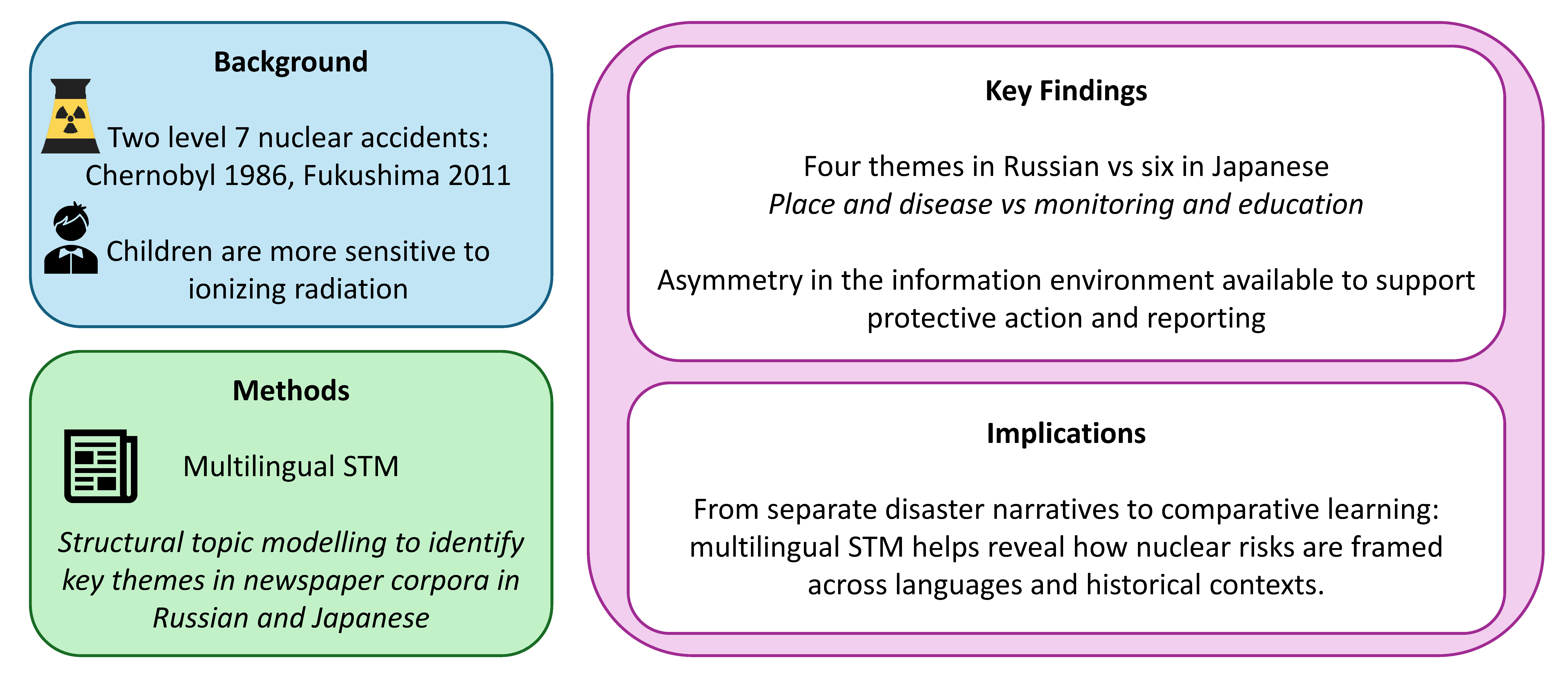
Public media communication, particularly through newspapers, plays a critical role in shaping public awareness, governmental response, and remediation efforts following large-scale crises, including nuclear power plant accidents. Because children are biologically more vulnerable to the effects of ionizing radiation, understanding how media narratives include children following nuclear events is especially important. This study employed a novel multilingual computational approach to analyze newspaper coverage following the Chernobyl (1986) and Fukushima (2011) accidents in Russian and Japanese. Using structural topic modeling (STM), we examined dominant themes related to children, nuclear events, and thyroid-related health concerns across both contexts. The analysis identified four topics in the Russian-language newspaper and six topics in the Japanese newspaper. Themes in the Russian-language newspaper focused more on the geographical environment, affected populations, and disease, while the Japanese newspaper emphasized health management, surveys, peace education, the Fukushima nuclear disaster, radiation, and Chernobyl, showcasing specific cultural emphasis in media reporting. Coverage of the later accident drew explicitly on the earlier one, whereas no comparable precedent was available at the time of Chernobyl, indicating an asymmetry in the information environment available to support protective action. Although the small and uneven corpus limits generalizability, the study demonstrates the exploratory value of multilingual STM for comparing nuclear-disaster reporting across languages and historical contexts.
- Open Access
- Article
A Multilingual Media Analysis of Pediatric and Thyroid-Related Newspaper Communications Following the Chernobyl and Fukushima Nuclear Disasters
Author Information
Received: 20 June 2026 | Revised: 31 August 2026 | Accepted: 02 September 2026 | Published: 17 September 2026
Abstract
Graphical Abstract
Keywords
media analysis | Chernobyl | Fukushima | multilingual | thyroid
References
- 1.
Lowrey, W.; Evans, W.; Gower, K.K.; et al. Effective media communication of disasters: Pressing problems and recommendations. BMC Public Health 2007, 7, 97. https://doi.org/10.1186/1471-2458-7-97.
- 2.
Fukasawa, M.; Kawakami, N.; Umeda, M.; et al. Distrust in government and its relationship with mental health after the Fukushima nuclear power plant accident. Int. J. Soc. Psychiatry 2021, 67, 680–686. https://doi.org/10.1177/0020764020968129.
- 3.
Perko, T. Risk communication in the case of the Fukushima accident: Impact of communication and lessons to be learned. Integr. Environ. Assess. Manag. 2016, 12, 683–686. https://doi.org/10.1002/ieam.1832.
- 4.
Orui, M.; Nakayama, C.; Kuroda, Y.; et al. The Association between Utilization of Media Information and Current Health Anxiety Among the Fukushima Daiichi Nuclear Disaster Evacuees. Int. J. Environ. Res. Public Health 2020, 17, 3921. https://doi.org/10.3390/ijerph17113921.
- 5.
Kashiwazaki, Y.; Takebayashi, Y.; Murakami, M. Relationships between radiation risk perception and health anxiety, and contribution of mindfulness to alleviating psychological distress after the Fukushima accident: Cross-sectional study using a path model. PLoS ONE 2020, 15, e0235517. https://doi.org/10.1371/journal.pone.0235517.
- 6.
Suzuki, Y.; Yabe, H.; Yasumura, S.; et al. Psychological distress and the perception of radiation risks: the Fukushima health management survey. Bull. World Health Organ. 2015, 93, 598–605. https://doi.org/10.2471/blt.14.146498.
- 7.
Högberg, L. Root Causes and Impacts of Severe Accidents at Large Nuclear Power Plants. Ambio 2013, 42, 267–284. https://doi.org/10.1007/s13280-013-0382-x.
- 8.
Rojavin, Y.; Seamon, M.J.; Tripathi, R.S.; et al. Civilian nuclear incidents: An overview of historical, medical, and scientific aspects. J. Emerg. Trauma Shock. 2011, 4, 260–272. https://doi.org/10.4103/0974-2700.82219.
- 9.
Caparic, J.S.; Donor, L.; Dosmanos, E.B.; et al. Comparative Risk Review of Major Nuclear Disasters: Analyzing Radiation Exposure, Environmental Impact and Health Consequences Across the Worst Accidents. Int. J. Innov. Sci. Res. Technol. 2025, 10, 717–726. https://doi.org/10.38124/ijisrt/25mar748.
- 10.
International Atomic Energy Agency. Fukushima Nuclear Accident Update Log. 2011. Available online: https://www.iaea.org/newscenter/news/fukushima-nuclear-accident-update-log-15 (accessed on 1 June 2026).
- 11.
Kai, M.; Homma, T.; Lochard, J.; et al. Radiological Protection of People and the Environment in the Event of a Large Nuclear Accident; SAGE: London, UK, 2020; p. 137.
- 12.
International Atomic Energy Agency. Environmental Consequences of the Chernobyl Accident and Their Remediation: Twenty Years of Experience. Report of the Chernobyl Forum Expert Group ‘Environment’. 2006. Available online: https://www-pub.iaea.org/MTCD/publications/PDF/Pub1239_web.pdf (accessed on 1 June 2026).
- 13.
Yap, C.K.; Al-Mutairi, K.A. Chernobyl nuclear catastrophe: lessons for sustainability and UNSDGs in health, energy, and environmental recovery. Front. Public Health 2025, 13, 1552122. https://doi.org/10.3389/fpubh.2025.1552122.
- 14.
Steinhauser, G.; Brandl, A.; Johnson, T.E. Comparison of the Chernobyl and Fukushima nuclear accidents: A review of the environmental impacts. Sci. Total Environ. 2014, 470–471, 800–817. https://doi.org/10.1016/j.scitotenv.2013.10.029. Erratum in Sci. Total Environ. 2014, 487, 575.
- 15.
Uyba, V.; Samoylov, A.; Shinkarev, S. Comparative analysis of the countermeasures taken to mitigate exposure of the public to radioiodine following the Chernobyl and Fukushima accidents: lessons from both accidents. J. Radiat. Res. 2018, 59, ii40–ii47. https://doi.org/10.1093/jrr/rry002.
- 16.
Evrard, O.; Laceby, J.P.; Nakao, A. Effectiveness of landscape decontamination following the Fukushima nuclear accident: A review. Soil 2019, 5, 333–350. https://doi.org/10.5194/soil-5-333-2019.
- 17.
International Atomic Energy Agency. Chernobyl's Legacy: Health, Environmental and Socio-Economic Impacts and Recommendations to the Governments of Belarus, the Russian Federation and Ukraine; IAEA: Vienna, Austria, 2006.
- 18.
Nonaka, S.; Sawano, T.; Oikawa, T.; et al. Difficulties faced by three hospitals evacuated from the urgent protective action planning zone after the 2011 Fukushima Daiichi Nuclear power plant accident. J. Radiat. Res. 2024, 65, i67–i79. https://doi.org/10.1093/jrr/rrae015.
- 19.
Vanmarcke, H. Importance of Engaging in Dialogue with the Population after a Nuclear Accident. Radiat. Prot. Dosim. 2017, 173, 63–68. https://doi.org/10.1093/rpd/ncw320.
- 20.
Ochi, S. ‘Life communication’ after the 2011 Fukushima nuclear disaster: what experts need to learn from residential non-scientific rationality. J. Radiat. Res. 2021, 62, i88–i94. https://doi.org/10.1093/jrr/rraa135.
- 21.
Rasmussen, J.; Eriksson, M.; Martinsson, J. Citizens’ Communication Needs and Attitudes to Risk in a Nuclear Accident Scenario: A Mixed Methods Study. Int. J. Environ. Res. Public Health 2022, 19, 7709. https://doi.org/10.3390/ijerph19137709.
- 22.
Takamura, N.; Orita, M.; Taira, Y.; et al. Experiences of crisis communication during radiation emergency and risk communication for recovery of the community in Fukushima. J. Radiat. Res. 2021, 62, i95–i100. https://doi.org/10.1093/jrr/rraa113.
- 23.
Kutanzi, K.R.; Lumen, A.; Koturbash, I.; et al. Pediatric Exposures to Ionizing Radiation: Carcinogenic Considerations. Int. J. Environ. Res. Public Health 2016, 13, 1057. https://doi.org/10.3390/ijerph13111057.
- 24.
United Nations Scientific Committee on the Effects of Atomic Radiation. Sources and Effects of Ionizing Radiation, United Nations Scientific Committee on the Effects of Atomic Radiation (UNSCEAR) 1996 Report; United Nations: New York, NY, USA, 1996; p. 87.
- 25.
Luccioni, C.; Kornevich, O.; Rozhko, A.; et al. Health check-ups of children living in a Belarus district contaminated after the Chernobyl accident. Radioprotection 2016, 51, 91–99. https://doi.org/10.1051/radiopro/2016020.
- 26.
Suzuki, K.; Mitsutake, N.; Saenko, V.; et al. Radiation signatures in childhood thyroid cancers after the Chernobyl accident: Possible roles of radiation in carcinogenesis. Cancer Sci. 2015, 106, 127–133. https://doi.org/10.1111/cas.12583.
- 27.
Lubin, J.H.; Adams, M.J.; Shore, R.; et al. Thyroid Cancer Following Childhood Low-Dose Radiation Exposure: A Pooled Analysis of Nine Cohorts. J. Clin. Endocrinol. Metab. 2017, 102, 2575–2583. https://doi.org/10.1210/jc.2016-3529.
- 28.
Massimino, M.; Gandola, L.; Mattavelli, F.; et al. Radiation-induced thyroid changes: A retrospective and a prospective view. Eur. J. Cancer 2009, 45, 2546–2551. https://doi.org/10.1016/j.ejca.2009.06.009.
- 29.
Fushiki, S. Radiation hazards in children – Lessons from Chernobyl, Three Mile Island and Fukushima. Brain Dev. 2013, 35, 220–227. https://doi.org/10.1016/j.braindev.2012.09.004.
- 30.
Cardis, E.; Krewski, D.; Boniol, M.; et al. Estimates of the cancer burden in Europe from radioactive fallout from the Chernobyl accident. Int. J. Cancer 2006, 119, 1224–1235. https://doi.org/10.1002/ijc.22037.
- 31.
Pacini, F.; Vorontsova, T.; Demidchik, E.P.; et al. Post-Chernobyl Thyroid Carcinoma in Belarus Children and Adolescents: Comparison with Naturally Occurring Thyroid Carcinoma in Italy and France. J. Clin. Endocrinol. Metab. 1997, 82, 3563–3569. https://doi.org/10.1210/jcem.82.11.4367.
- 32.
Demidchik, Y.E.; Saenko, V.A.; Yamashita, S. Childhood thyroid cancer in Belarus, Russia, and Ukraine after Chernobyl and at present. Arq. Bras. Endocrinol. Metabol. 2007, 51, 748–762. https://doi.org/10.1590/s0004-27302007000500012.
- 33.
Ory, C.; Leboulleux, S.; Salvatore, D.; et al. Consequences of atmospheric contamination by radioiodine: the Chernobyl and Fukushima accidents. Endocrine 2021, 71, 298–309. https://doi.org/10.1007/s12020-020-02498-9.
- 34.
Williams, D. Twenty years’ experience with post-Chernobyl thyroid cancer. Best Pract. Res. Clin. Endocrinol. Metab. 2008, 22, 1061–1073. https://doi.org/10.1016/j.beem.2008.09.020.
- 35.
Cléro, E.; Ostroumova, E.; Demoury, C.; et al. Lessons learned from Chernobyl and Fukushima on thyroid cancer screening and recommendations in case of a future nuclear accident. Environ. Int. 2021, 146, 106230. https://doi.org/10.1016/j.envint.2020.106230.
- 36.
Koerner, C.L. Media, fear, and nuclear energy: A case study. Soc. Sci. J. 2014, 51, 240–249. https://doi.org/10.1016/j.soscij.2013.07.011.
- 37.
Thu Zar, W.; Hande, V.; Orita, M.; et al. Concerns and knowledge-seeking behavior among Futaba residents after the Fukushima nuclear disaster: insights from qualitative and quantitative analyses. Radioprotection 2025, 60, 344–353. https://doi.org/10.1051/radiopro/2025016.
- 38.
Sugimoto, A.; Nomura, S.; Tsubokura, M.; et al. The Relationship between Media Consumption and Health-Related Anxieties after the Fukushima Daiichi Nuclear Disaster. PLoS ONE 2013, 8, e65331. https://doi.org/10.1371/journal.pone.0065331.
- 39.
Nakayama, C.; Iwasa, H.; Moriyama, N.; et al. Relationship between the Effects of Perceived Damage Caused by Harmful Rumors about Fukushima after the Nuclear Accident and Information Sources and Media. Int. J. Environ. Res. Public Health 2023, 20, 2077. https://doi.org/10.3390/ijerph20032077.
- 40.
Gallego, E.; Cantone, M.C.; Oughton, D.H.; et al. Mass media communication of emergency issues and countermeasures in a nuclear accident: Fukushima reporting in European newspapers. Radiat. Prot. Dosim. 2017, 173, 163–169. https://doi.org/10.1093/rpd/ncw334.
- 41.
Tricco, A.C.; Lillie, E.; Zarin, W.; et al. PRISMA Extension for Scoping Reviews (PRISMA-ScR): Checklist and Explanation. Ann. Intern. Med. 2018, 169, 467–473. https://doi.org/10.7326/m18-0850.
- 42.
Roberts, M.E.; Stewart, B.M.; Tingley, D. stm: An R Package for Structural Topic Models. J. Stat. Softw. 2019, 91, 1–40. https://doi.org/10.18637/jss.v091.i02.
- 43.
Murakami, M.; Nishikawa, Y.; Kitajima, M. Analysis of research fields involving wastewater-based epidemiology and interdisciplinary spillovers using a structural topic model. Results Chem. 2024, 12, 101897. https://doi.org/10.1016/j.rechem.2024.101897.
- 44.
Nishikawa, Y.; Ueda, K.; Masuzawa, Y.; et al. Case Study Related to Disasters: A Large-Scale Analysis Using Structural Topic Modeling. Disaster Med. Public Health Prep. 2026, 20, e13. https://doi.org/10.1017/dmp.2025.10279.
- 45.
Page, M.J.; McKenzie, J.E.; Bossuyt, P.M.; et al. The PRISMA 2020 statement: An updated guideline for reporting systematic reviews. BMJ 2021, 372, n71. https://doi.org/10.1136/bmj.n71
- 46.
World Health Organization. Iodine Thyroid Blocking: Guidelines for Use in Planning for and Responding to Radiological and Nuclear Emergencies; World Health Organization: Geneva, Switzerland, 2017.
- 47.
Nishikawa, Y.; Oguro, F.; Suzuki, C.; et al. Stable Iodine Intake and Thyroid Screening Outcomes after the Fukushima Nuclear Disaster: An Observational Study. J. Clin. Endocrinol. Metab. 2026, 111, e142–e147. https://doi.org/10.1210/clinem/dgaf312.
- 48.
Nishikawa, Y.; Suzuki, C.; Oguro, F.; et al. Stable Iodine Intake During Pregnancy and Children’s Thyroid Screening Outcomes after the 2011 Fukushima Nuclear Disaster in Japan: A Municipality-based Descriptive Study. Disaster Med. Public Health Prep. 2025, 19, e142. https://doi.org/10.1017/dmp.2025.10048.
- 49.
Goto, A.; Satoh, K.; Reich, M.R. Two pills and women’s health in Japan. Lancet Reg. Health-West. Pac. 2023, 40, 100946. https://doi.org/10.1016/j.lanwpc.2023.100946.

This work is licensed under a Creative Commons Attribution 4.0 International License.
