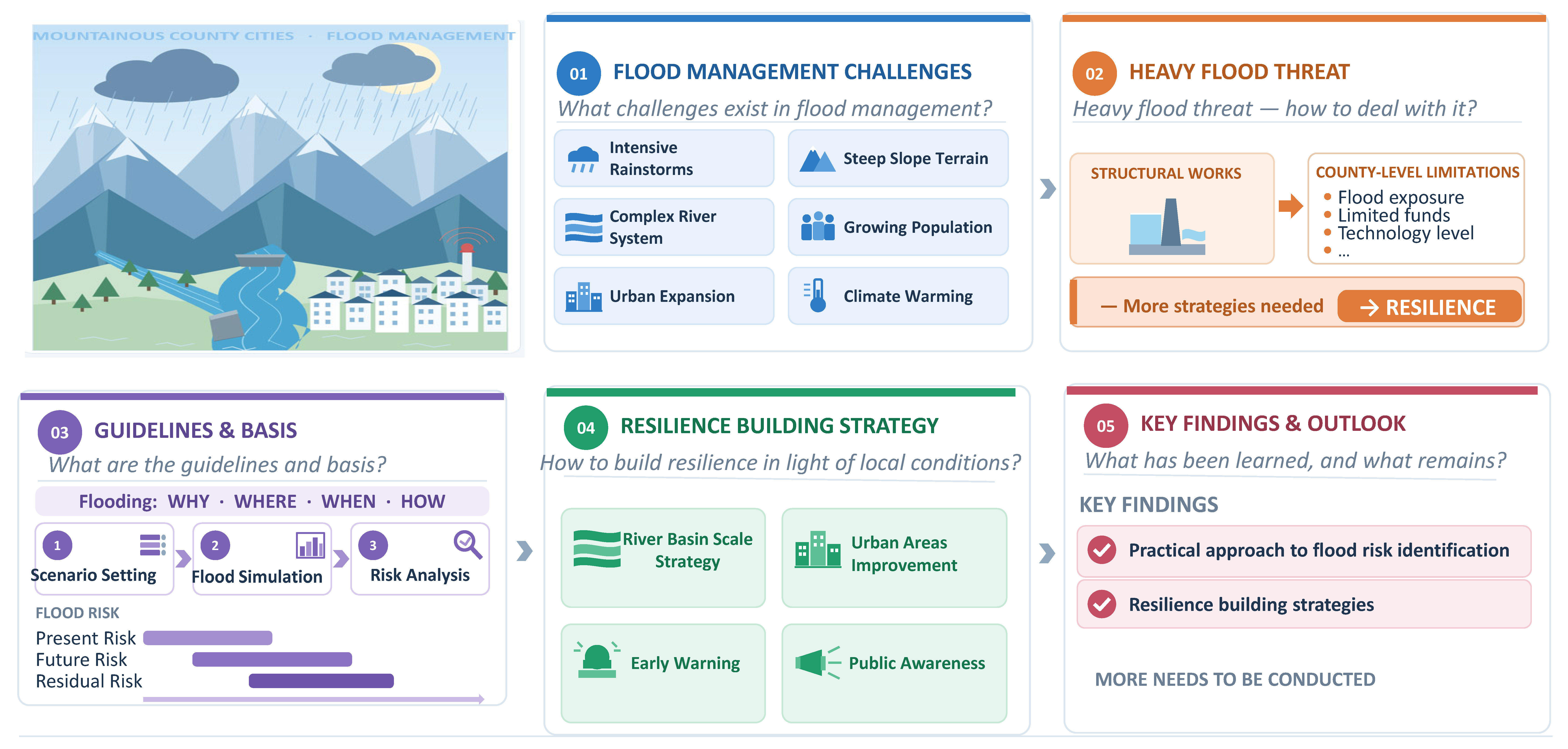
China has a large number of county-level cities in mountainous areas which are very prone to rainstorm-caused floods. Moreover, as county-level city, the exposures, as well as available funding and technologies, are very limited, and flood control standards are also constrained, therefore, resilience building is essential for flood management. Taking Xichuan as an example, this paper performed the analysis on the present, future, and residual flood risks in the urban area using flood simulation and scenario analysis methods, in which several key factors were taken into account, including built-up area expansion, flood control infrastructure improvement, rainfall change due to climate warming, and changes in the hydrological characteristics of the underlying surface due to human activities. Based on these findings, the strategies were proposed and analyzed for resilience building, including (1) practicing systematic management at river basin scale to delay and cut down of peak discharge flow of floods to the city, (2) establishing a multi-level, synergistic defense system integrating gray, green, and blue infrastructures to mitigate flooding, waterlogging and river bank erosion in urban areas, (3) enhancing the resilience of key infrastructures to keep the basic functions for the city during flooding, (4) strengthening monitoring and early warning capabilities, and (5) raising public’s awareness of flood risks and capacity of responding to floods, both (4) and (5) are significantly helpful for the public to timely take correct actions in case of floods.
- Open Access
- Article
Flood Risk Identification and Resilience Building Strategies for Mountainous County Level City—A Case Study of Xichuan
- Changzhi Li 1,*,
- Xiuling Pan 2,
- Jiali Shao 2 and
- Jian Wang 3
Author Information
Received: 29 June 2026 | Revised: 07 September 2026 | Accepted: 08 September 2026 | Published: 05 November 2026
Abstract
Graphical Abstract
Keywords
county level city | mountainous area | flood risk | resilience building
References
- 1.
Zhao, S.; Chen, X.; Zou, X.; et al. Spatiotemporal characteristics of extreme continuous precipitation processes in China during 1961–2022 (In Chinese). Hydro-Sci. Eng. 2026, 1, 23–33. https://doi.org/10.12170/20241219002.
- 2.
Cheng, X.; Yu, Q. Discussion on urban flood prevention and resilience enhancement in the transformation of high-quality water conservancy development (In Chinese). Water Resour. Dev. Res. 2025, 25, 1–11. https://doi.org/10.13928/j.cnki.wrdr.2025.11.001.
- 3.
Mechler, R.; Żebrowski, P.; Clercq-Roques, R.; et al. Positive externalities in the polycrisis: Effectively addressing disaster and climate risks for generating multiple resilience dividends. Int. J. Disaster Risk Sci. 2025, 16, 575–593. https://doi.org/10.1007/s13753-025-00661-2.
- 4.
Marcos, M.; Rohmer, J.; Vousdoukas, M.I.; et al. Increased extreme coastal water levels due to the combined action of storm surges and wind waves. Geophys. Res. Lett. 2019, 46, 4356–4364. https://doi.org/10.1029/2019gl082599.
- 5.
Sultan, U.; Waseem, M.; Shahid, M.; et al. Assessing vegetation dynamics and response patterns to climate change and human activities using advanced analytical tools. Environ. Earth Sci. 2024, 83, 356. https://doi.org/10.1007/s12665-024-11678-z.
- 6.
Li, H.L.; Xie, Y.; Tian, X.R.; et al. Impacts of climate change and human activities on vegetation cover change in Haihe River Basin (In Chinese). Res. Soil Water Conserv. 2026, 33, 178–185.
- 7.
Kikstra, J.S.; Nicholls, Z.R.J.; Smith, C.J.; et al. The IPCC Sixth Assessment Report WGIII climate assessment of mitigation pathways: From emissions to global temperatures. Geosci. Model Dev. 2022, 15, 9075–9109. https://doi.org/10.5194/gmd-15-9075-2022.
- 8.
Krishnan, R.; Dhara, C.; Horinouchi, T.; et al. Compound weather and climate extremes in the Asian region: Science-informed recommendations for policy. Front. Clim. 2024, 6, 1504475. https://doi.org/10.3389/fclim.2024.1504475.
- 9.
Li, Y.; Kappas, M.; Li, Y. Exploring the coastal urban resilience and transformation of coupled human-environment systems. J. Clean. Prod. 2018, 195, 1505–1511. https://doi.org/10.1016/j.jclepro.2017.10.227.
- 10.
Lu, P.; Sun, Y. Scenario-based hydrodynamic simulation of adaptive strategies for urban design to improve flood resilience: A case study of the Mingzhu Bay Region, Guangzhou, Greater Bay Area. River Res. Appl. 2023, 39, 1425–1436. https://doi.org/10.1002/rra.3913.
- 11.
Alves, A.; Vojinovic, Z.; Kapelan, Z.; et al. Exploring trade-offs among the multiple benefits of green-blue-grey infrastructure for urban flood mitigation. Sci. Total Environ. 2020, 703, 134980. https://doi.org/10.1016/j.scitotenv.2019.134980.
- 12.
Cheng, X.T.; Liu, C.J.; Li, C.Z.; et al. Evolution characteristics of flood risk under changing environment and strategy of urban resilience improvement (In Chinese). J. Hydraul. Eng. 2022, 53, 757–768.
- 13.
Zhou, W.; Zhu, J. Review on nature-based solutions and applications on urban waterlogging mitigation (In Chinese). Acta Ecol. Sin. 2022, 42, 5137–5151. https://doi.org/10.5846/stxb202106021454.
- 14.
Chiu, Y.Y.; Raina, N.; Chen, H.E. Evolution of flood defense strategies: Toward nature-based solutions. Environments 2022, 9, 2. https://doi.org/10.3390/environments9010002.
- 15.
Kapetas, L.; Fenner, R. Integrating blue-green and grey infrastructure through an adaptation pathways approach to surface water flooding. Philos. Trans. R. Soc. A Math. Phys. Eng. Sci. 2020, 378, 20190204. https://doi.org/10.1098/rsta.2019.0204.
- 16.
Meng, M.; Dabrowski, M.; Stead, D. Enhancing flood resilience and climate adaptation: The state of the art and new directions for spatial planning. Sustainability 2020, 12, 7864. https://doi.org/10.3390/su12197864.
- 17.
Uhlenbrook, S.; Connor, R.; Koncagül, E.; et al. The United Nations World Water Development Report 2018: Nature-Based Solutions for Water; United Nations Educational, Scientific and Cultural Organization: Paris, France, 2018.
- 18.
Asian Development Bank. Henan Xichuan Integrated Ecological Protection and Environmental Improvement Project: Report and Recommendation of the President (Project Number PRC-53053-001); ADB: Manila, Philippines, 2021.
- 19.
Changjiang Survey, Planning, Design and Research Co., Ltd. Feasible Study Report of Henan Xichuan Integrated Ecological Protection and Environmental Improvement Project (In Chinese); Changjiang Survey, Planning, Design and Research Co., Ltd.: Wuhan, China, 2020.
- 20.
Xichuan Government. Xichuan Territorial Spatial Planning (In Chinese); Xichuan Government: Xichuan, China, 2021.
- 21.
Kron, W. Flood Risk = Hazard·Values·Vulnerability. Water Int. 2005, 30, 58–68. https://doi.org/10.1080/02508060508691837.
- 22.
Plate, E.J. Flood risk and flood management. J. Hydrol. 2002, 267, 2–11. https://doi.org/10.1016/s0022-1694(02)00135-x.
- 23.
Wang, H.; Huang, S.; Fang, W.; et al. Multivariable flood risk and its dynamics considering project reasonable service life in a changing environment. J. Hydrol. 2020, 590, 125524. https://doi.org/10.1016/j.jhydrol.2020.125524.
- 24.
Hanif, A.; Dhanasekar, A.; Keene, A.; et al. Flood risk assessment methodology for planning under climate change scenarios and the corresponding change in land cover. J. Water Clim. Chang. 2020, 11, 1370–1382. https://doi.org/10.2166/wcc.2019.016.
- 25.
Liu, Z.; Yao, H.; Chen, Z.; et al. Differences in cost efficiency of runoff control in different urban built-up phases. Front. Environ. Sci. Eng. 2025, 19, 161. https://doi.org/10.1007/s11783-025-2081-9.
- 26.
Hsiao, S.C.; Chiang, W.S.; Jang, J.H.; et al. Flood risk influenced by the compound effect of storm surge and rainfall under climate change for low-lying coastal areas. Sci. Total Environ. 2021, 764, 144439. https://doi.org/10.1016/j.scitotenv.2020.144439.
- 27.
Feng, B.; Zhang, Y.; Bourke, R. Urbanization impacts on flood risks based on urban growth data and coupled flood models. Nat. Hazards 2021, 106, 613–627. https://doi.org/10.1007/s11069-020-04480-0.
- 28.
Nguyen, H.D.; Fox, D.; Dang, D.K.; et al. Predicting future urban flood risk using land change and hydraulic modeling in a river watershed in the central province of Vietnam. Remote Sens. 2021, 13, 262. https://doi.org/10.3390/rs13020262.
- 29.
Zhang, K.B. Soil and Water Conservation/Combating Rocky Desertification in Xichuan County of Henan Province; Supplementary Document. Project Number: PRC-53053-001; ADB: Manila, Philippines, 2020.
- 30.
Brunner, G.W. Hydraulic Reference Manual of HEC-RAS; Hydraulic Engineering Centre of US Army Corps of Engineers: Davis, CA, USA, 2021.
- 31.
Henan Provincial Water Conservancy Survey Design Institute. Atlas of Design Storms and Floods for Small- and Medium-Sized Watersheds in Henan Province (In Chinese); Institute of Survey and Design, Henan Provincial Water Conservancy: Zhengzhou, China, 1984.
- 32.
Xu, H.M. Climate Change Impacts, Risks and Adaptations Assessment; Supplementary Document. Project Number: PRC-53053-001; ADB: Manila, Philippines, 2020.
- 33.
Ministry of Water Resources of the People’s Republic of China. Guidelines for Flood Risk Mapping (In Chinese); MWR: Beijing, China, 2017.
- 34.
Office of the National Flood Control and Drought Relief Headquarters; Chengdu Institute of Mountain Hazards and Environment, CAS and MWR. Flash Floods, Mudslides, and Landslides: Disasters and Prevention and Mitigation (In Chinese); Science Press: Beijing, China, 1994; pp. 2–41.
- 35.
Zhong, W. Effects of soil and water conservation measures on runoff and sediment yield from slopes under heavy rainfall conditions (In Chinese). Marit. Saf. 2025, 18, 106–108.

This work is licensed under a Creative Commons Attribution 4.0 International License.