
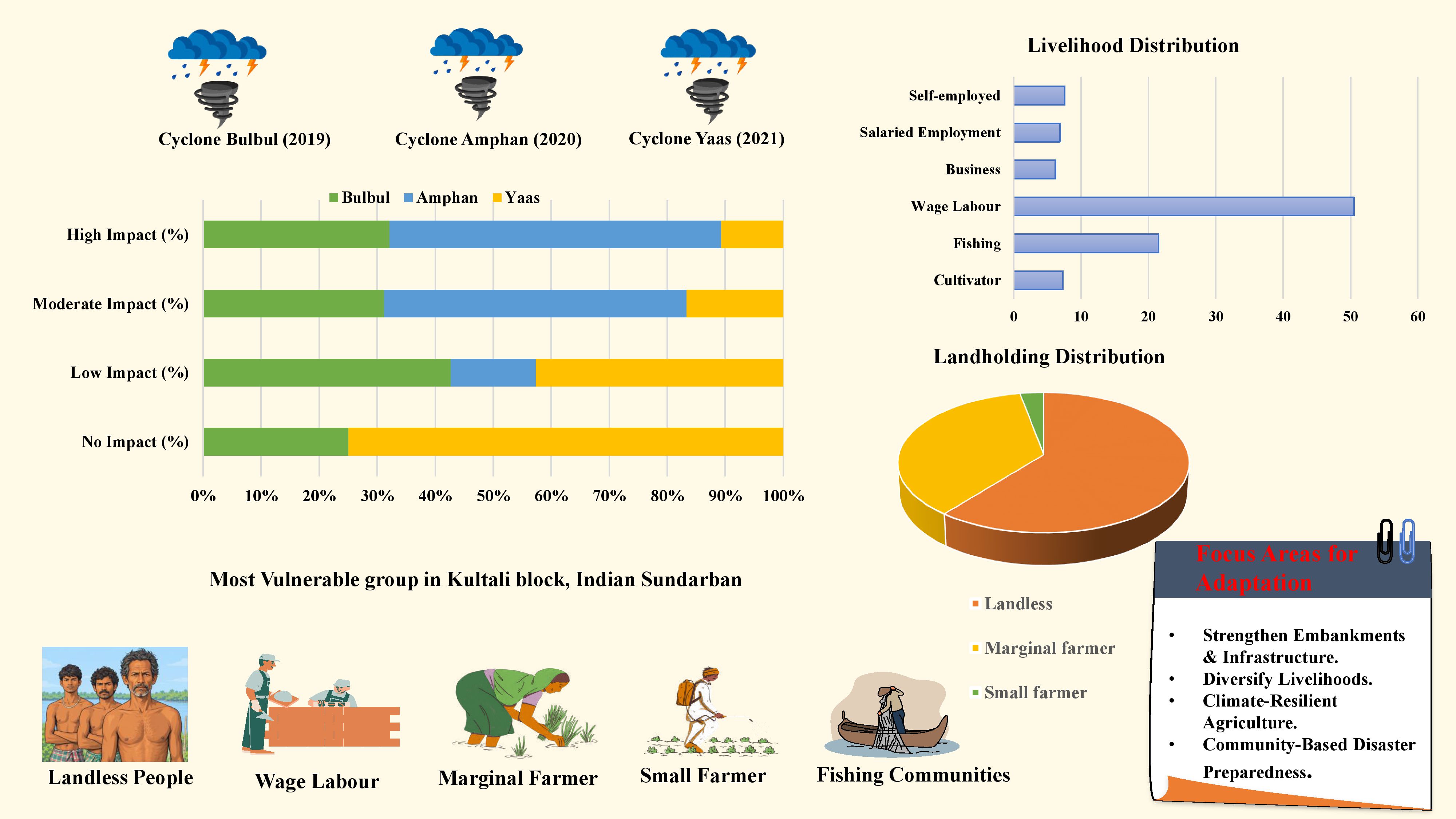
Cyclone-induced vulnerability is a major threat to livelihood security and socio-economic stability in coastal areas. The Indian Sundarban is especially vulnerable to cyclone-related impacts and has high exposure due to its population pressure, diminishing natural resources, and climate-sensitive livelihood choices. Cyclones have created massive destruction in the physical and socio-economic spheres. This study evaluates the differential impacts of cyclones Bulbul, Amphan, and Yaas, with particular focus on the relationship between livelihood structure and landholding in the Kultali CD block. A mixed-method approach is applied; a total of 550 household surveys and 54 Key informant interviews were conducted across the study area. The cyclone impact categorization-high impact, moderate impact, and low impact- was developed based on socio-economic losses. The descriptive statistics, crosstabulation and Kruskal–Wallis test were conducted to assess the relationship between cyclone-induced livelihood impact and landholding categories. The Kruskal–Wallis test results stated that livelihood vulnerability is different among the occupational groups for these three successive cyclones: Bulbul (H = 43.936, p < 0.001, ε2 = 0.072), Amphan (H = 34.626, p < 0.001, ε2 = 0.054), and Yass (H = 60.918, p < 0.001, ε2 = 0.103). The statistical results showed that cultivator households were found to be most vulnerable to the Bulbul cyclone, and fishing households faced the highest level of livelihood disruption to the Amphan and Yaas cyclones. Interviewed respondents are landless (60.7%), marginal farmers (36.4%) and small farmers (2.9%). Landless households are mostly from wage labour and fishing occupations and have less resilience to livelihood diversification and asset ownership. The statistical figures indicated that livelihood vulnerability is not only defined by cyclone intensity but also by unequal access to asset ownership. The findings suggested that there is a need to integrate a disaster reduction framework that gives special emphasis separately on direct asset exposure and broader socio-economic vulnerability. The disaster reduction policy should incorporate livelihood-specific interventions that provide a resilience pathway in the cyclone-prone coastal regions.
- Open Access
- Article
Differential Livelihood Impacts of Cyclones Bulbul, Amphan and Yaas: The Role of Landholding in Shaping Vulnerability and Recovery in Kultali CD Block, Indian Sundarban
Author Information
Received: 05 Jun 2026 | Revised: 31 Aug 2026 | Accepted: 11 Sep 2026 | Published: 22 Oct 2026
Abstract
Graphical Abstract
Keywords
cyclone impacts | livelihood vulnerability | landholding | Kultali community development (CD) block | Indian Sundarban
References
- 1.
Intergovernmental Panel on Climate Change. Sixth Assessment Report. Available online: https://www.ipcc.ch/assessment-report/ar6/?utm_source=chatgpt.com (accessed on 14 May 2026).
- 2.
Roy, S.S.; Ghosh, T.; Hewavithana, D.K. Transformation of coastal wetlands in the Sundarban Delta (1999–2020). Environ. Monit. Assess. 2024, 196, 758. https://doi.org/10.1007/s10661-024-12901-x.
- 3.
Santra, M.; Dwivedi, C.S.; Mitra, D. Modeling coastal vulnerability in the Indian Sundarban under possible Shared Socioeconomic Pathways (SSPs). Reg. Stud. Mar. Sci. 2025, 89, 104273. https://doi.org/10.1016/j.rsma.2025.104273.
- 4.
Saha, C.K. Dynamics of disaster-induced risk in southwestern coastal Bangladesh: An analysis on tropical Cyclone Aila 2009. Nat. Hazards 2015, 75, 727–754. https://doi.org/10.1007/s11069-014-1343-9.
- 5.
Swain, D. Tropical Cyclones and Coastal Vulnerability: Assessment and Mitigation. In Geospatial Technologies for Land and Water Resources Management; Shit, P.K., Bhunia, G.S., Adhikary, P.P., et al., Eds.; Springer International Publishing: Cham, Switzerland, 2022; pp. 587–621. https://doi.org/10.1007/978-3-030-90479-1_30.
- 6.
Ortiz, A.M.D.; Chua, P.L.C.; Salvador, D., Jr.; et al. Impact of tropical cyclones on food security, health and biodiversity. Bull. World Health Organ. 2022, 101, 152–154. https://doi.org/10.2471/blt.22.288838.
- 7.
Ghosh, S.; Mistri, B. Cyclone-Induced Coastal Vulnerability, Livelihood Challenges and Mitigation Measures of Matla–Bidya Inter-Estuarine Area, Indian Sundarban. Nat. Hazards 2023, 116, 3857–3878. https://doi.org/10.1007/s11069-023-05840-2.
- 8.
Mondal, M.; Paul, S.; Bhattacharya, S.; et al. Micro-level Assessment of Rural Societal Vulnerability of Coastal Regions: An Insight into Sagar Island, West Bengal, India. Asia-Pac. J. Rural Dev. 2020, 30, 55–88. https://doi.org/10.1177/1018529120946230.
- 9.
Das, S. The Role of Natural Ecosystems and Socio-Economic Factors in the Vulnerability of Coastal Villages to Cyclone and Storm Surge. Nat. Hazards 2012, 64, 531–546. https://doi.org/10.1007/s11069-012-0255-9.
- 10.
Mukherjee, N.; Siddique, G. Sundarbans: A Physical-Environmental & Socio-Cultural Complex Hitherto. In Impact of Climate Change in the Indian Sundarbans Region; Springer Nature Switzerland: Cham, Switzerland, 2024; pp. 13–22. https://doi.org/10.1007/978-3-031-54238-1_2.
- 11.
Banu, N.; Fazal, S. Climate Change, Livelihood Crisis and Resilience: An Introduction. In Livelihoods and Well-Being in the Era of Climate Change: Risk to Resilience across India; Springer Nature Switzerland: Cham, Switzerland, 2025; pp. 3–18. https://doi.org/10.1007/978-3-031-81132-6_1.
- 12.
Ghosh, A.; Schmidt, S.; Fickert, T.; et al. The Indian Sundarban Mangrove Forests: History, Utilization, Conservation Strategies and Local Perception. Diversity 2015, 7, 149–169. https://doi.org/10.3390/d7020149.
- 13.
Banerjee, S.; Chanda, A.; Ghosh, T.; et al. A Qualitative Assessment of Natural and Anthropogenic Drivers of Risk to Sustainable Livelihoods in the Indian Sundarban. Sustainability 2023, 15, 6146. https://doi.org/10.3390/su15076146.
- 14.
Rudra, K. Rivers of the Ganga-Brahmaputra-Meghna Delta: A Fluvial Account of Bengal, 1st ed.; Springer International Publishing: Cham, Switzerland, 2018. https://doi.org/10.1007/978-3-319-76544-0.
- 15.
Das, S.C. Mangroves of Sundarban. In Mangroves: Biodiversity, Livelihoods and Conservation; Das, S.C., Pullaiah Ashton, E.C., Eds.; Springer: Singapore, 2022; pp. 271–295. https://doi.org/10.1007/978-981-19-0519-3_12.
- 16.
Zaman, M.S.; Chowdhury, T.H. The Sundarbans, the World’s Largest Tidal Halophytic Mangrove Forest: Its Economic and Ecological Significance, Bangla J. Interdiscip. Sci. Comput. Life Sci. 2024, 2, E1–E15. https://doi.org/10.5281/zenodo.12683069.
- 17.
Nath, A.; Koley, B.; Choudhury, T. Unveiling the Geomorphological, Hydrometeorological, and Geological Insights of the Indian Sundarbans. In Shoreline Modification over the Indian Sundarban; Springer Nature Switzerland: Cham, Switzerland, 2026; pp. 1–21. https://doi.org/10.1007/978-3-032-13981-8_1.
- 18.
Mondal, M.; Biswas, A.; Haldar, S.; et al. Climate change, multi-hazards and society: An empirical study on the coastal community of Indian Sundarban. Nat. Hazards Res. 2022, 2, 84–96. https://doi.org/10.1016/j.nhres.2022.04.002.
- 19.
Kar, N.S.; Basu, A. A cyclone preparedness plan for the coastal blocks of the Indian Sundarban. J. Coast. Conserv. 2023, 27, 49. https://doi.org/10.1007/s11852-023-00978-4.
- 20.
Sahana, M.; Rehman, S.; Paul, A.K.; et al. Assessing socio-economic vulnerability to climate change-induced disasters: Evidence from Sundarban Biosphere Reserve, India. Geol. Ecol. Landsc. 2021, 5, 40–52. https://doi.org/10.1080/24749508.2019.1700670.
- 21.
Mallik, C.; Bandyopadhyay, S.; Bandopadhyay, S. Land scarcity and land access in a hazard-prone island: Sagar, Indian Sundarbans. Singap. J. Trop. Geogr. 2023, 44, 255–276. https://doi.org/10.1111/sjtg.12493.
- 22.
Tuihedur Rahman, H.M.; Robinson, B.E.; Ford, J.D.; et al. How Do Capital Asset Interactions Affect Livelihood Sensitivity to Climatic Stresses? Insights From the Northeastern Floodplains of Bangladesh. Ecol. Econ. 2018, 150, 165–176. https://doi.org/10.1016/j.ecolecon.2018.04.006.
- 23.
Debie, E.; Ayele, A.W. Perceived Determinants of Smallholder Households’ Resilience to Livelihood Insecurity in Goncha District, Northwest Highlands of Ethiopia. SAGE Open 2023, 13, 21582440231184861. https://doi.org/10.1177/21582440231184861.
- 24.
Paul, L.; Bhattacharya, S.; Das, B.K.; et al. Assessing Climate-Induced Vulnerability of Small-Scale Fisheries in the Lower Gangetic Delta, West Bengal. Sci. Cult. 2025, 91, 453–458. https://doi.org/10.36094/sc.v91.2025.assessing_climate_induced_vulnerability.paul.453.
- 25.
Ahmed, R. Livelihood Vulnerability, and the Role of Agency in Adaptation: Evidence from the Sundarbans Fishing Communities of Bangladesh. Available online: https://mspace.lib.umanitoba.ca/items/7053c5b2-0d0f-4324-907a-c11f7e9c3c48 (accessed on 14 May 2026).
- 26.
Roy, A.; Chatterjee, P.; Das, B.K. Nexus of Climate Change with Fish Production and Its Implications on Livelihood and Nutritional Security. In Outlook of Climate Change and Fish Nutrition; Sinha, A., Kumar, S., Kumari, K., Eds.; Springer: Singapore, 2022; pp. 85–96. https://doi.org/10.1007/978-981-19-5500-6_8.
- 27.
Paul, A.K.; Paul, A. Adjustment of the Coastal Communities in Response to Climate Variability and Sea Level Rise in the Sundarban, West Bengal, India. In Climate Change, Disaster and Adaptations: Contextualising Human Responses to Ecological Change; Springer International Publishing: Cham, Switzerland, 2022; pp. 201–217. https://doi.org/10.1007/978-3-030-91010-5_16.
- 28.
Mandal, P.; Roy, P.; Maiti, A.; et al. Assessing the interplay of environmental change, cyclonic hazards, and their ramifications on agriculture in Indian Sundarban. Ocean Coast. Manag. 2024, 251, 107080. https://doi.org/10.1016/j.ocecoaman.2024.107080.
- 29.
Mandal, P.; Paul, S. Cyclone-Induced Coastal Vulnerability and Human Migration Risk in Sundarbans. In Climatic Vulnerability and Migration: Evidence from Indian Sundarbans; Springer Nature Switzerland: Cham, Switzerland, 2025; pp. 53–88. https://doi.org/10.1007/978-3-032-05858-4_3.
- 30.
Mandal, P.; Paul, S. Climatic Vulnerability and Migration: Evidence from Coastal Sundarbans. In Climatic Vulnerability and Migration: Evidence from Indian Sundarbans; Springer Nature Switzerland: Cham, Switzerland, 2025; pp. 1–21. https://doi.org/10.1007/978-3-032-05858-4_1.
- 31.
Edmonds, C.; Mehtta, M.; Noy, I.; et al. The Climate-(Ir)Resilient Society of the Indian Sundarbans: Tropical Cyclones, Sea Level Rise, and Mortality Risk. In The Palgrave Handbook of Climate Resilient Societies; Brears, R.C., Ed.; Palgrave Macmillan: Cham, Switzerland, 2021; pp. 1–30. https://doi.org/10.1007/978-3-030-32811-5_95-1.
- 32.
Tenhunen, S.; Uddin, M.J.; Roy, D. After cyclone Aila: Politics of climate change in Sundarbans. Contemp. South Asia 2023, 31, 222–235. https://doi.org/10.1080/09584935.2023.2203903.
- 33.
Paul, B.K.; Chatterjee, S. Climate Change-Induced Environmental Hazards and Aila Relief Measures Undertaken to Sundarbans in Bangladesh and India. In The Sundarbans: A Disaster-Prone Eco-Region: Increasing Livelihood Security; Springer International Publishing: Cham, Switzerland, 2019; pp. 469–490. https://doi.org/10.1007/978-3-030-00680-8_16.
- 34.
Roy, S. Post-Cyclone Aila and Mobility Rights of the Shora Muslim Women of the Bangladesh Sundarbans Forest. In Climate Change, Hazards and Adaptation Options: Handling the Impacts of a Changing Climate; Springer International Publishing: Cham, Switzerland, 2020; pp. 641–658. https://doi.org/10.1007/978-3-030-37425-9_32.
- 35.
Pal, I.; Ghosh, T. Risk Governance Measures and Actions in Sundarbans Delta (India): A Holistic Analysis of Post-Disaster Situations of Cyclone Aila. In Disaster Risk Governance in India and Cross Cutting Issues; Disaster Risk Reduction; Pal, I., Shaw, R., Eds.; Springer: Singapore, 2017; pp. 225–243. https://doi.org/10.1007/978-981-10-3310-0_12.
- 36.
Prakash, S.; Varghese, A.; Amrutha, A.S.; et al. Assessment of Ecological Disturbance on Indian Sundarbans with Special Reference to Amphan Cyclone by Using Geospatial Technology. J. Geospat. Surv. 2023, 3, 26–32. https://doi.org/10.4038/jgs.v3i1.47.
- 37.
Majumder, M. Devastating Effect of Amphan Cyclone on the Biodiversity of the Sundarbans Mangroves and the Need of Its Rehabilitation. In Plant Metabolites under Environmental Stress; Apple Academic Press: Palm Bay, FL, USA, 2023; pp. 185–201.
- 38.
Chowdhury, A.; Naz, A.; Iyer, A.S.; et al. Ecosystem Based Disaster Risk Reduction at Indian Sundarbans: A Lesson Learned from AMPHAN Supercyclone. IOP Conf. Ser. Earth Environ. Sci. 2021, 796, 012042. https://doi.org/10.1088/1755-1315/796/1/012042.
- 39.
Mishra, M.; Acharyya, T.; Santos, C.A.G.; et al. Geo-ecological impact assessment of severe cyclonic storm Amphan on Sundarban mangrove forest using geospatial technology. Estuar. Coast. Shelf Sci. 2021, 260, 107486. https://doi.org/10.1016/j.ecss.2021.107486.
- 40.
Basu, S. Weathering the storm: Economic consequences of cyclones Amphan and Bulbul for fish farmers in Bangladesh. Nat. Hazards 2026, 122, 45. https://doi.org/10.1007/s11069-025-07866-0.
- 41.
Nath, C.D.; Sultana, Z.; Alam, T.B.; et al. Assessment of the Role of the Sundarbans as a Natural Buffer in Diminishing the Intensity of Cyclone: A Comparative Study on Cyclone Bulbul and Sitrang. In Proceedings of the International Conference on Civil Engineering Research & Innovations (ICCEI 2025), Rajshahi, Bangladesh, 12–14 December 2025.
- 42.
Wisner, B.; Blaikie, P.; Cannon, T.; et al. At Risk: Natural Hazards, People’s Vulnerability and Disasters, 2nd ed.; Routledge: London, UK, 2004.
- 43.
Awal, M.A. Vulnerability to Disaster: Pressure and Release Model for Climate Change Hazards in Bangladesh. Int. J. Environ. Monit. Prot. 2015, 2, 15–21.
- 44.
Natarajan, N.; Newsham, A.; Rigg, J.; et al. A sustainable livelihoods framework for the 21st century. World Dev. 2022, 155, 105898. https://doi.org/10.1016/j.worlddev.2022.105898.
- 45.
Mensah, E.J. The Sustainable Livelihood Framework: A Reconstruction; Report 46733; Munich Personal RePEc Archive (Ludwig Maximilian University of Munich): Munich, Germany, 2011.
- 46.
Saradar, A.; Hazra, S.; Guha, T.; et al. Assessment of the household vulnerability of the tribal communities to climate change in the Indian Sundarbans. SN Soc. Sci. 2025, 5, 160. https://doi.org/10.1007/s43545-025-01193-8.
- 47.
Biswas, S.; Nautiyal, S. An assessment of socio-economic vulnerability at the household level: A study on villages of the Indian Sundarbans. Environ. Dev. Sustain. 2021, 23, 11120–11137. https://doi.org/10.1007/s10668-020-01085-2.
- 48.
Sahana, M.; Rehman, S.; Ahmed, R.; et al. Analyzing climate variability and its effects in Sundarban Biosphere Reserve, India: Reaffirmation from local communities. Environ. Dev. Sustain. 2021, 23, 2465–2492. https://doi.org/10.1007/s10668-020-00682-5.
- 49.
Ali, S.A.; Khatun, R.; Ahmad, A.; et al. Assessment of Cyclone Vulnerability, Hazard Evaluation and Mitigation Capacity for Analyzing Cyclone Risk using GIS Technique: A Study on Sundarban Biosphere Reserve, India. Earth Syst. Environ. 2020, 4, 71–92. https://doi.org/10.1007/s41748-019-00140-x.
- 50.
Mandal, P.; Maiti, A.; Paul, S.; et al. Mapping the multi-hazards risk index for coastal block of Sundarban, India using AHP and machine learning algorithms. Trop. Cyclone Res. Rev. 2022, 11, 225–243. https://doi.org/10.1016/j.tcrr.2023.03.001.
- 51.
Categorisation of Farmers under Kisan Samman Pension Scheme. Available online: https://www.pib.gov.in/PressReleasePage.aspx?PRID=2085181 (accessed on 13 May 2026).
- 52.
Mohapatra, M.; Mandal, G.S.; Bandyopadhyay, B.K.; et al. Classification of cyclone hazard prone districts of India. Nat. Hazards 2012, 63, 1601–1620. https://doi.org/10.1007/s11069-011-9891-8.
- 53.
Mahendran, M. Cyclone Intensity Categories. Weather Forecast. 1998, 13, 878–883. https://doi.org/10.1175/1520-0434(1998)013<0878:cic>2.0.co;2.
- 54.
Tomczak, M.; Tomczak, E. The Need to Report Effect Size Estimates Revisited: An Overview of Some Recommended Measures of Effect Size. Trends Sport Sci. 2014, 21, 19–25.
- 55.
Fiel Peres, F. Effect sizes for nonparametric tests. Biochem. Med. 2026, 36, 5–16. https://doi.org/10.11613/bm.2026.010101.
- 56.
Mondal, M.; Paul, S.; Mukhopadhyay, A.; et al. Evaluating Rural Poverty and Livelihood Diversification in the Context of Climate-Induced Extreme Events in Coastal Area: Insights from Indian Sundarban. Reg. Stud. Mar. Sci. 2023, 67, 103191. https://doi.org/10.1016/j.rsma.2023.103191.
- 57.
Jain, S.; Rawat, I.; Patil, R. Livelihood Diversification by Indigenous Communities of Sundarbans. Int. J. Humanit. Soc. Sci. 2016, 6, 135–142.
- 58.
Zimmerer, K.; Vanek, S. Toward the Integrated Framework Analysis of Linkages among Agrobiodiversity, Livelihood Diversification, Ecological Systems, and Sustainability amid Global Change. Land 2016, 5, 10. https://doi.org/10.3390/land5020010.
- 59.
Bhowmick, S.A.; Agarwal, N.; Sharma, R.; et al. Cyclone Amphan: Oceanic Conditions Pre- and Post-Cyclone Using in Situ and Satellite Observations. Curr. Sci. 2020, 119, 1510–1516. https://doi.org/10.18520/cs/v119/i9/1510-1516.
- 60.
Shamsuzzoha, M.; Ahamed, T. Application of Introducing Damaged Area Index for Cultivated Agricultural Lands Affected by Recurrent Tropical Cyclones Bulbul and Amphan Using Satellite Remote Sensing. In Remote Sensing Application II: A Climate Change Perspective in Agriculture; Ahamed, T., Ed.; Springer Nature Singapore: Singapore, 2024; pp. 165–178. https://doi.org/10.1007/978-981-97-1188-8_6.
- 61.
Shamsuzzoha, M.; Noguchi, R.; Ahamed, T. Damaged area assessment of cultivated agricultural lands affected by cyclone bulbul in coastal region of Bangladesh using Landsat 8 OLI and TIRS datasets. Remote Sens. Appl. Soc. Environ. 2021, 23, 100523. https://doi.org/10.1016/j.rsase.2021.100523.
- 62.
Basu, S. Impacts of Climate Change and Tropical Cyclones on Rice Farming in Coastal Bangladesh. Asian J. Water Environ. Pollut. 2025, 22, 41–63. https://doi.org/10.36922/AJWEP025100063.
- 63.
Mishra, M.; Kar, D.; Debnath, M.; et al. Rapid eco-physical impact assessment of tropical cyclones using geospatial technology: A case from severe cyclonic storms Amphan. Nat. Hazards 2022, 110, 2381–2395. https://doi.org/10.1007/s11069-021-05008-w.
- 64.
Varma, A.K.; Jaiswal, N.; Das, A.; et al. A pathway for multi-stage cyclone-induced hazard tracking—Case study for Yaas. Nat. Hazards 2023, 117, 1035–1067. https://doi.org/10.1007/s11069-023-05893-3.
- 65.
Pramanik, M.; Szabo, S.; Pal, I.; et al. Twin Disasters: Tracking COVID-19 and Cyclone Amphan’s Impacts on SDGs in the Indian Sundarbans. Environ. Sci. Policy Sustain. Dev. 2021, 63, 20–30. https://doi.org/10.1080/00139157.2021.1924575.
- 66.
Raju, S.S.; Dash, G.; Ghosh, S.; et al. Impact of Cyclone Amphan on marine fisheries of West Bengal. Mar. Fish. Inf. Serv. Tech. Ext. Ser. 2020, 244, 30–31.
- 67.
Jana, M.; Roy, T.; Bisai, D. Socio-Economic Vulnerability and Recovery after Cyclone Yaas: A Micro level Study on Coastal Communities of Purba Medinipur. Int. J. Multidiscip. Res. 2026, 8, 69686. https://doi.org/10.36948/ijfmr.2026.v08i01.69686.
- 68.
Subhani, R.; Saqib, S.E.; Rahman, M.A.; et al. Impact of Cyclone Yaas 2021 Aggravated by COVID-19 Pandemic in the Southwest Coastal Zone of Bangladesh. Sustainability 2021, 13, 13324. https://doi.org/10.3390/su132313324.
- 69.
Prodhan, A.A.A.; Mutahara, M.; Nowreen, S.; et al. Livelihood risks of compound disasters in coastal Bangladesh: Cascading impacts of COVID-19 and cyclone Amphan. Prog. Disaster Sci. 2026, 29, 100537. https://doi.org/10.1016/j.pdisas.2026.100537.
- 70.
Paul, S.K.; Routray, J.K. Post-Cyclone Livelihood Strategies and Security Status of Coastal Households in Bangladesh: An Empirical Study. In Climate Change and Risk in South and Southeast Asia; Routledge: London, UK, 2022; pp. 36–58. https://doi.org/10.4324/9781003216476-4.
- 71.
DasGupta, R.; Shaw, R.; Basu, M. Implication and Management of Coastal Salinity for Sustainable Community Livelihood: Case Study from the Indian Sundarban Delta. In Coastal Management; Krishnamurthy, R.R., Jonathan, M.P., Srinivasalu, S., et al., Eds.; Academic Press: Cambridge, MA, USA, 2019; pp. 251–269. https://doi.org/10.1016/b978-0-12-810473-6.00013-3.
- 72.
Das, S.; Sharma, K.K. Perception of Climate Change and Climate Smart Agriculture Adaptation among the Farming Community in the Coastal Region of Sundarban Biosphere Reserve in India. SSRN Electron. J. 2023. https://doi.org/10.2139/ssrn.4544318.
- 73.
Sengupta, A.; Samanta, G. Understanding immobility of a highly vulnerable coastal village in the Indian Sundarban. Reg. Environ. Chang. 2022, 22, 90. https://doi.org/10.1007/s10113-022-01931-1.
- 74.
Raha, A.K.; Zaman, S.; Sengupta, K.; et al. Climate Change and Sustainable Livelihood Program: A Case Study from Indian Sundarbans. J. Ecol. 2013, 107, 335–348.
- 75.
Patra, S.; Haque, M. Livelihood Challenges and Governance Dynamics in the Indian Sundarbans Delta. In Sustainable Management of Delta Ecosystems Resilience: Case Studies on Delta Adaptation Pathways; Deltas of the World; Singha, C., Sahoo, S., Govind, A., Eds.; Springer Nature Switzerland: Cham, Switzerland, 2026; pp. 123–151. https://doi.org/10.1007/978-3-032-16261-8_5.

This work is licensed under a Creative Commons Attribution 4.0 International License.
