
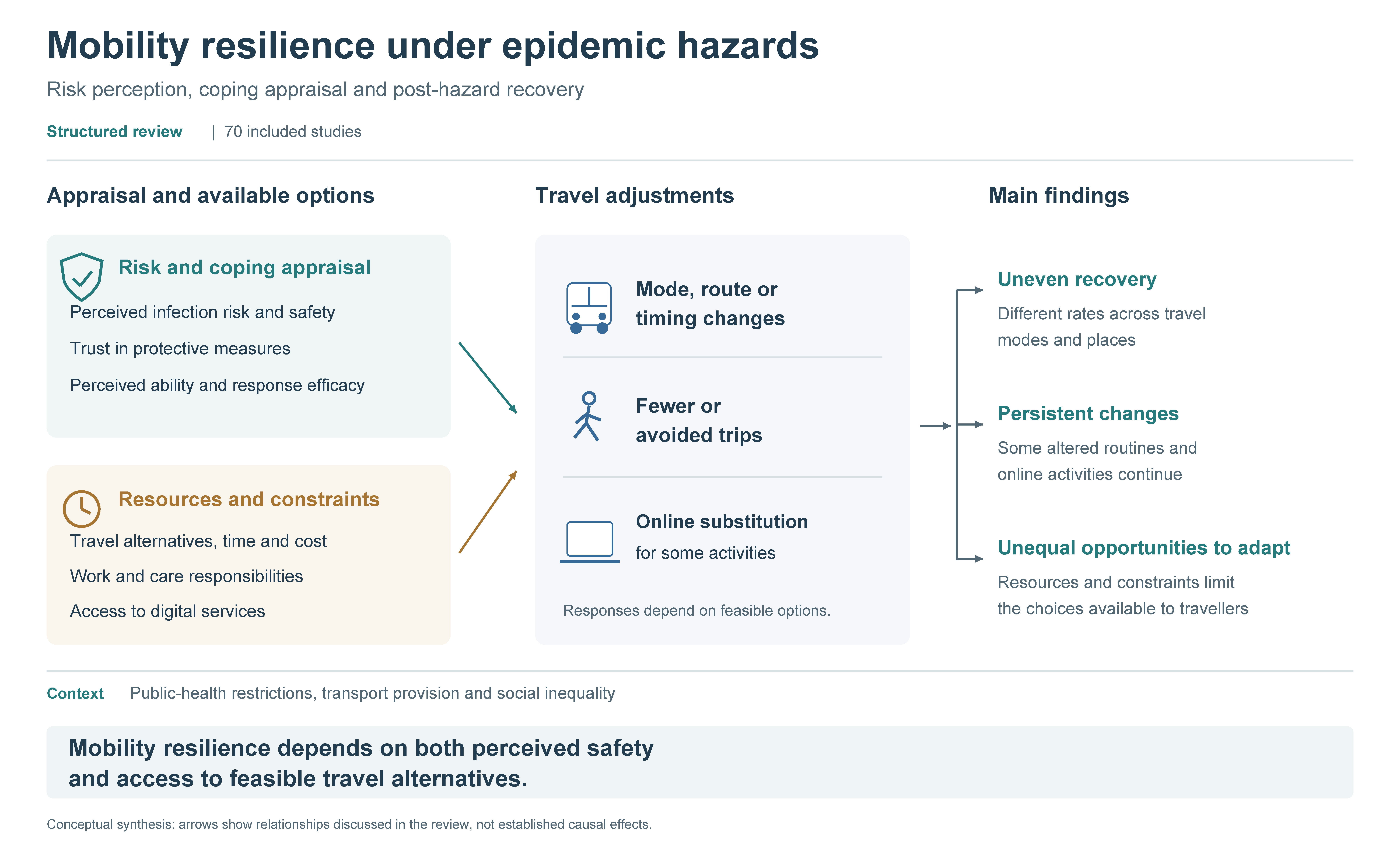
Epidemic hazards disturb mobility in a way that is both physical and behavioural. They reduce service supply, change perceived safety, and force travellers to decide whether a trip is necessary, safe, or replaceable. This review maps how risk perception, coping appraisal and structural constraints shaped mobility response and recovery during and after COVID-19. The literature search was completed on 21 June 2026. Searches in OpenAlex and PubMed, followed by a targeted update, identified 1263 records; 1145 unique records were screened and 70 studies were included. The evidence shows that perceived infection risk discouraged crowded and enclosed modes, especially public and shared transport. Yet risk perception alone did not explain behaviour. Travellers also needed feasible alternatives, trust in protective measures, money, time, information and social permission to adapt. Longitudinal and observed data were particularly useful for distinguishing temporary disruption from later recalibration, though these sources also carry their own limitations (e.g., sampling bias, algorithmic artefacts) and should not be treated as bias-free evidence.
- Open Access
- Article
Mobility Resilience under Epidemic Hazards: A Structured Review of Risk Perception, Coping Appraisal and Post-Hazard Recovery
- Jiangling Wu 1,
- Yating Ye 1,
- Linjie Tian 1,*,
- Qiuhao Lyu 1,
- Amit Kumar Singh 2,
- Mengjie Li 1
Author Information
Received: 30 Jun 2026 | Revised: 24 Sep 2026 | Accepted: 28 Sep 2026 | Published: 16 Oct 2026
Abstract
Graphical Abstract
Keywords
epidemic hazards | risk perception | coping appraisal | mobility resilience | public transport | post-hazard recovery
References
- 1.
Anwari, N.; Ahmed, M.T.; Islam, M.R.; et al. Exploring the travel behavior changes caused by the COVID-19 crisis: A case study for a developing country. Transp. Res. Interdiscip. Perspect. 2021, 9, 100334. https://doi.org/10.1016/j.trip.2021.100334.
- 2.
Barbieri, D.M.; Lou, B.; Passavanti, M.; et al. Impact of COVID-19 pandemic on mobility in ten countries and associated perceived risk for all transport modes. PLoS ONE 2021, 16, e0245886. https://doi.org/10.1371/journal.pone.0245886.
- 3.
Harrington, D.M.; Hadjiconstantinou, M. Changes in commuting behaviours in response to the COVID-19 pandemic in the UK. J. Transp. Health 2022, 24, 101313. https://doi.org/10.1016/j.jth.2021.101313.
- 4.
Irawan, M.Z.; Belgiawan, P.F.; Joewono, T.B.; et al. Exploring activity-travel behavior changes during the beginning of COVID-19 pandemic in Indonesia. Transportation 2022, 49, 529–553. https://doi.org/10.1007/s11116-021-10185-5.
- 5.
Parady, G.; Taniguchi, A.; Takami, K. Travel behavior changes during the COVID-19 pandemic in Japan: Analyzing the effects of risk perception and social influence on going-out self-restriction. Transp. Res. Interdiscip. Perspect. 2020, 7, 100181. https://doi.org/10.1016/j.trip.2020.100181.
- 6.
Pawar, D.S.; Yadav, A.K.; Akolekar, N.; et al. Impact of physical distancing due to novel coronavirus (SARS-CoV-2) on daily travel for work during transition to lockdown. Transp. Res. Interdiscip. Perspect. 2020, 7, 100203. https://doi.org/10.1016/j.trip.2020.100203.
- 7.
Mehdizadeh, M.; Fallah Zavareh, M.; Nordfjaern, T. Explaining trip generation during the COVID-19 pandemic: A psychological perspective. J. Transp. Health 2022, 26, 101390. https://doi.org/10.1016/j.jth.2022.101390.
- 8.
Tirachini, A.; Cats, O. COVID-19 and Public Transportation: Current Assessment, Prospects, and Research Needs. J. Public Transp. 2020. https://doi.org/10.5038/2375-0901.22.1.1.
- 9.
Vickerman, R. Will Covid-19 put the public back in public transport? A UK perspective. Transp. Policy 2021, 103, 95–102. https://doi.org/10.1016/j.tranpol.2021.01.005.
- 10.
Bandyopadhyaya, V.; Bandyopadhyaya, R. Understanding public transport use intention post Covid-19 outbreak using modified theory of planned behavior: Case study from developing country perspective. Case Stud. Transp. Policy 2022, 10, 2044–2052. https://doi.org/10.1016/j.cstp.2022.09.002.
- 11.
Zafri, N.M.; Khan, A.; Jamal, S.; et al. Impacts of the COVID-19 Pandemic on Active Travel Mode Choice in Bangladesh: A Study from the Perspective of Sustainability and New Normal Situation. Sustainability 2021, 13, 6975. https://doi.org/10.3390/su13126975.
- 12.
Wang, Y.; Gao, Y. Travel satisfaction and travel well-being: Which is more related to travel choice behaviour in the post COVID-19 pandemic? Evidence from public transport travellers in Xi’an, China. Transp. Res. Part A Policy Pract. 2022, 166, 218–233. https://doi.org/10.1016/j.tra.2022.10.003.
- 13.
Tricco, A.C.; Lillie, E.; Zarin, W.; et al. PRISMA Extension for Scoping Reviews (PRISMA-ScR): Checklist and Explanation. Ann. Intern. Med. 2018, 169, 467–473. https://doi.org/10.7326/m18-0850.
- 14.
Ben Saad, H.; Dergaa, I.; Ghouili, H.; et al. The assisted Technology dilemma: a reflection on AI chatbots use and risks while reshaping the peer review process in scientific research. AI Soc. 2025, 40, 5649–5656. https://doi.org/10.1007/s00146-025-02299-6.
- 15.
Dhahbi, W.; Jebabli, N.; Souaifi, M.; et al. Application of Artificial Intelligence for Predicting Sports Injuries and Customizing Personalized Prevention Strategies: A Scoping Review. Bioengineering 2026, 13, 692. https://doi.org/10.3390/bioengineering13060692.
- 16.
van Wee, B.; Witlox, F. COVID-19 and its long-term effects on activity participation and travel behaviour: A multiperspective view. J. Transp. Geogr. 2021, 95, 103144. https://doi.org/10.1016/j.jtrangeo.2021.103144.
- 17.
Ceccato, R.; Rossi, R.; Gastaldi, M. Travel Demand Prediction during COVID-19 Pandemic: Educational and Working Trips at the University of Padova. Sustainability 2021, 13, 6596. https://doi.org/10.3390/su13126596.
- 18.
Airak, S.; Sukor, N.S.A.; Rahman, N.A. Travel behaviour changes and risk perception during COVID-19: A case study of Malaysia. Transp. Res. Interdiscip. Perspect. 2023, 18, 100784. https://doi.org/10.1016/j.trip.2023.100784.
- 19.
Dhahbi, W.; Chamari, K. The Algorithmic Athlete: A Call to Standardize Assessment of Sensor Technologies and Artificial Intelligence. Int. J. Sport. Physiol. Perform. 2026, 21, 505–506. https://doi.org/10.1123/ijspp.2025-0547.
- 20.
Aaditya, B.; Rahul, T.M. Psychological impacts of COVID-19 pandemic on the mode choice behaviour: A hybrid choice modelling approach. Transp. Policy 2021, 108, 47–58. https://doi.org/10.1016/j.tranpol.2021.05.003.
- 21.
Zhang, X.; Liu, D.; Wang, Y.; et al. Behavioral Intentions of Urban Rail Transit Passengers during the COVID-19 Pandemic in Tianjin, China: A Model Integrating the Theory of Planned Behavior and Customer Satisfaction Theory. J. Adv. Transp. 2021, 2021, 1–12. https://doi.org/10.1155/2021/8793101.
- 22.
Zhao, P.; Gao, Y. Public transit travel choice in the post COVID-19 pandemic era: An application of the extended Theory of Planned behavior. Travel Behav. Soc. 2022, 28, 181–195. https://doi.org/10.1016/j.tbs.2022.04.002.
- 23.
Aloi, A.; Alonso, B.; Benavente, J.; et al. Effects of the COVID-19 Lockdown on Urban Mobility: Empirical Evidence from the City of Santander (Spain). Sustainability 2020, 12, 3870. https://doi.org/10.3390/su12093870.
- 24.
Wang, J.; Huang, J.; Yang, H.; et al. Resilience and recovery of public transport use during COVID-19. npj Urban Sustain. 2022, 2, 18. https://doi.org/10.1038/s42949-022-00061-1.
- 25.
Adam, M.; Sayagh, D.; Buhler, T. Changes in cycling practices in France during the Covid-19 pandemic. An illusory reduction in inequalities. J. Transp. Health 2023, 32, 101655. https://doi.org/10.1016/j.jth.2023.101655.
- 26.
Molloy, J.; Schatzmann, T.; Schoeman, B.; et al. Observed impacts of the Covid-19 first wave on travel behaviour in Switzerland based on a large GPS panel. Transp. Policy 2021, 104, 43–51. https://doi.org/10.1016/j.tranpol.2021.01.009.
- 27.
Awad-Núñez, S.; Julio, R.; Gomez, J.; et al. Post-COVID-19 travel behaviour patterns: impact on the willingness to pay of users of public transport and shared mobility services in Spain. Eur. Transp. Res. Rev. 2021, 13, 20. https://doi.org/10.1186/s12544-021-00476-4.
- 28.
Magassy, T.B.; Batur, I.; Mondal, A.; et al. Evolution of Mode Use During the COVID-19 Pandemic in the United States: Implications for the Future of Transit. Transp. Res. Rec. J. Transp. Res. Board 2024, 2678, 567–579. https://doi.org/10.1177/03611981231166942.
- 29.
Bouzaghrane, M.A.; Obeid, H.; González, M.; et al. Human mobility reshaped? Deciphering the impacts of the Covid-19 pandemic on activity patterns, spatial habits, and schedule habits. EPJ Data Sci. 2024, 13, 24. https://doi.org/10.1140/epjds/s13688-024-00463-4.
- 30.
Campisi, T.; Basbas, S.; Al-Rashid, M.A.; et al. A region-wide survey on emotional and psychological impacts of COVID-19 on public transport choices in Sicily, Italy. Trans. Transp. Sci. 2022, 12, 34–43. https://doi.org/10.5507/tots.2021.010.
- 31.
Chen, C.; Feng, T.; Gu, X. Role of latent factors and public policies in travel decisions under COVID-19 pandemic: Findings of a hybrid choice model. Sustain. Cities Soc. 2022, 78, 103601. https://doi.org/10.1016/j.scs.2021.103601.
- 32.
Ciriaco, T.G.M.; Pitombo, C.S.; Assirati, L. Travel behavior and activity resilience regarding the COVID-19 pandemic in Brazil: An approach based on smartphone panel data. Case Stud. Transp. Policy 2023, 12, 100998. https://doi.org/10.1016/j.cstp.2023.100998.
- 33.
de Palma, A.; Vosough, S.; Liao, F. An overview of effects of COVID-19 on mobility and lifestyle: 18 months since the outbreak. Transp. Res. Part A Policy Pract. 2022, 159, 372–397. https://doi.org/10.1016/j.tra.2022.03.024.
- 34.
Chalabi, G.; Dia, H. The Impacts of Remote Work and Attitudinal Shifts on Commuting Reductions in Post-COVID Melbourne, Australia. Sustainability 2024, 16, 7289. https://doi.org/10.3390/su16177289.
- 35.
Victoriano-Habit, R.; El-Geneidy, A. Studying the Interrelationship between Telecommuting during COVID-19, residential local accessibility, and active travel: a panel study in Montréal, Canada. Transportation 2024, 51, 1149–1166. https://doi.org/10.1007/s11116-022-10369-7.
- 36.
Garaus, M.; Garaus, C. The Impact of the Covid-19 Pandemic on Consumers' Intention to Use Shared-Mobility Services in German Cities. Front. Psychol. 2021, 12, 646593. https://doi.org/10.3389/fpsyg.2021.646593.
- 37.
Gnerre, M.; Abati, D.; Bina, M.; et al. Risk perception and travel satisfaction associated with the use of public transport in the time of COVID-19. The case of Turin, Italy. PLoS ONE 2022, 17, e0265245. https://doi.org/10.1371/journal.pone.0265245.
- 38.
Helfers, A.; Reiserer, M.; Schneider, N.; et al. Should I Stay or Should I Go? Risk Perception and Use of Local Public Transport During the COVID-19 Pandemic. Front. Psychol. 2022, 13, 926539. https://doi.org/10.3389/fpsyg.2022.926539.
- 39.
Aparicio, J.T.; Arsenio, E.; Henriques, R. Understanding the Impacts of the COVID-19 Pandemic on Public Transportation Travel Patterns in the City of Lisbon. Sustainability 2021, 13, 8342. https://doi.org/10.3390/su13158342.
- 40.
Hiselius, L.W.; Arnfalk, P. When the impossible becomes possible: COVID-19’s impact on work and travel patterns in Swedish public agencies. Eur. Transp. Res. Rev. 2021, 13, 17. https://doi.org/10.1186/s12544-021-00471-9.
- 41.
Hotle, S.; Murray-Tuite, P.; Singh, K. Influenza risk perception and travel-related health protection behavior in the US: Insights for the aftermath of the COVID-19 outbreak. Transp. Res. Interdiscip. Perspect. 2020, 5, 100127. https://doi.org/10.1016/j.trip.2020.100127.
- 42.
Bagdatli, M.E.C.; Ipek, F. Transport mode preferences of university students in post-COVID-19 pandemic. Transp. Policy 2022, 118, 20–32. https://doi.org/10.1016/j.tranpol.2022.01.017.
- 43.
Xu, N.; Nie, Q.; Liu, J.; et al. Post-pandemic shared mobility and active travel in Alabama: A machine learning analysis of COVID-19 survey data. Travel Behav. Soc. 2023, 32, 100584. https://doi.org/10.1016/j.tbs.2023.100584.
- 44.
Pawluk De-Toledo, K.; O'Hern, S.; Koppel, S. “I saw a fox in Melbourne CBD”: Urban travel behaviour changes during COVID-19 and beyond. Transp. Res. Part F Traffic Psychol. Behav. 2024, 100, 115–132. https://doi.org/10.1016/j.trf.2023.11.010.
- 45.
König, A.; Dreßler, A. A mixed-methods analysis of mobility behavior changes in the COVID-19 era in a rural case study. Eur. Transp. Res. Rev. 2021, 13, 15. https://doi.org/10.1186/s12544-021-00472-8.
- 46.
Lucchesi, S.T.; Tavares, V.B.; Rocha, M.K.; et al. Public Transport COVID-19-Safe: New Barriers and Policies to Implement Effective Countermeasures under User’s Safety Perspective. Sustainability 2022, 14, 2945. https://doi.org/10.3390/su14052945.
- 47.
Lee, S.; Kim, J.; Cho, K. Temporal dynamics of public transportation ridership in Seoul before, during, and after COVID-19 from urban resilience perspective. Sci. Rep. 2024, 14, 8981. https://doi.org/10.1038/s41598-024-59323-w.
- 48.
Luan, S.; Yang, Q.; Jiang, Z.; et al. Exploring the impact of COVID-19 on individual's travel mode choice in China. Transp. Policy 2021, 106, 271–280. https://doi.org/10.1016/j.tranpol.2021.04.011.
- 49.
Manout, O.; Bouzouina, L.; Kourtit, K.; et al. On the bumpy road to recovery: resilience of public transport ridership during COVID-19 in 15 European cities. Lett. Spat. Resour. Sci. 2023, 16, 14. https://doi.org/10.1007/s12076-023-00338-8.
- 50.
Mashrur, S.M.; Wang, K.; Loa, P.; et al. Application of Protection Motivation Theory to Quantify the Impact of Pandemic Fear on Anticipated Postpandemic Transit Usage. Transp. Res. Rec. J. Transp. Res. Board 2023, 2677, 267–286. https://doi.org/10.1177/03611981211065439.
- 51.
Moslem, S.; Campisi, T.; Szmelter-Jarosz, A.; et al. Best–Worst Method for Modelling Mobility Choice after COVID-19: Evidence from Italy. Sustainability 2020, 12, 6824. https://doi.org/10.3390/su12176824.
- 52.
Nice, K.A.; Thompson, J.; Zhao, H.; et al. Effects of city design on transport mode choice and exposure to health risks during and after a crisis: a retrospective observational analysis. Lancet Planet. Health 2025, 9, e467–e479. https://doi.org/10.1016/s2542-5196(25)00088-9.
- 53.
Suzuki Goshima, C.Y.; Dias, V.C.; Pedreira Junior, J.U.; et al. Relationships between Teleworking and Travel Behavior in the Brazilian COVID-19 Crisis. Future Transp. 2023, 3, 739–767. https://doi.org/10.3390/futuretransp3020043.
- 54.
Goodland, F.; Potoglou, D. The resilience of public transport post-COVID: The case of Great Britain. Case Stud. Transp. Policy 2023, 14, 101088. https://doi.org/10.1016/j.cstp.2023.101088.
- 55.
Dias, G.; Arsenio, E.; Ribeiro, P. The Role of Shared E-Scooter Systems in Urban Sustainability and Resilience during the Covid-19 Mobility Restrictions. Sustainability 2021, 13, 7084. https://doi.org/10.3390/su13137084.
- 56.
Rostami, A.; Kamjoo, E.; Bamney, A.; et al. Investigating changes in travel behavior over time in response to the COVID-19 pandemic. Transp. Res. Part F Traffic Psychol. Behav. 2023, 96, 133–154. https://doi.org/10.1016/j.trf.2023.06.001.
- 57.
Saha, T.; Lee, K.; Hyun, K.K.; et al. Understanding Travel Behaviors and Mobility Challenges Faced by Older Adults during the COVID-19 Pandemic. J. Ageing Longev. 2024, 4, 177–187. https://doi.org/10.3390/jal4030012.
- 58.
Islam, M.R.; Saphores, J.D.M. WILL COVID-19 jump-start telecommuting? Evidence from California. Transportation 2025, 52, 349–380. https://doi.org/10.1007/s11116-023-10424-x.
- 59.
Sevtsuk, A.; Hudson, A.; Halpern, D.; et al. The impact of COVID-19 on trips to urban amenities: Examining travel behavior changes in Somerville, MA. PLoS ONE 2021, 16, e0252794. https://doi.org/10.1371/journal.pone.0252794.
- 60.
Song, Y.; Lee, C.; Tao, Z.; et al. COVID-19 and campus users: A longitudinal and place-based study of university mobilities in Texas. Sustain. Cities Soc. 2023, 96, 104656. https://doi.org/10.1016/j.scs.2023.104656.
- 61.
Sträuli, L.; Tuvikene, T.; Weicker, T.; et al. Beyond fear and abandonment: Public transport resilience during the COVID-19 pandemic. Transp. Res. Interdiscip. Perspect. 2022, 16, 100711. https://doi.org/10.1016/j.trip.2022.100711.
- 62.
Tori, S.; de Séjournet, A.; Macharis, C. Reactions of the public transport sector to the COVID-19 pandemic. Insights from Belgium. Travel Behav. Soc. 2023, 31, 244–253. https://doi.org/10.1016/j.tbs.2023.01.001.
- 63.
Wang, Y.; Choudhury, C.; Hancock, T.O.; et al. Influence of perceived risk on travel mode choice during Covid-19. Transp. Policy 2024, 148, 181–191. https://doi.org/10.1016/j.tranpol.2024.01.009.
- 64.
Zafri, N.M.; Khan, A.; Jamal, S.; et al. Risk perceptions of COVID-19 transmission in different travel modes. Transp. Res. Interdiscip. Perspect. 2022, 13, 100548. https://doi.org/10.1016/j.trip.2022.100548.
- 65.
Fallah Zavareh, M.; Mehdizadeh, M.; Nordfjærn, T. Demand for mitigating the risk of COVID-19 infection in public transport: The role of social trust and fatalistic beliefs. Transp. Res. Part F Traffic Psychol. Behav. 2022, 84, 348–362. https://doi.org/10.1016/j.trf.2021.12.010.
- 66.
Zhang, S.; Jing, P.; Yuan, D.; et al. On parents' choice of the school travel mode during the COVID-19 pandemic. Math. Biosci. Eng. 2022, 19, 9412–9436. https://doi.org/10.3934/mbe.2022438.
- 67.
Zhang, X.; Shao, C.; Wang, B.; et al. The Impact of COVID-19 on Travel Mode Choice Behavior in Terms of Shared Mobility: A Case Study in Beijing, China. Int. J. Environ. Res. Public Health 2022, 19, 7130. https://doi.org/10.3390/ijerph19127130.
- 68.
Geng, D.C.; Innes, J.; Wu, W.; et al. Impacts of COVID-19 pandemic on urban park visitation: a global analysis. J. For. Res. 2021, 32, 553–567. https://doi.org/10.1007/s11676-020-01249-w.
- 69.
Grima, N.; Corcoran, W.; Hill-James, C.; et al. The importance of urban natural areas and urban ecosystem services during the COVID-19 pandemic. PLoS ONE 2020, 15, e0243344. https://doi.org/10.1371/journal.pone.0243344.
- 70.
Batur, I.; Dirks, A.C.; Bhat, C.R.; et al. Analysis of Changes in Time Use and Activity Participation in Response to the COVID-19 Pandemic in the United States: Implications for Well-Being. Transp. Res. Rec. J. Transp. Res. Board 2024, 2678, 512–526. https://doi.org/10.1177/03611981231165020.
- 71.
Leong, M.; Huang, D.; Moore, H.; et al. Can we save the downtown? Examining pandemic recovery trajectories across 62 North American cities. Cities 2023, 143, 104588. https://doi.org/10.1016/j.cities.2023.104588.
- 72.
Budnitz, H.; Tranos, E. Working from Home and Digital Divides: Resilience during the Pandemic. Ann. Am. Assoc. Geogr. 2022, 112, 893–913. https://doi.org/10.1080/24694452.2021.1939647.
- 73.
Adisa, T.A.; Aiyenitaju, O.; Adekoya, O.D. The work–family balance of British working women during the COVID-19 pandemic. J. Work.-Appl. Manag. 2021, 13, 241–260. https://doi.org/10.1108/jwam-07-2020-0036.
- 74.
Grossman, G.; Kim, S.; Rexer, J.M.; et al. Political partisanship influences behavioral responses to governors’ recommendations for COVID-19 prevention in the United States. Proc. Natl. Acad. Sci. USA 2020, 117, 24144–24153. https://doi.org/10.1073/pnas.2007835117. Correction in Proc. Natl. Acad. Sci. USA 2024, 121, e2420903121.
- 75.
Dhahbi, W.; Pyne, D.B.; Dergaa, I.; et al. Science Is About Thinking: How Can We Protect Thinking Time in a Distracted Digital World? Brain Sci. 2026, 16, 677. https://doi.org/10.3390/brainsci16070677.

This work is licensed under a Creative Commons Attribution 4.0 International License.

 Suite 4002 Level 4, 447 Collins Street, Melbourne, Victoria 3000, Australia
 General Inquiries: info@sciltp.com