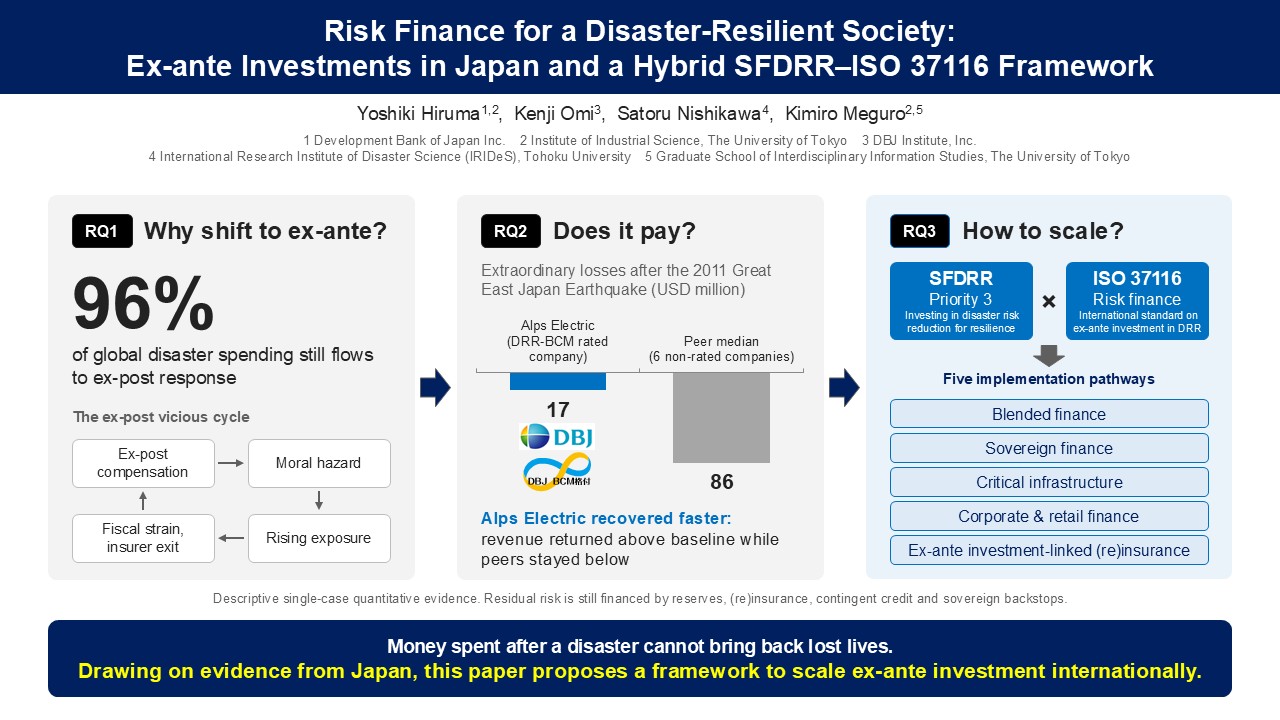
Approximately 96% of global disaster expenditures still flow to ex-post response, despite policy arguments—notably Sendai Framework (SFDRR) Priority 3—for redirecting capital toward ex-ante investment. This paper asks: (RQ1) what structural limitations make this shift imperative; (RQ2) whether company-level ex-ante investment in Japan yields financial benefits; and (RQ3) how SFDRR macro indicators can be integrated with the micro-level process requirements of ISO 37116:2026. Answering RQ1, probabilistic, expected-annual-damage-based benefit-cost analysis, extended by recovery-curve and spatial-CGE frameworks, emerges as the most suitable evaluation approach. We combine a historical review of international risk-finance policy with a within-industry case study of Alps Electric against six non-rated Japanese electronics peers affected by the 2011 Great East Japan Earthquake. Answering RQ2, the rated company’s extraordinary losses (≈USD 17 million) fell below both the peer median (≈USD 86 million) and mean (≈USD 200 million), and its quarterly revenue recovered above baseline by Q2 FY2011, while peers remained below baseline through Q3 FY2012. Given the single-treated-unit design, these patterns are descriptive evidence consistent with—not a causal test of—the Tatano–Tsuchiya recovery-curve mechanisms (attenuated ΔY0, higher γ). Answering RQ3, to scale ex-ante investment internationally, we propose a hybrid SFDRR × ISO 37116 framework with five implementation pathways—blended finance, sovereign finance, critical infrastructure, corporate and retail finance, and (re)insurance—offering common measurement infrastructure to narrow the Asia-Pacific protection gap. Together, these answers point to long-term measures for both sectors: governments embedding verified ex-ante investment into fiscal and regulatory conditionality, and companies and financial institutions translating resilience into financing terms. Large-sample econometric validation remains a priority. Importantly, ex-ante investment reduces and reshapes—but does not eliminate—disaster risk; the proposed framework is therefore designed to complement, rather than replace, the layered instruments that finance residual risk, including reserves, insurance, reinsurance, contingent credit, and sovereign backstops.
- Open Access
- Article
Risk Finance for a Disaster-Resilient Society: Ex-ante Investments in Japan and a Hybrid SFDRR–ISO 37116 Framework
- Yoshiki Hiruma 1,2,*,
- Kenji Omi 3,
- Satoru Nishikawa 4,5 and
- Kimiro Meguro 2,6
Author Information
Received: 30 April 2026 | Revised: 09 September 2026 | Accepted: 05 October 2026 | Published: 19 November 2026
Abstract
Graphical Abstract
Keywords
disaster risk finance | ex-ante investment | pre-arranged financing | Sendai Framework for Disaster Risk Reduction | ISO 37116:2026 | business continuity management | DBJ DRR-BCM rating | protection gap | residual risk
References
- 1.
UNDRR. International Cooperation in Disaster Risk Reduction; United Nations Office for Disaster Risk Reduction: Geneva, Switzerland, 2021.
- 2.
OECD. Fostering Catastrophe Bond Markets in Asia and the Pacific; OECD Development Centre Studies: Paris, France, 2024.
- 3.
Aon plc. 2025 Climate and Catastrophe Insight; Aon plc: London, UK, 2025.
- 4.
United Nations Office for Disaster Risk Reduction. Global Assessment Report on Disaster Risk Reduction 2022—Our World at Risk: Transforming Governance for a Resilient Future; United Nations: Geneva, Switzerland, 2022. https://doi.org/10.18356/9789210015059.
- 5.
United Nations. Sendai Framework for Disaster Risk Reduction 2015–2030. In UN General Assembly Resolution A/RES/69/283; UN: Geneva, Switzerland, 2015.
- 6.
G20 Disaster Risk Reduction Working Group. G20 Disaster Risk Reduction Ministerial Declaration: Resilience for All—Strengthening Disaster Risk Reduction through Solidarity, Equality and Sustainability; G20 South Africa Presidency, 2025. Available online: https://www.preventionweb.net/media/111645/download (accessed on 15 April 2026).
- 7.
ISO 37116:2026; Sustainable Cities and Communities—Disaster Risk Finance—Principles and General Requirements for Financing Ex-Ante Investment in Risk Reduction. ISO: Geneva, Switzerland, 2026.
- 8.
Ghesquiere, F.; Mahul, O. Financial Protection of the State against Natural Disasters: A Primer; World Bank: Washington, DC, USA, 2010.
- 9.
Buchanan, J.M. The Samaritan’s Dilemma. In Altruism, Morality, and Economic Theory; Phelps, E.S., Ed.; Russell Sage Foundation: New York, NY, USA, 1975; pp. 71–85.
- 10.
General Insurance Rating Organization of Japan (GIROJ). Earthquake Insurance Statistics; GIROJ: Tokyo. Available online: https://www.giroj.or.jp/databank/earthquake.html (accessed on 28 July 2026).
- 11.
Raschky, P.A.; Weck-Hannemann, H. Charity hazard—A real hazard to natural disaster insurance? Environ. Hazards 2007, 7, 321–329. https://doi.org/10.1016/j.envhaz.2007.09.002.
- 12.
Cummins, J.D.; Mahul, O. Catastrophe Risk Financing in Developing Countries: Principles for Public Intervention; The World Bank: Washington, DC, USA, 2008. https://doi.org/10.1596/978-0-8213-7736-9.
- 13.
Tanner, T.; Surminski, S.; Wilkinson, E.; et al. The Triple Dividend of Resilience: Realising Development Goals through the Multiple Benefits of Disaster Risk Management; Overseas Development Institute and World Bank: London, UK, 2015.
- 14.
Hallegatte, S.; Rentschler, J.; Rozenberg, J. Lifelines: The Resilient Infrastructure Opportunity; World Bank: Washington, DC, USA, 2019.
- 15.
Rokhideh, M.; Fearnley, C.; Budimir, M. Multi-Hazard Early Warning Systems in the Sendai Framework for Disaster Risk Reduction: Achievements, Gaps, and Future Directions. Int. J. Disaster Risk Sci. 2025, 16, 103–116. https://doi.org/10.1007/s13753-025-00622-9.
- 16.
Ikeda, M.; Palakhamarn, T.; Anbumozhi, V.; et al. Study on the Importance of Investment in DRR and Advanced DRR Technology in ASEAN Countries. In ERIA Discussion Paper No. 513; Economic Research Institute for ASEAN and East Asia: Jakarta, Indonesia, 2024.
- 17.
Global Facility for Disaster Reduction and Recovery. Annual Report 2025: Bringing Resilience to Scale; World Bank: Washington, DC, USA, 2025.
- 18.
Milly, P.C.D.; Betancourt, J.; Falkenmark, M.; et al. Stationarity Is Dead: Whither Water Management? Science 2008, 319, 573–574. https://doi.org/10.1126/science.1151915.
- 19.
Hochrainer-Stigler, S.; Mechler, R.; Pflug, G.; et al. Funding public adaptation to climate-related disasters. Estimates for a global fund. Glob. Environ. Chang. 2014, 4, 253–256. https://doi.org/10.1016/j.gloenvcha.2014.01.011.
- 20.
Giglio, S.; Kelly, B.; Stroebel, J. Climate Finance. Annu. Rev. Financ. Econ. 2021, 13, 15–36. https://doi.org/10.1146/annurev-financial-102620-103311.
- 21.
Stroebel, J.; Wurgler, J. What do you think about climate finance? J. Financ. Econ. 2021, 142, 487–498. https://doi.org/10.1016/j.jfineco.2021.08.004.
- 22.
Bolton, P.; Kacperczyk, M. Do investors care about carbon risk? J. Financ. Econ. 2021, 142, 517–549. https://doi.org/10.1016/j.jfineco.2021.05.008.
- 23.
Pástor, Ľ.; Stambaugh, R.F.; Taylor, L.A. Sustainable investing in equilibrium. J. Financ. Econ. 2021, 142, 550–571. https://doi.org/10.1016/j.jfineco.2020.12.011.
- 24.
Pástor, Ľ.; Stambaugh, R.F.; Taylor, L.A. Dissecting green returns. J. Financ. Econ. 2022, 146, 403–424. https://doi.org/10.1016/j.jfineco.2022.07.007.
- 25.
Campiglio, E.; Daumas, L.; Monnin, P.; et al. Climate-related risks in financial assets. J. Econ. Surv. 2023, 37, 950–992. https://doi.org/10.1111/joes.12525.
- 26.
Basel Committee on Banking Supervision. Climate-Related Financial Risks: Measurement Methodologies; Bank for International Settlements: Basel, Switzerland, 2021.
- 27.
Plichta, M.; Scott, Z.; Nagaria, D. The State of Pre-Arranged Financing for Disasters 2025; Centre for Disaster Protection: London, UK, 2025.
- 28.
Swiss Re Institute. Sigma 1/2025: Natural Catastrophes: Insured Losses on Trend to USD 145 Billion In 2025; Swiss Re: Zurich, Switzerland, 2025.
- 29.
Kellett, J.; Caravani, A. Financing Disaster Risk Reduction: A 20 Year Story of International Aid; Overseas Development Institute: London, UK; Global Facility for Disaster Reduction and Recovery: Washington, DC, USA, 2013.
- 30.
Jarzabkowski, P.A.; Chalkias, K.; Cacciatori, E.; et al. Disaster Insurance Reimagined: Protection in a Time of Increasing Risk; Oxford University Press: Oxford, UK, 2023. https://doi.org/10.1093/oso/9780192865168.001.0001.
- 31.
Beirne, J.; Renzhi, N.; Volz, U. Feeling the Heat: Climate Risks and the Cost of Sovereign Borrowing. Int. Rev. Econ. Financ. 2021, 76, 920–936.
- 32.
Klusak, P.; Agarwala, M.; Burke, M.; et al. Rising Temperatures, Falling Ratings: The Effect of Climate Change on Sovereign Creditworthiness. Manag. Sci. 2023, 69, 7468–7491. https://doi.org/10.1287/mnsc.2023.4869.
- 33.
Kousky, C. Understanding Disaster Insurance: New Tools for a More Resilient Future; Island Press: Washington, DC, USA, 2022.
- 34.
Kunreuther, H. Mitigating disaster losses through insurance. J. Risk Uncertain. 1996, 12, 171–187. https://doi.org/10.1007/bf00055792.
- 35.
Kunreuther, H.; Michel-Kerjan, E.; Ranger, N. Insuring future climate catastrophes. Clim. Chang. 2013, 118, 339–354. https://doi.org/10.1007/s10584-012-0625-z.
- 36.
Cantelmo, A.; Melina, G.; Papageorgiou, C. Macroeconomic outcomes in disaster-prone countries. J. Dev. Econ. 2023, 161, 103037. https://doi.org/10.1016/j.jdeveco.2022.103037.
- 37.
He, J.; Wu, L.; Meng, Z.; et al. Cost-Benefit Analysis Method for Disaster Prevention and Restoration Resource Investment in Power Systems Based on Resilience Assessment. In Proceedings of the 2024 IEEE 8th Conference on Energy Internet and Energy System Integration (EI2), Shenyang, China, 29 November–2 December 2024; pp. 4756–4762. https://doi.org/10.1109/ei264398.2024.10991619.
- 38.
Hallegatte, S.; Rentschler, J.; Walsh, B. Building Back Better: Achieving Resilience through Stronger, Faster, and More Inclusive Post-Disaster Reconstruction; World Bank: Washington, DC, USA, 2018.
- 39.
Ministry of Land, Infrastructure, Transport and Tourism. Manual for Economic Surveys on Flood Control [in Japanese]; MLIT: Tokyo, Japan.
- 40.
Nagami, K.; Inoue, R.; Komori, D. Flood Risk Perception in an Inherently Flood-Prone Urban Area: Based on a Land Price Analysis in the Arakawa River Downstream Area, Tokyo. J. Disaster Res. 2025, 20, 222–232. https://doi.org/10.20965/jdr.2025.p0222.
- 41.
Tatano, H.; Tsuchiya, S. Economic Impacts of the Transportation Network Disruption: An Extension of SCGE Model. In Methodologies for Estimating the Economic Impacts of Natural Disasters; Springer: Singapore, 2021; pp. 85–95.
- 42.
Development Bank of Japan Inc. DBJ DRR-BCM Rated Loan Program—Principles and Outline: Designing a Disaster-Resilient Japan. DBJ: Tokyo. Available online: https://www.dbj.jp/en/service/sustainability_rating/bcm/overview.html (accessed on 2 April 2026).
- 43.
UNISDR. Business and Disaster Risk Reduction: Good Practices and Case Studies; United Nations Office for Disaster Risk Reduction: Geneva, Switzerland, 2013. Available online: https://www.preventionweb.net/files/33428_334285essentialscasestudies.pdf (accessed on 18 November 2026).
- 44.
World Economic Forum. Global Risks 2012, 7th ed.; World Economic Forum: Geneva, Switzerland, 2012. Available online: https://www3.weforum.org/docs/WEF_GlobalRisks_Report_2012.pdf (accessed on 18 November 2026).
- 45.
Hiruma, Y.; Noda, K. Survey on the Disaster Preparedness and Business Continuity of Companies Based on the Hearing etc. Investigation to CRO in the Great East Japan Earthquake and Consideration of Enterprise Risk Management in Future. J. Jpn. Soc. Civ. Eng. Ser. A1 Struct. Eng. Earthq. Eng. SE EE 2012, 68, I_1224–I_1238. https://doi.org/10.2208/jscejseee.68.i_1224.
- 46.
Carvalho, V.M.; Nirei, M.; Saito, Y.U.; et al. Supply Chain Disruptions: Evidence from the Great East Japan Earthquake. Q. J. Econ. 2021, 136, 1255–1321. https://doi.org/10.1093/qje/qjaa044.
- 47.
Todo, Y.; Nakajima, K.; Matous, P. How Do Supply Chain Networks Affect the Resilience of Firms to Natural Disasters? Evidence from the Great East Japan Earthquake. J. Reg. Sci. 2015, 55, 209–229. https://doi.org/10.1111/jors.12119.
- 48.
Dasgupta, P. The Economics of Biodiversity: The Dasgupta Review; HM Treasury: London, UK, 2021.
- 49.
Network for Greening the Financial System. Nature-Related Financial Risks: A Conceptual Framework to Guide Action by Central Banks and Supervisors; NGFS Secretariat, Banque de France: Paris, France, 2023.
- 50.
Taskforce on Nature-related Financial Disclosures. Recommendations of the Taskforce on Nature-related Financial Disclosures; Taskforce on Nature-related Financial Disclosures: London, UK, 2023
- 51.
United Nations Environment Programme; S&P Global Sustainablel. Nature Risk Profile: A Methodology for Profiling Nature-Related Dependencies and Impacts; UNEP: Nairobi, Kenya, 2023.
- 52.
Calice, P.; Diaz Kalan, F.; Miguel, F. Nature-Related Financial Risks in Brazil; World Bank: Washington, DC, USA, 2021.
- 53.
Karolyi, G.A.; Tobin-de la Puente, J. Biodiversity finance: A call for research into financing nature. Financ. Manag. 2023, 52, 231–251. https://doi.org/10.1111/fima.12417.
- 54.
Giglio, S.; Kuchler, T.; Stroebel, J.; et al. Biodiversity Risk; National Bureau of Economic Research: Cambridge, MA, USA, 2023.
- 55.
Caldara, D.; Iacoviello, M. Measuring Geopolitical Risk. Am. Econ. Rev. 2022, 112, 1194–1225. https://doi.org/10.1257/aer.20191823.
- 56.
Caldara, D.; Conlisk, S.; Iacoviello, M.; et al. The Effect of the War in Ukraine on Global Activity and Inflation; Board of Governors of the Federal Reserve System: Washington, DC, USA, 2022.
- 57.
World Economic Forum. The Global Risks Report 2026, 21st ed.; World Economic Forum: Geneva, Switzerland, 2026.
- 58.
World Bank. Catastrophe Deferred Drawdown Option (Cat DDO): Product Note; World Bank: Washington, DC, USA, 2021. Available online: https://thedocs.worldbank.org/en/doc/1820b53ad5cba038ff885cc3758ba59f-0340012021/original/Cat-DDO-IBRD-Product-Note.pdf (accessed on 1 August 2026).
- 59.
Federal Emergency Management Agency (FEMA). National Flood Insurance Program: Community Rating System—Coordinator’s Manual; Federal Emergency Management Agency (FEMA): Washington, DC, USA, 2017.

This work is licensed under a Creative Commons Attribution 4.0 International License.