
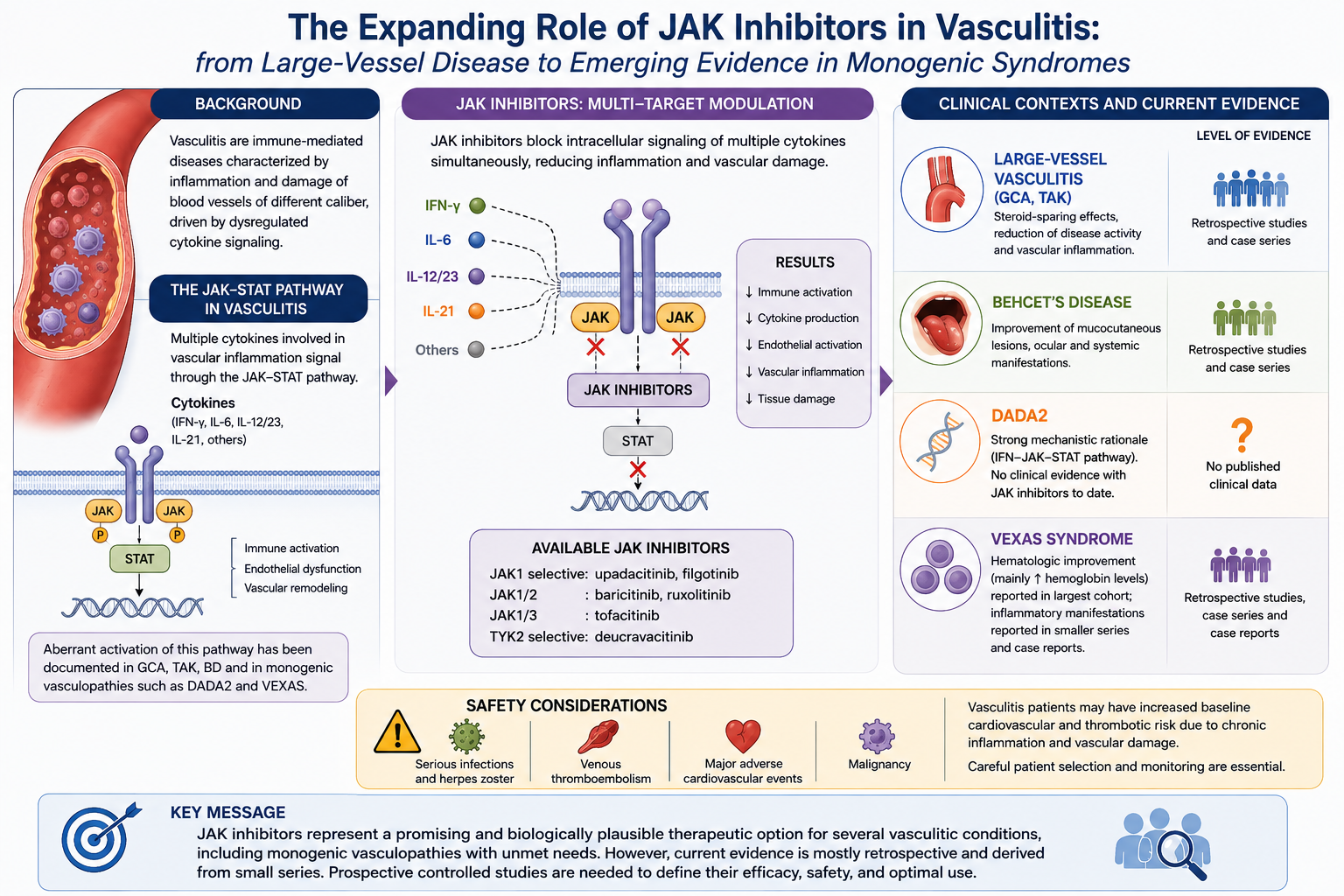
Janus kinase (JAK) inhibitors have emerged as a potential therapeutic class across immune-mediated diseases, prompting interest in their application to vasculitis. Although data remain limited, early evidence suggests that JAK inhibition may offer clinical benefit in selected settings, including large-vessel vasculitis and Behçet’s disease and monogenic vasculopathies such as adenosine deaminase 2 deficiency (DADA2) and VEXAS syndrome, where treatment options are often restricted and disease control is challenging. In these conditions, modulation of intracellular signaling pathways may translate into improvements across systemic, cutaneous, and hematologic domains. Overall, while JAK inhibitors represent a promising and biologically plausible therapeutic avenue for difficult-to-treat vasculitic conditions, current evidence is derived almost entirely from retrospective studies and case series. Ongoing and future investigations are needed to define efficacy and optimal treatment strategies.
- Open Access
- Review
The Expanding Role of JAK Inhibitors in Vasculitis: From Large-Vessel Disease to Emerging Evidence in Monogenic Syndromes
- Lorenza Bruno,
- Giacomo Cafaro,
- Roberto Dal Pozzolo,
- Elena Bartoloni and
- Carlo Perricone *
Author Information
Received: 22 March 2026 | Revised: 28 August 2026 | Accepted: 18 September 2026 | Published: 30 October 2026
Abstract
Graphical Abstract
Keywords
janus kinase inhibitors | vasculitis | large-vessel vasculitis | Behçet’s disease | DADA2 | VEXAS syndrome | autoimmunity
References
- 1.
Watts, R.A.; Robson, J. Introduction, epidemiology and classification of vasculitis. Best. Pract. Res. Clin. Rheumatol. 2018, 32, 3–20. https://doi.org/10.1016/j.berh.2018.10.003.
- 2.
Bursi, R.; Cafaro, G.; Perricone, C.; et al. Contribution of Janus-Kinase/Signal Transduction Activator of Transcription Pathway in the Pathogenesis of Vasculitis: A Possible Treatment Target in the Upcoming Future. Front. Pharmacol. 2021, 12, 635663. https://doi.org/10.3389/fphar.2021.635663.
- 3.
Deng, J.; Younge, B.; Olshen, R.; et al. Th17 and Th1 T-cell responses in giant cell arteritis. Circulation 2010, 121, 906–915. https://doi.org/10.1161/circulationaha.109.872903.
- 4.
Watanabe, R.; Hashimoto, M. Vasculitogenic T Cells in Large Vessel Vasculitis. Front. Immunol. 2022, 13, 923582. https://doi.org/10.3389/fimmu.2022.923582.
- 5.
Qin, Z.; Wang, R.; Hou, P.; et al. TCR signaling induces STAT3 phosphorylation to promote TH17 cell differentiation. J. Exp. Med. 2024, 221, e20230683. https://doi.org/10.1084/jem.20230683.
- 6.
Kaplan, M.H.; Grusby, M.J. Regulation of T helper cell differentiation by STAT molecules. J. Leukoc. Biol. 1998, 64, 2–5. https://doi.org/10.1002/jlb.64.1.2.
- 7.
Weyand, C.; Younge, B.; Goronzy, J. IFN-γ and IL-17: The two faces of T-cell pathology in giant cell arteritis. Curr. Opin. Rheumatol. 2011, 23, 43–49. https://doi.org/10.1097/bor.0b013e32833ee946.
- 8.
Weyand, C.M.; Goronzy, J.J. Immune mechanisms in medium and large-vessel vasculitis. Nat. Rev. Rheumatol. 2013, 9, 731–740. https://doi.org/10.1038/nrrheum.2013.161.
- 9.
Koster, M.J.; Warrington, K.J. Giant cell arteritis: Pathogenic mechanisms and new potential therapeutic targets. BMC Rheumatol. 2017, 1, 2. https://doi.org/10.1186/s41927-017-0004-5.
- 10.
Watanabe, R.; Berry, G.J.; Liang, D.H.; et al. Cellular Signaling Pathways in Medium and Large Vessel Vasculitis. Front. Immunol. 2020, 11, 587089. https://doi.org/10.3389/fimmu.2020.587089.
- 11.
Greigert, H.; Genet, C.; Ramon, A.; et al. New Insights into the Pathogenesis of Giant Cell Arteritis: Mechanisms Involved in Maintaining Vascular Inflammation. J. Clin. Med. 2022, 11, 2905. https://doi.org/10.3390/jcm11102905.
- 12.
Tulunay, A.; Dozmorov, M.; Ture-Ozdemir, F.; et al. Activation of the JAK/STAT pathway in Behcet’s disease. Genes Immun. 2015, 16, 170–175. https://doi.org/10.1038/gene.2014.64.
- 13.
van der Houwen, T.B.; van Hagen, P.M.; van Laar, J.A.M. Immunopathogenesis of Behçet’s disease and treatment modalities. Semin. Arthritis Rheum. 2022, 52, 151956. https://doi.org/10.1016/j.semarthrit.2022.151956.
- 14.
Lv, Y.; Mi, P.; Babon, J.J.; et al. Small molecule drug discovery targeting the JAK-STAT pathway. Pharmacol. Res. 2024, 204, 107217. https://doi.org/10.1016/j.phrs.2024.107217.
- 15.
Hu, X.; Li, J.; Fu, M.; et al. The JAK/STAT signaling pathway: From bench to clinic. Signal Transduct. Target. Ther. 2021, 6, 402. https://doi.org/10.1038/s41392-021-00791-1.
- 16.
Bonacini, M.; Rossi, A.; Ferrigno, I.; et al. The importance of defining which Janus kinases are activated in giant cell arteritis. Clin. Exp. Rheumatol. 2023, 41, 784–786. https://doi.org/10.55563/clinexprheumatol/u7elc2.
- 17.
Watanabe, R.; Hashimoto, M. Perspectives of JAK Inhibitors for Large Vessel Vasculitis. Front. Immunol. 2022, 13, 881705. https://doi.org/10.3389/fimmu.2022.881705.
- 18.
Virtanen, A.; Palmroth, M.; Liukkonen, S.; et al. Differences in JAK Isoform Selectivity Among Different Types of JAK Inhibitors Evaluated for Rheumatic Diseases Through In Vitro Profiling. Arthritis Rheumatol. 2023, 75, 2054–2061. https://doi.org/10.1002/art.42547.
- 19.
Bruno, L.; Cafaro, G.; Dal Pozzolo, R.; et al. JAK inhibitors in areas outside of inflammatory arthritis: Focus on connective tissue diseases. Rheumatology 2026, 65, keag317. https://doi.org/10.1093/rheumatology/keag317.
- 20.
Ma, C.; Liu, M.; Cheng, Y.; et al. Therapeutic efficacy and safety of JAK inhibitors in treating polymyositis/dermatomyositis: A single-arm systemic meta-analysis. Front. Immunol. 2024, 15, 1382728. https://doi.org/10.3389/fimmu.2024.1382728.
- 21.
Fazeli, P.; Bahramian, S.; Farahmand, K.; et al. JAK Inhibitors for Treatment of SAPHO Syndrome: A Systematic Review of 72 Cases. ACR Open Rheumatol. 2025, 7, e70101. https://doi.org/10.1002/acr2.70101.
- 22.
Ma, L.; Peng, L.; Zhao, J.; et al. Efficacy and safety of Janus kinase inhibitors in systemic and cutaneous lupus erythematosus: A systematic review and meta-analysis. Autoimmun. Rev. 2023, 22, 103440. https://doi.org/10.1016/j.autrev.2023.103440.
- 23.
Ansari, M.S.; Vahabi, S.M.; Memari, H.; et al. Use of the oral Janus kinase inhibitor tofacitinib in the treatment of morphea: A retrospective study. J. Am. Acad. Dermatol. 2025, 93, 769–771. https://doi.org/10.1016/j.jaad.2025.05.1377.
- 24.
Crisler, W.J.; Rowley, R.; Oke, O.; et al. Eosinophilic Fasciitis and Morphea Share Gene Signatures of Inflammatory Cell Death, Self-DNA Recognition, and Enhanced Jak/Signal Transducer and Activator of Transcription Signaling. J. Investig. Dermatol. 2026, 146, 64–77.e1. https://doi.org/10.1016/j.jid.2025.05.023.
- 25.
Rimar, D.; Alpert, A.; Starosvetsky, E.; et al. Tofacitinib for polyarteritis nodosa: A tailored therapy. Ann. Rheum. Dis. 2016, 75, 2214–2216. https://doi.org/10.1136/annrheumdis-2016-209330.
- 26.
Shikishima, Y.; Saeki, T.; Matsuura, N. Chemokines in Kawasaki disease: Measurement of CCL2, CCL22 and CXCL10. Asian Pac. J. Allergy Immunol. 2003, 21, 139–143.
- 27.
Hosaka, S.; Imagawa, K.; Yano, Y.; et al. The CXCL10-CXCR3 axis plays an important role in Kawasaki disease. Clin. Exp. Immunol. 2024, 216, 104–111. https://doi.org/10.1093/cei/uxad125.
- 28.
Pugh, D.; Karabayas, M.; Basu, N.; et al. Large-vessel vasculitis. Nat. Rev. Dis. Prim. 2022, 7, 93. https://doi.org/10.1038/s41572-021-00327-5.
- 29.
Régnier, P.; Le Joncour, A.; Maciejewski-Duval, A.; et al. Targeting JAK/STAT pathway in Takayasu’s arteritis. Ann. Rheum. Dis. 2020, 79, 951–959. https://doi.org/10.1136/annrheumdis-2019-216900.
- 30.
Zhang, H.; Watanabe, R.; Berry, G.J.; et al. Inhibition of JAK-STAT Signaling Suppresses Pathogenic Immune Responses in Medium and Large Vessel Vasculitis. Circulation 2018, 137, 1934–1948. https://doi.org/10.1161/circulationaha.117.030423.
- 31.
Maleszewski, J.J.; Younge, B.R.; Fritzlen, J.T.; et al. Clinical and pathological evolution of giant cell arteritis: A prospective study of follow-up temporal artery biopsies in 40 treated patients. Mod. Pathol. 2017, 30, 788–796. https://doi.org/10.1038/modpathol.2017.10.
- 32.
Samson, M.; Corbera-Bellalta, M.; Audia, S.; et al. Recent advances in our understanding of giant cell arteritis pathogenesis. Autoimmun. Rev. 2017, 16, 833–844. https://doi.org/10.1016/j.autrev.2017.05.014.
- 33.
Cid, M.C.; Ríos-Garcés, R.; Terrades-García, N.; et al. Treatment of giant-cell arteritis: From broad spectrum immunosuppressive agents to targeted therapies. Rheumatology 2020, 59, iii17–iii27. https://doi.org/10.1093/rheumatology/kez645.
- 34.
Cai, X.Y.; Ge, J.R.; Xu, L.; et al. Paeoniflorin 6′-o-benzene sulfonate (CP-25) improves vasculitis through inhibiting IL 17A/JAK/STAT3 signaling pathway in endothelial cells of HFD CIA rats. Phytother Res. 2021, 35, 1033-1047. https://doi.org/10.1002/ptr.6870.
- 35.
Eriksson, P.; Skoglund, O.; Hemgren, C.; et al. Clinical experience and safety of Janus kinase inhibitors in giant cell arteritis: A retrospective case series from Sweden. Front. Immunol. 2023, 14, 1187584. https://doi.org/10.3389/fimmu.2023.1187584.
- 36.
Loricera, J.; Tofade, T.; Prieto-Peña, D.; et al. Effectiveness of janus kinase inhibitors in relapsing giant cell arteritis in real-world clinical practice and review of the literature. Arthritis Res. Ther. 2024, 26, 116. https://doi.org/10.1186/s13075-024-03314-9.
- 37.
Prigent, K.; Aouba, A.; Aide, N.; et al. JAK inhibitor effectiveness in giant-cell arteritis with large-vessel involvement assessed by 18F-FDG PET-CT. Clin. Nucl. Med. 2022, 47, 234–235. https://doi.org/10.1097/rlu.0000000000003913.
- 38.
Régent, A.; Terrier, B.; Legendre, P.; et al. Efficacy of baricitinib for refractory large-vessel vasculitis. Rheumatology 2021, 60, e389–e391. https://doi.org/10.1093/rheumatology/keab541.
- 39.
Koster, M.J.; Crowson, C.S.; Giblon, R.E.; et al. Baricitinib for relapsing giant cell arteritis: A prospective open-label 52-week pilot study. Ann. Rheum. Dis. 2022, 81, 861–867. https://doi.org/10.1136/annrheumdis-2021-221961.
- 40.
Blockmans, D.; Penn, S.K.; Setty, A.R.; et al. A Phase 3 Trial of Upadacitinib for Giant-Cell Arteritis. N. Engl. J. Med. 2025, 392, 2013–2024. https://doi.org/10.1056/nejmoa2413449.
- 41.
Kong, X.; Sun, Y.; Dai, X.; et al. Treatment efficacy and safety of tofacitinib versus methotrexate in Takayasu arteritis: A prospective observational study. Ann. Rheum. Dis. 2022, 81, 117–123. https://doi.org/10.1136/annrheumdis-2021-220832.
- 42.
Palermo, A.; Marvisi, C.; Casali, M.; et al. Tofacitinib for the treatment of refractory Takayasu’s arteritis: Description of 2 cases. Clin. Exp. Rheumatol. 2020, 38, 234–235.
- 43.
Li, J.; Li, M.; Tian, X.; et al. Tofacitinib in patients with refractory Takayasu’s arteritis. Rheumatology 2020, 59, e95–e98. https://doi.org/10.1093/rheumatology/keaa281.
- 44.
Yamamura, Y.; Matsumoto, Y.; Asano, Y.; et al. Refractory Takayasu arteritis responding to the oral Janus kinase inhibitor, tofacitinib. Rheumatol. Adv. Pract. 2020, 4, rkz050. https://doi.org/10.1093/rap/rkz050.
- 45.
Sato, S.; Matsumoto, H.; Temmoku, J.; et al. A case of Takayasu arteritis complicated by refractory ulcerative colitis successfully treated with tofacitinib. Rheumatology 2020, 59, 1773–1775. https://doi.org/10.1093/rheumatology/kez580.
- 46.
Kuwabara, S.; Tanimura, S.; Matsumoto, S.; et al. Successful remission with tofacitinib in a patient with refractory Takayasu arteritis complicated by ulcerative colitis. Ann. Rheum. Dis. 2020, 79, 1125–1126. https://doi.org/10.1136/annrheumdis-2019-216606.
- 47.
Wang, C.; Tsai, Y.; Liu, Y.; et al. Extended-release tofacitinib improves refractory Takayasu’s arteritis. Scand. J. Rheumatol. 2022, 51, 72–75. https://doi.org/10.1080/03009742.2021.1911054.
- 48.
Mekinian, A.; Meneses, S.; Biard, L.; et al. Salvage therapy with JAK inhibitors in refractory Takayasu arteritis: A multicentre experience. RMD Open 2026, 12, e006501. https://doi.org/10.1136/rmdopen-2025-006501.
- 49.
Ino, K.; Kinoshita, N.; Arinuma, Y.; et al. Improvements in PET/CT results and serum cytokine profile of HLA-B52-positive patients with Takayasu’s arteritis and ulcerative colitis post-tofacitinib. Clin. Exp. Rheumatol. 2022, 40, 849–850. https://doi.org/10.55563/clinexprheumatol/i9chku.
- 50.
Zhou, Z.; Fang, C.; Wang, L.; et al. Baricitinib for refractory Takayasu arteritis: A prospective cohort study in a tertiary referral centre. RMD Open 2024, 10, e003985. https://doi.org/10.1136/rmdopen-2023-003985.
- 51.
ClinicalTrials.gov. Efficiency of Methotrexate and Tofacitinib in Mild and Moderate Patients with Takayasu Arteritis. Available online: https://clinicaltrials.gov/study/NCT04299971 (accessed on 19 October 2026).
- 52.
ClinicalTrials.gov. A Study to Evaluate the Efficacy and Safety of Upadacitinib in Participants with Takayasu Arteritis (TAK). Available online: https://clinicaltrials.gov/study/NCT04161898 (accessed on 19 October 2026).
- 53.
Pak, D.; Park, H.J. Behcet disease: An undifferentiating and complex vasculitis. Postgrad. Med. 2023, 135, 33–43. https://doi.org/10.1080/00325481.2022.2159205.
- 54.
Liu, J.; Hou, Y.; Sun, L.; et al. A pilot study of tofacitinib for refractory Behçet’s syndrome. Ann. Rheum. Dis. 2020, 79, 1517–1520. https://doi.org/10.1136/annrheumdis-2020-217307.
- 55.
Zhao, N.; Tang, Y.; Wang, S.; et al. Case report: Refractory intestinal Behçet’s syndrome successfully treated with tofacitinib: A report of four cases. Front. Immunol. 2022, 13, 981502. https://doi.org/10.3389/fimmu.2022.981502.
- 56.
Zou, J.; Cai, J.F.; Ye, J.F.; et al. Tofacitinib as an alternative therapy for refractory intestinal Behçet’s syndrome. Ther. Adv. Musculoskelet. Dis. 2022, 14, 1759720X221124014. https://doi.org/10.1177/1759720x221124014.
- 57.
Liu, J.; Yu, X.; Wang, Z.; et al. Baricitinib for the treatment of intestinal Behçet’s disease: A pilot study. Clin. Immunol. 2023, 247, 109241. https://doi.org/10.1016/j.clim.2023.109241.
- 58.
Wang, Z.; Wang, X.; Liu, W.; et al. Baricitinib for the treatment of refractory vascular Behçet’s disease. Clin. Immunol. 2023, 250, 109298. https://doi.org/10.1016/j.clim.2023.109298.
- 59.
Tao, T.; He, D.; Peng, X.; et al. Successful Remission with Upadacitinib in Two Patients with Anti-TNF-Refractory Macular Edema Associated with Behçet’s Uveitis. Ocul. Immunol. Inflamm. 2024, 32, 1897–1900. https://doi.org/10.1080/09273948.2023.2263557.
- 60.
Colangelo, A.; Tromby, F.; Cafaro, G.; et al. Vasculitis associated with adenosine deaminase 2 deficiency: At the crossroads between Behçet’s disease and autoinflammation. A viewpoint. Reumatismo 2023, 18, 75. https://doi.org/10.4081/reumatismo.2023.1578.
- 61.
Sharma, V.; Deo, P.; Sharma, A. Deficiency of adenosine deaminase 2 (DADA2): Review. Best. Pract. Res. Clin. Rheumatol. 2023, 37, 101844. https://doi.org/10.1016/j.berh.2023.101844.
- 62.
Signa, S.; Bertoni, A.; Penco, F.; et al. Adenosine deaminase 2 deficiency (DADA2): A crosstalk between innate and adaptive immunity. Front. Immunol. 2022, 13, 935957. https://doi.org/10.3389/fimmu.2022.935957.
- 63.
Nihira, H.; Izawa, K.; Ito, M.; et al. Detailed Analysis of Japanese Patients with Adenosine Deaminase 2 Deficiency Reveals Characteristic Elevation of Type II Interferon Signature and STAT1 Hyperactivation. J. Allergy Clin. Immunol. 2021, 148, 550–562. https://doi.org/10.1016/j.jaci.2021.01.018.
- 64.
Wu, Z.; Gao, S.; Watanabe, N.; et al. Single-Cell Profiling of T Lymphocytes in Deficiency of Adenosine Deaminase 2. J. Leukoc. Biol. 2022, 111, 301–312. https://doi.org/10.1002/jlb.5a0621-314r.
- 65.
Nakajima, H.; Kunimoto, H. VEXAS syndrome. Int. J. Hematol. 2025, 122, 341–350. https://doi.org/10.1007/s12185-024-03799-9.
- 66.
Holden, R.; Jeelall, Y.; McLean-Tooke, A.; et al. VEXAS: A review of current understandings and emerging treatment strategies. Front. Immunol. 2025, 16, 1644404. https://doi.org/10.3389/fimmu.2025.1644404.
- 67.
Kosmider, O.; Possémé, C.; Templé, M.; et al. VEXAS syndrome is characterized by inflammasome activation and monocyte dysregulation. Nat. Commun. 2024, 15, 910. https://doi.org/10.1038/s41467-024-44811-4.
- 68.
Heiblig, M.; Ferrada, M.; Koster, M.; et al. Ruxolitinib is more effective than other JAK inhibitors to treat VEXAS syndrome: A retrospective multicenter study. Blood 2022, 140, 927–931. https://doi.org/10.1182/blood.2022016642.
- 69.
Bahramian, S.; Fazeli, P.; Rafati, A.; et al. JAK Inhibitors for Treatment of VEXAS Syndrome: A Systematic Review of 186 Cases. Dermatol. Res. Pract. 2025, 2025, 9127126. https://doi.org/10.1155/drp/9127126.
- 70.
Bindoli, S.; Baggio, C.; Doria, A.; et al. JAK inhibitors for the treatment of VEXAS syndrome. Exp. Biol. Med. Maywood 2023, 248, 394–398. https://doi.org/10.1177/15353702231165030.
- 71.
Ytterberg, S.R.; Bhatt, D.L.; Mikuls, T.R.; et al. Cardiovascular and Cancer Risk with Tofacitinib in Rheumatoid Arthritis. N. Engl. J. Med. 2022, 386, 316–326. https://doi.org/10.1056/nejmoa2109927.
- 72.
Szekanecz, Z.; Buch, M.H.; Charles-Schoeman, C.; et al. Efficacy and safety of JAK inhibitors in rheumatoid arthritis: Update for the practising clinician. Nat. Rev. Rheumatol. 2024, 20, 101–115. https://doi.org/10.1038/s41584-023-01062-9.

This work is licensed under a Creative Commons Attribution 4.0 International License.
