
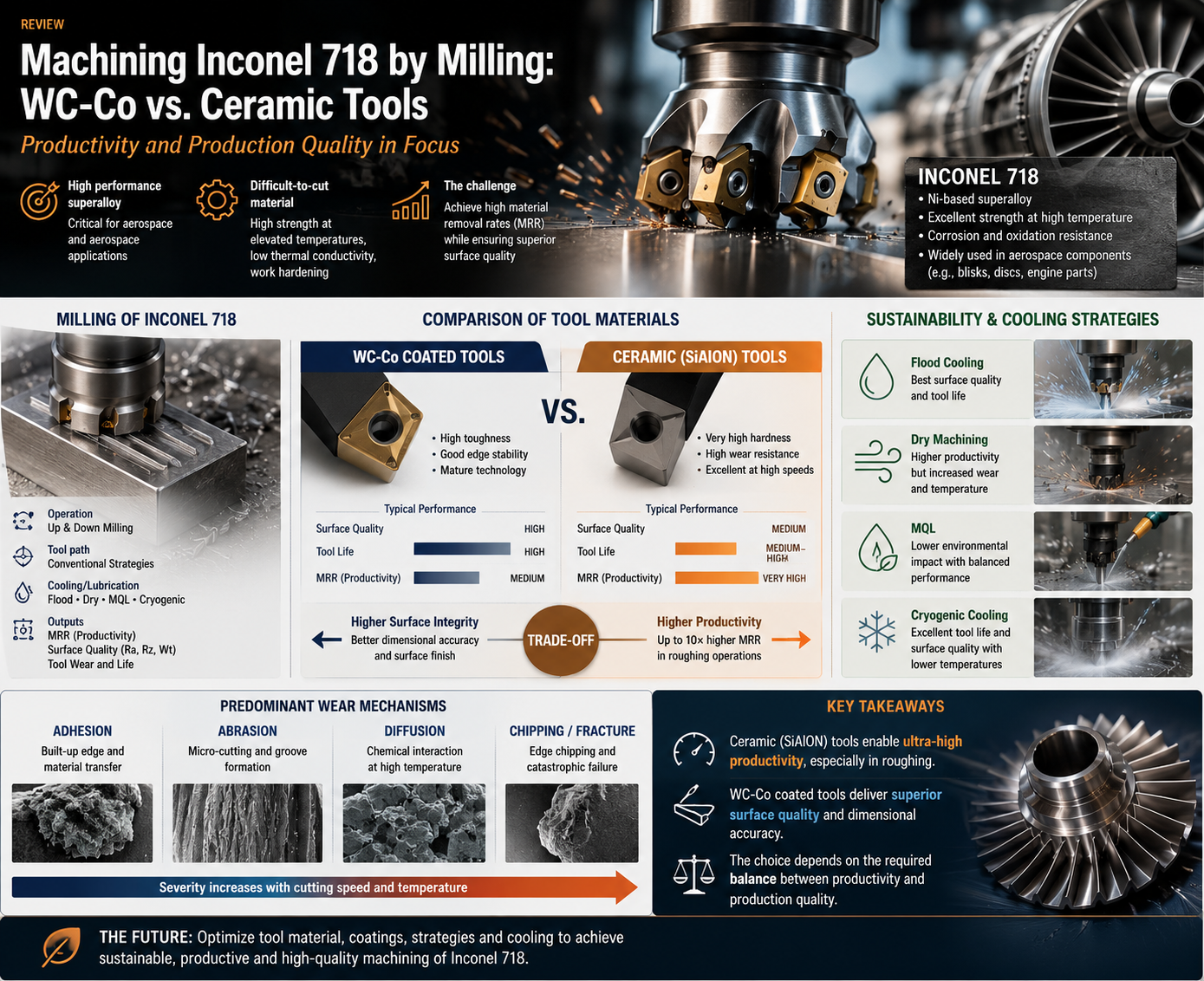
Machining Inconel 718 remains a challenge for various industry sectors, causing high levels of tool wear only after a few minutes of machining, making it a hard to process material. Furthermore, Inconel 718 parts are crucial for sectors such as the aeronautical and aerospace, with these components being required to have high-quality and tight tolerances. This makes the machining of this alloy even more challenging, as guaranteeing these pre-requisites requires a high number of tool changes, ensuring that are always in good condition. To mitigate the problems associated with the machining of this alloy, many researchers and manufacturers use coated tools, with the WC-Co tools still being widely used in this regard. However, since processing this alloy remains a challenge, there is a wide variety of studies focusing on finding even more solutions, by developing novel machining strategies, coatings and employing different tool materials. Lately there has been a focus on the study of ceramic tool materials to machine this alloy, as these materials exhibit high levels of hardness and wear resistance. Moreover, ceramic tools can be used at much higher cutting speeds than standard WC-Co tools, not only mitigating sustained wear, but also being more productive than their competitors. In the present review study, recent research papers were analysed, focusing on the milling of Inconel 718 using WC-Co tools and ceramic tool materials, particularly, SiAlON. The recent research trends and directions will be presented, as well as a comparison of the productivity and surface quality obtained with milling tools made of these tool materials. Regarding the comparison, the selected research studies focus on applications that can be replicated in industrial settings, thus facilitating this comparison. It was found that these ceramic tool materials show tremendous potential when applied to milling of Inconel 718, particularly for roughing operations, exhibiting material removal rates of up to ten times higher than standard WC-Co tools. However, the production quality is still not up to par with WC-Co tools.
- Open Access
- Review
Review on the Productivity and Production Quality of WC-Co and Ceramic Tools Applied in Milling Operations of Inconel 718
Author Information
Received: 11 Dec 2025 | Revised: 04 Feb 2026 | Accepted: 09 Feb 2026 | Published: 22 Apr 2026
Abstract
Graphical Abstract
Keywords
milling | Inconel 718 | wear | productivity | quality | sustainability
References
- 1.
Sousa, V.F.C.; Silva, F.J.G. Recent Advances in Turning Processes Using Coated Tools—A Comprehensive Review. Metals 2020, 10, 170. https://doi.org/10.3390/met10020170.
- 2.
Sousa, V.F.C.; Silva, F.J.G. Recent Advances on Coated Milling Tool Technology—A Comprehensive Review. Coatings 2020, 10, 235. https://doi.org/10.3390/coatings10030235.
- 3.
Mersni, W.; Boujelbene, M.; Ben Salem, S.; et al. Machining Time and Quadratic Mean Roughness Optimization in Ball End Milling of Titanium Alloy Ti-6Al-4V—Aeronautic Field. Mater. Today Proc. 2020, 26, 2619–2624. https://doi.org/10.1016/j.matpr.2020.02.553.
- 4.
Kulkarni, H.B.; Nadakatti, M.M.; Kulkarni, S.C.; et al. Investigations on Effect of Nanofluid Based Minimum Quantity Lubrication Technique for Surface Milling of Al7075-T6 Aerospace Alloy. Mater. Today Proc. 2020, 27, 251–256. https://doi.org/10.1016/j.matpr.2019.10.127.
- 5.
Singh, A.; Ghosh, S.; Aravindan, S. State of Art for Sustainable Machining of Nickel-Based Alloys Using Coated and Uncoated Tools and Machining of High Strength Materials Using Surface Modified Cutting Tools. Tribol. Int. 2022, 170, 107517. https://doi.org/10.1016/j.triboint.2022.107517.
- 6.
Barros, R.; Silva, F.J.G.; Gouveia, R.M.; et al. Laser Powder Bed Fusion of Inconel 718: Residual Stress Analysis Before and After Heat Treatment. Metals 2019, 9, 1290. https://doi.org/10.3390/met9121290.
- 7.
Teixeira, Ó.; Silva, F.J.G.; Atzeni, E. Residual Stresses and Heat Treatments of Inconel 718 Parts Manufactured via Metal Laser Beam Powder Bed Fusion: An Overview. Int. J. Adv. Manuf. Technol. 2021, 113, 3139–3162. https://doi.org/10.1007/s00170-021-06835-8.
- 8.
Asala, G.; Andersson, J.; Ojo, O.A. A Study of the Dynamic Impact Behaviour of IN 718 and ATI 718Plus® Superalloys. Philos. Mag. 2019, 99, 419–437. https://doi.org/10.1080/14786435.2018.1540891.
- 9.
Zhou, X.; Wang, K.; Li, C.; et al. Effect of Ultrafine Gradient Cemented Carbides Substrate on the Performance of Coating Tools for Titanium Alloy High Speed Cutting. Int. J. Refract. Met. Hard Mater. 2019, 84, 105024. https://doi.org/10.1016/j.ijrmhm.2019.105024.
- 10.
Ji, W.; Zou, B.; Zhang, S.; et al. Design and Fabrication of Gradient Cermet Composite Cutting Tool, and Its Cutting Performance. J. Alloys Compd. 2018, 732, 25–31. https://doi.org/10.1016/j.jallcom.2017.10.187.
- 11.
Uddin Siddiqui, T.; Kumar Singh, S. Design, Fabrication and Characterization of a Self-Lubricated Textured Tool in Dry Machining. Mater. Today Proc. 2021, 41, 863–869. https://doi.org/10.1016/j.matpr.2020.09.259.
- 12.
Sousa, V.F.C.; Da Silva, F.J.G.; Pinto, G.F.; et al. Characteristics and Wear Mechanisms of TiAlN-Based Coatings for Machining Applications: A Comprehensive Review. Metals 2021, 11, 260. https://doi.org/10.3390/met11020260.
- 13.
Sateesh Kumar, C.; Majumder, H.; Khan, A.; et al. Applicability of DLC and WC/C Low Friction Coatings on Al2O3/TiCN Mixed Ceramic Cutting Tools for Dry Machining of Hardened 52100 Steel. Ceram. Int. 2020, 46, 11889–11897. https://doi.org/10.1016/j.ceramint.2020.01.225.
- 14.
Peng, Z.; Zhang, X.; Zhang, D. Performance Evaluation of High-Speed Ultrasonic Vibration Cutting for Improving Machinability of Inconel 718 with Coated Carbide Tools. Tribol. Int. 2021, 155, 106766. https://doi.org/10.1016/j.triboint.2020.106766.
- 15.
Paturi, U.M.R.; Darshini, B.V.; Reddy, N.S. Progress of Machinability on the Machining of Inconel 718: A Comprehensive Review on the Perception of Cleaner Machining. Clean. Eng. Technol. 2021, 5, 100323. https://doi.org/10.1016/j.clet.2021.100323.
- 16.
De Bartolomeis, A.; Newman, S.T.; Biermann, D.; et al. State-of-The-Art Cooling and Lubrication for Machining Inconel 718. J. Manuf. Sci. Eng. 2021, 143, 050801. https://doi.org/10.1115/1.4047842.
- 17.
Thakur, A.; Gangopadhyay, S. State-of-the-Art in Surface Integrity in Machining of Nickel-Based Super Alloys. Int. J. Mach. Tools Manuf. 2016, 100, 25–54. https://doi.org/10.1016/j.ijmachtools.2015.10.001.
- 18.
De Bartolomeis, A.; Newman, S.T.; Jawahir, I.S.; et al. Future Research Directions in the Machining of Inconel 718. J. Mater. Process. Technol. 2021, 297, 117260. https://doi.org/10.1016/j.jmatprotec.2021.117260.
- 19.
Pusavec, F.; Hamdi, H.; Kopac, J.; et al. Surface Integrity in Cryogenic Machining of Nickel Based Alloy—Inconel 718. J. Mater. Process. Technol. 2011, 211, 773–783. https://doi.org/10.1016/j.jmatprotec.2010.12.013.
- 20.
Matos, F.; Silva, T.E.F.; Marques, F.; et al. Machinability Assessment of Inconel 718 Turning Using PCBN Cutting Tools. Procedia CIRP 2023, 117, 468–473. https://doi.org/10.1016/j.procir.2023.03.079.
- 21.
Bhattacharyya, S.K.; Jawaid, A.; Lewis, M.H.; et al. Wear Mechanisms of Syalon Ceramic Tools When Machining Nickel-Based Materials. Met. Technol. 1983, 10, 482–489. https://doi.org/10.1179/030716983803291415.
- 22.
Matos, F.; Silva, T.E.F.; Sousa, V.F.C.; et al. On the Influence of Binder Material in PCBN Cutting Tools for Turning Operations of Inconel 718. Metals 2023, 13, 934. https://doi.org/10.3390/met13050934.
- 23.
Silva, F.J.G.; Sebbe, N.P.V.; Costa, R.D.F.S.; et al. Investigations on the Surface Integrity and Wear Mechanisms of TiAlYN-Coated Tools in Inconel 718 Milling Operations. Materials 2024, 17, 443. https://doi.org/10.3390/ma17020443.
- 24.
Meng, G.; Gong, Y.; Zhang, J.; et al. Microstructure Effect on the Machinability Behavior of Additive and Conventionally Manufactured Inconel 718 Alloys. J. Mater. Process. Technol. 2024, 324, 118228. https://doi.org/10.1016/j.jmatprotec.2023.118228.
- 25.
Pimenov, D.Y.; da Silva, L.R.R.; Machado, A.R.; et al. A Comprehensive Review of Machinability of Difficult-to-Machine Alloys with Advanced Lubricating and Cooling Techniques. Tribol. Int. 2024, 196, 109677. https://doi.org/10.1016/j.triboint.2024.109677.
- 26.
Shokrani, A.; Betts, J.; Jawahir, I.S. Improved Performance and Surface Integrity in Finish Machining of Inconel 718 with Electrically Charged Tungsten Disulphide MQL. CIRP Ann. 2022, 71, 109–112. https://doi.org/10.1016/j.cirp.2022.04.068.
- 27.
Namlu, R.H.; Lotfi, B.; Kılıç, S.E. Multi-Axial Ultrasonic Vibration-Assisted Machining of Inconel 718 Using Al2O3-CuO Hybrid Nanofluid MQL. Procedia CIRP 2024, 123, 89–94. https://doi.org/10.1016/j.procir.2024.05.018.
- 28.
Pedroso, A.F.V.; Sousa, V.F.C.; Sebbe, N.P.V.; et al. Cooling and Lubricating Strategies for INCONEL® Alloys Machining: A Comprehensive Review on Recent Advances. J. Tribol. 2025, 147, 060801. https://doi.org/10.1115/1.4066955.
- 29.
Zhang, H.; Dang, J.; An, Q.; et al. Investigation of Machinability in Milling of Inconel 718 with Solid Sialon Ceramic Tool Using Supercritical Carbon Dioxide (ScCO2)-Based Cooling Conditions. Ceram. Int. 2022, 48, 4940–4952. https://doi.org/10.1016/j.ceramint.2021.11.032.
- 30.
Shah, P.; Khanna, N.; Arora, A.; et al. Comparison of LN2 and LCO2 Based on Machining Performance Indicators for Drilling Inconel 718. J. Manuf. Process. 2022, 81, 444–466. https://doi.org/10.1016/j.jmapro.2022.07.002.
- 31.
Betts, J.; Glanvill, S.; Shokrani, A. Impact of Directionality and Heat Treatment on Machining of Additively Manufactured Inconel 718. CIRP Ann. 2024, 73, 69–72. https://doi.org/10.1016/j.cirp.2024.04.057.
- 32.
Sousa, V.F.C.; Silva, F.J.G.; Fecheira, J.S.; et al. Cutting Forces Assessment in CNC Machining Processes: A Critical Review. Sensors 2020, 20, 4536. https://doi.org/10.3390/s20164536.
- 33.
Pereira Guimarães, B.M.; da Silva Fernandes, C.M.; Amaral de Figueiredo, D.; et al. Cutting Temperature Measurement and Prediction in Machining Processes: Comprehensive Review and Future Perspectives. Int. J. Adv. Manuf. Technol. 2022, 120, 2849–2878. https://doi.org/10.1007/s00170-022-08957-z.
- 34.
Guimarães, B.; Rosas, J.; Fernandes, C.M.; et al. Real-Time Cutting Temperature Measurement in Turning of AISI 1045 Steel through an Embedded Thermocouple—A Comparative Study with Infrared Thermography. J. Manuf. Mater. Process. 2023, 7, 50. https://doi.org/10.3390/jmmp7010050.
- 35.
Li, C.; Zhao, G.; Meng, F.; et al. Multi-Objective Optimization of Machining Parameters in Complete Peripheral Milling Process with Variable Curvature Workpieces. J. Manuf. Process. 2024, 117, 95–110. https://doi.org/10.1016/j.jmapro.2024.03.004.
- 36.
Zhujani, F.; Todorov, G.; Kamberov, K.; et al. Mathematical Modeling and Optimization of Machining Parameters in CNC Turning Process of Inconel 718 Using the Taguchi Method. J. Eng. Res. 2025, 13, 320–330. https://doi.org/10.1016/j.jer.2023.10.029.
- 37.
Hegab, H.; Salem, A.; Rahnamayan, S.; et al. Analysis, Modeling, and Multi-Objective Optimization of Machining Inconel 718 with Nano-Additives Based Minimum Quantity Coolant. Appl. Soft Comput. 2021, 108, 107416. https://doi.org/10.1016/j.asoc.2021.107416.
- 38.
Pedroso, A.F.V.; Sousa, V.F.C.; Sebbe, N.P.V.; et al. A Brief Review of INCONEL® Alloys Numerical Analysis on Traditional Machining Predictability. Procedia Comput. Sci. 2024, 232, 1109–1120. https://doi.org/10.1016/j.procs.2024.01.109.
- 39.
Kumar, M.S.; Reddy, S.R.; Vasu, V. A 3-D Simulation and Experimental Study of Cutting Forces in Turning Inconel-718. Mater. Today Proc 2017, 4, 9942–9945. https://doi.org/10.1016/j.matpr.2017.06.298.
- 40.
Paturi, U.M.R.; Methuku, S.; Siripragada, S.S.; et al. Finite Element Simulations of Machinability Parameters in Turning of Inconel 718. Mater. Today Proc. 2021, 38, 2658–2663. https://doi.org/10.1016/j.matpr.2020.08.275.
- 41.
Pedroso, A.F.V.; Sebbe, N.P.V.; Costa, R.D.F.S.; et al. INCONEL® Alloy Machining and Tool Wear Finite Element Analysis Assessment: An Extended Review. J. Manuf. Mater. Process. 2024, 8, 37. https://doi.org/10.3390/jmmp8010037.
- 42.
Klocke, F.; Kuchle, A. Cutting Tool Materials and Tools. In Manufacturing Processes 1; Springer: Berlin/Heidelberg, Germany, 2011; pp. 95–196. https://doi.org/10.1007/978-3-642-11979-8_4.
- 43.
Dudzinski, D.; Devillez, A.; Moufki, A.; et al. A Review of Developments towards Dry and High Speed Machining of Inconel 718 Alloy. Int. J. Mach. Tools Manuf. 2004, 44, 439–456. https://doi.org/10.1016/S0890-6955(03)00159-7.
- 44.
Sousa, V.F.C.; Silva, F.J.G.; Alexandre, R.; et al. Study of the Wear Behaviour of TiAlSiN and TiAlN PVD Coated Tools on Milling Operations of Pre-Hardened Tool Steel. Wear 2021, 476, 203695. https://doi.org/10.1016/j.wear.2021.203695.
- 45.
Lopes Correia Pinto, G.F.; Almeida, D.; Silva, F.; et al. Correlating Cutting Performance and Surface Roughness under Different Bias Using TiAlTaN Coated Milling Tools. J. Mech. Eng. Manuf. 2025, 1, 7. https://doi.org/10.53941/jmem.2025.100007.
- 46.
Pandey, K.; Datta, S. Performance of Si-Doped TiAlxN Supernitride Coated Carbide Tool during Dry Machining of Inconel 718 Superalloy. J. Manuf. Process. 2022, 84, 1258–1273. https://doi.org/10.1016/j.jmapro.2022.10.078.
- 47.
Grigoriev, S.; Vereschaka, A.; Uglov, V.; et al. Influence of Tribological Properties of Zr-ZrN-(Zr,Cr,Al)N and Zr-ZrN-(Zr,Mo,Al)N Multilayer Nanostructured Coatings on the Cutting Properties of Coated Tools during Dry Turning of Inconel 718 Alloy. Wear 2023, 512–513, 204521. https://doi.org/10.1016/j.wear.2022.204521.
- 48.
Chandra Behera, G.; Prasad Sahoo, S.; Kumari, S.; et al. Study on Wear Morphology of Uncoated and MT-CVD TiCN-Al2O3 Coated Carbide Inserts during Dry Machining of Inconel 825 Superalloy. Mater. Today Proc. 2023, in press. https://doi.org/10.1016/j.matpr.2023.02.013.
- 49.
Zhao, J.; Liu, Z.; Wang, B.; et al. PVD AlTiN Coating Effects on Tool-Chip Heat Partition Coefficient and Cutting Temperature Rise in Orthogonal Cutting Inconel 718. Int. J. Heat. Mass. Transf. 2020, 163, 120449. https://doi.org/10.1016/j.ijheatmasstransfer.2020.120449.
- 50.
Kumar, S.; Saravanan, I.; Patnaik, L. Optimization of Surface Roughness and Material Removal Rate in Milling of AISI 1005 Carbon Steel Using Taguchi Approach. Mater. Today Proc. 2020, 22, 654–658. https://doi.org/10.1016/j.matpr.2019.09.039.
- 51.
Pedroso, A.F.V.; Sousa, V.F.C.; Sebbe, N.P.V.; et al. A Review of INCONEL® Alloy’s Non-Conventional Machining Processes. In Proceedings of FAIM 2023, Porto, Portugal, 18–22 June 2023; pp. 773–783. https://doi.org/10.1007/978-3-031-38241-3_86.
- 52.
Iturbe, A.; Hormaetxe, E.; Garay, A.; et al. Surface Integrity Analysis When Machining Inconel 718 with Conventional and Cryogenic Cooling. Procedia CIRP 2016, 45, 67–70. https://doi.org/10.1016/j.procir.2016.02.095.
- 53.
Sivarupan, T.; Bermingham, M.; Ng, C.-H.; et al. A Review of the Use of Cryogenic Coolant during Machining Titanium Alloys. Sustain. Mater. Technol. 2024, 40, e00946. https://doi.org/10.1016/j.susmat.2024.e00946.
- 54.
Khosrowshahi, J.H.; Aramesh, M. Surface Integrity Enhancement of Inconel 718 in Dry Turning Using Novel Soft Metallic Coated Lubricants. Procedia CIRP 2024, 123, 505–510. https://doi.org/10.1016/j.procir.2024.05.088.
- 55.
Çelik, A.; Sert Alağaç, M.; Turan, S.; et al. Wear Behavior of Solid SiAlON Milling Tools during High Speed Milling of Inconel 718. Wear 2017, 378–379, 58–67. https://doi.org/10.1016/j.wear.2017.02.025.
- 56.
Zimmermann, R.; Welling, D.; Venek, T.; et al. Tool Wear Progression of SiAlON Ceramic End Mills in Five-Axis High-Feed Rough Machining of an Inconel 718 BLISK. Procedia CIRP 2021, 101, 13–16. https://doi.org/10.1016/j.procir.2021.02.003.
- 57.
Ma, Z.; Xu, X.; Huang, X.; et al. Cutting Performance and Tool Wear of SiAlON and TiC-Whisker-Reinforced Si3N4 Ceramic Tools in Side Milling Inconel 718. Ceram. Int. 2022, 48, 3096–3108. https://doi.org/10.1016/j.ceramint.2021.10.084.
- 58.
Finkeldei, D.; Sexauer, M.; Bleicher, F. End Milling of Inconel 718 Using Solid Si3N4 Ceramic Cutting Tools. Procedia CIRP 2019, 81, 1131–1135. https://doi.org/10.1016/j.procir.2019.03.280.
- 59.
Zimmermann, R.; Michel-Angeli, N.; Welling, D.; et al. Surface Integrity in High-Feed Roughing of Inconel 718 with SiAlON End Mills. Procedia CIRP 2022, 108, 595–600. https://doi.org/10.1016/j.procir.2022.03.094.
- 60.
Gautam, A.; Bartarya, G.; Dutta, P.; et al. Environment-Friendly Machining of Aerospace-Grade Ti Alloy Using SiAlON Ceramic and AlTiN Coated Carbide Inserts under Sustainable Biodegradable Mist Condition. CIRP J. Manuf. Sci. Technol. 2022, 39, 185–198. https://doi.org/10.1016/j.cirpj.2022.08.006.
- 61.
Sun, H.; Zou, B.; Chen, P.; et al. Effect of MQL Condition on Cutting Performance of High-Speed Machining of GH4099 with Ceramic End Mills. Tribol. Int. 2022, 167, 107401. https://doi.org/10.1016/j.triboint.2021.107401.
- 62.
Grguraš, D.; Kern, M.; Pušavec, F. Suitability of the Full Body Ceramic End Milling Tools for High Speed Machining of Nickel Based Alloy Inconel 718. Procedia CIRP 2018, 77, 630–633. https://doi.org/10.1016/j.procir.2018.08.190.
- 63.
Marques, A.; Paipa Suarez, M.; Falco Sales, W.; et al. Turning of Inconel 718 with Whisker-Reinforced Ceramic Tools Applying Vegetable-Based Cutting Fluid Mixed with Solid Lubricants by MQL. J. Mater. Process. Technol. 2019, 266, 530–543. https://doi.org/10.1016/j.jmatprotec.2018.11.032.
- 64.
Molaiekiya, F.; Stolf, P.; Paiva, J.M.; et al. Influence of Process Parameters on the Cutting Performance of SiAlON Ceramic Tools during High-Speed Dry Face Milling of Hardened Inconel 718. Int. J. Adv. Manuf. Technol. 2019, 105, 1083–1098. https://doi.org/10.1007/s00170-019-04210-2.
- 65.
Fernández-Lucio, P.; Pereira Neto, O.; Gómez-Escudero, G.; et al. Roughing Milling with Ceramic Tools in Comparison with Sintered Carbide on Nickel-Based Alloys. Coatings 2021, 11, 734. https://doi.org/10.3390/coatings11060734.
- 66.
Fricke, K.; Zimmermann, R.; Ganser, P.; et al. Life-Cycle-Assessment for Rough Machining of Inconel 718 Comparing Ceramic to Cemented Carbide End Mills. In Proceedings of the ASME Turbo Expo 2022: Turbomachinery Technical Conference and Exposition, Rotterdam, Netherlands, 13–17 June 2022. https://doi.org/10.1115/GT2022-82910.
- 67.
Osmond, L.; Cook, I.; Curtis, D.; et al. Tool Life and Wear Mechanisms of CVD Coated and Uncoated SiAlON Ceramic Milling Inserts When Machining Aged Inconel 718. Proc. Inst. Mech. Eng. B J. Eng. Manuf. 2024, 238, 1069–1083. https://doi.org/10.1177/09544054231180653.
- 68.
Zhang, G.; Zhang, J.; Fan, G.; et al. The Effect of Chip Formation on the Cutting Force and Tool Wear in High-Speed Milling Inconel 718. Int. J. Adv. Manuf. Technol. 2023, 127, 335–348. https://doi.org/10.1007/s00170-023-11551-6.
- 69.
Sebbe, N.P.V.; Fernandes, F.; Silva, F.J.G.; et al. Wear Behavior of TiAlVN-Coated Tools in Milling Operations of INCONEL® 718. Coatings 2024, 14, 311. https://doi.org/10.3390/coatings14030311.
- 70.
Sebbe, N.P.V.; Fernandes, F.; Silva, F.J.G.; et al. Wear Behavior Analysis of TiN/TiAlN Coated Tools in Milling of Inconel 718. In Proceedings of FAIM 2023, Porto, Portugal, 18–22 June 2023; pp. 784–795. https://doi.org/10.1007/978-3-031-38241-3_87.
- 71.
Filho, A.F.; da Silva, L.R.R.; de Souza Ruzzi, R.; et al. Influence of Milling Direction in the Machinability of Inconel 718 with Submicron Grain Cemented Carbide Tools. Int. J. Adv. Manuf. Technol. 2019, 105, 1343–1355. https://doi.org/10.1007/s00170-019-04328-3.
- 72.
Sousa, V.F.C.; Fernandes, F.; Silva, F.J.G.; et al. Wear Behavior Phenomena of TiN/TiAlN HiPIMS PVD-Coated Tools on Milling Inconel 718. Metals 2023, 13, 684. https://doi.org/10.3390/met13040684.
- 73.
Tan, L.; Yao, C.; Zhang, D.; et al. Effects of Tool Wear on Machined Surface Integrity during Milling of Inconel 718. Int. J. Adv. Manuf. Technol. 2021, 116, 2497–2509. https://doi.org/10.1007/s00170-021-07626-x.
- 74.
Banda, T.; Ho, K.Y.; Akhavan Farid, A.; et al. Characterization of Tool Wear Mechanisms and Failure Modes of TiAlN-NbN Coated Carbide Inserts in Face Milling of Inconel 718. J. Mater. Eng. Perform. 2022, 31, 2309–2320. https://doi.org/10.1007/s11665-021-06301-2.
- 75.
Banda, T.; Liu, Y.; Farid, A.A.; et al. A Machine Learning Model for Flank Wear Prediction in Face Milling of Inconel 718. Int. J. Adv. Manuf. Technol. 2023, 126, 935–945. https://doi.org/10.1007/s00170-023-11152-3.
- 76.
Wang, B.; Wang, Z.; Yin, Z.; et al. Wear Behavior of Ultrafine WC-Co Cemented Carbide End Mills during Milling of Inconel 718. Wear 2024, 546–547, 205359. https://doi.org/10.1016/j.wear.2024.205359.
- 77.
Molaiekiya, F.; Aliakbari Khoei, A.; Aramesh, M.; et al. Machined Surface Integrity of Inconel 718 in High-Speed Dry Milling Using SiAlON Ceramic Tools. Int. J. Adv. Manuf. Technol. 2021, 112, 1941–1950. https://doi.org/10.1007/s00170-020-06471-8.
- 78.
Devillez, A.; Le Coz, G.; Dominiak, S.; et al. Dry Machining of Inconel 718, Workpiece Surface Integrity. J. Mater. Process Technol. 2011, 211, 1590–1598. https://doi.org/10.1016/j.jmatprotec.2011.04.011.

This work is licensed under a Creative Commons Attribution 4.0 International License.

 Suite 4002 Level 4, 447 Collins Street, Melbourne, Victoria 3000, Australia
 General Inquiries: info@sciltp.com