
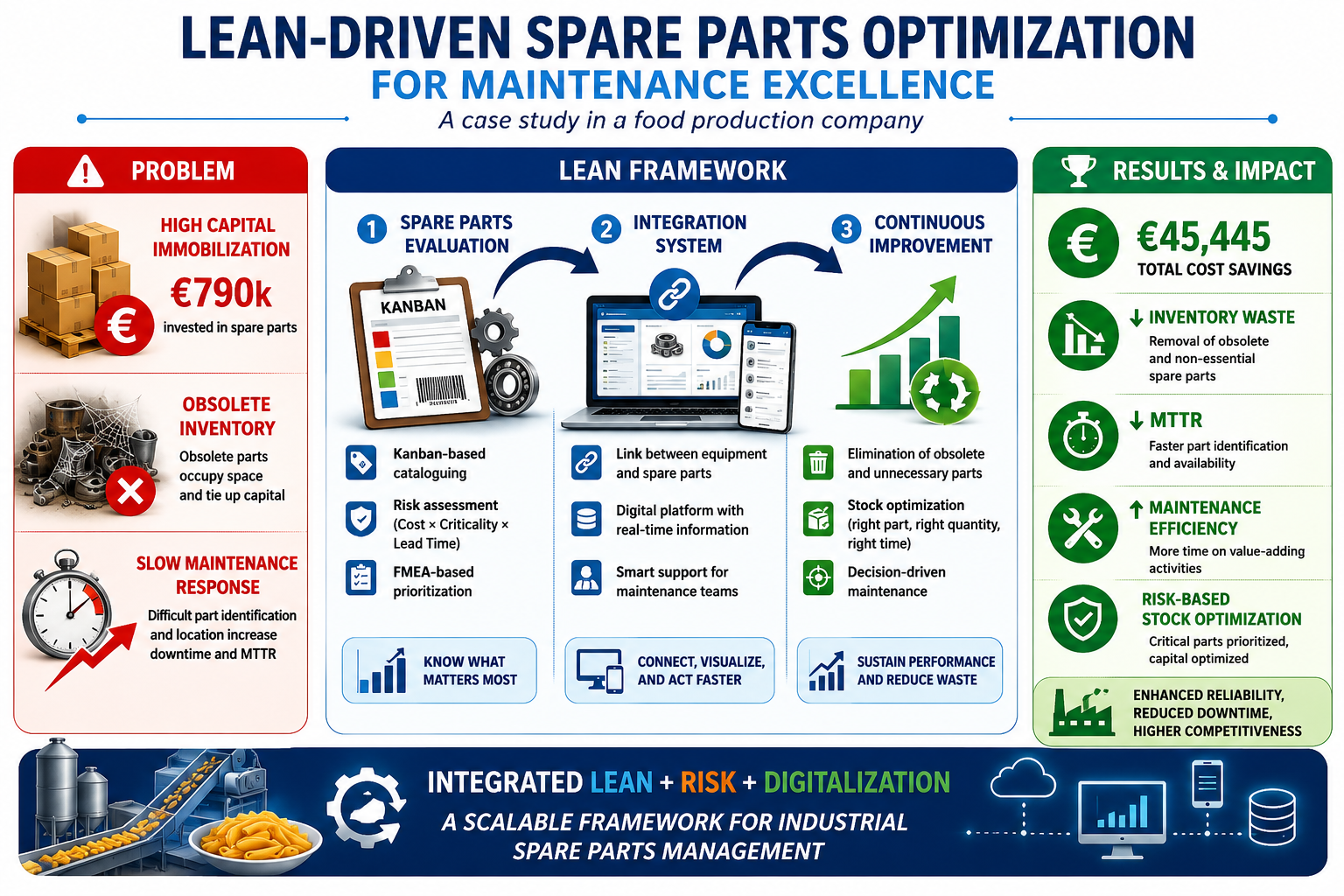
In a world increasingly driven by competition between companies, where profit constitutes the ultimate determinant of an organisation’s survival, it becomes essential to optimise production processes to reduce waste and inefficiencies. Within this context, Lean methodologies emerge as indispensable instruments to enhance the overall productivity of organisations. A critical domain where Lean principles can be effectively applied is equipment maintenance, whose primary objective is to ensure system reliability and prevent production downtime. Within maintenance management, the optimisation of spare parts management plays a fundamental role in sustaining operational continuity and efficiency. This study addresses this specific aspect, focusing on the application of Lean tools to improve spare parts management in an industrial pasta production line. The implemented approach involved the development and integration of a Kanban-based cataloguing system for the existing spare parts inventory. This system facilitated the elimination of obsolete components and significantly improved the speed and accuracy with which workers could identify and retrieve spare parts. Furthermore, the collected data supported a detailed risk analysis of each spare part, enabling the prioritisation of critical components and the optimisation of stock levels. The applied methodology demonstrated tangible results, achieving a total cost saving of 45,445 €. In subsequent stages of improvement, a software tool was developed to centralise and manage information related to each spare part and its corresponding equipment. This digital integration represented a significant advancement, as it provided warehouse personnel with real-time access to inventory status and allowed maintenance teams to quickly identify and allocate the correct spare parts during equipment failures. Collectively, these developments contributed to enhanced maintenance responsiveness, reduced downtime, and improved overall equipment reliability. Overall, this study contributes to the literature by proposing and validating an integrated Lean-based framework for spare parts management that goes beyond traditional qualitative applications. Unlike existing studies that address isolated Lean tools, the proposed approach combines Kanban-based cataloguing, quantitative risk assessment, Failure Mode and Effects Analysis (FMEA), and digital integration between spare parts and equipment. The proposed methodology is also structured to be replicable and adaptable to other industrial contexts facing high capital immobilization in spare parts.
- Open Access
- Article
Lean Approach to Spare Parts Management in a Food Production Company: A Case Study
- David Almeida 1,
- Raul D. S. G. Campilho 1,2,
- Ana Júlia Viamonte 1,3,
- Alexandra Gavina 1,3,
- Isabel Figueiredo 1,3,
- Marlene Brito 1,
- Isabel Mendes Pinto 1,3,*
Author Information
Received: 30 Dec 2025 | Revised: 26 Jan 2026 | Accepted: 09 Feb 2026 | Published: 23 Apr 2026
Abstract
Graphical Abstract
Keywords
spare part management | lean methodology | risk analysis | maintenance | warehouse management | spare parts obsoletion
References
- 1.
Chin, H.H.; Varbanov, P.S.; Klemeš, J.J.; et al. Asset Maintenance Optimisation Approaches in the Chemical and Process Industries—A Review. Chem. Eng. Res. Des. 2020, 164, 162–194. https://doi.org/10.1016/j.cherd.2020.09.034.
- 2.
Ben-Daya, M.; Duffuaa, S.O. Maintenance and Quality: The Missing Link. J. Qual. Maint. Eng. 1995, 1, 20–26. https://doi.org/10.1108/13552519510083110.
- 3.
Pinciroli, L.; Baraldi, P.; Zio, E. Maintenance Optimization in Industry 4.0. Reliab. Eng. Syst. Saf. 2023, 234, 109204. https://doi.org/10.1016/j.ress.2023.109204.
- 4.
Costa, S.; Silva, F.J.G.; Campilho, R.D.S.G.; et al. Guidelines for Machine Tool Sensing and Smart Manufacturing Integration. Procedia Manuf. 2020, 51, 251–257. https://doi.org/10.1016/j.promfg.2020.10.036.
- 5.
Kumar, S.; Mukherjee, D.; Guchhait, P.K.; et al. A Comprehensive Review of Condition Based Prognostic Maintenance (CBPM) for Induction Motor. IEEE Access 2019, 7, 90690–90704. https://doi.org/10.1109/ACCESS.2019.2926527.
- 6.
Gavrikova, E.; Volkova, I.; Burda, Y. Strategic Aspects of Asset Management: An Overview of Current Research. Sustainability 2020, 12, 5955. https://doi.org/10.3390/su12155955.
- 7.
Leite, H.d.R.; Vieira, G.E. Lean Philosophy and Its Applications in the Service Industry: A Review of the Current Knowledge. Production 2015, 25, 529–541. https://doi.org/10.1590/0103-6513.079012.
- 8.
Womack, J.P.; Jones, D.T. Lean Thinking—Banish Waste and Create Wealth in Your Corporation. J. Oper. Res. Soc. 1997, 48, 1148. https://doi.org/10.1038/sj.jors.2600967.
- 9.
Kumar Sharma, A.; Joshi, A.; Jurwall, V. Performance Measurement Metrics in TPM: A Contextual View to Training and Development. Mater. Today: Proc. 2020, 28, 2476–2480. https://doi.org/10.1016/j.matpr.2020.04.796.
- 10.
Ribeiro, I.M.; Godina, R.; Pimentel, C.; et al. Implementing TPM Supported by 5S to Improve the Availability of an Automotive Production Line. Procedia Manuf. 2019, 38, 1574–1581. https://doi.org/10.1016/j.promfg.2020.01.128.
- 11.
Campos, R.; Oliveira, L.C.Q.d.; Silvestre, B.d.S.; et al. A Ferramenta 5S e Suas Implicações na Gestão da Qualidade Total. In Proceedings of the Simpósio de Engenharia de Produção, Bauru, Brazil, 7–9 October 2005; Volume 12, pp. 685–692.
- 12.
Ahmed, T.; Ali, S.M.; Allama, M.M.; et al. A Total Productive Maintenance (TPM) Approach to Improve Production Efficiency and Development of Loss Structure in a Pharmaceutical Industry. Glob. J. Manag. Bus. Res. 2010, 10, 186–190.
- 13.
Pinto, G.; Silva, F.J.G.; Baptista, A.; et al. TPM Implementation and Maintenance Strategic Plan—A Case Study. Procedia Manuf. 2020, 51, 1423–1430. https://doi.org/10.1016/j.promfg.2020.10.198.
- 14.
Bakri, A.H.; Rahim, A.R.A.; Yusof, N.M.; et al. Boosting Lean Production via TPM. Procedia Soc. Behav. Sci. 2012, 65, 485–491. https://doi.org/10.1016/j.sbspro.2012.11.153.
- 15.
Suryaprakash, M.; Gomathi Prabha, M.; Yuvaraja, M.; et al. Improvement of Overall Equipment Effectiveness of Machining Centre Using TPM. Mater. Today Proc. 2021, 46, 9348–9353. https://doi.org/10.1016/j.matpr.2020.02.820.
- 16.
Lucantoni, L.; Antomarioni, S.; Ciarapica, F.E.; et al. A Data-Driven Framework for Supporting the Total Productive Maintenance Strategy. Expert Syst. Appl. 2025, 268, 126283. https://doi.org/10.1016/j.eswa.2024.126283.
- 17.
Bousdekis, A.; Lepenioti, K.; Apostolou, D.; et al. A Review of Data-Driven Decision-Making Methods for Industry 4.0 Maintenance Applications. Electronics 2021, 10, 828. https://doi.org/10.3390/electronics10070828.
- 18.
Teixeira, P.; Coelho, A.; Fontoura, P.; et al. Combining Lean and Green Practices to Achieve a Superior Performance: The Contribution for a Sustainable Development and Competitiveness—An Empirical Study on the Portuguese Context. Corp. Soc. Responsib. Environ. Manag. 2022, 29, 887–903. https://doi.org/10.1002/csr.2242.
- 19.
Achouch, M.; Dimitrova, M.; Ziane, K.; et al. On Predictive Maintenance in Industry 4.0: Overview, Models, and Challenges. Appl. Sci. 2022, 12, 8081. https://doi.org/10.3390/app12168081.
- 20.
Li, Z.; Wang, Y.; Wang, K.-S. Intelligent Predictive Maintenance for Fault Diagnosis and Prognosis in Machine Centers: Industry 4.0 Scenario. Adv. Manuf. 2017, 5, 377–387. https://doi.org/10.1007/s40436-017-0203-8.
- 21.
Mahmoodi, E.; Fathi, M.; Tavana, M.; et al. Data-Driven Simulation-Based Decision Support System for Resource Allocation in Industry 4.0 and Smart Manufacturing. J. Manuf. Syst. 2024, 72, 287–307. https://doi.org/10.1016/j.jmsy.2023.11.019.
- 22.
Soliman, M.H.A. A Comprehensive Review of Manufacturing Wastes: Toyota Production System Lean Principles. Emir. J. Eng. Res. 2017, 22, 1–10. https://doi.org/10.6084/M9.FIGSHARE.9121283.
- 23.
Thangarajoo, Y.; Smith, A. Lean Thinking: An Overview. Ind. Eng. Manag. 2015, 4, 159. https://doi.org/10.4172/2169-0316.1000159.
- 24.
Emiliani, M.L. Lean Behaviors. Manage. Decis. 1998, 36, 615–631. https://doi.org/10.1108/00251749810239504.
- 25.
Lian, Y.-H.; Van Landeghem, H. An Application of Simulation and Value Stream Mapping in Lean Manufacturing. In Proceedings of the 14th European Simulation Symposium, Dresden, Germany, 23–26 October 2002; pp. 1–8.
- 26.
Groover, M.P. Fundamentals of Modern Manufacturing: Materials, Processes, and Systems; John Wiley & Sons: Hoboken, NJ, USA, 2010.
- 27.
Cook, C.R.; Graser, J.C. Military Airframe Acquisition Costs: The Effects of Lean Manufacturing; RAND Corporation: Santa Monica, CA, USA, 2001.
- 28.
Reza, J.R.D.; García Alcaraz, J.L.; Ramírez, C.S.; et al. Achieving Strategic Goals by Continuous Improvement and Lean Manufacturing Implementation: A Structural Equation Model—System Dynamics Approach. Sustain. Futures 2025, 9, 100551. https://doi.org/10.1016/j.sftr.2025.100551.
- 29.
Ghodrati, A.; Zulkifli, N. A Review on 5S Implementation in Industrial and Business Organizations. IOSR J. Bus. Manag. 2012, 5, 11–13.
- 30.
Costa, C.; Ferreira, L.P.; Sá, J.C.; et al. Implementation of 5S Methodology in a Metalworking Company. DAAAM Int. Sci. Book 2018, 17, 1–12.
- 31.
Rizkya, I.; Sari, R.; Syahputri, K.; et al. Evaluation of Total Productive Maintenance Implementation in Manufacture. IOP Conf. Ser.: Mater. Sci. Eng. 2021, 1122, 012059. https://doi.org/10.1088/1757-899X/1122/1/012059.
- 32.
Altamirano, E.; Caballero-Rojas, K.; Palacios-Aguilar, O. Total Productive Maintenance Model Applying SMED and FMEA to Increase the Overall Efficiency of Equipment (OEE) in the Food Sector. In Proceedings of the Human Systems Engineering and Design (IHSED 2021), New Orleans, LA, USA, 25–29 July 2021. https://doi.org/10.54941/ahfe1001187.
- 33.
Pinto, G.; Silva, F.; Campilho, R.; et al. Continuous Improvement in Maintenance: A Case Study in the Automotive Industry Involving Lean Tools. Procedia Manuf. 2019, 38, 1582–1591.
- 34.
Moreira, A.; Silva, F.; Correia, A.; et al. Cost Reduction and Quality Improvements in the Printing Industry. Procedia Manuf. 2018, 17, 623–630.
- 35.
Hamasha, M.M.; Bani-Irshid, A.H.; Al Mashaqbeh, S.; et al. Strategical Selection of Maintenance Type Under Different Conditions. Sci. Rep. 2023, 13, 15560. https://doi.org/10.1038/s41598-023-42751-5.
- 36.
Mostafa, S.; Dumrak, J.; Soltan, H. Lean Maintenance Roadmap. Procedia Manuf. 2015, 2, 434–444. https://doi.org/10.1016/j.promfg.2015.07.076.
- 37.
Agoro, H. Reducing Downtime in Production Lines Through Proactive Maintenance Strategies. Available online: https://www.researchgate.net/profile/Habeeb_Agoro/publication/389891476_Reducing_Downtime_in_Production_Lines_Through_Proactive_Maintenance_Strategies/links/67d7439be62c604a0ddbdc6d/Reducing-Downtime-in-Production-Lines-Through-Proactive-Maintenance-Strategies.pdf (accessed on 24 September 2025).
- 38.
Martins, L.; Silva, F.J.G.; Pimentel, C.; et al. Improving Preventive Maintenance Management in an Energy Solutions Company. Procedia Manuf. 2020, 51, 1551–1558. https://doi.org/10.1016/j.promfg.2020.10.216.
- 39.
Ahmad, R.; Kamaruddin, S. An Overview of Time-Based and Condition-Based Maintenance in Industrial Application. Comput. Ind. Eng. 2012, 63, 135–149. https://doi.org/10.1016/j.cie.2012.02.002.
- 40.
Quatrini, E.; Costantino, F.; Di Gravio, G.; et al. Condition-Based Maintenance—An Extensive Literature Review. Machines 2020, 8, 31. https://doi.org/10.3390/machines8020031.
- 41.
de Jonge, B.; Teunter, R.; Tinga, T. The Influence of Practical Factors on the Benefits of Condition-Based Maintenance Over Time-Based Maintenance. Reliab. Eng. Syst. Saf. 2017, 158, 21–30. https://doi.org/10.1016/j.ress.2016.10.002.
- 42.
Smith, R.; Hawkins, B. Lean Maintenance: Reduce Costs, Improve Quality, and Increase Market Share; Elsevier: Amsterdam, The Netherlands, 2004.
- 43.
Shannon, N.; Trubetskaya, A.; Iqbal, J.; et al. A Total Productive Maintenance & Reliability Framework for an Active Pharmaceutical Ingredient Plant Utilising Design for Lean Six Sigma. Heliyon 2023, 9, e20516. https://doi.org/10.1016/j.heliyon.2023.e20516.
- 44.
Coccia, M. The Fishbone Diagram to Identify, Systematize and Analyze the Sources of General Purpose Technologies. J. Soc. Adm. Sci. 2018, 4, 291–303. https://doi.org/10.1453/jsas.v4i4.1518.
- 45.
Santos, T.; Silva, F.J.G.; Ramos, S.F.; et al. Asset Priority Setting for Maintenance Management in the Food Industry. Procedia Manuf. 2019, 38, 1623–1633. https://doi.org/10.1016/j.promfg.2020.01.122.
- 46.
Leonard, D.; Daya, A.; Leonard, J. Maintenance Plan Improvement Using Failure Mode Effect and Criticality Analysis: A Case Study on Mining Equipment. Eng. Sci. Technol. J. 2025, 6, 86–103. https://doi.org/10.51594/estj.v6i3.1879.
- 47.
Aleksić, A.; Tadić, D.; Komatina, N.; et al. Failure Mode and Effects Analysis Integrated with Multi-Attribute Decision-Making Methods Under Uncertainty: A Systematic Literature Review. Mathematics 2025, 13, 2216. https://doi.org/10.3390/math13132216.
- 48.
Wakode, R.B.; Raut, L.P.; Talmale, P. Overview on Kanban Methodology and Its Implementation. IJSRD 2015, 3.
- 49.
Batwara, A.; Sharma, V.; Makkar, M.; et al. Towards Smart Sustainable Development Through Value Stream Mapping—A Systematic Literature Review. Heliyon 2023, 9, e15852. https://doi.org/10.1016/j.heliyon.2023.e15852.
- 50.
Dragone, I.S.; Biotto, C.N.; Serra, S.M.B. Evaluation of Lean Principles in Building Maintenance Management. In Proceedings of the 29th Annual Conference of the International Group for Lean Construction (IGLC), Lima, Peru, 14–17 July 2021; pp. 13–22.
- 51.
Lee, J.; Bagheri, B.; Kao, H.-A. A Cyber-Physical Systems Architecture for Industry 4.0-Based Manufacturing Systems. Manuf. Lett. 2015, 3, 18–23. https://doi.org/10.1016/j.mfglet.2014.12.001.
- 52.
Maletič, D.; Maletič, M.; Gomiscek, B. Evaluating Company’s Maintenance Strategy Effectiveness by Maintenance Improvement Index—A Case Study. Acta Mech. Slovaca 2016, 20, 26–34. https://doi.org/10.21496/ams.2016.030.
- 53.
Moemenishahraki, P. Reliability and Maintenance Performance Analysis of a 1600-Ton Press Machine Using MTBF, MTTR, KPI, and Downtime Indicators. Ind. Eng. 2025, 9, 36–41. https://doi.org/10.11648/j.ie.20250902.11.
- 54.
Ben, J.S. Implementation of Autonomous Maintenance and Its Effect on MTBF, MTTR, and Reliability of a Critical Machine in a Beer Processing Plant. Int. J. Progress. Sci. Technol. 2022, 31, 57–66.
- 55.
Ylipää, T.; Skoogh, A.; Bokrantz, J.; et al. Identification of Maintenance Improvement Potential Using OEE Assessment. Int. J. Prod. Perform. Manag. 2017, 66, 126–143. https://doi.org/10.1108/IJPPM-01-2016-0028.
- 56.
Marinho, P.; Pimentel, D.; Casais, R.; et al. Selecting the Best Tools and Framework to Evaluate Equipment Malfunctions and Improve the OEE in the Cork Industry. Int. J. Ind. Eng. Manag. 2021, 12, 286–298. https://doi.org/10.24867/IJIEM-2021-4-295.
- 57.
Rofiudin, M.; Riyadi, S.; Purba, H. Improve Productivity by Reduce Stock Amount Spare Part through Hybrid Method ABC Classification & Pull System (Just in Time) in Electronics Manufacturing Industry. IJRES 2018, 5, 8–11. https://doi.org/10.1445/23497157/IJRES-V5I3P102.
- 58.
Zhu, S.; Jaarsveld, W.V.; Dekker, R. Spare Parts Inventory Control Based on Maintenance Planning. Reliab. Eng. Syst. Saf. 2020, 193, 106600. https://doi.org/10.1016/j.ress.2019.106600.
- 59.
Janvier, M.A.; Ibey, A.A.M.; Madhusudan, K.; et al. Finding the Waste: Parts Inventory Analysis Using Lean Methodology. Biomed. Instrum. Technol. 2024, 58, 72–80. https://doi.org/10.2345/0899-8205-58.4.72.


This work is licensed under a Creative Commons Attribution 4.0 International License.

 Suite 4002 Level 4, 447 Collins Street, Melbourne, Victoria 3000, Australia
 General Inquiries: info@sciltp.com