
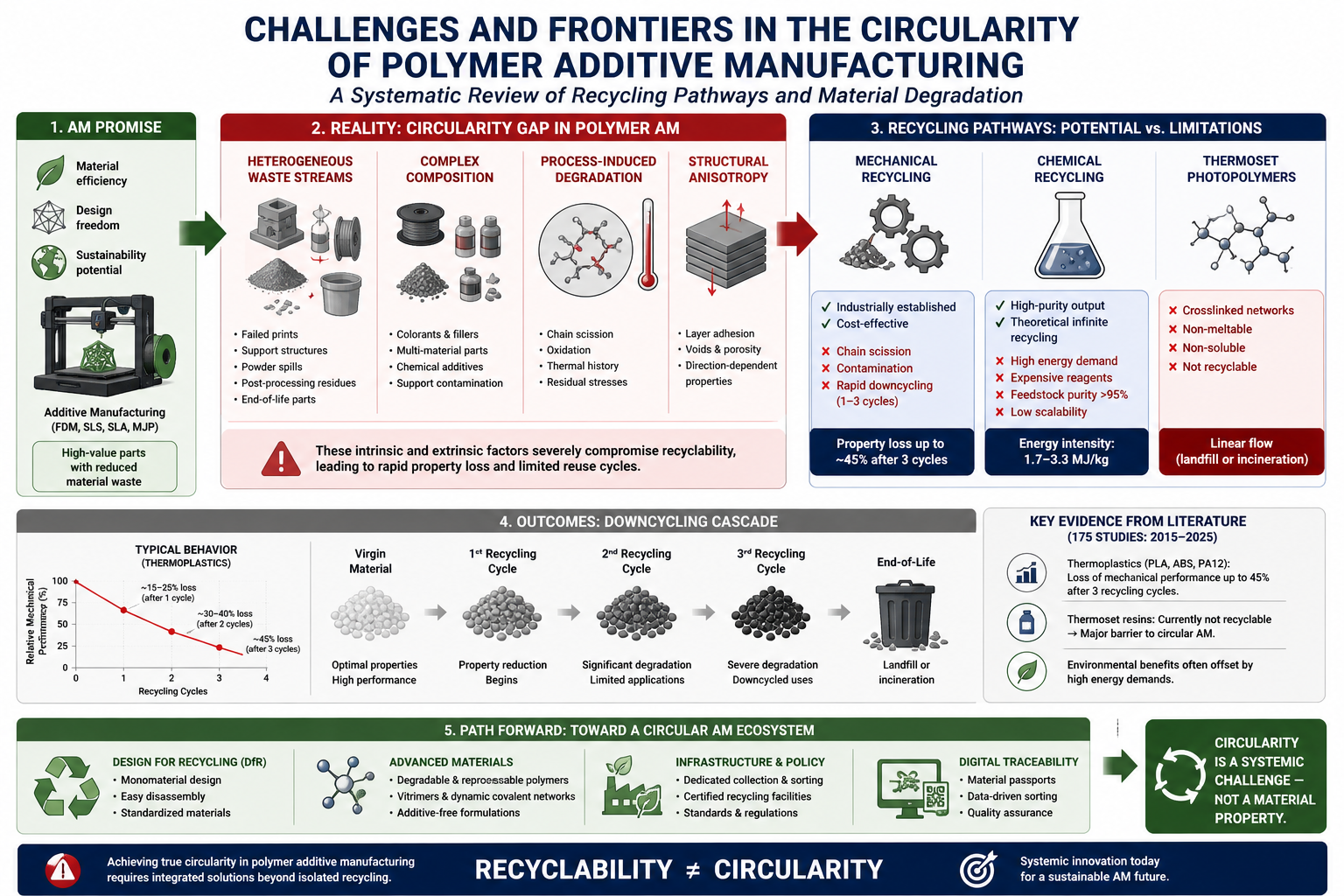
Additive Manufacturing (AM) is frequently framed as a sustainable production paradigm due to its material efficiency and design flexibility. However, this narrative often overlooks the complex challenges associated with the end-of-life (EoL) management of polymer components. This systematic review critically evaluates the recyclability of AM polymers by examining the intersection of material chemistry, manufacturing-induced degradation, and the inherent heterogeneity of AM waste streams. Drawing from a corpus of 175 studies (2015–2025), this work assesses both mechanical and chemical recycling pathways for thermoplastics and thermosets. The findings reveal a significant disparity between theoretical recyclability and practical circularity. Common thermoplastics, such as PLA, ABS, and PA12, exhibit rapid thermomechanical degradation, typically losing structural integrity and mechanical performance after only one to three recycling cycles. Furthermore, photopolymer resins used in high-precision AM processes present a critical barrier, as current technologies remain largely incapable of reintegrating these materials into circular value chains. The critical review identifies several AM-specific obstacles such as mechanical anisotropy, contamination from support structures, and the complexity of multi-material parts that render recycling both technically challenging and economically unviable. Furthermore, Life Cycle Assessment (LCA) data further suggests that the environmental benefits of AM recycling are frequently offset by high energy demands. The study concludes that achieving a truly circular polymer AM ecosystem requires more than isolated technical improvements. It demands systemic interventions in “Design for Recycling” (DfR), the development of more resilient polymer blends, the establishment of industry standards, and the expansion of specialized waste management infrastructure.
- Open Access
- Review
Challenges and Frontiers in the Circularity of Polymer Additive Manufacturing: A Systematic Review of Recycling Pathways and Material Degradation
- Filipa Pacheco 1,
- Naiara P. V. Sebbe 1,*,
- Francisco J. G. Silva 1,2,*,
- André F. V. Pedroso 1,
- Rita Sales-Contini 1,3
Author Information
Received: 29 Jan 2026 | Revised: 06 Feb 2026 | Accepted: 11 Feb 2026 | Published: 27 Apr 2026
Abstract
Graphical Abstract
Keywords
additive manufacturing | polymer recycling | circular economy | fused deposition modeling (FDM) | selective laser sintering | vat photopolymerization | life cycle assessment | sustainability
References
- 1.
Ngo, T.D.; Kashani, A.; Imbalzano, G.; et al. Additive manufacturing (3D printing): A review of materials, methods, applications and challenges. Compos. Part B Eng. 2018, 143, 172–196. https://doi.org/10.1016/j.compositesb.2018.02.012.
- 2.
Dizon, J.R.C.; Espera, A.H.; Chen, Q.Y.; et al. Mechanical characterization of 3D-printed polymers. Addit. Manuf. 2018, 20, 44–67. https://doi.org/10.1016/j.addma.2017.12.002.
- 3.
Ford, S.; Despeisse, M. Additive manufacturing and sustainability: An exploratory study of the advantages and challenges. J. Clean. Prod. 2016, 137, 1573–1587. https://doi.org/10.1016/j.jclepro.2016.04.150.
- 4.
Geissdoerfer, M.; Savaget, P.; Bocken, N.M.P.; et al. The Circular Economy—A new sustainability paradigm? J. Clean. Prod. 2017, 143, 757–768. https://doi.org/10.1016/j.jclepro.2016.12.048.
- 5.
Kellens, K.; Mertens, R.; Paraskevas, D.; et al. Environmental Impact of Additive Manufacturing Processes: Does AM Contribute to a More Sustainable Way of Part Manufacturing? Procedia CIRP 2017, 61, 582–587. https://doi.org/10.1016/j.procir.2016.11.153.
- 6.
Ragaert, K.; Delva, L.; Van Geem, K. Mechanical and chemical recycling of solid plastic waste. Waste Manag. 2017, 69, 24–58. https://doi.org/10.1016/j.wasman.2017.07.044.
- 7.
Hahladakis, J.N.; Velis, C.A.; Weber, R.; et al. An overview of chemical additives present in plastics: Migration, release, fate and environmental impact during their use, disposal and recycling. J. Hazard. Mater. 2018, 344, 179–199. https://doi.org/10.1016/j.jhazmat.2017.10.014.
- 8.
Brenken, B.; Barocio, E.; Favaloro, A.; et al. Fused filament fabrication of fiber-reinforced polymers: A review. Addit. Manuf. 2018, 21, 441–456. https://doi.org/10.1016/j.addma.2018.01.002.
- 9.
Shanmugam, V.; Das, O.; Neisiany, R.E. Polymer Recycling in Additive Manufacturing: An Opportunity for the Circular Economy. Mater. Circ. Econ. 2020, 2. https://doi.org/10.1007/s42824-020-00012-0.
- 10.
Daminabo, S.C.; Goel, S.; Grammatikos, S.A.; et al. Fused deposition modeling-based additive manufacturing (3D printing): Techniques for polymer material systems. Mater. Today Chem. 2020, 16, 100248. https://doi.org/10.1016/j.mtchem.2020.100248.
- 11.
Monaldo, E.; Ricci, M.; Marfia, S. Mechanical properties of 3D printed polylactic acid elements: Experimental and numerical insights. Mech. Mater. 2023, 177, 104551. https://doi.org/10.1016/j.mechmat.2022.104551.
- 12.
Zhang, F.; Zhu, L.; Li, Z.; et al. The recent development of vat photopolymerization: A review. Addit. Manuf. 2021, 48, 102423. https://doi.org/10.1016/j.addma.2021.102423.
- 13.
Chamas, A.; Moon, H.; Zheng, J.; et al. Degradation Rates of Plastics in the Environment. Chem. Eng. 2020, 8, 3494–3511. https://doi.org/10.1021/acssuschemeng.9b06635.
- 14.
Kokare, S.; Oliveira, J.P.; Godina, R. Life cycle assessment of additive manufacturing processes: A review. J. Manuf. Syst. 2023, 68, 536–559. https://doi.org/10.1016/j.jmsy.2023.05.007.
- 15.
Agnusdei, L.; Prete, A.D. Additive manufacturing for sustainability: A systematic literature review. Sustain. Futures 2022, 4, 100098. https://doi.org/10.1016/j.sftr.2022.100098.
- 16.
Peng, T.; Kellens, K.; Tang, R.; et al. Sustainability of additive manufacturing: An overview on its energy demand and environmental impact. Addit. Manuf. 2018, 21, 694–704. https://doi.org/10.1016/j.addma.2018.04.022.
- 17.
Goh, G.D.; Yap, Y.L.; Tan, H.K.J.; et al. Process–Structure–Properties in Polymer Additive Manufacturing via Material Extrusion: A Review. Crit. Rev. Solid State Mater. Sci. 2020, 45, 113–133. https://doi.org/10.1080/10408436.2018.1549977.
- 18.
Tao, Y.; Kong, F.; Li, Z.; et al. A review on voids of 3D printed parts by fused filament fabrication. J. Mater. Res. Technol. 2021, 15, 4860–4879. https://doi.org/10.1016/j.jmrt.2021.10.108.
- 19.
Wiesinger, H.; Wang, Z.; Hellweg, S. Deep Dive into Plastic Monomers, Additives, and Processing Aids. Environ. Sci. Technol. 2021, 55, 9339–9351. https://doi.org/10.1021/acs.est.1c00976.
- 20.
Yuan, S.; Shen, F.; Chua, C.K.; et al. Polymeric composites for powder-based additive manufacturing: Materials and applications. Prog. Polym. Sci. 2019, 91, 141–168. https://doi.org/10.1016/j.progpolymsci.2018.11.001.
- 21.
Singh, J.; Ordoñez, I. Resource recovery from post-consumer waste: Important lessons for the upcoming circular economy. J. Clean. Prod. 2016, 134, 342–353. https://doi.org/10.1016/j.jclepro.2015.12.020.
- 22.
Sanchez, F.A.C.; Boudaoud, H.; Hoppe, S.; et al. Polymer recycling in an open-source additive manufacturing context: Mechanical issues. Addit. Manuf. 2017, 17, 87–105. https://doi.org/10.1016/j.addma.2017.05.013.
- 23.
Pongwisuthiruchte, A.; Potiyaraj, P. Challenges and innovations in sustainable 3D printing. Mater. Today Sustain. 2025, 31, 101134. https://doi.org/10.1016/j.mtsust.2025.101134.
- 24.
Zhang, L.; Xu, Z. A review of current progress of recycling technologies for metals from waste electrical and electronic equipment. J. Clean. Prod. 2016, 127, 19–36. https://doi.org/10.1016/j.jclepro.2016.04.004.
- 25.
Morici, E.; Dintcheva, N.T. Recycling of Thermoset Materials and Thermoset-Based Composites: Challenge and Opportunity. Polymers 2022, 14, 4153. https://doi.org/10.3390/polym14194153.
- 26.
González-Henríquez, C.M.; Sarabia-Vallejos, M.A.; Rodriguez-Hernandez, J. Polymers for additive manufacturing and 4D-printing: Materials, methodologies, and biomedical applications. Prog. Polym. Sci. 2019, 94, 57–116. https://doi.org/10.1016/j.progpolymsci.2019.03.001.
- 27.
Unkovskiy, A.; Bui, P.H.; Schille, C.; et al. Objects build orientation, positioning, and curing influence dimensional accuracy and flexural properties of stereolithographically printed resin. Dent. Mater. 2018, 34, e324–e333. https://doi.org/10.1016/j.dental.2018.09.011.
- 28.
Rashid, A.A.; Ahmed, W.; Khalid, M.Y.; et al. Vat photopolymerization of polymers and polymer composites: Processes and applications. Addit. Manuf. 2021, 43, 102279. https://doi.org/10.1016/j.addma.2021.102279.
- 29.
Nazir, A.; Gokcekaya, O.; Billah, K.M.M.; et al. Multi-material additive manufacturing: A systematic review of design, properties, applications, challenges, and 3D printing of materials and cellular metamaterials. Mater. Des. 2023, 226, 111661. https://doi.org/10.1016/j.matdes.2023.111661.
- 30.
Mostafaei, A.; Elliott, A.M.; Barnes, J.O.; et al. Binder jet 3D printing—Process parameters, materials, properties, modeling, and challenges. Prog. Mater. Sci. 2021, 119, 100707. https://doi.org/10.1016/j.pmatsci.2020.100707.
- 31.
Brambilla, C.R.M.; Okafor-Muo, O.L.; Hassanin, H.; et al. 3DP Printing of Oral Solid Formulations: A Systematic Review. Pharmaceutics 2021, 13, 358. https://doi.org/10.3390/pharmaceutics13030358.
- 32.
Zhou, X.; Hsieh, S.J.; Sun, Y. Experimental and numerical investigation of the thermal behaviour of polylactic acid during the fused deposition process. Virtual Phys. Prototyp. 2017, 12, 221–233. https://doi.org/10.1080/17452759.2017.1317214.
- 33.
Yin, J.; Lu, C.; Fu, J.; et al. Interfacial bonding during multi-material fused deposition modeling (FDM) process due to inter-molecular diffusion. Mater. Des. 2018, 150, 104–112. https://doi.org/10.1016/j.matdes.2018.04.029.
- 34.
Plavec, R.; Horváth, V.; Hlaváčiková, S.; et al. Influence of Multiple Thermomechanical Processing of 3D Filaments Based on Polylactic Acid and Polyhydroxybutyrate on Their Rheological and Utility Properties. Polymers 2022, 14, 1947. https://doi.org/10.3390/polym14101947.
- 35.
Kyriakidis, I.F.; Kladovasilakis, N.; Pechlivani, E.M.; et al. Mechanical Performance of Recycled 3D Printed Sustainable Polymer-Based Composites: A Literature Review. J. Compos. Sci. 2024, 8, 215. https://doi.org/10.3390/jcs8060215.
- 36.
Han, D.; Lee, H. Recent advances in multi-material additive manufacturing: Methods and applications. Curr. Opin. Chem. Eng. 2020, 28, 158–166. https://doi.org/10.1016/j.coche.2020.03.004.
- 37.
Zhu, S.; Chen, H.; Wang, M.; et al. Plastic solid waste identification system based on near infrared spectroscopy in combination with support vector machine. Adv. Ind. Eng. Polym. Res. 2019, 2, 77–81. https://doi.org/10.1016/j.aiepr.2019.04.001.
- 38.
Annisa, M.; Suprihatin, A.; Sasongko, N.A.; et al. Challenges and prospects of multilayer plastic waste management in several countries: A systematic literature review. Case Stud. Chem. Environ. Eng. 2024, 10, 100911. https://doi.org/10.1016/j.cscee.2024.100911.
- 39.
Tavares, T.M.; Ganga, G.M.D.; Filho, M.G.; et al. The benefits and barriers of additive manufacturing for circular economy: A framework proposal. Sustain. Prod. Consum. 2023, 37, 369–388. https://doi.org/10.1016/j.spc.2023.03.006.
- 40.
Dananjaya, V.; Hansika, N.; Chevali, V. Investigation of the Effect of Reprocessing on Thermal and Mechanical Properties of Polymers and Polymer Nanocomposites. Int. J. Precis. Eng. Manuf. 2025, 27, 2401260. https://doi.org/10.1002/adem.202401260.
- 41.
Ogwu, M.C.; Kosoe, E.A. Innovative Approaches to Recycling, Upcycling, and Downcycling for Sustainable Waste Management. CleanMat 2025, 2, 242–261. https://doi.org/10.1002/clem.70013.
- 42.
Rouf, S.; Raina, A.; Haq, M.I.U.; et al. 3D printed parts and mechanical properties: Influencing parameters, sustainability aspects, global market scenario, challenges and applications. Adv. Ind. Eng. Polym. Res. 2022, 5, 143–158. https://doi.org/10.1016/j.aiepr.2022.02.001.
- 43.
Vendittoli, V.; Mascolo, M.C.; Polini, W.; et al. Degradation effects of reused PA12 powder in selective laser sintering on material characteristics, dimensional accuracy and mechanical strength. Sci. Rep. 2025, 15, 34114. https://doi.org/10.1038/s41598-025-20280-7.
- 44.
Yim, S.; Bian, H.; Aoyagi, K.; et al. Effect of powder morphology on flowability and spreading behavior in powder bed fusion additive manufacturing process: A particle-scale modeling study. Addit. Manuf. 2023, 72, 103612. https://doi.org/10.1016/j.addma.2023.103612.
- 45.
Bello, K.A.; Maladzhi, R.W. Innovative and best practices in sustainable strategies for waste reduction in additive manufacturing. Hybrid Adv. 2025, 11, 100527. https://doi.org/10.1016/j.hybadv.2025.100527.
- 46.
Ibarra, R.M. Chapter 20—Recycling of Thermosets and Their Composites. In Thermosets, 2nd ed.; Elsevier: Amsterdam, The Netherlands, 2018. https://doi.org/10.1016/B978-0-08-101021-1.00020-4.
- 47.
Martínez-Narro, G.; Hassan, S.; Phan, A.N. Chemical recycling of plastic waste for sustainable polymer manufacturing—A critical review. J. Environ. Chem. Eng. 2024, 12, 112323. https://doi.org/10.1016/j.jece.2024.112323.
- 48.
Chacón, J.M.; Caminero, M.A.; García-Plaza, E.; et al. Additive manufacturing of PLA structures using fused deposition modelling: Effect of process parameters on mechanical properties and their optimal selection. Mater. Des. 2017, 124, 143–157. https://doi.org/10.1016/j.matdes.2017.03.065.
- 49.
Chen, H.; Pan, Z.; Sulley, G.S.; et al. Hydrolytic degradation of amorphous PLA: Effect of mechanical loads. Polym. Degrad. Stab. 2026, 243, 111751. https://doi.org/10.1016/j.polymdegradstab.2025.111751.
- 50.
Aly, R.; Olalere, O.; Ryder, A.; et al. Mechanical Property Characterization of Virgin and Recycled PLA Blends in Single-Screw Filament Extrusion for 3D Printing. Polymers 2024, 16, 3569. https://doi.org/10.3390/polym16243569.
- 51.
Romani, A.; Perusin, L.; Ciurnelli, M.; et al. Characterization of PLA feedstock after multiple recycling processes for large-format material extrusion additive manufacturing. Mater. Today Sustain. 2024, 25, 100636. https://doi.org/10.1016/j.mtsust.2023.100636.
- 52.
Rosato, A.; Romano, A.; Totaro, G.; et al. Enzymatic Degradation of the Most Common Aliphatic Bio-Polyesters and Evaluation of the Mechanisms Involved: An Extended Study. Polymers 2022, 14, 1850. https://doi.org/10.3390/polym14091850.
- 53.
Senila, L.; Kovacs, E.; Resz, M.-A.; et al. Life Cycle Assessment (LCA) of Bioplastics Production from Lignocellulosic Waste (Study Case: PLA and PHB). Polymers 2024, 16, 3330. https://doi.org/10.3390/polym16233330.
- 54.
Oliver-Cuenca, V.; Salaris, V.; Muñoz-Gimena, P.F.; et al. Bio-Based and Biodegradable Polymeric Materials for a Circular Economy. Polymers 2024, 16, 3015. https://doi.org/10.3390/polym16213015.
- 55.
Shileyko, A.A.; Kutin, A.A.; Pirogov, V.V. Influence of 3D Printing Process Parameters on Mechanical Properties of ABS Plastic Samples Fabricated by Material Extrusion. Russ. Eng. Res. 2024, 44, 975–983. https://doi.org/10.3103/S1068798X24701697.
- 56.
Jung, S.M. Recent Progress in Sustainable Recycling of Waste Acrylonitrile–Butadiene–Styrene (ABS) Plastics. Sustainability 2025, 17, 8742. https://doi.org/10.3390/su17198742.
- 57.
Diambu, A.; Karadeniz, Z. Design of ABS Plastic Scrap Recycling Process for 3D Printer Filaments. Mater. Sci. Environ. Sci. 2021. https://doi.org/10.5281/zenodo.5260060.
- 58.
Charitopoulou, M.-A.; Papadimitriou, M.; Papadopoulou, L.; et al. Extraction-Based Pretreatment of End-of-Life Plastics from Waste Electrical and Electronic Equipment for Brominated Flame Retardant Removal and Subsequent Valorization via Pyrolysis. Processes 2025, 13, 1458. https://doi.org/10.3390/pr13051458.
- 59.
Gao, H.; Zeng, X.M.; Ni, H.G. Solvent-based recycling of PC and ABS from e-waste: Efficiency, economics, emissions reduction, and job opportunities. J. Environ. Manag. 2025, 395, 127803. https://doi.org/10.1016/j.jenvman.2025.127803.
- 60.
Yost, S.F.; Smith, J.C.; Vogt, B.D. A Synthetic Strategy for the Preparation of PETG with High-Performance, Less By-Products, and Good Comprehensive Properties. J. Appl. Polym. Sci. 2025, 142, e57312. https://doi.org/10.1002/app.57312.
- 61.
Wojnowski, W.; Marć, M.; Kalinowska, K.; et al. Emission Profiles of Volatiles during 3D Printing with ABS, ASA, Nylon, and PETG Polymer Filaments. Molecules 2022, 277, 3814. https://doi.org/10.3390/molecules27123814.
- 62.
Marsavina, L.; Dohan, V.; Galatanu, S.V. Mechanical Evaluation of Recycled PETG Filament for 3D Printing. Fract. Struct. Integr. 2024, 18, 310–321. https://doi.org/10.3221/IGF-ESIS.70.18.
- 63.
Goetzendorfer, B.; Mohr, T.; Hellmann, R. Hybrid Approaches for Selective Laser Sintering by Building on Dissimilar Materials. Materials 2020, 13, 5285. https://doi.org/10.3390/ma13225285.
- 64.
Sanders, B.; Cant, E.; Jenkins, M. Re-use of polyamide-12 in powder bed fusion and its effect on process-relevant powder characteristics and final part properties. Addit. Manuf. 2024, 80, 103961. https://doi.org/10.1016/j.addma.2024.103961.
- 65.
Drstvensek, I.; Rembert, D.; Snehashis, P.; et al. Effects of Aging and Refreshment Ratio on the Strength Properties of Selectively Laser Sintered Polyamide 12. Adv. Technol. Mater. 2024, 49, 19–23. https://doi.org/10.24867/ATM-2024-1-003.
- 66.
Bruère, V.M.; Lion, A.; Holtmannspötter, J.; et al. The influence of printing parameters on the mechanical properties of 3D printed TPU-based elastomers. Prog. Addit. Manuf. 2023, 8, 693–701. https://doi.org/10.1007/s40964-023-00418-7.
- 67.
Haleem, A.; Javaid, M. Polyether ether ketone (PEEK) and its 3D printed implants applications in medical field: An overview. Clin. Epidemiol. Glob. Health 2019, 7, 571–577. https://doi.org/10.1016/j.cegh.2019.01.003.
- 68.
Shanmugam, V.; Babu, K.; Kannan, G.; et al. The thermal properties of FDM printed polymeric materials: A review. Polym. Degrad. Stab. 2024, 228, 110902. https://doi.org/10.1016/j.polymdegradstab.2024.110902.
- 69.
Phuangmali, I.; Xu, Y.; Lin, L.; et al. Manufacturing and Recycling of 3D-Printed All-Polymer Composites. Recycling 2025, 10, 168. https://doi.org/10.3390/recycling10050168.
- 70.
Seibert, M.B.; Capote, G.A.M.; Gruber, M.; et al. Manufacturing of a PET Filament from Recycled Material for Material Extrusion (MEX). Recycling 2022, 7, 69. https://doi.org/10.3390/recycling7050069.
- 71.
Wang, J.; Li, Y.; Song, J.; et al. Recycling of acrylonitrile–butadiene–styrene (ABS) copolymers from waste electrical and electronic equipment (WEEE), through using an epoxy-based chain extender. Polym. Degrad. Stab. 2015, 122, 167–174. https://doi.org/10.1016/j.polymdegradstab.2014.12.025.
- 72.
Zander, N.; Boelter, Z. Rubber toughened recycled polyethylene terephthalate for material extrusion additive manufacturing. Polym. Int. 2021, 70, 742–748. https://doi.org/10.1002/pi.6079.
- 73.
Yang, F.; Zobeiry, N.; Mamidala, R.; et al. A review of aging, degradation, and reusability of PA12 powders in selective laser sintering additive manufacturing. Mater. Today Commun. 2023, 34, 105279. https://doi.org/10.1016/j.mtcomm.2022.105279.
- 74.
Barczewski, M.; Hejna, A.; Andrzejewski, J.; et al. The Recyclability of Fire-Retarded Biobased Polyamide 11 (PA11) Composites Reinforced with Basalt Fibers (BFs): The Influence of Reprocessing on Structure, Properties, and Fire Behavior. Molecules 2024, 29, 3233. https://doi.org/10.3390/molecules29133233.
- 75.
Calvo-Correas, T.; Benitez, M.; Larraza, I.; et al. Advanced and traditional processing of thermoplastic polyurethane waste. Polym. Degrad. Stab. 2022, 198, 109880. https://doi.org/10.1016/j.polymdegradstab.2022.109880.
- 76.
Dong, Z.; Lu, Y.; Li, Y.; et al. Dynamic imine bonds enable closed-loop recycling of high performance PEEK/CF composites. Polym. Degrad. Stab. 2025, 242, 111693. https://doi.org/10.1016/j.polymdegradstab.2025.111693.
- 77.
Gomes, T.E.P.; Cadete, M.S.; Oliveira, J.D.; et al. Controlling the properties of parts 3D printed from recycled thermoplastics: A review of current practices. Polym. Degrad. Stab. 2022, 196, 109850. https://doi.org/10.1016/j.polymdegradstab.2022.109850.
- 78.
Sánchez-Cadena, L.E.; Tersac, G.; Coqueret, X.; et al. Solvolysis of acrylate-urethane coatings cured by electron-beam and UV radiation. Prog. Org. Coat. 2019, 136, 105268. https://doi.org/10.1016/j.porgcoat.2019.105268.
- 79.
Lima, R.; Costa, P.; Nunes-Pereira, J.; et al. Additive manufacturing of multifunctional epoxy adhesives with self-sensing piezoresistive and thermoresistive capabilities. Compos. Part B Eng. 2025, 293, 112130. https://doi.org/10.1016/j.compositesb.2025.112130.
- 80.
Mahmud, M.S.; Delgadillo, A.; Urbay, J.E.M.; et al. Chemical aging and degradation of stereolithographic 3D-printed material: Effect of printing and post-curing parameters. Polym. Degrad. Stab. 2025, 232, 111151. https://doi.org/10.1016/j.polymdegradstab.2024.111151.
- 81.
Maddock, R.M.A.; Pollard, G.J.; Moreau, N.G.; et al. Enzyme-catalysed polymer cross-linking: Biocatalytic tools for chemical biology, materials science and beyond. Biopolymers 2020, 111, e23390. https://doi.org/10.1002/bip.23390.
- 82.
Utekar, S.V.K.; More, N.; Rao, A. Comprehensive study of recycling of thermosetting polymer composites—Driving force, challenges and methods. Compos. Part B Eng. 2021, 207, 108596. https://doi.org/10.1016/j.compositesb.2020.108596.
- 83.
Nagy, A.; Kuti, R. The Environmental Impact of Plastic Waste Incineration. Acad. Appl. Res. Mil. Public Manag. Sci. 2016, 15, 231–237.
- 84.
Sagen, M.A.; Uhlig, S.; Holm, H.V.; et al. Resin materials for 3D-printing and milling of indirect restorations—Composition and leachables using an artificial saliva model. Dent. Mater. 2025, 42, 370–380. https://doi.org/10.1016/j.dental.2025.10.017.
- 85.
Cao, Y.; Xu, Y.; Zhang, J.; et al. Well-controlled atom transfer radical polymerizations of acrylates using recyclable niobium complex nanoparticle as photocatalyst under visible light irradiation. Polymer 2015, 61, 198–203. https://doi.org/10.1016/j.polymer.2015.02.010.
- 86.
Olszewski, T.; Matykiewicz, D.; Barczewski, M.; et al. Efficient Use of Secondary Raw Material from the Production of Polyamide Construction Products. Processes 2024, 12, 1304. https://doi.org/10.3390/pr12071304.
- 87.
Inoue, Y.; Kamoto, H. Estimation method to achieve desired mechanical properties with minimum virgin polymer in plastics recycling. Resour. Conserv. Recycl. 2024, 211, 107856. https://doi.org/10.1016/j.resconrec.2024.107856.
- 88.
Jin, Y.; Lei, Z.; Taynton, P.; et al. Malleable and Recyclable Thermosets: The Next Generation of Plastics. Matter 2019, 1, 1456–1493. https://doi.org/10.1016/j.matt.2019.09.004.
- 89.
Zhao, J.; Yang, Y.; Kobir, M.H.; et al. Driving additive manufacturing towards circular economy: State-of-the-art and future research directions. J. Manuf. Process. 2024, 124, 621–637. https://doi.org/10.1016/j.jmapro.2024.06.018.
- 90.
Kassab, A.; Al Nabhani, D.; Mohanty, P.; et al. Advancing Plastic Recycling: Challenges and Opportunities in the Integration of 3D Printing and Distributed Recycling for a Circular Economy. Polymers 2023, 15, 3881. https://doi.org/10.3390/polym15193881.
- 91.
Gao, Y.; Serrenho, A.C. Evaluating the potential to reduce the global demand for polymers. Resour. Conserv. Recycl. 2025, 223, 108518. https://doi.org/10.1016/j.resconrec.2025.108518.
- 92.
Hasan, M.R.; Davies, I.J.; Paramanik, A.; et al. Fabrication and Characterisation of Sustainable 3D-Printed Parts Using Post-Consumer PLA Plastic and Virgin PLA Blends. Processes 2024, 12, 760. https://doi.org/10.3390/pr12040760.
- 93.
Caceres-Mendoza, C.; Santander-Tapia, P.; Sanchez, F.A.C.; et al. Life cycle assessment of filament production in distributed plastic recycling via additive manufacturing. Clean. Waste Syst. 2023, 5, 100100. https://doi.org/10.1016/j.clwas.2023.100100.
- 94.
Mousania, Z.; Angulo, A.V.; Poon, J.P.H.; et al. Quantifying the environmental impact of transportation for plastic film packaging end-of-life: Landfill, incineration, physical recycling, or chemical recycling. Resour. Conserv. Recycl. 2024, 207, 107681. https://doi.org/10.1016/j.resconrec.2024.107681.
- 95.
Nasser, R.M.; El Shazly, R.I.; Haseeb, M.E. Depolymerization for a Circular Economy: Sustainable Polymer Waste Management and Resource Recovery. In Depolymerization: Concepts, Progress, and Challenges; ACS Publications: Washington, DC, USA, 2025; Volume 3, pp. 137–168. https://doi.org/10.1021/bk-2025-1501.ch007.
- 96.
Schwarz, A.E.; Ligthart, T.N.; Bizarro, D.G.; et al. Plastic recycling in a circular economy; determining environmental performance through an LCA matrix model approach. Waste Manag. 2021, 121, 331–342. https://doi.org/10.1016/j.wasman.2020.12.020.
- 97.
Titone, V.; Botta, L.; La Mantia, F.P. Mechanical Recycling of New and Challenging Polymer Systems: A Brief Overview. Macromol. Mater. Eng. 2025, 310, 2400275. https://doi.org/10.1002/mame.202400275.
- 98.
Umdagas, L.; Orozco, R.; Heeley, K.H.; et al. Advances in chemical recycling of polyethylene terephthalate (PET) via hydrolysis: A comprehensive review. Polym. Degrad. Stab. 2025, 234, 111246. https://doi.org/10.1016/j.polymdegradstab.2025.111246.
- 99.
Kristensen, S.K.; Ahrens, A.; Onslund, B.S.; et al. Perspective on the Development of Monomer Recovery Technologies from Plastics Designed to Last. ACS Org. Inorg. Au 2024, 4, 373–386. https://doi.org/10.1021/acsorginorgau.4c00009.
- 100.
Schade, A.; Melzer, M.; Zimmermann, S.; et al. Plastic Waste Recycling—A Chemical Recycling Perspective. ACS Sustain. Chem. Eng. 2024, 12, 12270–12288. https://doi.org/10.1021/acssuschemeng.4c02551.
- 101.
Dwivedi, P.; Mishra, P.K.; Mondal, M.K.; et al. Non-biodegradable polymeric waste pyrolysis for energy recovery. Heliyon 2019, 5, e02198. https://doi.org/10.1016/j.heliyon.2019.e02198.
- 102.
Khoshakhlagh, A.H.; Al Sulaie, S.; Yazdanirad, S.; et al. A global evaluation of exposure to pollutants in 3D printing: A systematic review and meta-analysis. J. Hazard. Mater. Adv. 2025, 20, 100931. https://doi.org/10.1016/j.hazadv.2025.100931.
- 103.
Ibrahim, I.; Ashour, A.G.; Zeiada, W.; et al. A Systematic Review on the Technical Performance and Sustainability of 3D Printing Filaments Using Recycled Plastic. Sustainability 2024, 16, 8247. https://doi.org/10.3390/su16188247.
- 104.
Naveed, N.; Anwar, M.N.; Armstrong, M.; et al. Enhancing Sustainability and Functionality with Recycled Materials in Multi-Material Additive Manufacturing. Sustainability 2025, 17, 6105. https://doi.org/10.3390/su17136105.
- 105.
Cagno, E.; Morioka, S.N.; Neri, A.; et al. Understanding how circular economy practices and digital technologies are adopted and interrelated: A broad empirical study in the manufacturing sector. Resour. Conserv. Recycl. 2025, 216, 108172. https://doi.org/10.1016/j.resconrec.2025.108172.
- 106.
Helbig, C.; Huether, J.; Joachimsthaler, C.; et al. A terminology for downcycling. J. Ind. Ecol. 2022, 26, 1164–1174. https://doi.org/10.1111/jiec.13289.
- 107.
Vidakis, N.; Petousis, M.; Mountakis, N.; et al. Thermomechanical response of thermoplastic polyurethane used in MEX additive manufacturing over repetitive mechanical recycling courses. Polym. Degrad. Stab. 2023, 207, 110232. https://doi.org/10.1016/j.polymdegradstab.2022.110232.
- 108.
Lupi, F.; Cimino, M.G.C.A.; Berlec, T.; et al. Blockchain-based Shared Additive Manufacturing. Comput. Ind. Eng. 2023, 183, 109497. https://doi.org/10.1016/j.cie.2023.109497.
- 109.
Markou, I.; Sinnott, D.; Thomas, K. Current methodologies of creating material passports: A systematic literature review. Case Stud. Constr. Mater. 2025, 22, e04267. https://doi.org/10.1016/j.cscm.2025.e04267.
- 110.
Ecker, J.; Liska, R.; Stampfl, J. Design for disassembly: Using a multi-material approach in 3D printing for easier recycling strategies. Addit. Manuf. 2024, 92, 104394. https://doi.org/10.1016/j.addma.2024.104394.
- 111.
Thomas, A.; Mishra, U. A sustainable circular economic supply chain system with waste minimization using 3D printing and emissions reduction in plastic reforming industry. J. Clean. Prod. 2022, 345, 131128. https://doi.org/10.1016/j.jclepro.2022.131128.
- 112.
Fico, D.; Rizzo, D.; Casciaro, R.; et al. A Review of Polymer-Based Materials for Fused Filament Fabrication (FFF): Focus on Sustainability and Recycled Materials. Polymers 2022, 14, 465. https://doi.org/10.3390/polym14030465.
- 113.
Hyvärinen, M.; Pylkkö, M; Kärki, T. Closed-Loop Recycling and Remanufacturing of Polymeric Aircraft Parts. J. Compos. Sci. 2023, 7, 121. https://doi.org/10.3390/jcs7030121.
- 114.
Skene, K.R. Circles, spirals, pyramids and cubes: Why the circular economy cannot work. Sustain. Sci. 2017, 13, 479–492. https://doi.org/10.1007/s11625-017-0443-3.
- 115.
Shamsuyeva, M.; Endres, H.J. Plastics in the context of the circular economy and sustainable plastics recycling: Comprehensive review on research development, standardization and market. Compos. Part C Open Access 2021, 6, 100168. https://doi.org/10.1016/j.jcomc.2021.100168.
- 116.
Rahmani, R.; Bashiri, B.; Lopes, S.I.; et al. Sustainable Additive Manufacturing: An Overview on Life Cycle Impacts and Cost Efficiency of Laser Powder Bed Fusion. J. Manuf. Mater. Process. 2025, 9, 18. https://doi.org/10.3390/jmmp9010018.
- 117.
Huang, R.; Riddle, M.E.; Graziano, D.; et al. Eric Masanet, “Environmental and Economic Implications of Distributed Additive Manufacturing: The Case of Injection Mold Tooling. J. Ind. Ecol. 2017, 21, S130–S143. https://doi.org/10.1111/jiec.12641.
- 118.
Wiedenhofer, D.; Wieland, H.; Leipold, S.; et al. The Circular Economy and Climate Change: The State of National and Global Evidence on Mitigation Potential. Annu. Rev. Environ. Resour. 2025, 50. https://doi.org/10.1146/annurev-environ-111523-102441.
- 119.
Sola, A.; Trinchi, A. Recycling as a Key Enabler for Sustainable Additive Manufacturing of Polymer Composites: A Critical Perspective on Fused Filament Fabrication. Polymers 2023, 15, 4219. https://doi.org/10.3390/polym15214219.
- 120.
Sharma, A.; Kumar, M.; Sharma, A. Sustainable additive manufacturing: Challenges and opportunities of recycling plastic waste for 3D printing filaments. Sādhanā 2025, 50, 14. https://doi.org/10.1007/s12046-025-02669-2.
- 121.
Meng, X.; Qiu, J.; Zhang, B.; et al. Thermal properties, mechanical performance, and environmental degradation behavior of polylactic acid and polyvinyl alcohol blends. Polym. Bull. 2025, 82, 3417–3437. https://doi.org/10.1007/s00289-025-05676-9.
- 122.
Ateeq, M.; Shafique, M.; Azam, A.; Rafiq, M. A review of 3D printing of the recycled carbon fiber reinforced polymer composites: Processing, potential, and perspectives. J. Mater. Res. Technol. 2023, 26, 2291–2309. https://doi.org/10.1016/j.jmrt.2023.07.171.
- 123.
Csapó; M; Kovács, J.G. Impact of fiber fragmentation on mechanical performance and environmental footprint of recycled glass fiber-reinforced polyamide composites. J. Clean. Prod. 2025, 511, 145678. https://doi.org/10.1016/j.jclepro.2025.145678.
- 124.
Ni, F.; Xiao, P.; Zhang, C.; et al. Hygroscopic polymer gels toward atmospheric moisture exploitations for energy management and freshwater generation. Matter 2022, 5, 2624–2658. https://doi.org/10.1016/j.matt.2022.06.010.
- 125.
Chyzna, V.; Rowe, S.; Finnerty, J.; et al. Effect of Screw Configuration on the Recyclability of Natural Fiber-Based Composites. Fibers 2025, 13, 98. https://doi.org/10.3390/fib13070098.
- 126.
Christ, J.; Perrot, A.; Ottosen, L.M.; et al. Rheological characterization of temperature-sensitive biopolymer-bound 3D printing concrete. Constr. Build. Mater. 2024, 411, 134337. https://doi.org/10.1016/j.conbuildmat.2023.134337.
- 127.
Yost, S.F.; Pester, C.W.; Vogt, B.D. Molecular mass engineering for filaments in material extrusion additive manufacture. J. Polym. Sci. 2024, 62, 2616–2629. https://doi.org/10.1002/pol.20230559.
- 128.
Devra, R.S.; Srivastava, N.; Vadali, M.; et al. Recycling, thermophysical characterisation and assessment of low-density polythene waste as feedstock for 3D printing. Mater. Today Sustain. 2024, 28, 100949. https://doi.org/10.1016/j.mtsust.2024.100949.
- 129.
What Is Mechanical Recycling? Available online: https://www.twi-global.com/technical-knowledge/faqs/what-is-mechanical-recycling (accessed on 10 January 2026).
- 130.
Cheng, Y.; Lopez, A.; Wong, T.H.; et al. Revealing chain scission modes in variable polymer degradation kinetics. Newton 2025, 1, 100168. https://doi.org/10.1016/j.newton.2025.100168.
- 131.
Zhao, P.; Rao, C.; Gu, F.; et al. Close-looped recycling of polylactic acid used in 3D printing: An experimental investigation and life cycle assessment. J. Clean. Prod. 2018, 197, 1046–1055. https://doi.org/10.1016/j.jclepro.2018.06.275.
- 132.
Kakanuru, P.; Pochiraju, K. Moisture Ingress and Degradation of Additively Manufactured PLA, ABS and PLA/SiC Composite Parts. Addit. Manuf. 2020, 36, 101529. https://doi.org/10.1016/j.addma.2020.101529.
- 133.
Mendiburu-Valor, E.; Calvo-Correas, T.; Martin, L.; et al. Synthesis and characterization of sustainable polyurethanes from renewable and recycled feedstocks. J. Clean. Prod. 2023, 400, 136749. https://doi.org/10.1016/j.jclepro.2023.136749.
- 134.
Kemnitzer, J.; Wimmer, M.; Tarasova, A.; et al. High Speed Sintering of Polyamide 12: From Powder to Part Properties. Polymers 2024, 16, 3605. https://doi.org/10.3390/polym16243605.
- 135.
Yang, S.; Li, S.R.; Zhou, S.Y.; et al. Cold crystallization behavior of poly(lactic acid) induced by poly(ethylene glycol)-grafted graphene oxide: Crystallization kinetics and polymorphism. Compos. Sci. Technol. 2024, 258, 110871. https://doi.org/10.1016/j.compscitech.2024.110871.
- 136.
Morano, C.; Alfano, M.; Pagnotta, L. Effect of Strain Rates and Heat Exposure on Polyamide (PA12) Processed via Selective Laser Sintering. Materials 2023, 16, 4654. https://doi.org/10.3390/ma16134654.
- 137.
Vidakis, N.; Petousis, M.; Michailidis, N.; et al. Cyclic economy driven additive manufacturing: Valorization of mechanically recycled poly(methyl methacrylate) scrap in material extrusion 3D printing. J. Clean. Prod. 2025, 486, 144639. https://doi.org/10.1016/j.jclepro.2024.144639.
- 138.
Jirků, P.; Muller, M.; Mishra, R.K.; et al. Effect of Recycling and UV Ageing on the Properties of PLA-Based Materials Used in Additive Manufacturing. Polymers 2025, 17, 1862. https://doi.org/10.3390/polym17131862.
- 139.
Wang, S.; Xu, B. Calibrated X-ray computed tomography for testing micro-scale pore defect in metallic powder particles for additive manufacturing. Meas. Sens. 2021, 18, 100110. https://doi.org/10.1016/j.measen.2021.100110.
- 140.
Javadian, M.; Dadashi, A.; Bagheri, A.; et al. Fatigue behavior and failure mechanism of 3D-printed continuous glass fiber-reinforced PLA composites under rotating bending fatigue. Compos. Part C Open Access 2025, 17, 100623. https://doi.org/10.1016/j.jcomc.2025.100623.
- 141.
Fiorio, R.; Villanueva Díez, S.; Sánchez, A.; et al. Influence of Different Stabilization Systems and Multiple Ultraviolet A (UVA) Aging/Recycling Steps on Physicochemical, Mechanical, Colorimetric, and Thermal-Oxidative Properties of ABS. Materials 2020, 13, 212. https://doi.org/10.3390/ma13010212.
- 142.
Martín-Alfonso, J.E.; Franco, J.M. Influence of polymer reprocessing cycles on the microstructure and rheological behavior of polypropylene/mineral oil oleogels. Polym. Test. 2015, 45, 12–19. https://doi.org/10.1016/j.polymertesting.2015.04.016.
- 143.
Battu, A.K.; Pope, T.R.; Varga, T.; et al. Build orientation dependent microstructure in polymer laser sintering: Relationship to part performance and evolution with aging. Addit. Manuf. 2020, 36, 101464. https://doi.org/10.1016/j.addma.2020.101464.
- 144.
Staplevan, M.J.; Ansari, A.J.; Ahmed, A.; et al. Impact of bioplastic contamination on the mechanical recycling of conventional plastics. Waste Manag. 2024, 185, 1–9. https://doi.org/10.1016/j.wasman.2024.05.028.
- 145.
Tagscherer, N.; Schromm, T.; Drechsler, K. Foundational Investigation on the Characterization of Porosity and Fiber Orientation Using XCT in Large-Scale Extrusion Additive Manufacturing. Materials 2022, 15, 2290. https://doi.org/10.3390/ma15062290.
- 146.
Valera, E.H.; Cremades, R.; van Leeuwen, E.; et al. Additive manufacturing in cities: Closing circular resource loops. Circ. Econ. 2023, 2, 100049. https://doi.org/10.1016/j.cec.2023.100049.
- 147.
Oliaei, E.; Josephson, P.; Montanari, C.; et al. Fully biobased circular biocomposites for chemical recycling to monomer and fiber. Compos. Part B Eng. 2025, 306, 112814. https://doi.org/10.1016/j.compositesb.2025.112814.
- 148.
Huang, P.; Pitcher, J.; Mushing, A.; et al. Chemical recycling of multi-materials from glycol-modified poly(ethylene terephthalate). Resour. Conserv. Recycl. 2023, 190, 106854. https://doi.org/10.1016/j.resconrec.2022.106854.
- 149.
Gama, N.; Penzo, D.; Godinho, B.; et al. Rethinking nylon recycling: A novel chemical approach for sustainable polyamide valorization. J. Environ. Chem. Eng. 2026, 14, 120988. https://doi.org/10.1016/j.jece.2025.120988.
- 150.
Lv, S.; Zhang, Y.; Tan, H. Thermal and thermo-oxidative degradation kinetics and characteristics of poly (lactic acid) and its composites. Waste Manag. 2019, 87, 335–344. https://doi.org/10.1016/j.wasman.2019.02.027.
- 151.
Sun, Y.; Zhang, H.; Zhang, F.; et al. Pyrolysis properties and kinetics of photocured waste from photopolymerization-based 3D printing: A TG-FTIR/GC–MS study. Waste Manag. 2022, 150, 151–160. https://doi.org/10.1016/j.wasman.2022.06.031.
- 152.
Nagengast, N.; Bay, C.; Döpper, F.; et al. Thermo-Mechanical Recyclability of Additively Manufactured Polypropylene and Polylactic Acid Parts and Polypropylene Support Structures. Polymers 2023, 15, 2291. https://doi.org/10.3390/polym15102291.
- 153.
Mistry, A.N.; Kachenchart, B.; Wongthanaroj, A.; et al. Rapid biodegradation of high molecular weight semi-crystalline polylactic acid at ambient temperature via enzymatic and alkaline hydrolysis by a defined bacterial consortium. Polym. Degrad. Stab. 2022, 202, 110051. https://doi.org/10.1016/j.polymdegradstab.2022.110051.
- 154.
Akinsemolu, A.A.; Idowu, A.M.; Onyeaka, H.N. Recycling Technologies for Biopolymers: Current Challenges and Future Directions. Polymers 2024, 16, 2770. https://doi.org/10.3390/polym16192770.
- 155.
Chakraborty, A.; Castillo-Preciado, D.J.; Moges, B.; et al. Process optimization and techno-economic analysis of polyethylene terephthalate (PET) depolymerization in a non-aqueous alkaline environment for monomer recovery and reuse. Waste Manag. 2026, 210, 115229. https://doi.org/10.1016/j.wasman.2025.115229.
- 156.
Cháfer, A.; Gil-Castell, O.; Björling, A.; et al. Mechanism and performance of the hydrolytic chemical recycling of polylactide catalyzed by the protic ionic liquid 2-HEAA. Resour. Conserv. Recycl. 2024, 210, 107826. https://doi.org/10.1016/j.resconrec.2024.107826.
- 157.
Mckeown, P.; Jones, M.D. The Chemical Recycling of PLA: A Review. Sustain. Chem. 2020, 1, 1–22. https://doi.org/10.3390/suschem1010001.
- 158.
Djonyabe Habiba, R.; Malça, C.; Branco, R. Exploring the Potential of Recycled Polymers for 3D Printing Applications: A Review. Materials 2024, 17, 2915. https://doi.org/10.3390/ma17122915.
- 159.
Liber-Kneć, A.; Łagan, S. Effect of Mass Reduction of 3D-Printed PLA on Load Transfer Capacity—A Circular Economy Perspective. Materials 2025, 18, 3262. https://doi.org/10.3390/ma18143262.
- 160.
King, S.; Locock, K.E.S. A circular economy framework for plastics: A semi-systematic review. J. Clean. Prod. 2022, 364, 132503. https://doi.org/10.1016/j.jclepro.2022.132503.
- 161.
Rezvani Ghomi, E.; Khosravi, F.; Saedi Ardahaei, A.; et al. The Life Cycle Assessment for Polylactic Acid (PLA) to Make It a Low-Carbon Material. Polymers 2021, 13, 1854. https://doi.org/10.3390/polym13111854.
- 162.
Munir, Q.; Lahtela, V.; Kärki, T.; et al. Assessing life cycle sustainability: A comprehensive review of concrete produced from construction waste fine fractions. J. Environ. Manag. 2024, 366, 121734. https://doi.org/10.1016/j.jenvman.2024.121734.
- 163.
Guerritore, M.; Olivieri, F.; Castaldo, R.; et al. Recyclable-by-design mono-material flexible packaging with high barrier properties realized through graphene hybrid coatings. Resour. Conserv. Recycl. 2022, 179, 106126. https://doi.org/10.1016/j.resconrec.2021.106126.
- 164.
Toldy, A.; Poór, D.I.; Geier, N.; et al. Recent advances and challenges in the mechanical and chemical recycling of vitrimers and fibre-reinforced vitrimer composites: A review. Compos. Part B Eng. 2025, 306, 112760. https://doi.org/10.1016/j.compositesb.2025.112760.
- 165.
Thomas-Seale, L.E.J.; Kirkman-Brown, J.C.; Attallah, M.M.; et al. The barriers to the progression of additive manufacture: Perspectives from UK industry. Int. J. Prod. Econ. 2018, 198, 104–118. https://doi.org/10.1016/j.ijpe.2018.02.003.
- 166.
Zhang, R.; Jia, S.; Li, J.; et al. Techno-Economic Assessment of a Closed-Loop Circular Economy for Polylactic Acid. ACS Sustain. Chem. Eng. 2025, 13, 11226–11237. https://doi.org/10.1021/acssuschemeng.5c01154.
- 167.
Sanchez, F.A.C.; Boudaoud, H.; Camargo, M.; et al. Plastic recycling in additive manufacturing: A systematic literature review and opportunities for the circular economy. J. Clean. Prod. 2020, 264, 121602. https://doi.org/10.1016/j.jclepro.2020.121602.
- 168.
Tripathi, S.; Supriya, H.; Bose, S. Covalent adaptable network offers “sustainable” closed-loop circularity in epoxy vitrimers. SPE Polym. 2024, 5, 95–111. https://doi.org/10.1002/pls2.10113.
- 169.
Rashid, A.A.; Koç, M. Additive manufacturing for sustainability and circular economy: Needs, challenges, and opportunities for 3D printing of recycled polymeric waste. Mater. Today Sustain. 2023, 24, 100529. https://doi.org/10.1016/j.mtsust.2023.100529.
- 170.
Cappucci, G.M.; Avolio, R.; Carfagna, C.; et al. Environmental life cycle assessment of the recycling processes of waste plastics recovered by landfill mining. Waste Manag. 2020, 118, 68–78. https://doi.org/10.1016/j.wasman.2020.07.048.
- 171.
Olawumi, M.A.; Oladapo, B.I.; Olugbade, T.O. Evaluating the Impact of Recycling on Polymer of 3D Printing for Energy and Material Sustainability. Resour. Conserv. Recycl. 2024, 209, 107769. https://doi.org/10.1016/j.resconrec.2024.107769.
- 172.
Bao, Y.; Paunović, N; Leroux, J.C. Challenges and Opportunities in 3D Printing of Biodegradable Medical Devices by Emerging Photopolymerization Techniques. Adv. Funct. Mater. 2022, 32, 2109864. https://doi.org/10.1002/adfm.202109864.
- 173.
Despeisse, M.; Baumers, M.; Brown, P.; et al. Unlocking value for a circular economy through 3D printing: A research agenda. Technol. Forecast. Soc. Chang. 2017, 115, 75–84. https://doi.org/10.1016/j.techfore.2016.09.021.
- 174.
Mecheter, A.; Tarlochan, F.; Kucukvar, M. A Review of Conventional versus Additive Manufacturing for Metals: Life-Cycle Environmental and Economic Analysis. Sustainability 2023, 15, 12299. https://doi.org/10.3390/su151612299.
- 175.
Hasan, M.R.; Davies, I.J.; Pramanik, A.; et al. Potential of recycled PLA in 3D printing: A review. Sustain. Manuf. Serv. Econ. 2024, 3, 100020. https://doi.org/10.1016/j.smse.2024.100020.


This work is licensed under a Creative Commons Attribution 4.0 International License.

 Suite 4002 Level 4, 447 Collins Street, Melbourne, Victoria 3000, Australia
 General Inquiries: info@sciltp.com