
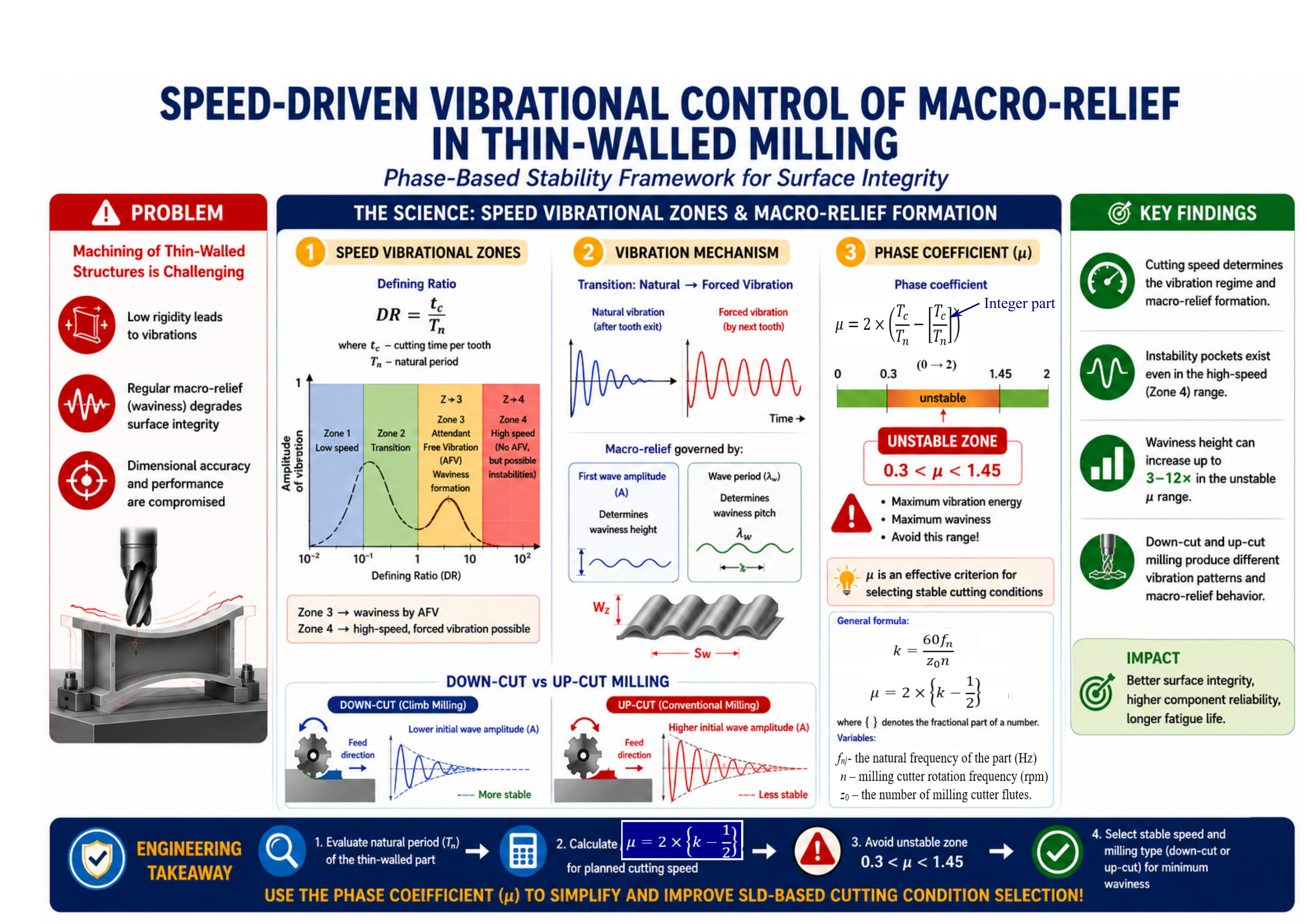
The use of thin-walled structures and assemblies in high-tech industries such as aerospace, energy, defense, etc. solves many technical problems related to weight and size reduction, but also creates new ones. The machining of such structures is a challenge for industry, as they do not have sufficient rigidity to ensure dimensional accuracy and macro-relief requirements. The main factor affecting the quality of the machined surface is the vibrations that occur during machining, and a significant amount of research is devoted to mitigating their impact. This work is devoted to the formation of the macro-relief of the machined surface during end milling of thin-walled structures. The work shows that the cutting speed significantly affects the nature of vibrations, the patterns, and the mechanism of regular macro-relief formation. This is explained by belonging to one of the speed vibrational zones. The paper also considers the influence of the type of milling—down-cut and up-cut—on the formation of macro-relief and provides practical recommendations on the conditions for their application. The novelty of the study is in combining two approaches to zoning machining conditions and, accordingly, analysing vibration phenomena during the machining of thin-walled structures based on the Defining Ratio and using Stability Lobe Diagrams. Such a combination is possible for conditions in which Attendant Free Vibrations does not apply. As a criterion for selecting the conditions and type of machining, it is proposed to use the phase coefficient, which characterises the transition from the damped natural vibrations of the part to the cutting period of the next milling cutter tooth, which should significantly simplify the selection process. The article also formulates the direction of further research, which will contribute to solving the current production problem.



 Suite 4002 Level 4, 447 Collins Street, Melbourne, Victoria 3000, Australia
 General Inquiries: info@sciltp.com