
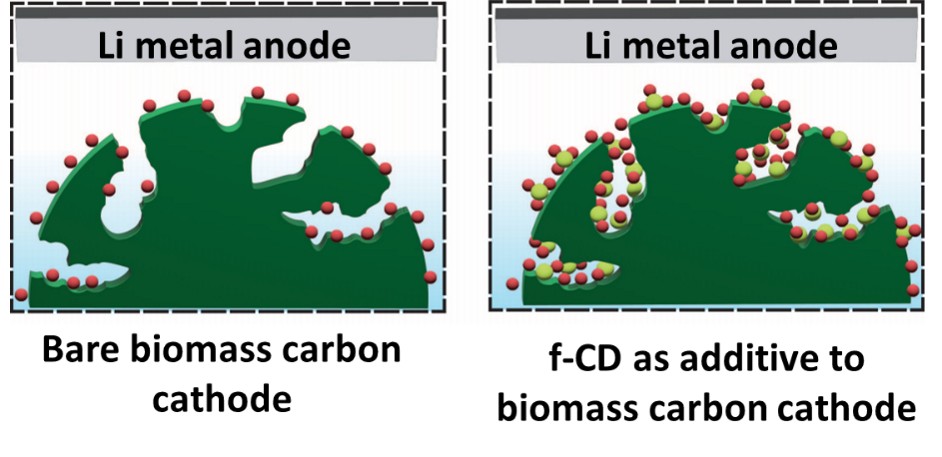
Hybrid devices such as lithium-metal capacitors (LMC) are in rising demand and can simultaneously meet the requirements of energy storage devices with superior specific energy and high specific power. LMCs combine a lithium anode with high specific energy and an activated carbon cathode with high specific power. Biomass-derived porous carbon (BC) is an ideal candidate as cathode material and stands out for its tuneable porosity, sustainability, and low cost. However, the inherent limitations of BC in delivering optimal electrochemical performance necessitate using additives with superior electronic conductivity. In this study, we introduce functionalized carbon quantum dots (f-CDs), synthesized from biomass, as an effective additive to enhance the performance of BC. The physicochemical and electrochemical figures of merit of BC integrated with 7 wt.% f-CDs (BC@f-CD) were systematically compared with BC modified with 0.4 wt.% single walled carbon nanotube (BC@s-CNT). Electrochemical evaluations revealed that BC@f-CD exhibited a superior specific capacitance of approximately 191 F·g−1 within a 2–4.3 V voltage window. The nano-sized dimensions and functional groups of f-CDs significantly improved performance, enabling a remarkable 111% increase in specific energy. Additionally, BC@f-CD demonstrated excellent cycling stability, retaining ~86% of its initial capacity after 5000 cycles, outperforming traditional lithium-metal batteries. This study underscores the potential of f-CDs as a cost-effective and efficient alternative additive to s-CNTs that can enhance the performance of LMCs, providing a sustainable solution for advanced energy storage applications.
- Open Access
- Article
Hierarchical Porous Carbon-Carbon Dot Architecture as a High Energy Density Cathode for Lithium-Metal Capacitors
- Gayathry Ganesh 1, 2,
- Gokul Raj Deivendran 3,
- Vaishak Sunil 1, 2,
- Izan Izwan Misnon 1, 2,
- Chun Chen Yang 3, 4,
- Rajan Jose 1, 2, 3, *
Author Information
Received: 08 Dec 2024 | Revised: 19 Mar 2025 | Accepted: 24 Mar 2025 | Published: 26 Mar 2025
Abstract
Graphical Abstract
References
- 1.Khan, M.I.; Gilani, R.; Hafeez, J.; et al. Advantages and disadvantages of lithium-ion batteries. In Nanostructured Lithium-ion Battery Materials; Elsevier: Amsterdam, The Netherlands, 2025; pp. 47–64.
- 2.Kim, T.; Song, W.; Son, D.-Y.; et al. Lithium-ion batteries: Outlook on present, future, and hybridized technologies. J. Mater. Chem. A 2019, 7, 2942–2964.
- 3.Wu, J.; Cao, Y.; Zhao, H.; et al. The critical role of carbon in marrying silicon and graphite anodes for high-energy lithium-ion batteries. Carbon Energy 2019, 1, 57–76.
- 4.Acebedo, B.; Morant-Miñana, M.C.; Gonzalo, E.; et al. Current Status and Future Perspective on Lithium Metal Anode Production Methods. Adv. Energy Mater. 2023, 13, 2203744, https://doi.org/10.1002/aenm.202203744.
- 5.Yang, L.; Hagh, N.M.; Macciomei, E.; et al. Challenges and Opportunities in Lithium Metal Battery Technology. J. Electrochem. Soc. 2024, 171, 060504.
- 6.Cheng, X.-B.; Zhang, R.; Zhao, C.-Z.; et al. Toward safe lithium metal anode in rechargeable batteries: A review. Chem. Rev. 2017, 117, 10403–10473.
- 7.Yerdauletov, M.S.; Nazarov, K.; Mukhametuly, B.; et al. Characterization of activated carbon from rice husk for enhanced energy storage devices. Molecules 2023, 28, 5818.
- 8.Shaibani, M.; Abedin, M.J.; Sharifzadeh Mirshekarloo, M.; et al. New Class of High-Energy, High-Power Capacitive Devices Enabled by Stabilized Lithium Metal Anodes. ACS Appl. Mater. Interfaces 2023, 15, 37454–37466.
- 9.Tan, L.; Huang, X.; Yin, T.; et al. A 5 V ultrahigh energy density lithium metal capacitor enabled by the fluorinated electrolyte. Energy Storage Mater. 2024, 71, 103692, https://doi.org/10.1016/j.ensm.2024.103692.
- 10.Liu, B.; Chen, J.; Yang, B.; et al. Boosting the performance of lithium metal capacitors with a Li composite anode. J. Mater. Chem. A 2021, 9, 10722–10730.
- 11.Liu, B.; Chen, J.; Yang, B.; et al. An ultrahigh-energy-density lithium metal capacitor. Energy Storage Mater. 2021, 42, 154–163.
- 12.Zhong, Q.; Liu, B.; Yang, B.; et al. Flexible lithium metal capacitors enabled by an in situ prepared gel polymer electrolyte. Chin. Chem. Lett. 2021, 32, 3496–3500.
- 13.Shah, N.; Ling, J.; Misnon, I.I.; et al. A simple formula to fabricate high performance lithium metal capacitors. J. Energy Storage 2025, 105, 114682.
- 14.Vijayan, B.L.; Yasin, A.; Misnon, I.I.; et al. Lithium-ion adsorption on surface modified porous carbon. J. Energy Storage 2023, 71, 108221, https://doi.org/10.1016/j.est.2023.108221.
- 15.Vijayan, B.L.; Misnon, I.I.; Anilkumar, G.M.; et al. Void-size-matched hierarchical 3D titania flowers in porous carbon as an electrode for high-density supercapacitive charge storage. J. Alloys Compd. 2021, 858, 157649, https://doi.org/10.1016/j.jallcom.2020.157649.
- 16.Vijayan, B.L.; Misnon, I.I.; Karuppaiah, C.; et al. Thin metal film on porous carbon as a medium for electrochemical energy storage. J. Power Sources 2021, 489, 229522, https://doi.org/10.1016/j.jpowsour.2021.229522.
- 17.Jiang, T.; Amadei, C.A.; Gou, N.; et al. Toxicity of single-walled carbon nanotubes (SWCNTs): Effect of lengths, functional groups and electronic structures revealed by a quantitative toxicogenomics assay. Environ. Sci. Nano 2020, 7, 1348–1364.
- 18.Raphey, V.; Henna, T.; Nivitha, K.; et al. Advanced biomedical applications of carbon nanotube. Mater. Sci. Eng. C 2019, 100, 616–630.
- 19.Izadi-Najafabadi, A.; Futaba, D.N.; Iijima, S.; et al. Ion diffusion and electrochemical capacitance in aligned and packed single-walled carbon nanotubes. J. Am. Chem. Soc. 2010, 132, 18017–18019.
- 20.Dong, Q.; Nasir, M.Z.M.; Pumera, M. Semi-conducting single-walled carbon nanotubes are detrimental when compared to metallic single-walled carbon nanotubes for electrochemical applications. Phys. Chem. Chem. Phys. 2017, 19, 27320–27325.
- 21.Ganesh, G.; Misnon, I.I.; Jose, R. Solvothermal synthesis of green fluorescent carbon dots from palm kernel shells. Mater. Today Proc. 2023, https://doi.org/10.1016/j.matpr.2023.02.332.
- 22.Shaker, M.; Ng, S.; Ghazvini, A.A.S.; et al. Carbon/graphene quantum dots as electrolyte additives for batteries and supercapacitors: A review. J. Energy Storage 2024, 85, 111040.
- 23.Jiang, Z.; Guan, L.; Xu, X.; et al. Applications of carbon dots in electrochemical energy storage. ACS Appl. Electron. Mater. 2022, 4, 5144–5164.
- 24.Li, S.; Luo, Z.; Tu, H.; et al. N,S-codoped carbon dots as deposition regulating electrolyte additive for stable lithium metal anode. Energy Storage Mater. 2021, 42, 679–686.
- 25.Arumugam, P.; Elumali, S.R.; Raman, K.; et al. Green Synthesis of Corn Cob Derived Carbon Quantum Dots and Its Applications as Electrolyte Additive for Lithium-Metal Batteries. ECS Trans. 2022, 107, 16547.
- 26.Yang, S.; Xu, Z.; Wang, S.; et al. Hydrophilic and nanocrystalline carbon quantum dots enable highly reversible zinc-ion batteries. Green Chem. 2024, 26, 7293–7301.
- 27.Ganesh, G.; Sunil, V.; Ling, J.; et al. Carbon dots as a sustainable electrolyte enhancer in aqueous alkaline electrochemical capacitors. J. Energy Storage 2024, 94, 112465.
- 28.Sunil, V.; Yasin, A.; Pal, B.; et al. Tailoring the charge storability of commercial activated carbon through surface treatment. J. Energy Storage 2022, 55, 105809.
- 29.Liu, C.; Wen, M.; Zhou, X.; et al. Starch-Derived Carbon Dots with Enhanced Photoluminescence and Tunable Emission for Multilevel Anticounterfeiting. ACS Sustain. Chem. Eng. 2024, 12, 12354–12364.
- 30.Luo, H.; Lari, L.; Kim, H.; et al. Structural evolution of carbon dots during low temperature pyrolysis. Nanoscale 2022, 14, 910–918.
- 31.Kim, K.; Chokradjaroen, C.; Saito, N. Solution plasma: New synthesis method of N-doped carbon dots as ultra-sensitive fluorescence detector for 2, 4, 6-trinitrophenol. Nano Express 2020, 1, 020043.
- 32.Yu, R.; Liang, S.; Ru, Y.; et al. A facile preparation of multicolor carbon dots. Nanoscale Res. Lett. 2022, 17, 32.
- 33.Wang, S.; Liu, S.; Zhang, J.; et al. Highly fluorescent nitrogen-doped carbon dots for the determination and the differentiation of the rare earth element ions. Talanta 2019, 198, 501–509.
- 34.Zulfajri, M.; Gedda, G.; Chang, C.-J.; et al. Cranberry beans derived carbon dots as a potential fluorescence sensor for selective detection of Fe3+ ions in aqueous solution. ACS Omega 2019, 4, 15382–15392.
- 35.Wang, J.; Xiao, L.; Wen, S.; et al. Hierarchically porous SiO 2/C hollow microspheres: A highly efficient adsorbent for Congo Red removal. RSC Adv. 2018, 8, 19852–19860.
- 36.Zhang, M.; Wang, W.; Liang, X.; et al. Promoting operating voltage to 2.3 V by a superconcentrated aqueous electrolyte in carbon-based supercapacitor. Chin. Chem. Lett. 2021, 32, 2217–2221.
- 37.Meng, F.; Song, M.; Wei, Y.; et al. The contribution of oxygen-containing functional groups to the gas-phase adsorption of volatile organic compounds with different polarities onto lignin-derived activated carbon fibers. Environ. Sci. Pollut. Res. 2019, 26, 7195–7204.
- 38.Rezaei, A.; Hadian-Dehkordi, L.; Samadian, H.; et al. Pseudohomogeneous metallic catalyst based on tungstate-decorated amphiphilic carbon quantum dots for selective oxidative scission of alkenes to aldehyde. Sci. Rep. 2021, 11, 4411.
- 39.Yu, M.; Zhang, S.; Chen, Y.; et al. A green method to reduce graphene oxide with carbonyl groups residual for enhanced electrochemical performance. Carbon 2018, 133, 101–108.
- 40.Liu, Y.; Zhu, C.; Gao, Y.; et al. Biomass-derived nitrogen self-doped carbon dots via a simple one-pot method: Physicochemical, structural, and luminescence properties. Appl. Surf. Sci. 2020, 510, 145437.
- 41.Sunil, V.; Salehan, S.S.; Ganesh, G.; et al. Nanoarchitectonics with improved supercapacitive performance of jering-derived porous activated carbon electrodes in aqueous electrolyte. Ionics 2024, 30, 5767–5776.
- 42.Misnon, I.I.; Zain, N.K.M.; Jose, R. Conversion of oil palm kernel shell biomass to activated carbon for supercapacitor electrode application. Waste Biomass Valorization 2019, 10, 1731–1740.
- 43.Sahoo, S.; Satpati, A.K.; Sahoo, P.K.; et al. Incorporation of Carbon Quantum Dots for Improvement of Supercapacitor Performance of Nickel Sulfide. ACS Omega 2018, 3, 17936–17946. https://doi.org/10.1021/acsomega.8b01238.
- 44.Li, Q.; Chen, J.; Zhang, L. Nickel-cobalt oxide coated CNTs as additives of activated carbon electrode for high-performance supercapacitors. In Proceedings of the 2013 13th IEEE International Conference on Nanotechnology (IEEE-NANO 2013), Beijing, China, 5–8 August 2013; pp. 348–351.
- 45.Schopf, D.; Es-Souni, M. Supported porous carbon and carbon–CNT nanocomposites for supercapacitor applications. Appl. Phys. A 2016, 122, 203.
- 46.Tang, J.; Chen, S.; Jia, Y.; et al. Carbon dots as an additive for improving performance in water-based lubricants for amorphous carbon (aC) coatings. Carbon 2020, 156, 272–281.
- 47.Kumar, V.B.; Borenstein, A.; Markovsky, B.; et al. Activated carbon modified with carbon nanodots as novel electrode material for supercapacitors. J. Phys. Chem. C 2016, 120, 13406–13413.
- 48.Zhang, P.; Fan, J.; Wang, Y.; et al. Insights into the role of defects on the Raman spectroscopy of carbon nanotube and biomass-derived carbon. Carbon 2024, 222, 118998.
- 49.Bläker, C.; Muthmann, J.; Pasel, C.; et al. Characterization of activated carbon adsorbents–state of the art and novel approaches. ChemBioEng Rev. 2019, 6, 119–138.
- 50.Sunil, V.; Pal, B.; Misnon, I.I.; et al. Characterization of supercapacitive charge storage device using electrochemical impedance spectroscopy. Mater. Today Proc. 2021, 46, 1588–1594.
- 51.Pal, B.; Yasin, A.; Sunil, V.; et al. Enhancing the materials circularity: From laboratory waste to electrochemical capacitors. Mater. Today Sustain. 2022, 20, 100221.
- 52.Wang, D.; Qiu, J.; Inui, N.; et al. Between Promise and Practice: A Comparative Look at the Energy Density of Li Metal-Free Batteries and Li Metal Batteries. ACS Energy Lett. 2023, 8, 5248–5252. https://doi.org/10.1021/acsenergylett.3c02105.
- 53.An, G.-H.; Kim, H.; Ahn, H.-J. Improved Ionic Diffusion through the Mesoporous Carbon Skin on Silicon Nanoparticles Embedded in Carbon for Ultrafast Lithium Storage. ACS Appl. Mater. Interfaces 2018, 10, 6235–6244, https://doi.org/10.1021/acsami.7b15950.
- 54.Kumar, S.; Goswami, M.; Singh, N.; et al. Exploring carbon quantum dots as an aqueous electrolyte for energy storage devices. J. Energy Storage 2022, 55, 105522.
- 55.Lindström, H.; Södergren, S.; Solbrand, A.; et al. Li+ ion insertion in TiO2 (anatase). 2. Voltammetry on nanoporous films. J. Phys. Chem. B 1997, 101, 7717–7722.
- 56.Jorn-am, T.; Supchocksoonthorn, P.; Pholauyphon, W.; et al. Quasi-solid, bio-renewable supercapacitors based on cassava peel and cassava starch and the use of carbon dots as performance enhancers. Energy Fuels 2022, 36, 7865–7877.
- 57.Raavi, R.; Archana, S.; Reddy, P.A.; et al. Performances of dual carbon multi-ion supercapacitors in aqueous and non-aqueous electrolytes. Energy Adv. 2023, 2, 385–397.
- 58.Schoetz, T.; Gordon, L.; Ivanov, S.; et al. Disentangling faradaic, pseudocapacitive, and capacitive charge storage: A tutorial for the characterization of batteries, supercapacitors, and hybrid systems. Electrochim. Acta 2022, 412, 140072.
- 59.Eleri, O.E.; Huld, F.; Pires, J.; et al. Revealing mechanisms of activated carbon capacity fade in lithium-ion capacitors. Electrochim. Acta 2023, 453, 142359, https://doi.org/10.1016/j.electacta.2023.142359.
- 60.Zhang, T.; Fuchs, B.; Secchiaroli, M.; et al. Electrochemical behavior and stability of a commercial activated carbon in various organic electrolyte combinations containing Li-salts. Electrochim. Acta 2016, 218, 163–173, https://doi.org/10.1016/j.electacta.2016.09.126.
- 61.Eleri, O.E.; Lou, F.; Yu, Z. Lithium-Ion Capacitors: A Review of Strategies toward Enhancing the Performance of the Activated Carbon Cathode. Batteries 2023, 9, 533.
- 62.Choi, W.; Shin, H.-C.; Kim, J.M.; et al. Modeling and applications of electrochemical impedance spectroscopy (EIS) for lithium-ion batteries. J. Electrochem. Sci. Technol. 2020, 11, 1–13
- 63.Lee, S.P., Ali, G.A.M.; Hegazy, H.H.; et al. Optimizing Reduced Graphene Oxide Aerogel for a Supercapacitor. Energy Fuels 2021, 35, 4559–4569.
- 64.Jiang, Y.; Li, J.; Jiang, Z.; et al. Large-surface-area activated carbon with high density by electrostatic densification for supercapacitor electrodes. Carbon 2021, 175, 281–288.
- 65.Quan, Y.; Wang, G.; Lu, L.; et al.; High-performance pseudo-capacitor energy storage device based on a hollow-structured copper sulfide nanoflower and carbon quantum dot nanocomposite. Electrochimica Acta 2020, 353, 136606.
- 66.Yang, P.; Zhu, Z.; Chen, M.; et al. Microwave-assisted synthesis of xylan-derived carbon quantum dots for tetracycline sensing. Opt.Mater. 2018, 85, 329–336.
- 67.Zhao, C.; Zhao, Z.; Liang, Y.; et al. Bi/BiOI/carbon quantum dots nano-sheets with superior photocatalysis. RSC Adv. 2023, 13, 30520–30527.
- 68.Rong, C.; Liao, C.; Chen, Y.; et al. High-performance supercapacitor electrode materials from composite of bamboo tar pitch activated carbon and tannic acid carbon quantum dots. J. Energy Storage 2024, 95, 112657.
How to Cite
Ganesh, G.; Deivendran, G. R.; Sunil, V.; Misnon, I. I.; Yang, C. C.; Jose, R. Hierarchical Porous Carbon-Carbon Dot Architecture as a High Energy Density Cathode for Lithium-Metal Capacitors. Materials and Sustainability 2025, 1 (1), 7. https://doi.org/10.53941/matsus.2025.100007.
RIS
BibTex
Copyright & License

Copyright (c) 2025 by the authors.
This work is licensed under a Creative Commons Attribution 4.0 International License.
Article Metrics
202
Article Views
3
Citations
Contents
References
