
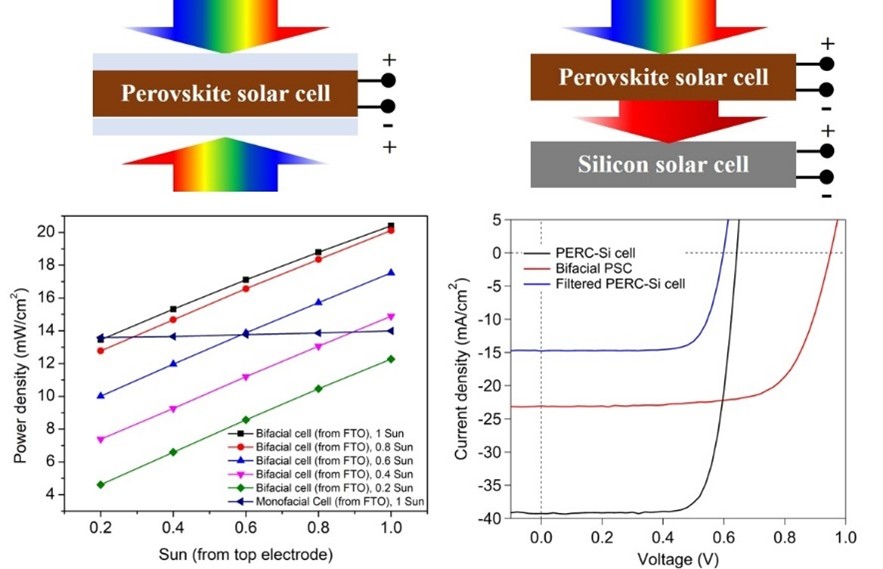
Bifacial perovskite solar cells (PSCs) offer the potential for higher power output through tandem configurations with silicon solar cells or by harvesting light from both sides. A high-transmittance and low-resistance transparent electrode is crucial for bifacial PSCs. However, the most widely used transparent conductive oxide (TCO) as transparent electrodes often require energetic ion bombardment during deposition and high post-annealing temperatures to obtain high transmittance and low resistance, making them incompatible for direct deposition onto delicate perovskite films. In this work, a cerium-doped indium oxide (ICO) film, prepared via radio frequency (RF) magnetron sputtering at room temperature (RT), is employed as the top transparent conductive electrode in bifacial PSCs. A 20 nm MoOx layer is introduced as a buffer layer to protect the underlying spiro-OMeTAD and perovskite layers against sputtering damage. The ICO film, deposited with an RF power of 80 W for 1 h and 20 min at RT, exhibits an amorphous structure with a thickness of 210 nm, a mobility of 8.3 cm2/Vs, a carrier concentration of 6.07 × 1020 cm⁻3, a resistivity of 1.24 × 10⁻³ Ω·cm, and an average transmittance of 89.70% between 550 nm and 1000 nm, resulting in a figure of merit (FOM) of 6.67 × 10⁻³ Ω−1. The fabricated bifacial PSC demonstrates power conversion efficiencies (PCEs) of 15.28% and 10.00% when illuminated from the FTO side and ICO side, respectively. Furthermore, the bifacial PSC under simultaneous illumination from both sides achieves a superior power density compared to the monofacial PSC in albedo utilization. Finally, by mechanically stacking the bifacial PSC as the top cell with a passivated emitter rear contact (PERC) crystalline silicon solar cell as the bottom cell, the 4-terminal perovskite/silicon tandem solar cell achieves a PCE of 21.89%.
- Open Access
- Article
Room-Temperature Sputtered Cerium-Doped Indium Oxide Transparent Conducting Electrodes for Bifacial Perovskite Solar Cells: Albedo Utilization and Perovskite/Silicon Tandems
- Zachary Ryan Hill Smith 1,
- Ming-Hsien Li 2,
- Chen-Fu Lin 3,
- Farhan Yousuf 3,
- Keh-Chin Chang 1, 4, *,
- Peter Chen 1, 3, 5, 6, *
Author Information
Received: 26 May 2025 | Revised: 25 Jun 2025 | Accepted: 26 Jun 2025 | Published: 30 Jun 2025
Abstract
Graphical Abstract
Keywords
cerium-doped indium oxide | transparent conducting oxide | magnetron sputtering | perovskite solar cells | bifacial solar cells | 4-terminal tandem solar cells
References
- 1.Afroz, M.; Ratnesh, R.K.; Srivastava, S.; et al. Perovskite solar cells: Progress, challenges, and future avenues to clean energy. Sol. Energy 2025, 287, 113205. https://doi.org/10.1016/j.solener.2024.113205.
- 2.Mei, J.; Yan, F. Recent Advances in Wide-Bandgap Perovskite Solar Cells. Adv. Mater. 2025, 2418622. https://doi.org/10.1002/adma.202418622.
- 3.Tang, G.; Chen, L.; Cao, X.; et al. A Review on Recent Advances in Flexible Perovskite Solar Cells. Sol. RRL 2025, 9, 2400844. https://doi.org/10.1002/solr.202400844.
- 4.Wallach, T.; Etgar, L. Highly transparent and semi-transparent perovskites and their applications. Appl. Phys. Rev. 2025, 12, 011314. https://doi.org/10.1063/5.0237977.
- 5.Liu, Y.; Ma, Z.; Zhang, J.; et al. Light-Emitting Diodes Based on Metal Halide Perovskite and Perovskite Related Nanocrystals. Adv. Mater. 2025, 2415606. https://doi.org/10.1002/adma.202415606.
- 6.Li, X.; Aftab, S.; Mukhtar, M.; et al. Exploring Nanoscale Perovskite Materials for Next-Generation Photodetectors: A Comprehensive Review and Future Directions. Nano Micro Lett. 2024, 17, 28. https://doi.org/10.1007/s40820-024-01501-6.
- 7.Li, F. Halide perovskites, a game changer for future medical imaging technology. Biophys. Rev. 2025, 6, 011302. https://doi.org/10.1063/5.0217068.
- 8.Yao, F.; Dong, K.; Ke, W.; et al. Micro/Nano Perovskite Materials for Advanced X-ray Detection and Imaging. ACS Nano 2024, 18, 6095–6110. https://doi.org/10.1021/acsnano.3c10116.
- 9.Feng, Z.; Wang, J.; Chen, F.; et al. Coupling Light into Memristors: Advances in Halide Perovskite Resistive Switching and Neuromorphic Computing. Small Methods 2025, 2500089. https://doi.org/10.1002/smtd.202500089.
- 10.Bagade, S.S.; Patel, P.K. A comprehensive review on potential of diffusion length enhancement to upraise perovskite solar cell performance. Phys. Scr. 2024, 99, 052003. https://doi.org/10.1088/1402-4896/ad3a26.
- 11.Zhang, M.; Wu, C.; Yin, M.; et al. High Efficiency Tin Halide Perovskite Solar Cells with over 1 Micrometer Carrier Diffusion Length. Adv. Funct. Mater. 2024, 34, 2410772. https://doi.org/10.1002/adfm.202410772.
- 12.Miah, M.H.; Khandaker, M.U.; Rahman, M.B.; et al. Band gap tuning of perovskite solar cells for enhancing the efficiency and stability: Issues and prospects. RSC Adv. 2024, 14, 15876–15906. https://doi.org/10.1039/D4RA01640H.
- 13.Novikov, S.A.; Valueva, A.D.; Klepov, V.V. Band gap engineering and photoluminescence tuning in halide double perovskites. Dalton Trans. 2024, 53, 12442–12449. https://doi.org/10.1039/D4DT01420K.
- 14.Li, X.; Aftab, S.; Hussain, S.; et al. Dimensional diversity (0D, 1D, 2D, and 3D) in perovskite solar cells: Exploring the potential of mixed-dimensional integrations. J. Mater. Chem. A 2024, 12, 4421–4440. https://doi.org/10.1039/D3TA06953B.
- 15.Zhang, Q.; Zhang, D.; Cao, B.; et al. Improving the Operational Lifetime of Metal-Halide Perovskite Light-Emitting Diodes with Dimension Control and Ligand Engineering. ACS Nano 2024, 18, 8557–8570. https://doi.org/10.1021/acsnano.3c13136.
- 16.Muhammad, Z.; Rashid, A. Exciton binding energies and polaron interplay in the optically excited state of organic–inorganic lead halide perovskites. Mater. Adv. 2025, 6, 13–38. https://doi.org/10.1039/D4MA00454J.
- 17.Liu, G.; Ghasemi, M.; Wei, Q.; et al. Dynamic Defect Tolerance in Metal Halide Perovskites: From Phenomena to Mechanism. Adv. Energy Mater. 2025, 15, 2405239. https://doi.org/10.1002/aenm.202405239.
- 18.Available online: https://www2.nrel.gov/pv/cell-efficiency (accessed on 18 May 2025).
- 19.Yang, X.; Zhu, Y.; Yan, S.; et al. Blade-Coating Perovskites for Tandem Devices: Liquid Mechanism, Film Formation, and Performance. Sol. RRL 2025, 9, 202500149. https://doi.org/10.1002/solr.202500149.
- 20.Wang, H.; Lin, W.; Wang, Y.; et al. Perovskite/silicon tandem solar cells: A comprehensive review of recent strategies and progress. Semicond. Sci. Technol. 2025, 40, 023001. https://doi.org/10.1088/1361-6641/adab11.
- 21.Adnan, M.; Irshad, Z.; Lim, J. Impact of structural advancements interface engineering operational stability and commercial viability of perovskite/silicon tandem solar cells. Sol. Energy 2025, 286, 113190. https://doi.org/10.1016/j.solener.2024.113190.
- 22.Guo, H.; Hou, F.; Ren, X.; et al. Recent Progresses on Transparent Electrodes and Active Layers Toward Neutral, Color Semitransparent Perovskite Solar Cells. Sol. RRL 2023, 7, 2300333. https://doi.org/10.1002/solr.202300333.
- 23.Hou, F.; Ren, X.; Guo, H.; et al. Monolithic perovskite/silicon tandem solar cells: A review of the present status and solutions toward commercial application. Nano Energy 2024, 124, 109476. https://doi.org/10.1016/j.nanoen.2024.109476.
- 24.Kumar, P.; Shankar, G.; Pradhan, B. Recent progress in bifacial perovskite solar cells. Appl. Phys. A 2022, 129, 63. https://doi.org/10.1007/s00339-022-06337-8.
- 25.Jung, H.; Kim, G.; Jang, G.S.; et al. Transparent Electrodes with Enhanced Infrared Transmittance for Semitransparent and Four-Terminal Tandem Perovskite Solar Cells. ACS Appl. Mater. Interfaces 2021, 13, 30497–30503. https://doi.org/10.1021/acsami.1c02824.
- 26.Feng, Y.; Kim, P.; Nemitz, C.A.; et al. Boosting charge collection efficiency via large-area free-standing Ag/ZnO core-shell nanowire array electrodes. Prog. Nat. Sci. Mater. Int. 2019, 29, 124–128. https://doi.org/10.1016/j.pnsc.2019.03.002.
- 27.Chavan, G.T.; Kim, Y.; Khokhar, M.Q.; et al. A Brief Review of Transparent Conducting Oxides (TCO): The Influence of Different Deposition Techniques on the Efficiency of Solar Cells. Nanomaterials 2023, 13, 1226.
- 28.Príncipe, J.; Duarte, V.C.M.; Mendes, A.; et al. Influence of the Transparent Conductive Oxide Type on the Performance of Inverted Perovskite Solar Cells. ACS Appl. Energy Mater. 2023, 6, 12442–12451. https://doi.org/10.1021/acsaem.3c02292.
- 29.Chen, Y.-J.; Li, M.-H.; Huang, J.-C.-A.; et al. The Cu/Cu2O nanocomposite as a p-type transparent-conductive-oxide for efficient bifacial-illuminated perovskite solar cells. J. Mater. Chem. C 2018, 6, 6280–6286. https://doi.org/10.1039/C8TC00768C.
- 30.Chiang, Y.-H.; Peng, C.-C.; Chen, Y.-H.; et al. The utilization of IZO transparent conductive oxide for tandem and substrate type perovskite solar cells. J. Phys. D Appl. Phys. 2018, 51, 424002. https://doi.org/10.1088/1361-6463/aad71c.
- 31.Li, P.; Li, F.; Ma, J.; et al. Over 500 °C stable transparent conductive oxide for optoelectronics. InfoMat 2024, 6, e12607. https://doi.org/10.1002/inf2.12607.
- 32.Abe, Y.; Nishimura, T.; Yamada, A. Optimum Electrical and Optical Properties of Transparent Conducting Oxide for Cu(In,Ga)Se2 Photovoltaic Module Applications. Phys. Status Solidi 2024, 221, 2300641. https://doi.org/10.1002/pssa.
- 33.Yang, Q.; Duan, W.; Eberst, A.; et al. Origin of sputter damage during transparent conductive oxide deposition for semitransparent perovskite solar cells. J. Mater. Chem. A 2024, 12, 14816–14827. https://doi.org/10.1039/D3TA06654A.
- 34.Özkol, E.; Magalhães, M.M.R.; Zhao, Y.; et al. Optimization and integration of room temperature RF sputtered ICO as TCO layers in high-performance SHJ solar cells. Sol. Energy Mater. Sol. Cells 2025, 288, 113637. https://doi.org/10.1016/j.solmat.2025.113637.
- 35.Zhang, L.; Che, Z.; Shang, J.; et al. Cerium-Doped Indium Oxide as a Top Electrode of Semitransparent Perovskite Solar Cells. ACS Appl. Mater. Interfaces 2023, 15, 10838–10846. https://doi.org/10.1021/acsami.2c22942.
- 36.An, S.; Chen, P.; Hou, F.; et al. Cerium-doped indium oxide transparent electrode for semi-transparent perovskite and perovskite/silicon tandem solar cells. Sol. Energy 2020, 196, 409–418. https://doi.org/10.1016/j.solener.2019.12.040.
- 37.Lee, P.-H.; Wu, T.-T.; Li, C.-F.; et al. Featuring Semitransparent p–i–n Perovskite Solar Cells for High-Efficiency Four-Terminal/Silicon Tandem Solar Cells. Sol. RRL 2022, 6, 2100891. https://doi.org/10.1002/solr.202100891.
- 38.Zhang, Y.; Gan, Y.; Gan, T.; et al. High mobility cerium-doped indium oxide thin films prepared by reactive plasma deposition without oxygen. Vacuum 2022, 206, 111512. https://doi.org/10.1016/j.vacuum.2022.111512.
- 39.Wan, S.; Man, X.; Zhang, P.; et al. Ultra-Transparent Cerium-Doped Indium Oxide Films Deposited with Industry-Scale Reactive Plasma Deposition. J. Electron. Mater. 2024, 53, 4829–4840. https://doi.org/10.1007/s11664-024-11198-3.
- 40.Tumen-Ulzii, G.; Qin, C.; Matsushima, T.; et al. Understanding the Degradation of Spiro‐OMeTAD‐Based Perovskite Solar Cells at High Temperature. Solar RRL 2020, 4, 2000305. https://doi.org/10.1002/solr.202000305.
- 41.Magliano, E.; Mariani, P.; Agresti, A.; et al. Semitransparent Perovskite Solar Cells with Ultrathin Protective Buffer Layers. ACS Appl. Energy Mater. 2023, 6, 10340–10353. https://doi.org/10.1021/acsaem.3c00735.
- 42.Mujahid, M.; Chen, C.; Zhang, J.; et al. Recent advances in semitransparent perovskite solar cells. InfoMat 2021, 3, 101–124. https://doi.org/10.1002/inf2.12154.
- 43.Lou, J.; Feng, J.; Cao, Y.; et al. Designed multi-layer buffer for high-performance semitransparent wide-bandgap perovskite solar cells. Mater. Adv. 2023, 4, 1777–1784. https://doi.org/10.1039/D2MA01089E.
- 44.Liang, F.; Ying, Z.; Lin, Y.; et al. High-Performance Semitransparent and Bifacial Perovskite Solar Cells with MoOx/Ag/WOx as the Rear Transparent Electrode. Adv. Mater. Interfaces 2020, 7, 2000591. https://doi.org/10.1002/admi.202000591.
- 45.Shi, H.; Zhang, L.; Huang, H.; et al. Simultaneous Interfacial Modification and Defect Passivation for Wide-Bandgap Semitransparent Perovskite Solar Cells with 14.4% Power Conversion Efficiency and 38% Average Visible Transmittance. Small 2022, 18, 2202144. https://doi.org/10.1002/smll.202202144.
- 46.Sahli, F.; Werner, J.; Kamino, B.A.; et al. Fully textured monolithic perovskite/silicon tandem solar cells with 25.2% power conversion efficiency. Nat. Mater. 2018, 17, 820–826. https://doi.org/10.1038/s41563-018-0115-4.
- 47.Werner, J.; Weng, C.-H.; Walter, A.; et al. Efficient Monolithic Perovskite/Silicon Tandem Solar Cell with Cell Area > 1 cm2. J. Phys. Chem. Lett. 2016, 7, 161–166. https://doi.org/10.1021/acs.jpclett.5b02686.
- 48.Hörantner, M.T.; Snaith, H.J. Predicting and optimising the energy yield of perovskite-on-silicon tandem solar cells under real world conditions. Energy Environ. Sci. 2017, 10, 1983–1993. https://doi.org/10.1039/C7EE01232B.
- 49.Huang, Y.-C.; Huang, S.-W.; Li, C.-F.; et al. A comprehensive optimization of highly efficient MA-Free wide-bandgap perovskites for 4-T Perovskite/Silicon tandem solar cells. Chem. Eng. J. 2025, 503, 158272. https://doi.org/10.1016/j.cej.2024.158272.
How to Cite
Smith, Z. R. H.; Li, M.-H.; Lin, C.-F.; Yousuf, F.; Chang, K.-C.; Chen, P. Room-Temperature Sputtered Cerium-Doped Indium Oxide Transparent Conducting Electrodes for Bifacial Perovskite Solar Cells: Albedo Utilization and Perovskite/Silicon Tandems. Materials and Sustainability 2025, 1 (2), 10. https://doi.org/10.53941/matsus.2025.100010.
RIS
BibTex
Copyright & License

Copyright (c) 2025 by the authors.
This work is licensed under a Creative Commons Attribution 4.0 International License.
Article Metrics
277
Article Views
0
Citations
Contents
References
