
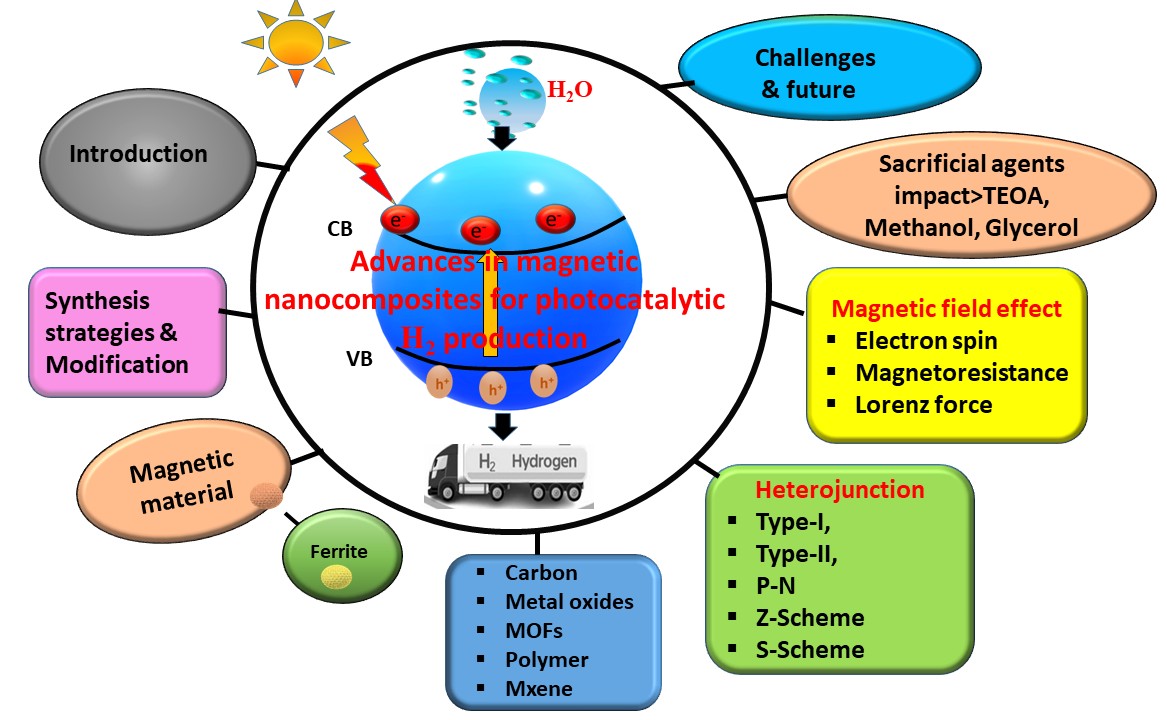
Harnessing solar energy via semiconductor-based photocatalysis offers a sustainable solution for global energy and environmental challenges. Therefore, the development of high-performance photocatalysts is a crucial strategy for mitigating the energy crisis and environmental pollution. Further, photocatalytic hydrogen production (H2) from water splitting is the most promising clean technology for renewable energy conversion. Towards this, exploring magnetic materials and their nanocomposites has gathered substantial attention for green H2 generation. This review summarizes advances in ferrite-based photocatalysts, including hematite, spinel ferrites, and magnetite, as well as their nanocomposites with carbon materials, metal oxides (MOS), conducting polymer, metal–organic frameworks (MOFs), and Maxene. Different synthesis strategies and structural modifications are discussed, highlighting their roles in enhancing charge separation, light absorption, and improving catalytic properties. Particular emphasis is given to the correlation between magnetic properties and photocatalytic performance, as well as the recyclability of these materials. Current challenges, including stability, scalability, and limited photocatalytic efficiency, are critically examined. Finally, future perspectives are presented, focusing on rational material design, multifunctional heterostructures, and scalable synthesis methods for efficient and durable hydrogen production.
- Open Access
- Review
Advancements in Magnetic Nanocomposites for Enhanced Photocatalytic Water Splitting
- V. S. Manikandan 1,*,
- Kesiya George 2,
- Sandeep Kumar Yadav 3,
- Rajagopalan Vijayaraghavan 4,
- Ananthakumar Ramadoss 5,
- Sathish-Kumar Kamaraj 6,
- Mangalaraja Ramalinga Viswanathan 7,
- Arun Thirumurugan 1,*
Author Information
Received: 01 Nov 2025 | Revised: 17 Dec 2025 | Accepted: 23 Dec 2025 | Published: 31 Dec 2025
Abstract
Graphical Abstract
Keywords
magnetic material | heterostructure | nanocomposites | water splitting
References
- 1.
Zainal, B.S.; Ker, P.J.; Mohamed, H.; et al. Recent Advancement and Assessment of Green Hydrogen Production Technologies. Renew. Sustain. Energy Rev. 2024, 189, 113941. https://doi.org/10.1016/j.rser.2023.113941.
- 2.
Dincer, I.; Acar, C. Review and Evaluation of Hydrogen Production Methods for Better Sustainability. Int. J. Hydrogen Energy 2015, 40, 11094–11111.
- 3.
Kalamaras, C.M.; Efstathiou, A.M. Hydrogen Production Technologies: Current State and Future Developments. Conf. Pap. Energy 2013, 2013, 690627. https://doi.org/10.1155/2013/690627.
- 4.
Fujishima, A.; Honda, K. Electrochemical Photolysis of Water at a Semiconductor Electrode. Nature 1972, 238, 37–38.
- 5.
Khan, H. Graphene Based Semiconductor Oxide Photocatalysts for Photocatalytic Hydrogen (H2) Production, a Review. Int. J. Hydrogen Energy 2024, 84, 356–371.
- 6.
Saleh, M.R.; El-Gendy, R.A.; Bakier, Y.M.; et al. Modulating G-C3N4 Photocatalyst for H2 Production via Water Splitting: The Impact of Schiff Base Incorporation. J. Environ. Chem. Eng. 2024, 12, 113866.
- 7.
Cheng, H.; Bai, Z.; Cong, R.; et al. NiS Modified SrTiO3: Al Bifunctional Photocatalyst for H2 Generation and Cathodic Protection. Ceram. Int. 2024, 50, 25518–25527.
- 8.
Zhang, X.; Ye, H.; Zeng, Z.; et al. Bridging the Gap between Metallic MoO2 and ZnIn2S4 for Enhanced Photocatalytic H2 Production. Sep. Purif. Technol. 2024, 347, 127624.
- 9.
Robust One-Pot Solvothermal Incorporation of InVO4 with Polymeric-C3N4 Nanosheets with Improved Charge Carrier Separation and Transfer: A Highly Efficient and Stable Photocatalyst for Solar Fuel (H2) Generation—ScienceDirect. Available online: https://www-sciencedirect-com.uai.idm.oclc.org/science/article/pii/S0921510723004245?getft_integrator=sciencedirect_contenthosting&pes=vor&utm_source=sciencedirect_contenthosting (accessed on 29 November 2025).
- 10.
Alshgari, R.A.; Khan, M.R.; Mohandoss, S.; et al. Enhanced Photocatalytic Activity in H2 Production from Methanol Aqueous Solution Based on the Synthesized Pt-TiO2-Decorated MoSe2 Nanocomposites. J. Alloys Compd. 2024, 980, 173595. https://doi.org/10.1016/j.jallcom.2024.173595.
- 11.
Wang, J.; Tian, J.; Han, P.; et al. Enhanced Photocatalytic Hydrogen Production Activity Driven by TiO2/(MoP/CdS): Insights from Powder Particles to Thin Films. Langmuir 2024, 40, 21161–21170. https://doi.org/10.1021/acs.langmuir.4c02635.
- 12.
Ghosh, S.; Das, P.S.; Biswas, M.; et al. Z-Scheme Ferrite Nanoparticle/Graphite Carbon Nitride Nanosheet Heterojunctions for Photocatalytic Hydrogen Evolution. Int. J. Hydrogen Energy 2025, 107, 586–596. https://doi.org/10.1016/j.ijhydene.2024.06.167.
- 13.
El-Khair, M.A.A.; Al-Gamal, A.G.; Kabel, K.I.; et al. Harvesting the Synergistic Effect of CuFe2O4@Ni-MOF Nanomagnetic Photocatalyst for Enhanced Visible Light-Driven Green Hydrogen Production. Int. J. Hydrogen Energy 2025, 101, 280–294.
- 14.
Sun, X.; Chen, Z.; Shen, Y.; et al. Efficient Photothermal-Assisted Photocatalytic H2 Production Using Carbon Dots-Infused g-C3N4 Nanoreactors Synthesized via One-Step Template-Free Thermal Polymerization. Chem. Eng. J. 2024, 488, 151041. https://doi.org/10.1016/j.cej.2024.151041.
- 15.
Hybrid Porous Polymers Combination of Octavinylsilsesquioxane/Pyrene with Benzothiadiazole Units for Robust Energy Storage and Efficient Photocatalytic Hydrogen Production from Water|ACS Applied Polymer Materials Available online: https://pubs-acs-org.uai.idm.oclc.org/doi/full/10.1021/acsapm.4c00655 (accessed on 29 November 2025).
- 16.
Fan, Y.; Kong, C.; Zhang, L.; et al. Enhancing Photocatalytic Hydrogen Evolution Performance for D-π-A Conjugated Polymers Based on the Perylene Diimide. Sep. Purif. Technol. 2025, 355, 129721. https://doi.org/10.1016/j.seppur.2024.129721.
- 17.
Chen, H.; Wu, J.; Zhu, Y.; et al. Cu-MOF Modified ZnIn2S4 Nanosheet Composite Catalyst for Photocatalytic Hydrogen Production. Renew. Energy 2024, 228, 120672.
- 18.
Fatima, U.; Tahir, M.B.; Sagir, M.; et al. The Synthesis of Nickel Ferrite NiFe2O4/Ti3C2 MXene Composite for the Photocatalytic Evolution of Hydrogen. Int. J. Hydrogen Energy 2024, 74, 316–321.
- 19.
Amari, A.; Aljibori, H.S.S.; Ismail, M.A.; et al. Engineering Novel 2D MXene-Based Dual Z-Scheme Heterojunction Photocatalyst for Enhanced TC Hydrochloride Degradation and Hydrogen Evolution. J. Water Process Eng. 2025, 70, 107127.
- 20.
Guo, D.; Kang, H.; Wei, P.; et al. A High-Performance Bimetallic Cobalt Iron Oxide Catalyst for the Oxygen Evolution Reaction. CrystEngComm 2020, 22, 4317–4323.
- 21.
Hong, D.; Yamada, Y.; Nagatomi, T.; et al. Catalysis of Nickel Ferrite for Photocatalytic Water Oxidation Using [Ru(Bpy)3]2+ and S2O82–. J. Am. Chem. Soc. 2012, 134, 19572–19575. https://doi.org/10.1021/ja309771h.
- 22.
Xiong, Y.; Yang, Y.; Feng, X.; et al. A Strategy for Increasing the Efficiency of the Oxygen Reduction Reaction in Mn-Doped Cobalt Ferrites. J. Am. Chem. Soc. 2019, 141, 4412–4421. https://doi.org/10.1021/jacs.8b13296.
- 23.
Hosni, N.; Zehani, K.; Bartoli, T.; et al. Semi-Hard Magnetic Properties of Nanoparticles of Cobalt Ferrite Synthesized by the Co-Precipitation Process. J. Alloys Compd. 2017, 694, 1295–1301.
- 24.
Abe, R. Recent Progress on Photocatalytic and Photoelectrochemical Water Splitting under Visible Light Irradiation. J. Photochem. Photobiol. C Photochem. Rev. 2010, 11, 179–209.
- 25.
Shi, N.; Li, X.; Fan, T.; et al. Artificial Chloroplast: Au/Chloroplast-Morph-TiO2 with Fast Electron Transfer and Enhanced Photocatalytic Activity. Int. J. Hydrogen Energy 2014, 39, 5617–5624.
- 26.
Hossain, M.M.; Islam, M.T.; Islam, T.; et al. Progress in Scalable Photocatalytic Hydrogen Production from Water and Techno-Economic Insights. Int. J. Hydrogen Energy 2026, 198, 152567.
- 27.
Fajrina, N.; Tahir, M. A Critical Review in Strategies to Improve Photocatalytic Water Splitting towards Hydrogen Production. Int. J. Hydrogen Energy 2019, 44, 540–577.
- 28.
Fatima, R.; Rodríguez-Ortiz, G.; Waseem, M.; et al. ZnO/α-Fe2O3 Nanocomposites as Efficient Photocatalysts for Sustainable Hydrogen Generation. Next Mater. 2025, 6, 100486.
- 29.
Zheng, X.; Song, Y.; Liu, Y.; et al. ZnIn2S4-Based Photocatalysts for Photocatalytic Hydrogen Evolution via Water Splitting. Coord. Chem. Rev. 2023, 475, 214898.
- 30.
Teng, T.-Y.; Ng, K.H. A Novel Type I-like F-Scheme Heterojunction for Improving H2 Generation from Water: A Case Modelled by Physically-Attached ZnCdS-Cu2O Composite. Chem. Eng. J. 2025, 519, 164603. https://doi.org/10.1016/j.cej.2025.164603.
- 31.
Jin, N.; Sun, Y.; Shi, W.; et al. Type-I CdS/ZnS Core/Shell Quantum Dot-Gold Heterostructural Nanocrystals for Enhanced Photocatalytic Hydrogen Generation. J. Am. Chem. Soc. 2023, 145, 21886–21896. https://doi.org/10.1021/jacs.3c06065.
- 32.
Rawool, S.A.; Pai, M.R.; Banerjee, A.M.; et al. Pn Heterojunctions in NiO:TiO2 Composites with Type-II Band Alignment Assisting Sunlight Driven Photocatalytic H2 Generation. Appl. Catal. B Environ. 2018, 221, 443–458.
- 33.
Patil, P.S.; Ubale, Y.P.; Gawali, S.S.; et al. Hybrid Magnetic Nanocomposite NiFe2O4/TiO2 for Photocatalytic Dye Degradation and Green Hydrogen (H2) Generation. Ceram. Int. 2024, 50, 54155–54173.
- 34.
Xu, Q.; Zhang, L.; Cheng, B.; et al. S-Scheme Heterojunction Photocatalyst. Chem 2020, 6, 1543–1559.
- 35.
Maeda, K. Z-Scheme Water Splitting Using Two Different Semiconductor Photocatalysts. ACS Catal. 2013, 3, 1486–1503. https://doi.org/10.1021/cs4002089.
- 36.
Ge, W.; Song, J.; Deng, S.; et al. Construction of Z-Scheme CoFe2O4@ZnIn2S4 p–n Heterojunction for Enhanced Photocatalytic Hydrogen Production. Sep. Purif. Technol. 2024, 328, 125059. https://doi.org/10.1016/j.seppur.2023.125059.
- 37.
0D/2D Z-Scheme Heterojunctions of Zn-AgIn5S8 QDs/α-Fe2O3 Nanosheets for Efficient Visible-Light-Driven Hydrogen Production—ScienceDirect. Available online: https://www-sciencedirect-com.uai.idm.oclc.org/science/article/pii/S1385894720343874?casa_token=PEQst6Wo0f0AAAAA:fEZZsxEnHI3tzw_B78VK5326cOUkm33R69yfjpi6nIYuhzQmW3Ecg0q_c3MfMpYgikGXZn3YgOvf (accessed on 1 December 2025).
- 38.
Balapure, A.; Dutta, J.R.; Ganesan, R. Recent Advances in Semiconductor Heterojunctions: A Detailed Review of the Fundamentals of Photocatalysis, Charge Transfer Mechanism and Materials. RSC Appl. Interfaces 2024, 1, 43–69.
- 39.
Moniz, S.J.; Shevlin, S.A.; Martin, D.J.; Guo, Z.-X.; Tang, J. Visible-Light Driven Heterojunction Photocatalysts for Water Splitting–a Critical Review. Energy Environ. Sci. 2015, 8, 731–759.
- 40.
Ma, X.; Liu, X.; Tang, J.; et al. Design and Construction of an Immobilized Z-Scheme Fe2O3/CuFe2O4|Cu Photocatalyst Film for Organic Pollutant Degradation with Simultaneous Hydrogen Production. Appl. Surf. Sci. 2022, 602, 154276.
- 41.
Sun, L.; Yu, X.; Tang, L.; et al. Hollow Dodecahedron K3PW12O40/CdS Core-Shell S-Scheme Heterojunction for Photocatalytic Synergistic H2 Evolution and Benzyl Alcohol Oxidation. Chin. J. Catal. 2023, 52, 164–175. https://doi.org/10.1016/S1872-2067(23)64507-3.
- 42.
Bootluck, W.; Chittrakarn, T.; Techato, K.; et al. S-Scheme α-Fe2O3/TiO2 Photocatalyst with Pd Cocatalyst for Enhanced Photocatalytic H2 Production Activity and Stability. Catal. Lett. 2022, 152, 2590–2606. https://doi.org/10.1007/s10562-021-03873-5.
- 43.
Boumaza, S.; Kabir, H.; Gharbi, I.; et al. Preparation and Photocatalytic H2-Production on α-Fe2O3 Prepared by Sol-Gel. Int. J. Hydrogen Energy 2018, 43, 3424–3430. https://doi.org/10.1016/j.ijhydene.2017.07.227.
- 44.
Bootluck, W.; Chittrakarn, T.; Techato, K.; et al. Modification of Surface α-Fe2O3/TiO2 Photocatalyst Nanocomposite with Enhanced Photocatalytic Activity by Ar Gas Plasma Treatment for Hydrogen Evolution. J. Environ. Chem. Eng. 2021, 9, 105660. https://doi.org/10.1016/j.jece.2021.105660.
- 45.
Prakash, R.M.; Govindaraju; Pramoda, K.; et al. Iron Nitride-Derived In Situ N-doped Fe2O3 Nanoaggregates with Optimized Band Structure for Solar-Driven Photocatalytic Water Splitting. Chem. Asian J. 2025, 20, e202500484. https://doi.org/10.1002/asia.202500484.
- 46.
Das, S.; Paramanik, S.; Nair, R.G.; et al. Rational Design of Mesoporous ZnFe2O4@g-C3N4 Heterojunctions for Environmental Remediation and Hydrogen Evolution. Chem. A Eur. J 2024, 30, e202402512. https://doi.org/10.1002/chem.202402512.
- 47.
Hsu, Y.-K.; Chen, Y.-C.; Lin, Y.-G. Novel ZnO/Fe2O3 Core–Shell Nanowires for Photoelectrochemical Water Splitting. ACS Appl. Mater. Interfaces 2015, 7, 14157–14162. https://doi.org/10.1021/acsami.5b03921.
- 48.
Wang, X.; Zhang, H.; Huang, Y.; et al. Nitrogen Defects and Interfacial Chemical Bonds in Fe Single-Site Mediated C3N4 With Rod-Like Fe2O3 Enhanced the S-Scheme Heterojunction for Efficient Energy Conversion. Adv. Funct. Mater. 2025, 2421847. https://doi.org/10.1002/adfm.202421847.
- 49.
Kushwaha, P.; Chauhan, P. Influence of Different Surfactants on Morphological, Structural, Optical, and Magnetic Properties of α-Fe2O3 Nanoparticles Synthesized via Co-Precipitation Method. Appl. Phys. A 2021, 128, 18. https://doi.org/10.1007/s00339-021-05157-6.
- 50.
Bouakaz, H.; Abbas, M.; Benallal, S.; et al. Semiconducting and Electrochemical Properties of the Spinel FeCo2O4 Synthetized by Co-Precipitation. Application to H2 Production under Visible Light. J. Photochem. Photobiol. A Chem. 2023, 438, 114543. https://doi.org/10.1016/j.jphotochem.2023.114543.
- 51.
Xu, Z.; Chu, F.; Luo, X.; et al. Magnetic Fe3O4 Nanoparticle/ZIF-8 Composites for Contaminant Removal from Water and Enhanced Flame Retardancy of Flexible Polyurethane Foams. ACS Appl. Nano Mater. 2022, 5, 3491–3501. https://doi.org/10.1021/acsanm.1c04115.
- 52.
Xie, J.; Wu, Q.; Zhao, D. Electrospinning Synthesis of ZnFe2O4/Fe3O4/Ag Nanoparticle-Loaded Mesoporous Carbon Fibers with Magnetic and Photocatalytic Properties. Carbon 2012, 50, 800–807. https://doi.org/10.1016/j.carbon.2011.09.036.
- 53.
Wang, K.; Huang, Z.; Jin, X.; et al. MOF–Derived Hollow Porous ZnFe2O4/AgCl/Ag/C Nanotubes with Magnetic–Dielectric Synergy as High–Performance Photocatalysts for Hydrogen Evolution Reaction. Chem. Eng. J. 2021, 422, 130140.
- 54.
Bellamkonda, S.; Chakma, C.; Guru, S.; et al. Rational Design of Plasmonic Ag@ CoFe2O4/g-C3N4 Pn Heterojunction Photocatalysts for Efficient Overall Water Splitting. Int. J. Hydrogen Energy 2022, 47, 18708–18724.
- 55.
Sijo, A.K.; Dutta, D.P. Size-Dependent Magnetic and Structural Properties of CoCrFeO4 Nano-Powder Prepared by Solution Self-Combustion. J. Magn. Magn. Mater. 2018, 451, 450–453. https://doi.org/10.1016/j.jmmm.2017.11.092.
- 56.
A.k., S.; Dutta, D.P.; Roy, M. Dielectric Properties of CoCrFeO4 Nano-Powder Prepared by Solution Self Combustion Synthesis. Ceram. Int. 2017, 43, 16915–16918. https://doi.org/10.1016/j.ceramint.2017.09.093.
- 57.
Mithun Prakash, R.; Ningaraju, C.; Gayathri, K.; et al. One-Step Solution Auto-Combustion Process for the Rapid Synthesis of Crystalline Phase Iron Oxide Nanoparticles with Improved Magnetic and Photocatalytic Properties. Adv. Powder Technol. 2022, 33, 103435. https://doi.org/10.1016/j.apt.2022.103435.
- 58.
Singh, D.; Khossossi, N.; Ainane, A.; et al. Modulation of 2D GaS/BTe vdW Heterostructure as an Efficient HER Catalyst under External Electric Field Influence. Catal. Today 2021, 370, 14–25.
- 59.
Wang, G.; Huang, Y.; Li, G.; et al. Preparation of a Novel Sonocatalyst, Au/NiGa2O4-Au-Bi2O3 Nanocomposite, and Application in Sonocatalytic Degradation of Organic Pollutants. Ultrason. Sonochemistry 2017, 38, 335–346.
- 60.
Amer, A.A.; Reda, S.M.; Mousa, M.A.; et al. Mn 3 O 4/Graphene Nanocomposites: Outstanding Performances as Highly Efficient Photocatalysts and Microwave Absorbers. RSC Adv. 2017, 7, 826–839.
- 61.
Dai, B.; Guo, J.; Gao, C.; et al. Recent Advances in Efficient Photocatalysis via Modulation of Electric and Magnetic Fields and Reactive Phase Control. Adv. Mater. 2023, 35, 2210914. https://doi.org/10.1002/adma.202210914.
- 62.
Li, R.; Qiu, L.; Cao, S.; et al. Ramakrishna, S.; Long, Y. Research Advances in Magnetic Field-Assisted Photocatalysis. Adv. Funct. Mater. 2024, 34, 2316725. https://doi.org/10.1002/adfm.202316725.
- 63.
Ye, L.; Cen, W.; Sun, D. Recent Progress on the Magnetic Field Assisted Photocatalytic Hydrogen Evolution. Int. J. Hydrogen Energy 2024, 93, 1419–1428.
- 64.
Benlembarek, M.; Salhi, N.; Benrabaa, R.; et al. Synthesis, Physical and Electrochemical Properties of the Spinel CoFe2O4: Application to the Photocatalytic Hydrogen Production. Int. J. Hydrogen Energy 2022, 47, 9239–9247.
- 65.
Yu, H.; Huang, J.; Xu, J.; et al. Electron Spin Polarization Promotes Photocatalytic Hydrogen Production: Assembly of Polyoxometalate-Based Magnetic-Responsable Heterojunction and Magnetic Modulation Mechanism. Appl. Surf. Sci. 2025, 707, 163650.
- 66.
Li, Y.; Wang, Z.; Wang, Y.; et al. Local Magnetic Spin Mismatch Promoting Photocatalytic Overall Water Splitting with Exceptional Solar-to-Hydrogen Efficiency. Energy Environ. Sci. 2022, 15, 265–277.
- 67.
Sun, D.; Mao, J.; Cheng, L.; et al. Magnetic G-C3N4/NiFe2O4 Composite with Enhanced Activity on Photocatalytic Disinfection of Aspergillus Flavus. Chem. Eng. J. 2021, 418, 129417.
- 68.
Li, M.; Sun, J.; Zhou, X.; et al. Modulating Negative Magnetoresistance via Inducing Vacancy for Regulates Electron Transport under Magnetic Ambient Conditions. Appl. Catal. B Environ. 2023, 322, 122096.
- 69.
Behera, A.; Kandi, D.; Mansingh, S.; et al. Facile Synthesis of ZnFe2O4@RGO Nanocomposites towards Photocatalytic Ciprofloxacin Degradation and H2 Energy Production. J. Colloid Interface Sci. 2019, 556, 667–679.
- 70.
Zhang, D.; Zhang, D.; Fan, D.; et al. Decorating Cd0.9Zn0.1S Using a Magnetic FeCo@ N-Doped Graphite Carbon Layer to Achieve Considerable Hydrogen Evolution Efficiency. ACS Sustain. Chem. Eng. 2024, 12, 8236–8246. https://doi.org/10.1021/acssuschemeng.4c01726.
- 71.
Shoaib, M.; Naz, M.Y.; Hussain, M.A.; et al. Synthesis and Testing of NixZn1-xFe2O4/CNTs Photoresponsive Magnetic Composite Catalysts for Hydrogen Generation from Water Splitting. J. Solid State Chem. 2024, 329, 124358.
- 72.
Domínguez-Arvizu, J.L.; Jiménez-Miramontes, J.A.; Hernández-Majalca, B.C.; et al. Study of NiFe2O4/Cu2O Pn Heterojunctions for Hydrogen Production by Photocatalytic Water Splitting with Visible Light. J. Mater. Res. Technol. 2022, 21, 4184–4199.
- 73.
Soto-Arreola, A.; Huerta-Flores, A.M.; Mora-Hernández, J.M.; et al. Improved Photocatalytic Activity for Water Splitting over MFe2O4–ZnO (M= Cu and Ni) Type-Ll Heterostructures. J. Photochem. Photobiol. A Chem. 2018, 364, 433–442.
- 74.
Hafeez, H.Y.; Lakhera, S.K.; Narayanan, N.; et al. Environmentally Sustainable Synthesis of a CoFe2O4–TiO2/rGO Ternary Photocatalyst: A Highly Efficient and Stable Photocatalyst for High Production of Hydrogen (Solar Fuel). ACS Omega 2019, 4, 880–891. https://doi.org/10.1021/acsomega.8b03221.
- 75.
Veldurthi, N.K.; Eswar, N.K.; Singh, S.A.; et al. Cooperative Effect between BaTiO3 and CaFe2O4 in a Cocatalyst-Free Heterojunction Composite for Improved Photochemical H2 Generation. Int. J. Hydrogen Energy 2018, 43, 22929–22941.
- 76.
Zeng, D.; Wang, J.; Xie, Y.; et al. TiO2@ZnFe2O4 Heterojunctions for Effecicent Photocatalytic Degradation of Persistent Pollutants and Hydrogen Evolution. Mater. Chem. Phys. 2022, 277, 125462.
- 77.
Yusuf, V.F.; Malek, N.I.; Kailasa, S.K. Review on Metal–Organic Framework Classification, Synthetic Approaches, and Influencing Factors: Applications in Energy, Drug Delivery, and Wastewater Treatment. ACS Omega 2022, 7, 44507–44531. https://doi.org/10.1021/acsomega.2c05310.
- 78.
Tripathy, S.P.; Subudhi, S.; Das, S.; et al. Hydrolytically Stable Citrate Capped Fe3O4@UiO-66-NH2 MOF: A Hetero-Structure Composite with Enhanced Activity towards Cr (VI) Adsorption and Photocatalytic H2 Evolution. J. Colloid Interface Sci. 2022, 606, 353–366.
- 79.
Yao, J.; Chen, J.; Shen, K.; et al. Phase-Controllable Synthesis of MOF-Templated Maghemite–Carbonaceous Composites for Efficient Photocatalytic Hydrogen Production. J. Mater. Chem. A 2018, 6, 3571–3582.
- 80.
Chamani, S.; Sadeghi, E.; Peighambardoust, N.S.; et al. Photocatalytic Hydrogen Evolution Performance of Metal Ferrites/Polypyrrole Nanocomposites. Int. J. Hydrogen Energy 2022, 47, 32940–32954.
- 81.
Wu, J.; Wang, Y.; Zhang, S.; et al. Poly(Dibenzothiophene-S,S-Dioxide)-Fe2O3 Heterojunction for Photocatalytic Hydrogen Production Coupled with Selective Oxidation of Benzyl Alcohol. Appl. Catal. B Environ. 2023, 332, 122741. https://doi.org/10.1016/j.apcatb.2023.122741.
- 82.
Bai, J.; Shen, R.; Chen, W.; et al. Enhanced Photocatalytic H2 Evolution Based on a Ti3C2/Zn0.7Cd0.3S/Fe2O3 Ohmic/S-Scheme Hybrid Heterojunction with Cascade 2D Coupling Interfaces. Chem. Eng. J. 2022, 429, 132587.
- 83.
Dai, F.; Zhao, R.; Huai, X.; et al. Magnetic ZnFe2O4@ZnSe Hollow Nanospheres for Photocatalytic Hydrogen Production Application. Compos. Part B Eng. 2019, 173, 106891. https://doi.org/10.1016/j.compositesb.2019.05.102.
- 84.
Ashok, K.; Rosaiah, P.; Radhalayam, D.; et al. Enhancing Photocatalytic Efficiency and Hydrogen Production through Oxygen-Defective g-C3N4/Fe2O3 Composites. Diam. Relat. Mater. 2025, 159, 112851.
- 85.
Durai, M.; Ahn, Y.-H. Photocatalytic H2 Generation under Blue and White LEDs by Fe2O3/KTLO/rGO S-Scheme Composite Photocatalyst. J. Alloys Compd. 2023, 965, 171457.
- 86.
Ma, L.; Xu, J.; Liu, Z.; et al. Fe2O3 Hexagonal Nanosheets Assembled with NiS Formed p–n Heterojunction for Efficient Photocatalytic Hydrogen Evolution. J. Mater. Sci. 2022, 57, 6734–6748. https://doi.org/10.1007/s10853-022-07064-4.
- 87.
Sarifuddin, W.S.; Mahadi, A.H.; Hussin, M.R.; et al. Cu Doped ZnFe2O4 Photocatalysts for Enhanced Hydrogen Production and Dye Degradation in the Visible Region. J. Photochem. Photobiol. A Chem. 2024, 453, 115658.
- 88.
Zhang, D.; Zhang, D.; Wang, S.; et al. Synthesize Magnetic ZnFe2O4@C/Cd0.9Zn0.1S Catalysts with S-Scheme Heterojunction to Achieve Extraordinary Hydrogen Production Efficiency. J. Colloid Interface Sci. 2024, 657, 672–683.
- 89.
Liu, S.; Dong, S.; Hao, Y.; et al. Gd-Doped ZnFe2O4 Multi-Shell Microspheres for Enhancing Photocatalytic H2 Production or Antibiotic Degradation. J. Rare Earths 2025, 43, 1412–1420.
- 90.
Zhang, D.; Chen, P.; Qin, R.; et al. Effect of Surface Carbon Layer on Hydrogen Evolution Activity of NiFe2O4@C/Cd0.9Zn0.1S S-Scheme Heterojunction Photocatalyst. Appl. Catal. B Environ. Energy 2025, 361, 124690.
- 91.
Li, L.; Xu, J.; Zhao, S.; et al. Construction of Pn Type Heterojunction for Effective Photo-Generated Electron Separation and Visible Light Hydrogen Evolution. Int. J. Hydrogen Energy 2021, 46, 1934–1944.
- 92.
Ismael, M.; Wark, M. A Simple Sol–Gel Method for the Synthesis of Pt Co-Catalyzed Spinel-Type CuFe2O4 for Hydrogen Production; the Role of Crystallinity and Band Gap Energy. Fuel 2024, 359, 130429.
- 93.
Chen, D.; Zhang, F.; Wang, W.; et al. Synergistic Effect of PANI and NiFe2O4 for Photocatalytic Hydrogen Evolution under Visible Light. Int. J. Hydrogen Energy 2018, 43, 2121–2129.
- 94.
Das, K.K.; Patnaik, S.; Mansingh, S.; et al. Enhanced Photocatalytic Activities of Polypyrrole Sensitized Zinc Ferrite/Graphitic Carbon Nitride Nn Heterojunction towards Ciprofloxacin Degradation, Hydrogen Evolution and Antibacterial Studies. J. Colloid Interface Sci. 2020, 561, 551–567.
- 95.
Ma, X.; Liu, X.; Zhang, X.; et al. Construction of Dual Z-Scheme NiO/NiFe2O4/Fe2O3 Photocatalyst via Incomplete Solid State Chemical Combustion Reactions for Organic Pollutant Degradation with Simultaneous Hydrogen Production. Int. J. Hydrogen Energy 2021, 46, 31659–31673.
- 96.
Pellegrino, F.; Sordello, F.; Minella, M.; et al. The Role of Surface Texture on the Photocatalytic H2 Production on TiO2. Catalysts 2019, 9, 32.
- 97.
Kumaravel, V.; Imam, M.D.; Badreldin, A.; et al. Photocatalytic Hydrogen Production: Role of Sacrificial Reagents on the Activity of Oxide, Carbon, and Sulfide Catalysts. Catalysts 2019, 9, 276. https://doi.org/10.3390/catal9030276.
- 98.
Souza, E.A.; Silva, L.A. Energy Recovery from Tannery Sludge Wastewaters through Photocatalytic Hydrogen Production. J. Environ. Chem. Eng. 2016, 4, 2114–2120.

This work is licensed under a Creative Commons Attribution 4.0 International License.
