
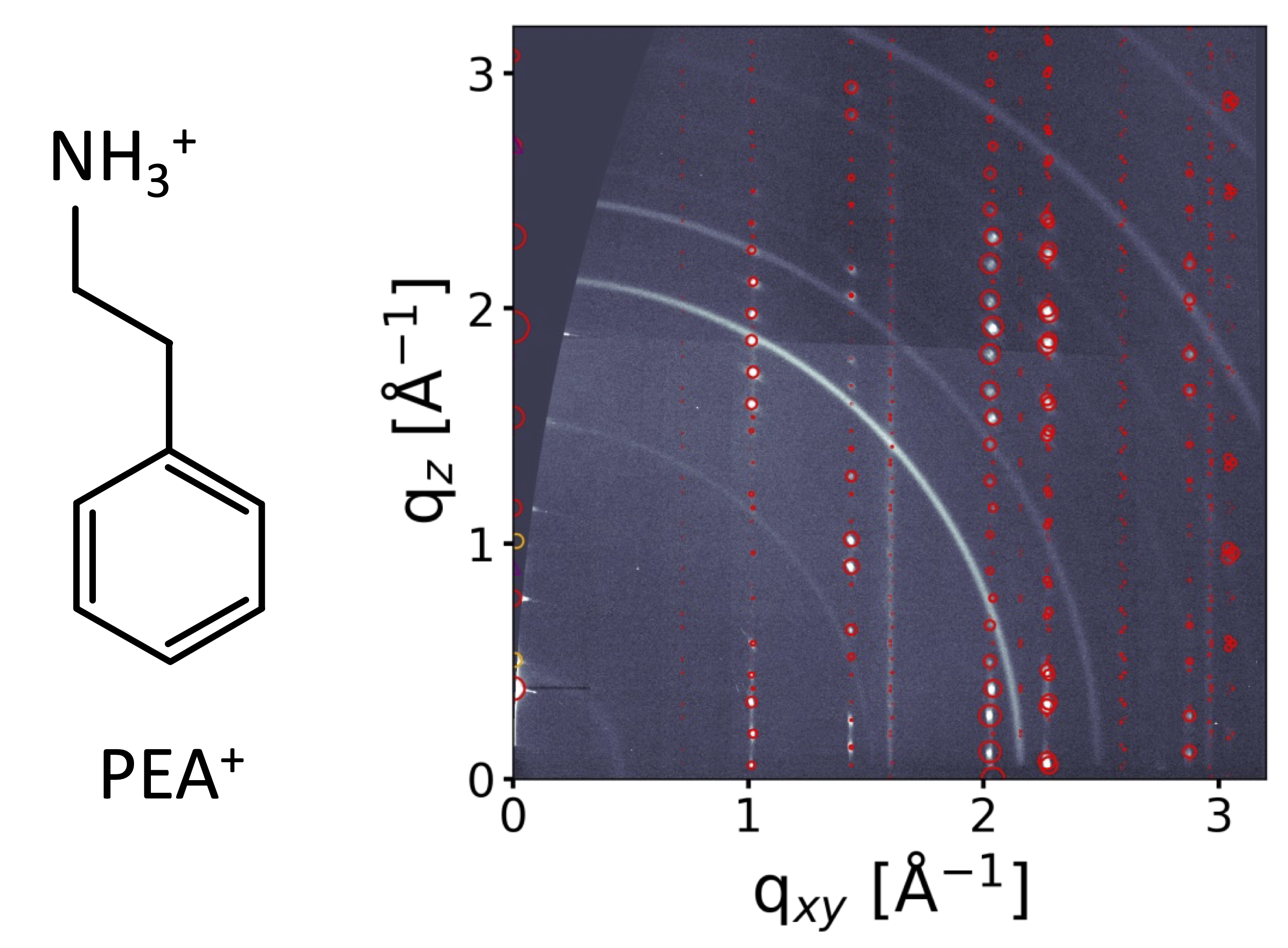
Hybrid lead halide perovskites are considered a highly promising material for future advancements of photovoltaic technologies due to their outstanding optoelectronic properties. Nevertheless, their instability under ambient conditions hinders the large-scale adoption of perovskite solar cells. Two-dimensional (2D) perovskites have been proposed to address the issue of instability, but these structures display anisotropic optoelectronic properties related to their layered structure. Moreover, their crystallization pathways are not well understood. Here we present insight into the crystallization process of 2-phenyethylammonium (PEA+) Ruddlesden-Popper 2D perovskites with iodide (I−) and bromide (Br−) anions by performing in situ grazing incidence wide-angle X-ray scattering (GIWAXS) measurements of thin films with various compositions during their fabrication via spin-coating and thermal annealing. The GIWAXS data reveals the structure of coexisting 2D perovskite phases and their orientation with respect to the substrate for different precursor compositions. The bromide-based compositions exhibited crystallization already during spin-coating, while iodide-based compositions required thermal annealing to induce the crystallization process. For the latter ones, additional polymorphs were found, suggesting the intrinsic differences for compositions with different halides.
- Open Access
- Article
Unravelling the Formation of 2-Phenylethylammonium 2D Perovskites by In Situ GIWAXS
- Valentin Munteanu 1,
- Ekaterina Kneschaurek 1,
- Lena Merten 1,2,
- Algirdas Ducinskas 3,
- Jovana Milic 3,4,
- Florian Bertram 5,
- Alexander Hinderhofer 1,6,
- Alexander Gerlach 1,7,
- Ivan Zaluzhnyy 1,6,*,
- Frank Schreiber 1,6,*
Author Information
Received: 09 Feb 2026 | Revised: 16 Mar 2026 | Accepted: 23 Mar 2026 | Published: 08 Apr 2026
Abstract
Graphical Abstract
Keywords
References
- 1.
1. Green, M.A.; Ho-Baillie, A.; Snaith, H.J. The emergence of perovskite solar cells. Nat. Photon. 2014, 8, 506–514.
- 2.
2. Park, N.G. Perovskite solar cells: An emerging photovoltaic technology. Mater. Today 2015, 18, 65–72.
- 3.
3. Snaith, H.J. Present status and future prospects of perovskite photovoltaics. Nat. Mater. 2018, 17, 372–376.
- 4.
4. Biegel, C.M. Perovskite Stories from Around the World. ACS Energy Lett. 2019, 4, 879–887.
- 5.
5. Schmidt-Mende, L.; Dyakonov, V.; Olthof, S.; et al. Roadmap on organic-inorganic hybrid perovskite semiconductors and devices. APL Mater. 2021, 9, 109202.
- 6.
6. Maqsood, A.; Nasstrom, H.; Chen, C.; et al. Towards an interoperable perovskite description or how to keep track of 300 perovskite ions. Nat. Commun. 2025, 16, 8725.
- 7.
7. Kojima, A.; Teshima, K.; Shirai, Y.; et al. Organometal Halide Perovskites as Visible-Light Sensitizers for Photovoltaic Cells. J. Am. Chem. Soc. 2009, 131, 6050–6051.
- 8.
8. Stranks, S.D.; Eperon, G.E.; Grancini, G.; et al. Electron-Hole Diffusion Lengths Exceeding 1 Micrometer in an Organometal Trihalide Perovskite Absorber. Science 2013, 342, 341–344.
- 9.
9. Johnston, M.B.; Herz, L.M. Hybrid Perovskites for Photovoltaics: Charge-Carrier Recombination, Diffusion, and Radiative Efficiencies. Acc. Chem. Res. 2015, 49, 146–154.
- 10.
10. Snaith, H.J. Perovskites: The Emergence of a New Era for Low-Cost, High-Efficiency Solar Cells. J. Phys. Chem. Lett. 2013, 4, 3623–3630.
- 11.
11. Gielen, D.; Boshell, F.; Saygin, D.; et al. The role of renewable energy in the global energy transformation. Energy Strateg. Rev. 2019, 24, 38–50.
- 12.
12. Jiang, W.; Qu, G.; Huang, X.; et al. Toughened self-assembled monolayers for durable perovskite solar cells. Nature 2025, 646, 95.
- 13.
Tan, H.; Jain, A.; Voznyy, O.; et al. Efficient and stable solution-processed planar perovskite solar cells via contact passivation. Science 2017, 355, 722–726.
- 14.
Hu, Y.; Niu, T.; Liu, Y.; et al. Flexible Perovskite Solar Cells with High Power-Per-Weight: Progress, Application, and Perspectives. ACS Energy Lett. 2021, 6, 2917–2943.
- 15.
Brinkmann, K.O.; Becker, T.; Zimmermann, F.; et al. Perovskite–organic tandem solar cells with indium oxide interconnect. Nature 2022, 604, 280.
- 16.
Pearson, A.J.; Eperon, G.E.; Hopkinson, P.E.; et al. Oxygen Degradation in Mesoporous Al2O3/CH3NH3PbI3−xClx Perovskite Solar Cells: Kinetics and Mechanisms. Adv. Energy Mater. 2016, 6, 1600014.
- 17.
Niu, G.; Guo, X.; Wang, L. Review of recent progress in chemical stability of perovskite solar cells. J. Mater. Chem. A 2015, 3, 8970–8980.
- 18.
Ortiz-Cervantes, C.; Carmona-Monroy, P.; Solis-Ibarra, D. Two-Dimensional Halide Perovskites in Solar Cells: 2D or not 2D? ChemSusChem 2019, 12, 1560–1575.
- 19.
Milic, J.V. Multifunctional layered hybrid perovskites. J. Mater. Chem. C 2021, 9, 11428–11443.
- 20.
Loizos, M.; Rogdakis, K.; Luo, W.; et al. Resistive switching memories with enhanced durability enabled by mixed-dimensional perfluoroarene perovskite heterostructures. Nanoscale Horiz. 2024, 9, 1146.
- 21.
Luo, W.; Kim, J.M.; Zimmermann, P.; et al. Perfluoroarene-Based 2D/3D Perovskite Solar Cells. ACS Appl. Energy Mater. 2025, 8, 8914.
- 22.
Liu, Y.; Akin, S.; Pan, L.; et al. Ultrahydrophobic 3D/2D fluoroarene bilayer-based water-resistant perovskite solar cells with efficiencies exceeding 22%. Sci. Adv. 2019, 5, eaaw2543.
- 23.
Milic, J.V.; Zakeeruddin, S.M.; Gr¨atzel, M. Layered Hybrid Formamidinium Lead Iodide Perovskites: Challenges and Opportunities. Acc. Chem. Res. 2021, 54, 2729–2740.
- 24.
AlSabeh, G.; Slama, V.; Almalki, M.; et al. On the Accessibility of Higher-n Phases in Formamidinium-Based Ruddlesden-Popper and Dion–Jacobson Layered Hybrid Perovskites. Adv. Electron. Mater. 2025, 11, e00164.
- 25.
25. Wali, Q.; Iftikhar, F.J.; Khan, M.E.; et al. Advances in stability of perovskite solar cells. Org. Electron. 2020, 78, 105590.
- 26.
Scardina, A.; Loeff, T.F.; Vikram, V.; et al. Spacer Cation Design: Promoting Vertical Orientation in Layered Perovskites. EES Sol. 2026. https://doi.org/10.1039/d6el00006a.
- 27.
Chen, A.Z.; Shiu, M.; Ma, J.H.; et al. Origin of vertical orientation in two-dimensional metal halide perovskites and its effect on photovoltaic performance. Nat. Commun. 2018, 9, 1336.
- 28.
Sun, K.; Guo, R.; Liu, S.; et al. Deciphering Structure and Charge Carrier Behavior in Reduced-Dimensional Perovskites. Adv. Funct. Mater. 2024, 34, 2411153.
- 29.
Moore, D.T.; Sai, H.; Tan, K.W.; et al. Crystallization Kinetics of Organic–Inorganic Trihalide Perovskites and the Role of the Lead Anion in Crystal Growth. J. Am. Chem. Soc. 2015, 137, 2350–2358.
- 30.
Buyan-Arivjikh, A.; Fricker, J.; Baier, T.; et al. CsPbBr3 Nanocrystals as Bottom Interface Nucleation Seeds for Printing Oriented FAPbI3 Thin Films: An In Situ Study. Small 2025, 21, e05895.
- 31.
Liang, D.; Dong, C.; Cai, L.; et al. Unveiling Crystal Orientation in Quasi-2D Perovskite Films by In Situ GIWAXS for High-Performance Photovoltaics. Small 2021, 17, 2100972.
- 32.
Li, C.; Chen, X.; Jin, T.; et al. Impact of functional groups in spacer cations on the properties of PEA-based 2D monolayer halide perovskites. Nano Mater. Sci. 2025, 7, 74–82.
- 33.
Nishimura, N.; Kanda, H.; Katoh, R.; et al. Thermally stable phenylethylammonium-based perovskite passivation: Spontaneous passivation with phenylethylammonium bis(trifluoromethylsulfonyl)imide during deposition of PTAA for enhancing photovoltaic performance of perovskite solar cells. J. Mater. Chem. A 2024, 12, 15631.
- 34.
Chen, R.; Gu, L.; Su, J.; et al. Stabilizing 2D perovskite passivation layer with mixed spacer cations for efficient and stable perovskite solar cells. Nano Energy 2025, 139, 110904.
- 35.
Kneschaurek, E.; Hinderhofer, A.; Hofferberth, B.; et al. Compact sample environment for in situ X-ray scattering during spin-coating. Rev. Sci. Instrum. 2023, 94, 063901.
- 36.
Hexemer, A.; M¨uller-Buschbaum, P. Advanced grazing-incidence techniques for modern soft-matter materials analysis. IUCrJ 2015, 2, 106–125.
- 37.
Greco, A.; Hinderhofer, A.; Dar, M.I.; et al. Kinetics of Ion-Exchange Reactions in Hybrid Organic–Inorganic Perovskite Thin Films Studied by In Situ Real-Time X-ray Scattering. J. Phys. Chem. Lett. 2018, 9, 6750–6754.
- 38.
Arora, N.; Greco, A.; Meloni, S.; et al. Kinetics and energetics of metal halide perovskite conversion reactions at the nanoscale. Commun. Mater. 2022, 3, 22.
- 39.
Held, V.; Mrkyvkova, N.; N´adaˇzdy, P.; et al. Evolution of Structure and Optoelectronic Properties During Halide Perovskite Vapor Deposition. J. Phys. Chem. Lett. 2022, 13, 11905–11912.
- 40.
Antrack, T.; Kroll, M.; Merten, L.; et al. Enhancing Luminescence Efficiency by Controlled Island Formation of CsPbBr3 Perovskite. Adv. Opt. Mater. 2022, 11, 2201408.
- 41.
Telschow, O.; Scheffczyk, N.; Hinderhofer, A.; et al. Elucidating Structure Formation in Highly Oriented Triple Cation Perovskite Films. Adv. Sci. 2023, 10, 2206325.

This work is licensed under a Creative Commons Attribution 4.0 International License.
