
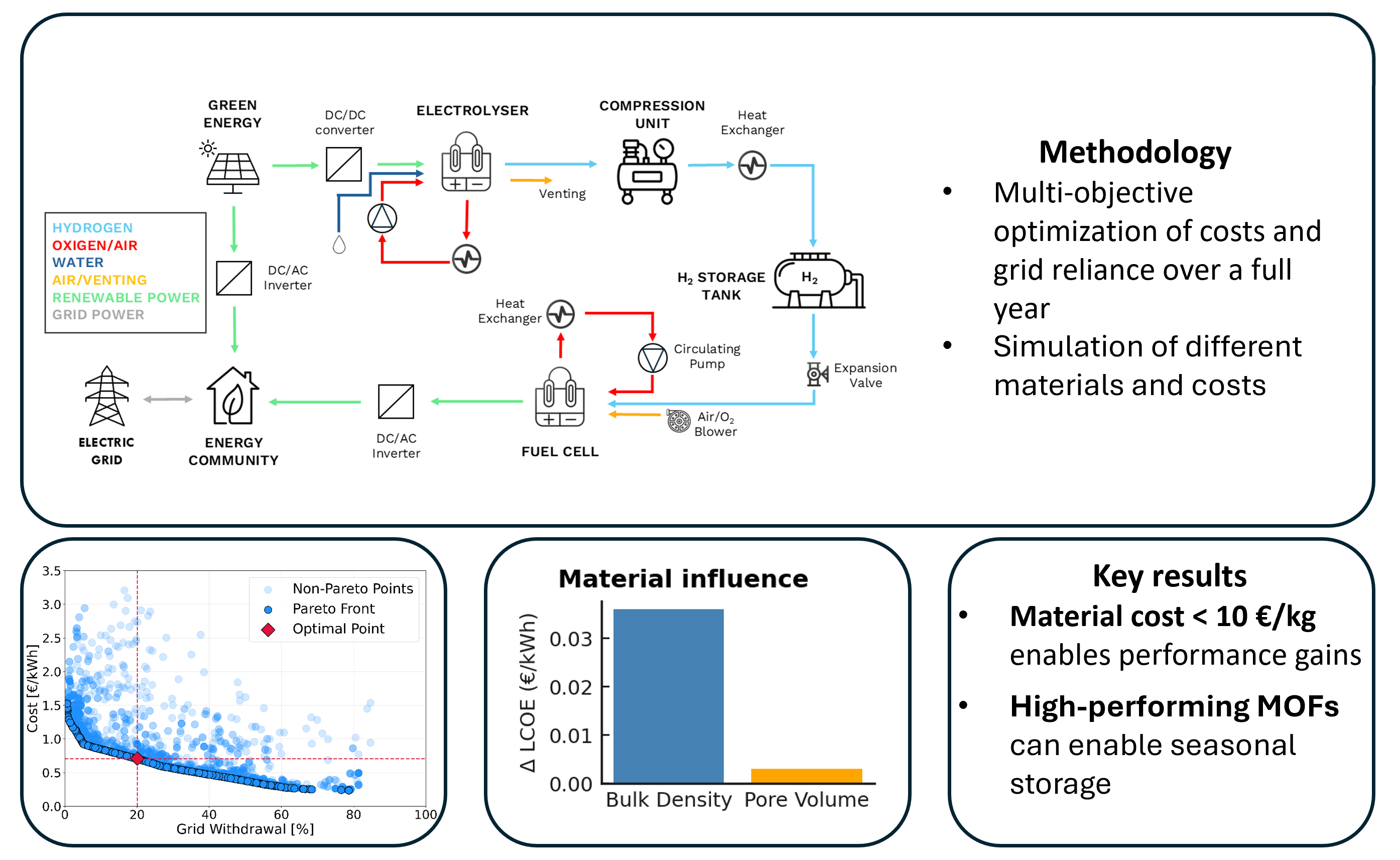
The increasing deployment of variable renewable energy sources calls for scalable and long-duration energy storage solutions. This study investigates the integration of hydrogen storage via physisorption in microporous materials into a Power-to-Power system operating under ambient conditions. A dynamic model is developed to simulate power flows and component interactions, and a multi-objective optimisation is used to minimise both the levelized cost of electricity (LCOE) and grid dependency, with a reference scenario fixed at 20% external electricity withdrawal. Results show that bulk density is the key adsorbent property affecting system performance, while pore volume has a negligible effect. At a material cost of 3.5 € kg−1, high-density metal-organic frameworks (e.g., IRMOF-1 at 500 kg m−3) enable seasonal storage operation at low pressure, achieving LCOE values as low as 0.707 € kW−1 h−1 and specific hydrogen storage costs of 7.1 € kW−1 h−1, below the target of 10 $ kW−1 h−1. Conversely, elevated material costs (35 € kg−1) lead to capacity constraints, operation at 350 bar, and increased compressor demand, raising the LCOE to over 0.73 € kW−1 h−1. Only selected combinations of material cost and density, such as IRMOF-1 at ≤10 € kg−1, meet cost targets, while MSC-30 remains uncompetitive due to lower hydrogen uptake. These findings underline the importance of reducing MOF synthesis costs and improving packing density. The system exhibits a dual operational role—short-term cycling or seasonal buffering—depending on storage capacity.
- Open Access
- Article
Multi-Objective Optimization of a Power-to-Power System with Hydrogen Storage in Solid Materials at Room Temperature
- Elisa Maurizi 1, *,
- Marcel Stolte 1, 2,
- Elena Rozzi 1, 2, *,
- Francesco D. Minuto 1, 2,
- Andrea Lanzini 1, 2
Author Information
Received: 06 Aug 2025 | Revised: 15 Jan 2026 | Accepted: 12 Apr 2026 | Published: 02 Jun 2026
Abstract
Graphical Abstract
Keywords
optimization | hydrogen storage | physisorption | microgrid | techno-economic assessment
References
- 1.
Net Zero by 2050—A Roadmap for the Global Energy Sector; IEA: Singapore, 2021.
- 2.
World Energy Outlook 2024—Analysis Available online: https://www.iea.org/reports/world-energy-outlook-2024 (accessed on 1 July 2025).
- 3.
Suraparaju, S.K.; Samykano, M.; Vennapusa, J.R.; et al. Challenges and Prospectives of Energy Storage Integration in Renewable Energy Systems for Net Zero Transition. J. Energy Storage 2025, 125, 116923. https://doi.org/10.1016/j.est.2025.116923.
- 4.
Worku, M.Y. Recent Advances in Energy Storage Systems for Renewable Source Grid Integration: A Comprehensive Review. Sustainability 2022, 14, 5985. https://doi.org/10.3390/su14105985.
- 5.
Volfkovich, Y.M. Electrochemical Supercapacitors (a Review). Russ. J. Electrochem. 2021, 57, 311–347. https://doi.org/10.1134/S1023193521040108.
- 6.
Ursua, A.; Gandia, L.M.; Sanchis, P. Hydrogen Production from Water Electrolysis: Current Status and Future Trends. Proc. IEEE 2012, 100, 410–426. https://doi.org/10.1109/JPROC.2011.2156750.
- 7.
Bhandari, R.; Adhikari, N. A Comprehensive Review on the Role of Hydrogen in Renewable Energy Systems. Int. J. Hydrogen Energy 2024, 82, 923–951. https://doi.org/10.1016/j.ijhydene.2024.08.004.
- 8.
Barthelemy, H.; Weber, M.; Barbier, F. Hydrogen Storage: Recent Improvements and Industrial Perspectives. Int. J. Hydrogen Energy 2017, 42, 7254–7262. https://doi.org/10.1016/j.ijhydene.2016.03.178.
- 9.
Muthukumar, P.; Kumar, A.; Afzal, M.; et al. Review on Large-Scale Hydrogen Storage Systems for Better Sustainability. Int. J. Hydrogen Energy 2023, 48, 33223–33259. https://doi.org/10.1016/j.ijhydene.2023.04.304.
- 10.
Zhang, L.; Allendorf, M.D.; Balderas-Xicohténcatl, R.; et al. Fundamentals of Hydrogen Storage in Nanoporous Materials. Prog. Energy 2022, 4, 042013. https://doi.org/10.1088/2516-1083/ac8d44.
- 11.
Hirscher, M.; Zhang, L.; Oh, H. Nanoporous Adsorbents for Hydrogen Storage. Appl. Phys. A 2023, 129, 112. https://doi.org/10.1007/s00339-023-06397-4.
- 12.
Klopčič, N.; Grimmer, I.; Winkler, F.; et al. A Review on Metal Hydride Materials for Hydrogen Storage. J. Energy Storage 2023, 72, 108456. https://doi.org/10.1016/j.est.2023.108456.
- 13.
Kilic, M.; Altun, A.F. Dynamic Modelling and Multi-Objective Optimization of off-Grid Hybrid Energy Systems by Using Battery or Hydrogen Storage for Different Climates. Int. J. Hydrogen Energy 2023, 48, 22834–22854. https://doi.org/10.1016/j.ijhydene.2022.12.103.
- 14.
Li, J.; Li, G.; Ma, S.; et al. Modeling and Simulation of Hydrogen Energy Storage System for Power-to-Gas and Gas-to-Power Systems. J. Mod. Power Syst. Clean. Energy 2023, 11, 885–895. https://doi.org/10.35833/MPCE.2021.000705.
- 15.
Li, J.; Zhang, H.; Li, C.; et al. Modeling of Large-Scale Hydrogen Storage System Considering Capacity Attenuation and Analysis of Its Efficiency Characteristics. Energy 2024, 121, 291–313. https://doi.org/10.32604/ee.2023.027593.
- 16.
Minuto, F.D.; Rozzi, E.; Borchiellini, R.; et al. Modeling Hydrogen Storage at Room Temperature: Adsorbent Materials for Boosting Pressure Reduction in Compressed H2 Tanks. J. Energy Storage 2024, 90, 111758. https://doi.org/10.1016/j.est.2024.111758.
- 17.
Rozzi, E.; Minuto, F.D.; Lanzini, A. Dynamic Modeling and Thermal Management of a Power-to-Power System with Hydrogen Storage in Microporous Adsorbent Materials. J. Energy Storage 2021, 41, 102953. https://doi.org/10.1016/j.est.2021.102953.
- 18.
DeSantis, D.; Mason, J.A.; James, B.D.; et al. Techno-Economic Analysis of Metal–Organic Frameworks for Hydrogen and Natural Gas Storage. Energy Fuels 2017, 31, 2024–2032. https://doi.org/10.1021/acs.energyfuels.6b02510.
- 19.
Peng, P.; Anastasopoulou, A.; Brooks, K.; et al. Cost and Potential of Metal–Organic Frameworks for Hydrogen Back-up Power Supply. Nat. Energy 2022, 7, 448–458. https://doi.org/10.1038/s41560-022-01013-w.
- 20.
DOE Technical Targets for Onboard Hydrogen Storage for Light-Duty Vehicles. Available online: https://www.energy.gov/eere/fuelcells/doe-technical-targets-onboard-hydrogen-storage-light-duty-vehicles (accessed on 8 July 2025).
- 21.
Huld, T.; Müller, R.; Gambardella, A. A New Solar Radiation Database for Estimating PV Performance in Europe and Africa. Sol. Energy 2012, 86, 1803–1815. https://doi.org/10.1016/j.solener.2012.03.006.
- 22.
PUN Index GME. Available online: https://gme.mercatoelettrico.org/it-it/Home/Esiti/Elettricita/MGP/Esiti/PUN (accessed on 9 July 2025).
- 23.
Electricity Price Statistics. Available online: https://ec.europa.eu/eurostat/statistics-explained/index.php?title=Electricity_price_statistics (accessed on 9 July 2025).
- 24.
Ulleberg, O. Stand-Alone Power Systems for the Future: Optimal Design, Operation and Control of Solar-Hydrogen Energy Systems. Ph.D. Thesis, Norges Teknisk-Naturvitenskapelige Universitet, Trondheim, Norway, 1998.
- 25.
Harrison, K. MW-Scale PEM-Based Electrolyzers for RES Applications: Cooperative Research and Development Final Report, CRADA Number CRD-18-00742; National Renewable Energy Lab (NREL): Golden, CO, USA, 2021.
- 26.
Rozzi, E.; Grimaldi, A.; Minuto, F.D.; et al. Model Complexity and Optimization Trade-Offs in the Design and Scheduling of Hybrid Hydrogen-Battery Systems. Energy Convers. Manag. 2025, 344, 120306. https://doi.org/10.1016/j.enconman.2025.120306.
- 27.
Sdanghi, G.; Schaefer, S.; Maranzana, G.; et al. Application of the Modified Dubinin-Astakhov Equation for a Better Understanding of High-Pressure Hydrogen Adsorption on Activated Carbons. Int. J. Hydrogen Energy 2020, 45, 25912–25926. https://doi.org/10.1016/j.ijhydene.2019.09.240.
- 28.
Li, B.; Wen, H.-M.; Zhou, W.; et al. Porous Metal-Organic Frameworks: Promising Materials for Methane Storage. Chem. 2016, 1, 557–580. https://doi.org/10.1016/j.chempr.2016.09.009.
- 29.
Abdelkareem, M.A.; Abbas, Qaisar.; Mouselly, M.; et al. High-Performance Effective Metal–Organic Frameworks for Electrochemical Applications. J. Sci. Adv. Mater. Devices 2022, 7, 100465. https://doi.org/10.1016/j.jsamd.2022.100465.
- 30.
da Silva, G.G.; Silva, C.S.; Ribeiro, R.T.; et al. Sonoelectrochemical Synthesis of Metal-Organic Frameworks. Synth. Met. 2016, 220, 369–373. https://doi.org/10.1016/j.synthmet.2016.07.003.
- 31.
Wang, J.; Wang, Y.; Hu, H.; et al. From Metal–Organic Frameworks to Porous Carbon Materials: Recent Progress and Prospects from Energy and Environmental Perspectives. Nanoscale 2020, 12, 4238–4268. https://doi.org/10.1039/C9NR09697C.
- 32.
Purewal, J.J.; Liu, D.; Yang, J.; et al. Increased Volumetric Hydrogen Uptake of MOF-5 by Powder Densification. Int. J. Hydrogen Energy 2012, 37, 2723–2727. https://doi.org/10.1016/j.ijhydene.2011.03.002.
- 33.
Rozzi, E.; Minuto, F.D.; Lanzini, A. Techno-Economic Dataset for Hydrogen Storage-Based Microgrids. Data Brief. 2024, 56, 110795. https://doi.org/10.1016/j.dib.2024.110795.
- 34.
Energia: MASE, Pubblicato Decreto CER. Available online: https://www.mase.gov.it/portale/-/energia-mase-pubblicato-decreto-cer (accessed on 11 July 2025).
- 35.
Stolte, M.; Minuto, F.D.; Perol, A.; et al. Optimisation of Green Hydrogen Production for Hard-to-Abate Industries: An Italian Case Study Considering National Incentives. Int. J. Hydrogen Energy 2025, 141, 1294–1304. https://doi.org/10.1016/j.ijhydene.2025.03.008.
- 36.
Stolte, M.; Minuto, F.D.; Lanzini, A. Optimizing Green Hydrogen Production from Wind and Solar for Hard-to-Abate Industrial Sectors across Multiple Sites in Europe. Int. J. Hydrogen Energy 2024, 79, 1201–1214. https://doi.org/10.1016/j.ijhydene.2024.07.106.
- 37.
Pymoo—NSGA-III. Available online: https://pymoo.org/algorithms/moo/nsga3.html (accessed on 10 September 2025).
- 38.
Giannuzzo, L.; Massano, M.; Schiera, D.S.; et al. Benchmarking Genetic Algorithms for Short-Term Battery Energy Storage Systems Optimization. In Proceedings of the 2025 IEEE 49th Annual Computers, Software, and Applications Conference (COMPSAC), Toronto, ON, Canada, 1 July 2025; pp. 2053–2059.
- 39.
Alander, J.T. On Optimal Population Size of Genetic Algorithms. In Proceedings of the CompEuro 1992 Proceedings Computer Systems and Software Engineering, The Hague, The Netherlands, 4–8 May 1992; pp. 65–70.
- 40.
EU 2023/1184. Available online: https://eur-lex.europa.eu/eli/reg_del/2023/1184/oj/eng (accessed on 23 July 2025).
- 41.
EU 2023/1185. Available online: https://eur-lex.europa.eu/eli/reg_del/2023/1185/oj/eng (accessed on 23 July 2025).
- 42.
Ramasamy, V.; Zuboy, J.; Woodhouse, M.; et al. Solar Photovoltaic System and Energy Storage Cost Benchmarks, with Minimum Sustainable Price Analysis: Q1 2023; National Renewable Energy Lab (NREL): Golden, CO, USA, 2023.
- 43.
Farrell, J. Questioning Solar Energy Economies of Scale, 2015 Edition. Available online: https://www.renewableenergyworld.com/solar/questioning-solar-energy-economies-of-scale-2015-edition/ (accessed on 23 July 2025).
- 44.
Marocco, P.; Ferrero, D.; Lanzini, A.; et al. Optimal Design of Stand-Alone Solutions Based on RES + Hydrogen Storage Feeding off-Grid Communities. Energy Convers. Manag. 2021, 238, 114147. https://doi.org/10.1016/j.enconman.2021.114147.
- 45.
Singla, M.K.; Gupta, J.; Beryozkina, S.; et al. The Colorful Economics of Hydrogen: Assessing the Costs and Viability of Different Hydrogen Production Methods—A Review. Int. J. Hydrogen Energy 2024, 61, 664–677. https://doi.org/10.1016/j.ijhydene.2024.02.255.

This work is licensed under a Creative Commons Attribution 4.0 International License.
