
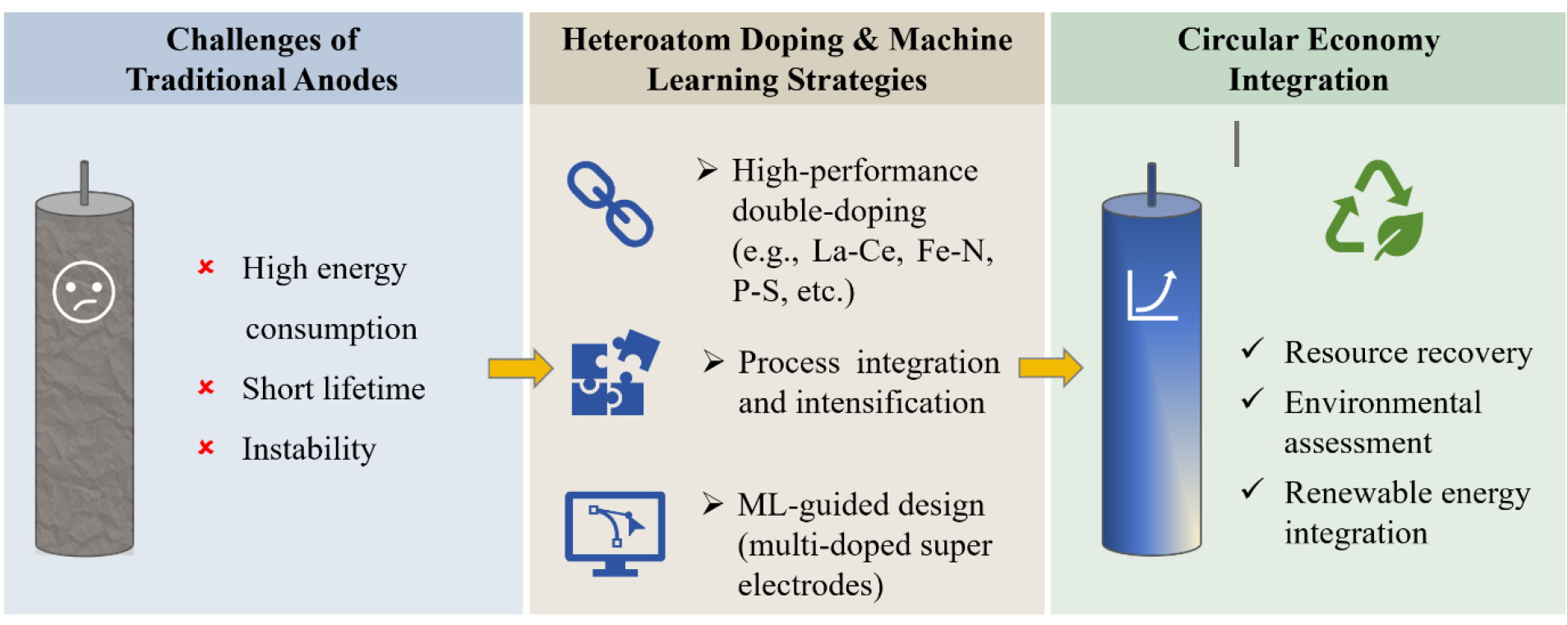
Electrocatalytic oxidation (EO) is considered an effective technology for removing recalcitrant organic compounds from industrial wastewater; however, its practical deployment remains limited by electrode deactivation, high energy consumption, and insufficient performance under complex wastewater conditions. This review discusses recent advances in overcoming the intrinsic trade-off between oxidation activity, electrode durability, energy efficiency, and practical applicability of EO systems. Strategies ranging from heteroatom-based electrode engineering and process intensification to sustainable integration and data-driven optimization are critically summarized. Particular emphasis is placed on how doping strategies regulate electrode structures and reaction pathways, how process integration improves treatment efficiency, and how artificial intelligence enables predictive design and adaptive operation. Future efforts should emphasize durability assessment, real wastewater validation, and intelligent EO development to promote the practical implementation of EO in sustainable wastewater treatment.
- Open Access
- Review
Electrocatalytic Oxidation: Enhancement Strategies for Catalyst Stability and Process Performance in Wastewater Treatment
Author Information
Received: 06 Jun 2026 | Revised: 20 Jul 2026 | Accepted: 30 Jul 2026 | Published: 17 Aug 2026
Abstract
Graphical Abstract
Keywords
electrocatalytic oxidation | heteroatom doping | electrode stability | machine-learning | circular economy | wastewater treatment
References
- 1.
Preethi; Shanmugavel, S.P.; Kumar, G.; et al. Recent progress in mineralization of emerging contaminants by advanced oxidation process: A review. Environ. Pollut. 2024, 341, 122842. https://doi.org/10.1016/j.envpol.2023.122842.
- 2.
Zheng, T.H.; Zhang, Z.Z.; Liu, Y.; et al. Recent progress in catalytically driven advanced oxidation processes for wastewater treatment. Catalysts 2025, 15, 761. https://doi.org/10.3390/catal15080761.
- 3.
Khan, Z.U.; Sabahat, S.; Shah, N.S.; et al. Electrochemical advanced oxidation processes as a feasible approach towards treatment of pesticides contaminated water and environmental sustainability: A review. J. Water Process Eng. 2025, 70, 107083. https://doi.org/10.1016/j.jwpe.2025.107083.
- 4.
Correa-Lozano, B.; Comninellis, C.; De Battisti, A. Service life of Ti/SnO2–Sb2O5 anodes. J. Appl. Electrochem. 1997, 27, 970–974. https://doi.org/10.1023/A:1018414005000.
- 5.
Montilla, F.; Morallon, E.; Vazquez, J.L. Evaluation of the electrocatalytic activity of antimony-doped tin dioxide anodes toward oxidation of phenol in aqueous solutions. J. Electrochem. Soc. 2005, 152, B421–B427. https://doi.org/10.1149/1.2013047.
- 6.
Rosli, N.A.; Shairuddin, S.F.M.; Mahmoudi, E.; et al. Advancements in SnO2-modified electrodes for electrochemical oxidation of persistent organic pollutants: Mechanisms, challenges, and opportunities. Chem. Eng. J. Adv. 2025, 24, 100876. https://doi.org/10.1016/j.ceja.2025.100876.
- 7.
Radjenovic, J.; Sedlak, D.L. Challenges and opportunities for electrochemical processes as next-generation technologies for the treatment of contaminated water. Environ. Sci. Technol. 2015, 49, 11292–11302. https://doi.org/10.1021/acs.est.5b02414.
- 8.
Rodríguez-Peña, M.; Natividad, R.; Barrera-Díaz, C.E.; et al. Current perspective of advanced electrochemical oxidation processes in wastewater treatment and life cycle analysis. Int. J. Electrochem. Sci. 2024, 19, 100589. https://doi.org/10.1016/j.ijoes.2024.100589.
- 9.
Yan, Y.; Lin, B.; Zhang, L.; et al. Electrochemical oxidation processes based on renewable energy towards carbon neutrality: Oxidation fundamentals, catalysts, challenges and prospects. Chem. Eng. J. 2024, 487, 150447. https://doi.org/10.1016/j.cej.2024.150447.
- 10.
Martinez-Huitle, C.A.; Rodrigo, M.A.; Sires, I.; et al. Single and coupled electrochemical processes and reactors for the abatement of organic water pollutants: A critical review. Chem. Rev. 2015, 115, 13362–13407. https://doi.org/10.1021/acs.chemrev.5b00361.
- 11.
Mousset, E.; Loh, W.H.; Lim, W.S.; et al. Cost comparison of advanced oxidation processes for wastewater treatment using accumulated oxygen-equivalent criteria. Water Res. 2021, 200, 117234. https://doi.org/10.1016/j.watres.2021.117234.
- 12.
Najafinejad, M.S.; Chianese, S.; Fenti, A.; et al. Application of Electrochemical Oxidation for Water and Wastewater Treatment: An Overview. Molecules 2023, 28, 4208. https://doi.org/10.3390/molecules28104208.
- 13.
Hubner, U.; Lutze, H.; Wieland, A.; et al. Advanced oxidation processes for water and wastewater treatment—Guidance for systematic future research. Heliyon 2024, 10, e30402. https://doi.org/10.1016/j.heliyon.2024.e30402.
- 14.
Wang, X.Y.; Li, X.Y.; Li, S.S.; et al. Degradation of antibiotics by electrochemical oxidation: Current issues, environmental risks, and future strategies. Chem. Eng. J. 2025, 516, 163941. https://doi.org/10.1016/j.cej.2025.163941.
- 15.
Liu, S.; Cai, W.T.; Zhang, T.X.; et al. Synergistic doping and microenvironment engineering enable efficient electrocatalytic oxidation of 5-hydroxymethylfurfural. J. Mater. Chem. A 2025, 13, 31435–31447. https://doi.org/10.1039/d5ta03989d.
- 16.
Pan, H.K.; Ye, Y.F.; Liu, Y.T.; et al. Interfacial electronic modulation in electrochemically reconstructed CoOOHCuO@CeO2 for efficient electrooxidation of 5-hydroxymethylfurfural. J. Mater. Chem. A 2026, 14, 9266–9276. https://doi.org/10.1039/d5ta09549b.
- 17.
Li, Q.; Zhang, Q.; Cui, H.; et al. Fabrication of cerium-doped lead dioxide anode with improved electrocatalytic activity and its application for removal of Rhodamine B. Chem. Eng. J. 2013, 228, 806–814. https://doi.org/10.1016/j.cej.2013.05.064.
- 18.
Chille, D.; Papanikolaou, G.; Squillaci, P.; et al. Metal-free (B,N,P)-doped ordered mesoporous carbons for enhanced electrocatalytic oxidation of phenol. Appl. Catal. O Open 2025, 207, 207067. https://doi.org/10.1016/j.apcato.2025.207067.
- 19.
Yan, L.; Lei, M.; Huang, J.H.; et al. Electrocatalytic degradation of dye wastewater by La-Ce co-doped with a PVDF-modified PbO2 electrode and the effect of chloride. ACS EST Water 2025, 5, 5865–5880. https://doi.org/10.1021/acsestwater.5c00491.
- 20.
Ye, P.; Fang, K.; Wang, H.; et al. Lattice oxygen activation and local electric field enhancement by co-doping Fe and F in CoO nanoneedle arrays for industrial electrocatalytic water oxidation. Nat. Commun. 2024, 15, 1012. https://doi.org/10.1038/s41467-024-45320-0.
- 21.
Li, D.; Xing, Y.; Zhou, C.; et al. Iron and nitrogen Co-doped CoSe₂ nanosheet arrays for robust electrocatalytic water oxidation. Inorg. Chem. Front. 2021, 8, 2725–2734. https://doi.org/10.1039/d1qi00113b.
- 22.
Wu, H.; Huang, S.R.; Li, F.Q.; et al. Structural advantages of medium-/high-entropy materials for electrocatalysis. Chem. Eng. J. 2024, 499, 156419. https://doi.org/10.1016/j.cej.2024.156419.
- 23.
Dong, X.T.; Chen, X.J.; Li, G.K.; et al. MOF-based and MOF-derived electrocatalysts for anodic reactions coupled with hydrogen evolution. J. Mater. Chem. A 2026, 14, 25059–25100. https://doi.org/10.1039/d6ta01533f.
- 24.
Xin, M.H.; Khan, U.; Nairan, A.; et al. Strategic evolution of bifunctional metal-organic frameworks for electrocatalysis. ChemCatChem 2026, 18, e01759. https://doi.org/10.1002/cctc.202501759.
- 25.
Chianeh, F.N.; Mahmoudian, F.; Khoramipoor, Z.; et al. Bridging electrochemistry and artificial intelligence: A review of modeling, simulation, and optimization of electrochemical oxidation processes for wastewater treatment. J. Environ. Chem. Eng. 2026, 14, 123094. https://doi.org/10.1016/j.jece.2026.123094.
- 26.
Song, H.X.; Sun, Z.P.; Hao, Y.L.; et al. Machine learning-assisted prediction and optimization of electrocatalytic activity. J. Mater. Sci. Technol. 2026, 245, 17–32. https://doi.org/10.1016/j.jmst.2025.04.050.
- 27.
Ding, R.; Liu, J.G.; Hua, K.; et al. Leveraging data mining, active learning, and domain adaptation for efficient discovery of advanced oxygen evolution electrocatalysts. Sci. Adv. 2025, 11, eadr9038. https://doi.org/10.1126/sciadv.adr9038.
- 28.
Ruan, M.B.; Sun, X.J.; Zhang, Y.W.; et al. Regeneration and enhanced catalytic activity of Pt/C electrocatalysts. ACS Catal. 2015, 5, 233–240. https://doi.org/10.1021/cs5013427.
- 29.
Xu, Q.; Liu, W.; Xie, L.; et al. Advances in catalytic materials for wastewater treatment: Design strategies and reaction mechanisms. Catalysts 2026, 16, 472. https://doi.org/10.3390/catal16050472.
- 30.
Guo, M.Y.; Feng, Y.; Li, X.; et al. Enhanced degradation of pharmaceuticals and personal care products (PPCPs) by three-dimensional electrocatalysis coupled biological aerated filter. J. Environ. Chem. Eng. 2021, 9, 106035. https://doi.org/10.1016/j.jece.2021.106035.
- 31.
Meiramkulova, K.; Devrishov, D.; Zhumagulov, M.; et al. Performance of an integrated membrane process with electrochemical pretreatment on poultry slaughterhouse wastewater purification. Membranes 2020, 10, 256. https://doi.org/10.3390/membranes10100256.
- 32.
Martinez-Huitle, C.A.; Brillas, E. Decontamination of wastewaters containing synthetic organic dyes by electrochemical methods. A general review. Appl. Catal. B Environ. 2009, 87, 105–145. https://doi.org/10.1016/j.apcatb.2008.09.017.
- 33.
Moradi, M.; Vasseghian, Y.; Khataee, A.; et al. Service life and stability of electrodes applied in electrochemical advanced oxidation processes: A comprehensive review. J. Ind. Eng. Chem. 2020, 87, 18–39. https://doi.org/10.1016/j.jiec.2020.03.038.
- 34.
Lin, N.; Wang, R.; Zhao, J.H.; et al. In situ carbon recovery from refractory organics in wastewater: A critical review. Green Chem. 2026, 28, 8649-8666. https://doi.org/10.1039/d6gc01352j.
- 35.
Fernández-Marchante, C.M.; Souza, F.L.; Millán, M.; et al. Improving sustainability of electrolytic wastewater treatment processes by green powering. Sci. Total Environ. 2021, 754, 142230. https://doi.org/10.1016/j.scitotenv.2020.142230.
- 36.
de Sousa, R.A.; Cavalcanti, L.N.; Gondim, A.; et al. Sustainable photovoltaic-powered series electrochemical reactors using nonactive electrocatalytic materials for electro-refinery in organics and energy production. ACS Omega 2025, 10, 31466–31479. https://doi.org/10.1021/acsomega.5c01329.
- 37.
Souza, F.L.; Lanza, M.R.V.; Llanos, J.; et al. A wind-powered BDD electrochemical oxidation process for the removal of herbicides. J. Environ. Manage. 2015, 158, 36–39. https://doi.org/10.1016/j.jenvman.2015.04.040.
- 38.
Millán, M.; Fernández-Marchante, C.M.; Lobato, J.; et al. Modelling of the treatment of wastewater by photovoltaic solar electrochemical oxidation (PSEO) assisted by redox-flow batteries. J. Water Process Eng. 2021, 40, 101974. https://doi.org/10.1016/j.jwpe.2021.101974.
- 39.
Brillas, E. Electrochemical advanced oxidation processes for real wastewater remediation: Systems, performance, and generated oxidants. ACS Electrochem. 2025, 1, 2292–2316. https://doi.org/10.1021/acselectrochem.5c00311.

This work is licensed under a Creative Commons Attribution 4.0 International License.

 Suite 4002 Level 4, 447 Collins Street, Melbourne, Victoria 3000, Australia
 General Inquiries: info@sciltp.com