
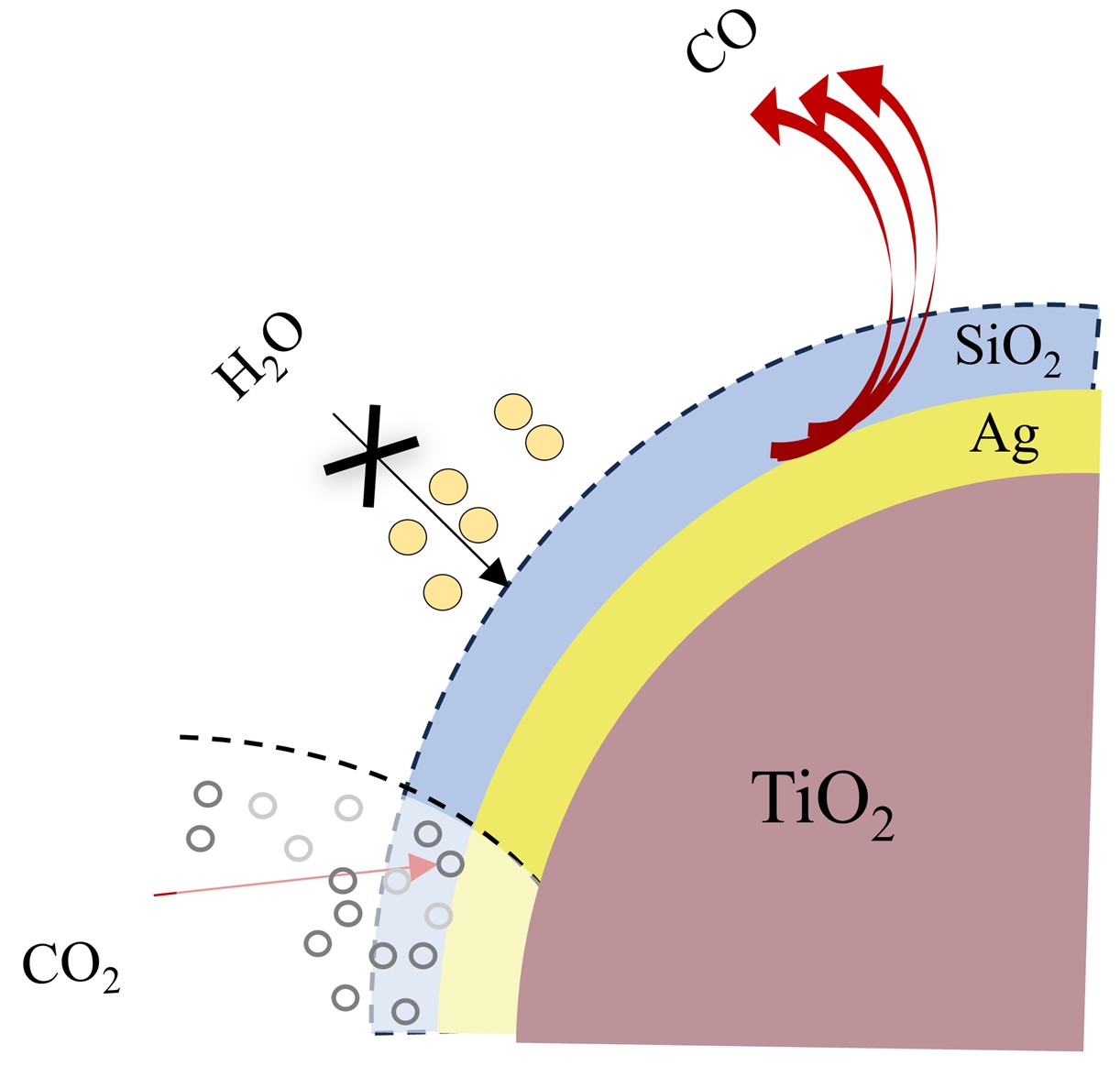
Photocatalytic carbon dioxide reduction reaction (CO2RR) represents a promising route for sustainable energy conversion. However, in conventional solid-liquid-gas reaction systems, inefficient CO2 diffusion to the catalyst surface often leads to dominant hydrogen evolution reaction (HER), limiting CO2 conversion efficiency and product selectivity. Herein, we propose a catalyst encapsulation strategy using porous silicon dioxide (SiO2) to spatially control molecular transport toward the active sites. By encapsulating Ag-modified titanium dioxide within a porous SiO2 layer, we effectively restrict water access to the catalytic interface while facilitating CO2 permeation. As a result, the parasitic HER is significantly suppressed, enabling an exceptional 100% selectivity for CO production from photocatalytic CO2 reduction in pure water, which is a dramatic improvement from the mere 5.9% CO selectivity of the unencapsulated Ag-TiO2 catalyst. This design achieves near-complete suppression of HER and 100% selectivity toward CO production under photocatalytic conditions. Our work provides a versatile interfacial engineering approach to overcome mass transfer limitations in three-phase photocatalytic systems, opening avenues for efficient gas-involving photoreactions.
- Open Access
- Article
Encapsulation in Porous SiO2 for Selective Suppression of Hydrogen Evolution in Photocatalytic CO2 Reduction
- Junhao Lu 1,
- Yanan Li 1,2,3,
- Yiduo Wang 1,
- Qingqing Guan 1,
- Zixin Ge 1,2,3,
- Yuan Ren 1,2,3,
- Yaohui Zhao 1,2,3,
- Qian Wang 1,
- Mingshang Jin 1,2,3,*
Author Information
Received: 03 Dec 2025 | Revised: 02 Feb 2026 | Accepted: 09 Feb 2026 | Published: 25 Feb 2026
Abstract
Graphical Abstract
Keywords
CO2RR | SiO2 shell | core-shell | HER suppression | interface engineering
References
- 1.
Gao, W.; Liang, S.; Wang, R.; Jiang, Q.; Zhang, Y.; Zheng, Q.; Xie, B.; Toe, C.Y.; Zhu, X.; Wang, J.; et al. Industrial carbon dioxide capture and utilization: state of the art and future challenges. Chem. Soc. Rev. 2020, 49, 8584–8686.
- 2.
Das, S.; Pérez-Ramírez, J.; Gong, J.L.; Dewangan, N.; Hidajat, K.; Gates, B.C.; Kawi, S. Core–shell structured catalysts for thermocatalytic, photocatalytic, and electrocatalytic conversion of CO2. Chem. Soc. Rev. 2020, 49, 2937–3004.
- 3.
Xie, Z.K.; Xu, S.J.; Li, L.H.; Gong, S.H.; Wu, X.J.; Xu, D.B.; Mao, B.D.; Zhou, T.; Chen, M.; Wang, X.; et al. Well-defined diatomic catalysis for photosynthesis of C2H4 from CO2. Nat. Commun. 2024, 15, 2422.
- 4.
Choi, C.; Kwon, S.; Cheng, T.; Xu, M.J.; Tieu, P.; Lee, C.; Cai, J.; Lee, H.M.; Pan, X.Q.; Duan, X.F.; et al. Highly active and stable stepped Cu surface for enhanced electrochemical CO2 reduction to C2H4. Nat. Catal. 2020, 3, 804–812.
- 5.
Li, X.; Sun, Y.; Xu, J.; Shao, Y.; Wu, J.; Xu, X.; Pan, Y.; Ju, H.; Zhu, J.; Xie, Y. Selective visible-light-driven photocatalytic CO2 reduction to CH4 mediated by atomically thin CuIn5S8 layers Nat. Energy 2019, 4, 690–699.
- 6.
Fang, S.; Rahaman, M.; Bharti, J.; Reisner, E.; Robert, M.; Ozin, G.A.; Hu, Y.H. Photocatalytic CO2 reduction. Nat. Rev. Methods Primers 2023, 3, 61.
- 7.
Kong, T.T.; Low, J.X.; Xiong, Y.J. Catalyst: How Material Chemistry Enables Solar-Driven CO2 Conversion. Chem 2020, 6, 1035–1038.
- 8.
Zhou, Q.X.; Guo, Y.; Zhu, Y.F. Reticular copper dual sites embedded with semiconductor particles for selective CO2-to-C2H4 photoreduction. Nat. Catal. 2025, 8, 728–739.
- 9.
Li, J.; Chen, G.; Zhu, Y.; Liang, Z.; Pei, A.; Wu, C.-L.; Wang, H.; Lee, H.R.; Liu, K.; Chu, S.; et al. Efficient electrocatalytic CO2 reduction on a three-phase interface. Nat. Catal. 2018, 1, 592–600.
- 10.
Jiang, Z.F.; Sun, H.L.; Wang, T.Q.; Wang, B.; Wei, W.; Li, H.M.; Yuan, S.Q.; An, T.C.; Zhao, H.J.; Yu, J.G.; et al. Nature-based catalyst for visible-light-driven photocatalytic CO2 reduction. Energy Environ. Sci. 2018, 11, 2382–2389.
- 11.
Zhang, Y.Z.; Xia, B.Q.; Ran, J.R.; Davey, K.; Qiao, S.Z. Atomic-Level Reactive Sites for Semiconductor-Based Photocatalytic CO2 Reduction. Adv. Energy Mater. 2020, 10, 1903879.
- 12.
Wei, Y.; Mao, Z.J.; Jiang, T.W.; Li, H.; Ma, X.Y.; Zhan, C.; Cai, W.B. Uncovering Photoelectronic and Photothermal Effects in Plasmon-Mediated Electrocatalytic CO2 Reduction. Angew. Chem. Int. Ed. 2024, 63, e202317740.
- 13.
Mohata, S.; Das, R.; Koner, K.; Riyaz, M.; Das, K.; Chakraborty, S.; Ogaeri, Y.; Nishiyama, Y.; Peter, S.C.; Banerjee, R. Selective Metal-Free CO2 Photoreduction in Water Using Porous Nanostructures with Internal Molecular Free Volume J. Am. Chem. Soc. 2023, 145, 23802–23813.
- 14.
Wu, X.Y.; Li, Y.; Zhang, G.K.; Chen, H.; Li, J.; Wang, K.; Pan, Y.; Zhao, Y.; Sun, Y.F.; Xie, Y. Photocatalytic CO2 Conversion of M0.33WO3 Directly from the Air with High Selectivity: Insight into Full Spectrum-Induced Reaction Mechanism J. Am. Chem. Soc. 2019, 141, 5267–5274.
- 15.
Su, H.; Yin, H.; Orbell, W.; Li, Y.; Wang, G.; Wang, Y.; Mori, K.; Chen, Z.; Li, H.; Yamashita, H.; et al. Asymmetric Triple-Atom Sites Combined with Oxygen Vacancy for Selective Photocatalytic Conversion of CO2 to Propionic Acid Angew. Chem. Int. Ed. 2025, 64, e202425446.
- 16.
Ren, Y.; Si, Y.; Du, M.; You, C.; Zhang, C.; Zhu, Y.-H.; Sun, Z.; Huang, K.; Liu, M.; Duan, L.; et al. Photothermal Synergistic Effect Induces Bimetallic Cooperation to Modulate Product Selectivity of CO2 Reduction on Different CeO2 Crystal Facets. Angew. Chem. Int. Ed. 2024, 63, e202410474.
- 17.
Wang, J.; Zhang, H.; Nian, Y.; Chen, Y.; Cheng, H.; Yang, C.; Han, Y.; Tan, X.; Ye, J.; Yu, T. Disruption Symmetric Crystal Structure Favoring Photocatalytic CO2 Reduction: Reduced *COOH Formation Energy Barrier on Al Doped CuS/TiO2. Adv. Funct. Mater. 2024, 34, 2406549.
- 18.
Ma, Y.; Jiang, Q.; Li, X.; Yu, H.; Han, X.; Liu, Y.; Li, Q.; Lv, K.; Hu, J. Heterojunction constructed from ZIF-8-on-MIL-68(Ga) precursor for photocatalytic CO2 reduction. Chem. Commun. 2025, 61, 6831.
- 19.
Kim, C.; Cho, K.M.; Al-Saggaf, A.; Gereige, I.; Jung, H.T. Z-scheme Photocatalytic CO2 Conversion on Three-Dimensional BiVO4/Carbon-Coated Cu2O Nanowire Arrays under Visible Light. ACS Catal. 2018, 8, 4170–4177.
- 20.
Guo, F.; Li, R.-X.; Yang, S.; Zhang, X.-Y.; Yu, H.; Urban, J.J.; Sun, W.-Y. Designing heteroatom-codoped iron metal–organic framework for promotional photoreduction of carbon dioxide to ethylene. Angew. Chem. Int. Ed. 2023, 62, e202216232.
- 21.
Hu, S.; Qiao, P.; Yi, X.; Lei, Y.; Hu, H.; Ye, J.; Wang, D. Selective Photocatalytic Reduction of CO2 to CO Mediated by Silver Single Atoms Anchored on Tubular Carbon Nitride Angew. Chem. Int. Ed. 2023, 62, e202304585.
- 22.
Li, A.; Cao, Q.; Zhou, G.; Schmidt, B.V.K.J.; Zhu, W.; Yuan, X.; Huo, H.; Gong, J.; Antonietti, M. Three-Phase Photocatalysis for the Enhanced Selectivity and Activity of CO2 Reduction on a Hydrophobic Surface. Angew. Chem. Int. Ed. 2019, 58, 14549–14555.
- 23.
Wang, R.A.; Zhang, M.J.; Zhang, S.L.; Zheng, J.Z.; Zeng, Y.Q.; Yang, Y.; Ding, J.; Wu, X.; Zhong, Q. Simultaneous Photocatalytic CO2 Reduction and H2O Oxidation Under Non-Sacrificial Ambient Conditions.ACS Nano 2023, 17, 24363–24373.
- 24.
Wang, Y.; Huang, N.-Y.; Shen, J.-Q.; Liao, P.-Q.; Chen, X.-M.; Zhang, J.-P. Hydroxide Ligands Cooperate with Catalytic Centers in Metal–Organic Frameworks for Efficient Photocatalytic CO2 Reduction. J. Am. Chem. Soc. 2018, 140, 38–41.
- 25.
Robert, M.; Zhang, J.-H.; Ge, Z.-M.; Zhong, D.-C.; Zuo, J.-L.; Lu, T.-B. Self-Photosensitizing Cobalt Complexes for Photocatalytic CO2 Reduction Coupled with CH3OH Oxidation. Angew. Chem. Int. Ed. 2025, 64, e202506060.
- 26.
Yu, Y.Y.; He, Y.; Yan, P.; Wang, S.Y.; Dong, F. Boosted C-C coupling with Cu-Ag alloy sub-nanoclusters for CO2-to-C2H4 photosynthesis. Proc. Natl. Acad. Sci. USA 2023, 120, e2307320120.
- 27.
Deng, Y.; Qi, D.; Deng, C.; Zhang, X.; Zhao, D. Superparamagnetic High-Magnetization Microspheres with an Fe3O4@SiO2 Core and Perpendicularly Aligned Mesoporous SiO2 Shell for Removal of Microcystins. J. Am. Chem. Soc. 2008, 130, 28–29.
- 28.
Huang, H.N.; Shi, R.; Li, Z.H.; Zhao, J.Q.; Su, C.L.; Zhang, T.R. Triphase Photocatalytic CO2 Reduction over Silver-Decorated Titanium Oxide at a Gas–Water Boundary. Angew. Chem. Int. Ed. 2022, 61, e202200802.
- 29.
Yin, C.; Li, X.; Sun, S.; Wei, X.; Tong, Q.; Tan, W.; Wang, X.; Peng, B.; Wan, H.; Dong, L. High photocatalytic performance over ultrathin 2D TiO2 for CO2 reduction to alcohols. Chem. Commun. 2024, 60, 3531–3534.
- 30.
Xia, P.F.; Antonietti, M.; Zhu, B.C.; Heil, T.; Yu, J.G.; Cao, S.W. Designing Defective Crystalline Carbon Nitride to Enable Selective CO2 Photoreduction in the Gas Phase. Adv. Funct. Mater. 2019, 29,1900093.
- 31.
Jiang, M.; Gao, Y.L.; Wang, Z.Y.; Ding, Z.X. Photocatalytic CO2 reduction promoted by a CuCo2O4 cocatalyst with homogeneous and heterogeneous light harvesters. Appl. Catal. B 2016, 198, 180–188.
- 32.
Kattel, S.; Yu, W.T.; Yang, X.F.; Yan, B.H.; Huang, Y.Q.; Wan, W.M.; Liu, P.; Chen, J.G.G. CO2 Hydrogenation over Oxide-Supported PtCo Catalysts: The Role of the Oxide Support in Determining the Product Selectivity. Angew. Chem. Int. Ed. 2016, 55, 7968–7973.
- 33.
Zhao, Z.J.; Mu, R.T.; Wang, X.H.; Gong, J.L. Fast prediction of CO binding energy via the local structure effect on PtCu alloy surfaces. Langmuir 2017, 33, 8700–8706.
- 34.
Su, B.; Wang, S.; Xing, W.; Liu, K.; Hung, S.-F.; Chen, X.; Fang, Y.; Zhang, G.; Zhang, H.; Wang, X. Synergistic Ru Species on Poly(heptazine imide) Enabling Efficient Photocatalytic CO2 Reduction with H2O beyond 800 nm. Angew. Chem. Int. Ed. 2025, 64, e202505453.
- 35.
Kaushik, T.; Ghosh, S.; Dolkar, T.; Biswas, R.; Dutta, A. Noble Metal Plasmon–Molecular Catalyst Hybrids for Renewable Energy Relevant Small Molecule Activation. ACS Nanosci. Au 2024, 4, 273–289.


This work is licensed under a Creative Commons Attribution 4.0 International License.

 Suite 4002 Level 4, 447 Collins Street, Melbourne, Victoria 3000, Australia
 General Inquiries: info@sciltp.com