
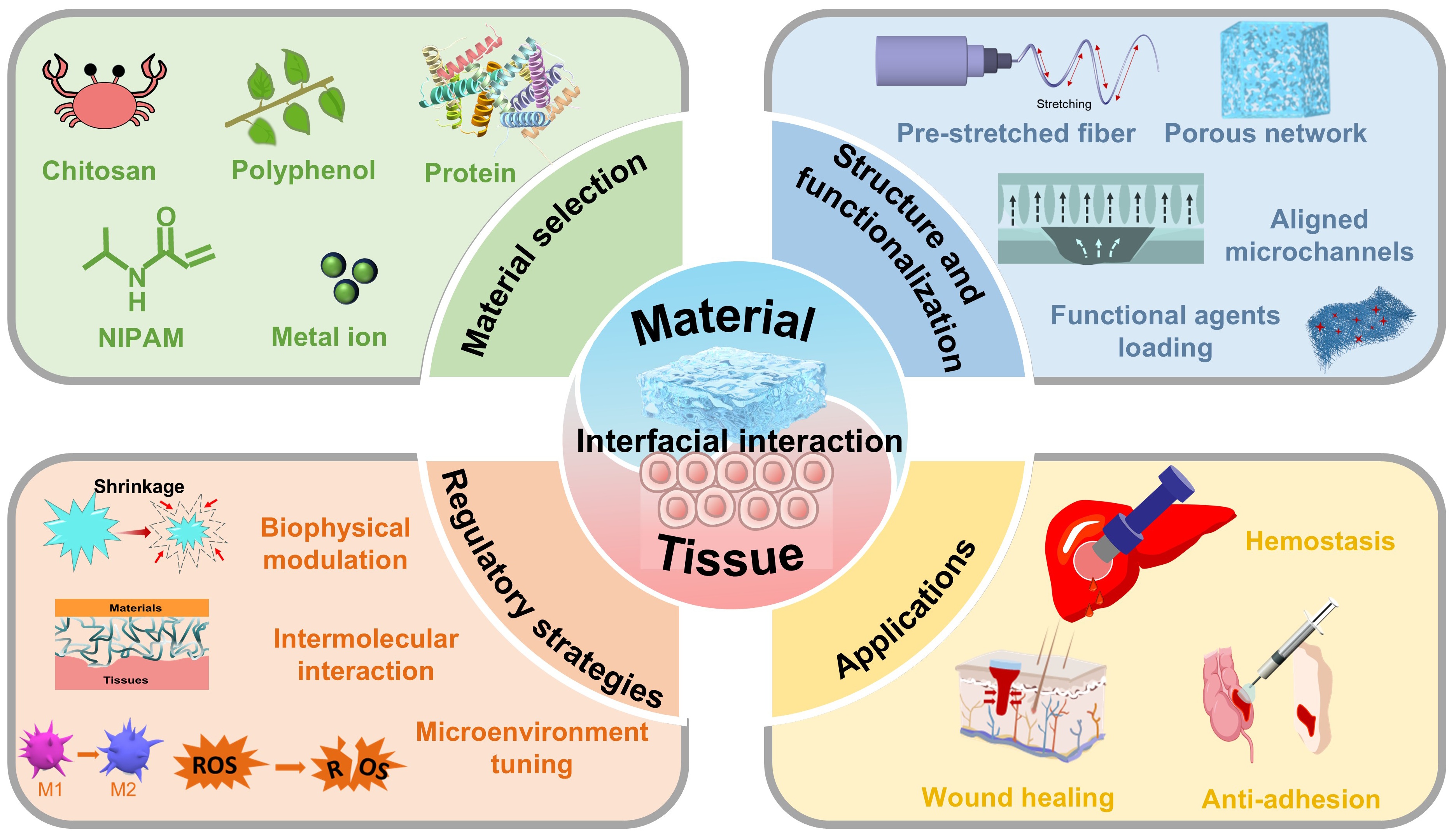
Interfacial materials provide an emerging platform for regulating biomaterial-tissue interactions to improve the therapeutic efficacy. Herein, this review systematically examines the lasted progress in interfacial engineered biomaterials, emphasizing the design principles and the benefits for soft tissue repair. This review begins with a discussion on material selection, structural design, and functionalization aimed to steer the biophysical, chemical, and biological interactions at the interfaces. Then, the basic regulatory strategies are highlighted, including mechanical modulation, intermolecular interaction regulation, and microenvironment tuning. Additionally, the applications of the functional interfacial materials in diverse soft tissues are discussed. Finally, this review offers the current challenges for interface design, and proposes future directions for improving therapeutic outcomes and translation.
- Open Access
- Review
Interfacial Engineering of Biofunctional Materials for Soft Tissue Repair
- Xueyan Li 1,
- Xinyu Wang 1,
- Meimeng Dai 1,
- Lisi Liu 1,
- Urszula Stachewicz 2,
- Jianyong Yu 1,
- Xiaoran Li 1,*,
- Bin Ding 1,*
Author Information
Received: 05 Feb 2026 | Revised: 23 Mar 2026 | Accepted: 30 Mar 2026 | Published: 31 Mar 2026
Abstract
Graphical Abstract
Keywords
biofunctional materials | interfacial engineering | intermolecular interaction regulation | microenvironment tuning | soft tissue repair
References
- 1.
Horn, C.; Uzor, N.; Fierro, A.; Abeshouse, M.; Ray, K.; Lantis, J.C. Implantable Biologics for Soft Tissue Surgery Reinforcement. Surg. Technol. Int. 2023, 42, 31–44.
- 2.
Van Damme, L.; Blondeel, P.; Van Vlierberghe, S. Injectable Biomaterials as Minimal Invasive Strategy towards Soft Tissue Regeneration—An Overview. J. Phys. Mater. 2021, 4, 022001.
- 3.
Capella-Monsonís, H.; Crum, R.J.; Hussey, G.S.; Badylak, S.F. Advances, Challenges, and Future Directions in the Clinical Translation of ECM Biomaterials for Regenerative Medicine Applications. Adv. Drug Deliv. Rev. 2024, 211, 115347.
- 4.
Mazzoni, E.; Iaquinta, M.; Lanzillotti, C.; Mazziotta, C.; Maritati, M.; Montesi, M.; Sprio, S.; Tampieri, A.; Tognon, M.; Martini, F. Bioactive Materials for Soft Tissue Repair. Front. Bioeng. Biotechnol. 2021, 9, 613787.
- 5.
Wu, T.; Li, X.; Xue, J.; Xia, Y. Rational Fabrication of Functionally-Graded Surfaces for Biological and Biomedical Applications. Acc. Mater. Res. 2024, 5, 1507–1519.
- 6.
Wang, Y.; Wang, T.; Tang, R.; Wang, D.; Zhang, X.; Nagaumi, H.; Yang, B.; Ren, X.; Huang, J.; Zhang, Y.; et al. Multiscale Interface Engineering in Biohybrid Composites for Biomedical Applications. Mater. Today Bio 2025, 35, 102382.
- 7.
Ma, P.; Liu, Y.; Yang, C.; Yang, J.; Cao, Z.; Ren, B.; He, Z.; An, B.; Huang, C.; Liu, J.; et al. A Multifunctional Bilayer Hydrogel Patch with Photothermal-Driven Directional Contraction and Bioregulation for Enhanced Wound Healing. Mater. Today 2025, 90, 297–313.
- 8.
Karami, P.; Rana, V.; Zhang, Q.; Boniface, A.; Guo, Y.; Moser, C.; Pioletti, D.P. NIR Light-Mediated Photocuring of Adhesive Hydrogels for Noninvasive Tissue Repair via Upconversion Optogenesis. Biomacromolecules 2022, 23, 5007–5017.
- 9.
Lee, D.; Tran, H.; Sharma, N.; Andrabi, S.; Yan, Z.; Killeen, A.C.; Reinhardt, R.A.; Zhu, W.; Xie, J. 3D-Printed Microfluidic Platform for Creating Porous Nanofibrous Microspheres to Regulate Cell Response and Enhance Tissue Regeneration. Small 2025, 21, 2502033.
- 10.
Ji, Z.; Wei, T.; Zhu, J.; Hu, J.; Xiao, Z.; Bai, B.; Lv, X.; Miao, Y.; Chen, M.; Wang, C.; et al. Actively Contractible and Antibacterial Hydrogel for Accelerated Wound Healing. Nano Res. 2024, 17, 7394–7403.
- 11.
Zhang, Y.; Li, J.; Soleimani, M.; Giacomini, F.; Friedrich, H.; Truckenmüller, R.; Habibovic, P. Biodegradable Elastic Sponge from Nanofibrous Biphasic Calcium Phosphate Ceramic as an Advanced Material for Regenerative Medicine. Adv. Funct. Mater. 2021, 31, 2102911.
- 12.
Shi, Y.; Yu, W.; Liang, X.; Cheng, J.; Cao, Y.; Liu, M.; Fang, Y.; Yang, Z.; Liu, H.; Wei, H.; et al. Interpenetrating Network Expansion Sponge Based on Chitosan and Plasma for Ultrafast Hemostasis of Arterial Bleeding Wounds. Carbohydr. Polym. 2023, 307, 120590.
- 13.
Zhou, M.; Liao, J.; Li, G.; Yu, Z.; Xie, D.; Zhou, H.; Wang, F.; Ren, Y.; Xu, R.; Dai, Y.; et al. Expandable Carboxymethyl Chitosan/Cellulose Nanofiber Composite Sponge for Traumatic Hemostasis. Carbohydr. Polym. 2022, 294, 119805.
- 14.
Ni, P.; Huang, H.; Zhang, L.; Chen, Y.; Liang, Z.; Weng, Y.; Fang, Y.; Liu, H. Mussel Foot Protein Inspired Tape-Type Adhesive with Water-Responsive, High Conformal, Tough, and On-Demand Detachable Adhesion to Wet Tissue. Adv. Healthc. Mater. 2023, 12, 2203342.
- 15.
Ji, M.; Su, J.; Li, J.; Li, F.; Wang, Y.; Wang, X.; Zhang, C.; Peng, S.; Li, J.; Man, J. Asymmetric Wettability Janus Aerogel Dressing for Enhanced Unidirectional Exudate Drainage through a Structural Gradient. J. Mater. Sci. Technol. 2026, 242, 102–114.
- 16.
Gao, Y.; Guo, J.; Li, S.; Ye, L.; Lu, B.; Liu, J.; Luo, J.; Zhu, Y.; Chen, L.; Peng, T.; et al. A Bio-Adaptive Janus-Adhesive Dressing with Dynamic Lubrication Overlayer for Prevention of Postoperative Infection and Adhesion. Adv. Sci. 2025, 12, 2500138.
- 17.
Wang, X.; Huo, H.; Cao, L.; Zhong, Y.; Gong, J.; Lin, Z.; Xie, X.; Bao, Z.; Zhang, P. Curcumin-Release Antibacterial Dressings with Antioxidation and Anti-Inflammatory Function for Diabetic Wound Healing and Glucose Monitoring. J. Control. Release 2025, 378, 153–169.
- 18.
Zhou, Z.; Chen, Y.; Li, J.; Shen, J.; Zeng, H. Silk Nonwoven Fabric-Based Dressing with Antibacterial and ROS-Scavenging Properties for Modulating Wound Microenvironment and Promoting Diabetic Wound Healing. Adv. Healthc. Mater. 2025, 14, 2405151.
- 19.
Zhou, Z.; Wang, Y.; Liu, N.; Zhang, X.; Ning, X.; Miao, Y.; He, C.; Wu, T.; Leng, X. Multifunctional Nanofiber-Based Dressings in Coordination with Adipose-Derived Stem Cells for Accelerated Burn Wound Healing. Mater. Des. 2025, 253, 113929.
- 20.
Xue, J.; Wu, T.; Dai, Y.; Xia, Y. Electrospinning and Electrospun Nanofibers: Methods, Materials, and Applications. Chem. Rev. 2019, 119, 5298–5415.
- 21.
Chen, S.; Li, R.; Li, X.; Xie, J. Electrospinning: An Enabling Nanotechnology Platform for Drug Delivery and Regenerative Medicine. Adv. Drug Deliv. Rev. 2018, 132, 188–213.
- 22.
Tang, Y.; Gong, G.; He, X.; Dai, M.; Chen, M.; Wang, B.; Wang, Y.; Wang, X.; Guo, J. Multifunctional Dual Cross-Linked Bioadhesive Patch with Low Immunogenic Response and Wet Tissues Adhesion. Adv. Healthc. Mater. 2023, 12, 2201578.
- 23.
Liang, Y.; Xu, H.; Li, Z.; Zhangji, A.; Guo, B. Bioinspired Injectable Self-Healing Hydrogel Sealant with Fault-Tolerant and Repeated Thermo-Responsive Adhesion for Sutureless Post-Wound-Closure and Wound Healing. Nano-Micro Lett. 2022, 14, 185.
- 24.
Lei, X.; Liu, M.; Lu, C.; Han, L.; Jia, J.; Li, Z.; Xu, N.; Li, J.; Fu, X.; Jin, Y.; et al. A Self-Hygroscopic, Rapidly Self-Gelling Polysaccharide-Based Sponge with Robust Wet Adhesion for Non-Compressible Hemorrhage Control and Infected Wounds Healing. Bioact. Mater. 2025, 46, 311–330.
- 25.
Aussel, A.; Boiziau, C.; L’Azou, B.; Siadous, R.; Delmond, S.; Montembault, A.; David, L.; Bordenave, L.; Thébaud, N.B. Cell and Tissue Responses at the Interface with a Chitosan Hydrogel Intended for Vascular Applications: In Vitro and in Vivo Exploration. Biomed. Mater. 2019, 14, 025009.
- 26.
Mehmood, S.; Dawit, H.; Hussain, Z.; Ullah, S.; Ullah, I.; Liu, X.; Liu, Y.; Cao, Y.; Wang, Z.; Pei, R. Harnessing Bi-Layered Supramolecular Janus Tissue-Adhesive/Anti-Adhesive Fibrous Hydrogel for Efficient Hemostasis, Wound Healing, and Suppressing Postoperative Tissue Adhesion. Chem. Eng. J. 2024, 495, 153095.
- 27.
Hu, Q.; Xu, J.; Cheng, J.; Wen, J.; He, W.; Yang, X.; Zhai, G.; Liu, A.; Ye, L. Four-Dimensional Adhesive and Shrinkable Hydrogels with Hemostasis, Antibiosis and Immunoregulation for Enhanced Scarless Healing of Skin Wounds. Chem. Eng. J. 2025, 519, 164915.
- 28.
Zheng, Z.; Chen, X.; Wang, Y.; Wen, P.; Duan, Q.; Zhang, P.; Shan, L.; Ni, Z.; Feng, Y.; Xue, Y.; et al. Self-Growing Hydrogel Bioadhesives for Chronic Wound Management. Adv. Mater. 2024, 36, 2408538.
- 29.
Zhou, Z.; Li, J.; Hu, J.; Fu, H. Towards Promoting Wound Healing: A Near-Infrared Light-Triggered Persistently Antibacterial, Synergistically Hemostatic Nanoarchitecture-Integrated Chitosan Hydrogel. Carbohydr. Polym. 2024, 329, 121783.
- 30.
Wang, R.; Zheng, W.; Huang, Y.; Zhang, R.; Zhang, Y.; Yan, J.; Gu, Y.; Xi, J.; Yuan, T.; Su, H.; et al. A Single-Component Adhesive Sponge Based on Blood-Triggered and Autopenetrative Adhesion for Robust Vascular Closure. Adv. Sci. 2025, 12, e10377.
- 31.
Mao, Q.; Hoffmann, O.; Yu, K.; Lu, F.; Lan, G.; Dai, F.; Shang, S.; Xie, R. Self-Contracting Oxidized Starch/Gelatin Hydrogel for Noninvasive Wound Closure and Wound Healing. Mater. Des. 2020, 194, 108916.
- 32.
Du, J.; Rybak, D.; Su, Q.; Wang, Q.; Yuan, Q.; Gao, J.; Wang, Y.; Nakielski, P.; Wang, X.; Pierini, F.; et al. Sprayable Photothermal Fiber-Embedded Hydrogels to Engineer Microenvironment for Infected Wound Healing. Adv. Funct. Mater. 2025, 35, 2501242.
- 33.
Wang, M.; Du, J.; Li, M.; Pierini, F.; Li, X.; Yu, J.; Ding, B. In Situ Forming Double-Crosslinked Hydrogels with Highly Dispersed Short Fibers for the Treatment of Irregular Wounds. Biomater. Sci. 2023, 11, 2383–2394.
- 34.
Umemori, K.; Little, D. Impact of Polymer Degradation on Cellular Behavior in Tissue Engineering. Bioprinting 2025, 50, e00429.
- 35.
Mohseni, M.; Cometta, S.; Klein, L.; Wille, M.L.; Vaquette, C.; Hutmacher, D.W. In Vitro and in Vivo Degradation Studies of a Dual Medical-Grade Scaffold Design for Guided Soft Tissue Regeneration. Biomater. Sci. 2025, 13, 2115–2133.
- 36.
Tian, M.; Wan, J.; Wang, X.; Liu, J.; Pan, M.; Tan, H.; Pan, Z. Anisotropic Nanocomposite Hydrogel Dressings with Thermo-Responsive Contraction for Actively Stimulated Tissue Regeneration. Chem. Eng. J. 2025, 514, 163202.
- 37.
Chen, M.; Wu, Y.; Chen, B.; Tucker, A.M.; Jagota, A.; Yang, S. Fast, Strong, and Reversible Adhesives with Dynamic Covalent Bonds for Potential Use in Wound Dressing. Proc. Natl. Acad. Sci. USA 2022, 119, e2203074119.
- 38.
Liu, W.; Zhao, W.; Xie, K.; Li, X.F.; Wang, Y.; Kong, D.; Liu, Y.; Leng, J. Toughening and Responsive Contractile Shape Memory Fibrous Membrane via Water for Mechanically Active Wound Dressing. Adv. Fiber Mater. 2024, 6, 1942–1954.
- 39.
Xu, W.; Xu, T.; Yu, L.; Ning, X.; Zhang, C.; Yi, B.; Dai, W.; Zhu, Z.; Zhao, H. Nanofibrous Dressings Incorporating a Synergistic Antibacterial-Anti-Inflammatory Effect for Infected Wound Healing. Mater. Today Bio 2025, 34, 102155.
- 40.
Kai, K.; Taiki, H.; Yukikazu, T. Development of a Temperature-Responsive Polymer Network with Enhanced Transparency and Volume Shrinkage via Star-Shaped PEG-b-PNIPA Block Copolymer. Mater. Interfaces 2025, 2, 285–301.
- 41.
Zhong, Q.; Zhang, R.; Chen, Y.; Tan, S.; Huang, L.; Zhang, J.; Luo, Z. A Mechanical Contraction-Driven Hydrogel Dressing for pH Visualization and Tailored Acute/Chronic Wound Healing. Adv. Funct. Mater. 2025, 36, e12807.
- 42.
Pi, Y.; Ganabady, K.; Celiz, A.D. Enzyme-Responsive Biomaterials for Biomedical Applications. Commun. Mater. 2025, 6, 263.
- 43.
Li, H.; Li, X.; Jain, P.; Peng, H.; Rahimi, K.; Singh, S.; Pich, A. Dual-Degradable Biohybrid Microgels by Direct Cross-Linking of Chitosan and Dextran Using Azide-Alkyne Cycloaddition. Biomacromolecules 2020, 21, 4933–4944.
- 44.
Dong, Y.; Zhang, X.; Chen, Y.; Yu, J.; Li, X.; Ding, B. “Stiff-Elastic” Binary Synergistic Fibrous Tape with Thermal-Triggered Shrinkable and Shape Recoverable Performances for Wound Closure. Adv. Funct. Mater. 2024, 34, 2402252.
- 45.
Huang, Y.; Song, M.; Li, X.; Du, Y.; Gao, Z.; Zhao, Y.-Q.; Li, C.; Yan, H.; Mo, X.; Wang, C.; et al. Temperature-Responsive Self-Contraction Nanofiber/Hydrogel Composite Dressing Facilitates the Healing of Diabetic-Infected Wounds. Mater. Today Bio 2024, 28, 101214.
- 46.
Theocharidis, G.; Yuk, H.; Roh, H.; Wang, L.; Mezghani, I.; Wu, J.; Kafanas, A.; Contreras, M.; Sumpio, B.; Li, Z.; et al. A Strain-Programmed Patch for the Healing of Diabetic Wounds. Nat. Biomed. Eng. 2022, 6, 1118–1133.
- 47.
Lu, X.; Liu, Z.; Jia, Q.; Wang, Q.; Zhang, Q.; Li, X.; Yu, J.; Ding, B. Flexible Bioactive Glass Nanofiber-Based Self-Expanding Cryogels with Superelasticity and Bioadhesion Enabling Hemostasis and Wound Healing. ACS Nano 2023, 17, 11507–11520.
- 48.
Zhao, X.; Huang, Y.; Li, Z.; Chen, J.; Luo, J.; Bai, L.; Huang, H.; Cao, E.; Yin, Z.; Han, Y.; et al. Injectable Self-Expanding/Self-Propelling Hydrogel Adhesive with Procoagulant Activity and Rapid Gelation for Lethal Massive Hemorrhage Management. Adv. Mater. 2024, 36, 2308701.
- 49.
Xu, Z.; Fan, J.; Tian, W.; Ji, X.; Cui, Y.; Nan, Q.; Sun, F.; Zhang, J. Cellulose-Based pH-Responsive Janus Dressing with Unidirectional Moisture Drainage for Exudate Management and Diabetic Wounds Healing. Adv. Funct. Mater. 2024, 34, 2307449.
- 50.
Xiao, W.; Wan, X.; Shi, L.; Ye, M.; Zhang, Y.; Wang, S. A Viscous-Biofluid Self-Pumping Organohydrogel Dressing to Accelerate Diabetic Wound Healing. Adv. Mater. 2024, 36, 2401539.
- 51.
Li, W.; Kong, M.; Yang, T.; Li, J.; Sun, H.; Li, Z.; Wang, Q.; Teng, W. “One Stone Four Birds” Strategy of Advanced Hydrogel System Based on Eight-Arm Nanocages to Promote Chronic Wound Healing in Diabetes. Chem. Eng. J. 2023, 475, 146174.
- 52.
Chen, Y.; Wang, Q.; Ning, F.; Du, C.; Chen, M.; Feng, C.; Dong, C.M. Dynamic Hyaluronic Acid Hydrogels for Comprehensively Regulating Inflammation, Angiogenesis, and Metabolism to Effectively Proheal Diabetic Wounds. ACS Appl. Mater. Interfaces 2024, 16, 70256–70273.
- 53.
Lu, B.; Han, X.; Zou, D.; Luo, X.; Liu, L.; Wang, J.; Maitz, M.F.; Yang, P.; Huang, N.; Zhao, A. Catechol-Chitosan/Polyacrylamide Hydrogel Wound Dressing for Regulating Local Inflammation. Mater. Today Bio 2022, 16, 100392.
- 54.
Sha, Z.; Li, J.; Song, Y.; Li, H.; Liu, H.; Fan, J.; Li, X.; Fei, X.; Zhu, M. Self-Pumping, pH-Responsive Janus Fibrous Dressing for Enhanced Immunomodulation and Accelerated Diabetic Wound Healing. Nano Today 2025, 65, 102847.
- 55.
Qi, X.; Cai, E.; Xiang, Y.; Zhang, C.; Ge, X.; Wang, J.; Lan, Y.; Xu, H.; Hu, R.; Shen, J. An Immunomodulatory Hydrogel by Hyperthermia-Assisted Self-Cascade Glucose Depletion and ROS Scavenging for Diabetic Foot Ulcer Wound Therapeutics. Adv. Mater. 2023, 35, 2306632.
- 56.
Fang, Y.; Xiu, L.; Xiao, D.; Zhang, D.; Wang, M.; Dong, Y.; Ye, J. Sandwich-Structured Nanofiber Dressings Containing MgB2 and Metformin Hydrochloride with ROS Scavenging and Antibacterial Properties for Wound Healing in Diabetic Infections. Adv. Healthc. Mater. 2024, 13, 2402452.
- 57.
Cai, J.; Liu, S.; Zhong, Q.; Shang, Y.; Chen, Z.; Yao, Y.; Zhou, B.; Yin, F.; Zhao, J.; Zheng, L. Multifunctional PDA/ZIF8 Based Hydrogel Dressing Modulates the Microenvironment to Accelerate Chronic Wound Healing by ROS Scavenging and Macrophage Polarization. Chem. Eng. J. 2024, 487, 150632.
- 58.
Li, Y.; Sun, Z.; Chai, S.; Zhang, Z.; Li, Y.; Zhu, C.; Fan, D. Tissue-Like Soft Dual-Network Hydrogel Patch with Instant/Tunable Adhesion and Microenvironment Modulation for Infected Wound Healing. ACS Nano 2025, 19, 27714–27730.
- 59.
Zhao, Y.; Zhao, S.; Du, Y.; Gao, Z.; Li, Y.; Ma, H.; Li, H.; Ren, X.; Fan, Q.; Wu, D.; et al. Inverse Oxide/Alloy-Structured Nanozymes with NIR-Triggered Enzymatic Cascade Regulation of ROS Homeostasis for Efficient Wound Healing. Adv. Mater. 2025, 37, 2418731.
- 60.
Lian, C.; Liu, J.; Wei, W.; Wu, X.; Goto, T.; Li, H.; Tu, R.; Dai, H. Mg-Gallate Metal-Organic Framework-Based Sprayable Hydrogel for Continuously Regulating Oxidative Stress Microenvironment and Promoting Neurovascular Network Reconstruction in Diabetic Wounds. Bioact. Mater. 2024, 38, 181–194.
- 61.
Kang, X.; Wang, Y.; Zhao, X.; Chen, C.; Li, F.; Weng, J.; Li, J.; Chen, X. Dual-Functional Photonic Crystal Hydrogel: Drug Release Monitoring and Immunomodulation for Chronic Infected Wounds. Adv. Healthc. Mater. 2026, e71039. https://doi.org/10.1002/adhm.71039.
- 62.
Li, Z.; He, M.; Wang, Y.; Yang, J.; He, Y.; Chen, X.; Zhang, W.; Wu, H.; Chai, R.; Wang, B. Advances in Biocompatible Metal-Organic Frameworks for Biomedical Applications. Adv. Mater. 2025, 37, 2503946.
- 63.
Park, J.; Kim, T.Y.; Kim, Y.; An, S.; Kim, K.S.; Kang, M.; Kim, S.A.; Kim, J.; Lee, J.; Cho, S.W.; et al. A Mechanically Resilient and Tissue-Conformable Hydrogel with Hemostatic and Antibacterial Capabilities for Wound Care. Adv. Sci. 2023, 10, 2303651.
- 64.
An, H.; Zhang, M.; Zhou, L.; Huang, Z.; Duan, Y.; Wang, C.; Gu, Z.; Zhang, P.; Wen, Y. Anti-Dehydration and Rapid Trigger-Detachable Multifunctional Hydrogels Promote Scarless Therapeutics of Deep Burn. Adv. Funct. Mater. 2023, 33, 2211182.
- 65.
Liu, M.; Ding, R.; Li, Z.; Xu, N.; Gong, Y.; Huang, Y.; Jia, J.; Du, H.; Yu, Y.; Luo, G. Hyaluronidase-Responsive Bactericidal Cryogel for Promoting Healing of Infected Wounds: Inflammatory Attenuation, ROS Scavenging, and Immune Regulation. Adv. Sci. 2024, 11, 2306602.
- 66.
Li, S.; Li, R.; Zhang, X.; Zhu, Y.; Wang, D.; Cui, W.; Chai, H.; Hou, Y.; Li, S. Core-Shell Structure-Based Smart Hydrogel Wound Dressing with Endogenous and Exogenous Dual Adhesion Dynamic Response to Promote Wound Healing. Adv. Funct. Mater. 2025, 35, 2500329.
- 67.
Zhu, C.; Fan, Z.; Cheng, Z.; Qin, L.; Zhao, X. Nature-Derived Microneedles with Metal-Polyphenolic Networks Encapsulation for Chronic Soft Tissue Defects Repair: Responding and Remodeling the Regenerative Microenvironment. Mater. Today Bio 2025, 31, 101539.
- 68.
Wang, Y.; Guan, P.; Tan, R.; Shi, Z.; Li, Q.; Lu, B.; Hu, E.; Ding, W.; Wang, W.; Cheng, B.; et al. Fiber-Reinforced Silk Microneedle Patches for Improved Tissue Adhesion in Treating Diabetic Wound Infections. Adv. Fiber Mater. 2024, 6, 1596–1615.
- 69.
Alberts, A.; Lungescu, I.A.; Niculescu, A.G.; Grumezescu, A.M. Natural Products for Improving Soft Tissue Healing: Mechanisms, Innovations, and Clinical Potential. Pharmaceutics 2025, 17, 758.
- 70.
Kasemo, B.; Lausmaa, J. Surface Properties and Processes of the Biomaterial-Tissue Interface. Mater. Sci. Eng. C 1994, 1, 115–119.
- 71.
Kingshott, P.; Andersson, G.; McArthur, S.L.; Griesser, H.J. Surface Modification and Chemical Surface Analysis of Biomaterials. Curr. Opin. Chem. Biol. 2011, 15, 667–676.
- 72.
Gomes, B.S.; Simoes, B.; Mendes, P.M. The Increasing Dynamic, Functional Complexity of Bio-Interface Materials. Nat. Rev. Chem. 2018, 2, 0120.
- 73.
Dong, L.; Zhang, W.; Ren, M.; Li, Y.; Wang, Y.; Zhou, Y.; Wu, Y.; Zhang, Z.; Di, J. Moisture-Adaptive Contractile Biopolymer-Derived Fibers for Wound Healing Promotion. Small 2023, 19, 2300589.
- 74.
Chen, Q.; Li, S.; Li, K.; Zhao, W.; Zhao, C. A Skin Stress Shielding Platform Based on Body Temperature-Induced Shrinking of Hydrogel for Promoting Scar-Less Wound Healing. Adv. Sci. 2024, 11, 2306018.
- 75.
Wang, Y.; Zhao, Y.; Qiao, L.; Zou, F.; Xie, Y.; Zheng, Y.; Chao, Y.; Yang, Y.; He, W.; Yang, S. Cellulose Fibers-Reinforced Self-Expanding Porous Composite with Multiple Hemostatic Efficacy and Shape Adaptability for Uncontrollable Massive Hemorrhage Treatment. Bioact. Mater. 2021, 6, 2089–2104.
- 76.
Zhang, X.; Wang, X.; Yuan, P.; Ma, C.; Wang, Y.; Zhang, Z.; Wang, P.; Zhao, Y.; Wu, W. A 3D-Printed Cuttlefish Bone Elastomeric Sponge Rapidly Controlling Noncompressible Hemorrhage. Small 2024, 20, 2307041.
- 77.
Mehmood, S.; Ullah, I.; Hussain, Z.; Dawit, H.; Ullah, S.; Liu, X.; Ahmed, W.; Xu, M.; Cao, Y.; Pei, R. Bioactive Self-Pumping Janus Fibrous Hydrogel Dressings with Aligned Microneedle Channels for Chronic Wound Healing. Adv. Funct. Mater. 2025, 36, e04317.
- 78.
Wang, Y.; Zhang, Q.; Liu, Z.; Jin, C.; Rao, Y.; Yuan, X.; He, Q.; Lu, L.; Guo, J.; Yan, F. Janus Fibrous Dressing with Controllable Nitric Oxide-Releasing and Unidirectional Exudate Transport Activities for Bacteria-Infected Burn Wound Therapy. Adv. Funct. Mater. 2025, 35, 2503992.
- 79.
Yang, S.; Yang, S.; Cai, Y.; Zou, J.; Qiao, X.; Wang, R.; Zheng, X.; Xiong, H.; Zhou, Z. Substitution-Degree-Engineered Acetylated Curdlan Janus Dressing: Unidirectional Self-Pumping for Efficient Wound Exudate Management and Accelerated Healing. Carbohydr. Polym. 2026, 378, 124944.
- 80.
Lu, B.; Wang, D.; Guo, J.; Shen, Y.; Feng, Q.; Yang, J.; Han, X.; Yu, H.; Li, L.; Liu, J.; et al. High-Efficiency Exudates Drainage of Anti-Adhesion Dressings for Chronic Wound. Chin. Chem. Lett. 2025, 36, 110601.
- 81.
Xue, B.; Gu, J.; Li, L.; Yu, W.; Yin, S.; Qin, M.; Jiang, Q.; Wang, W.; Cao, Y. Hydrogel Tapes for Fault-Tolerant Strong Wet Adhesion. Nat. Commun. 2021, 12, 7156.
- 82.
Zhang, L.; Wang, L.; Li, W.; Bai, X.; Wang, X.; Lu, C.; Yuan, Z.; Ge, W.; Liu, Y. Bioinspired Hydrogels for Enhanced Wet Adhesion: From Natural Mechanisms to Biomedical Applications. Chem. Eng. J. 2025, 520, 165878.
- 83.
Yao, P.; Deng, X.; Zhang, R.; Liu, Z. Hydrogel-Based Implantable Medical Devices: Pioneering Therapies and Monitoring. Adv. Funct. Mater. 2026, e31960.
- 84.
Zhang, J.; Fu, C.; Tian, T.; Batur, S.; Lv, J.; Xie, Q.; Kong, L.; Yang, C.; Zhang, Z. In Situ Ultrafast Self-Gelling Coacervate Powder with Antibacterial, Antioxidant, and Robust Wet Adhesion Properties for Hemostasis and Wound Healing. Adv. Funct. Mater. 2025, 35, 2502577.
- 85.
Gao, J.; Wen, J.; Hu, D.; Liu, K.; Zhang, Y.; Zhao, X.; Wang, K. Bottlebrush Inspired Injectable Hydrogel for Rapid Prevention of Postoperative and Recurrent Adhesion. Bioact. Mater. 2022, 16, 27–46.
- 86.
Xie, Q.; Yan, C.; Liu, G.; Bian, L.; Zhang, K. In Situ Triggered Self-Contraction Bioactive Microgel Assembly Accelerates Diabetic Skin Wound Healing by Activating Mechanotransduction and Biochemical Pathway. Adv. Mater. 2024, 36, 2406434.
- 87.
Kim, Y.E.; Kim, J. ROS-Scavenging Therapeutic Hydrogels for Modulation of the Inflammatory Response. ACS Appl. Mater. Interfaces 2022, 14, 23002–23021.
- 88.
Zhang, S.; Zhao, X.; Zhang, W.; Wei, X.; Chen, X.; Wang, X. Zn-DHM Nanozymes Regulate Metabolic and Immune Homeostasis for Early Diabetic Wound Therapy. Bioact. Mater. 2025, 49, 63–84.
- 89.
Liu, Z.; Chen, X.; Xu, Z.; Li, S.; Ma, W.; Wang, Y.; Chen, Y.; Yao, L.; Liang, J.; Liao, S.; et al. Diamond-Inspired DNA Hydrogel Based on Tetrahedral Framework Nucleic Acids for Burn Wound Healing. Adv. Mater. 2025, 37, e09727.
- 90.
Sun, J.; Jia, W.; Qi, H.; Huo, J.; Liao, X.; Xu, Y.; Wang, J.; Sun, Z.; Liu, Y.; Liu, J.; et al. An Antioxidative and Active Shrinkage Hydrogel Integratedly Promotes Re-Epithelization and Skin Constriction for Enhancing Wound Closure. Adv. Mater. 2024, 36, 2312440.
- 91.
Qin, Y.; Jia, S.; Shi, X.L.; Gao, S.; Zhao, J.; Ma, H.; Wei, Y.; Huang, Q.; Yang, L.; Chen, Z.G.; et al. Self-Powered Thermoelectric Hydrogels Accelerate Wound Healing. ACS Nano 2025, 19, 15924–15940.
- 92.
Kizhakkedathu, J.N.; Conway, E.M. Biomaterial and Cellular Implants: Foreign Surfaces Where Immunity and Coagulation Meet. Blood 2022, 139, 1987–1998.
- 93.
Gawaz, M.; Vogel, S. Platelets in Tissue Repair: Control of Apoptosis and Interactions with Regenerative Cells. Blood 2013, 122, 2550–2554.
- 94.
Yu, Q.; Wang, W.; Deng, N.; Su, B.; Zhao, W.; Zhao, C. Janus Amphipathic Dressing with Liquid Self-Pumping and Blood-Clot Anti-Adhesion for Satisfactory Hemostasis. Adv. Healthc. Mater. 2024, 13, 2400993.
- 95.
Cai, M.; Huang, L.; Lv, S.; Jiang, X. Synthesis and Characterization of Thermosensitive 2-Hydroxypropyl-Trimethylammonium Chitin and Its Antibacterial Sponge for Noncompressible Hemostasis and Tissue Regeneration. Carbohydr. Polym. 2024, 331, 121879.
- 96.
Zhang, P.; Yu, C.; Hu, Z.; Li, Y.; Wan, G.; Tang, K.; Fan, X. On-Demand Removal of Rapid Hemostatic Sponge for Non-Compressible Hemorrhage through Disrupting Ionic Bonds. Adv. Healthc. Mater. 2025, 14, 2404894.
- 97.
Qi, L.; Mu, L.; Guo, X.; Liu, A.; Chen, C.; Ye, Q.; Zhong, Z.; Shi, X. Fast Expandable Chitosan-Fibers Cryogel from Ambient Drying for Noncompressible Bleeding Control and In Situ Tissue Regeneration. Adv. Funct. Mater. 2023, 33, 2212231.
- 98.
Lan, J.; Shi, L.; Xiao, W.; Zhang, X.; Wang, S. A Rapid Self-Pumping Organohydrogel Dressing with Hydrophilic Fractal Microchannels to Promote Burn Wound Healing. Adv. Mater. 2023, 35, 2301765.
- 99.
Cheng, L.; Zhuang, Z.; Yin, M.; Lu, Y.; Liu, S.; Zhan, M.; Zhao, L.; He, Z.; Meng, F.; Tian, S.; et al. A Microenvironment-Modulating Dressing with Proliferative Degradants for the Healing of Diabetic Wounds. Nat. Commun. 2024, 15, 9786.
- 100.
Zhang, X.; Gong, B.; Rao, F.; Hu, H.; Tian, F.; Lu, Y.; Zhang, L.; Xia, Y.; Xue, J. Spatiotemporally Controlled Delivery of Biological Effectors from Nanofiber Scaffolds Accelerates Skin Wound Healing in Porcine Models. Sci. Adv. 2025, 11, eadz5302.
- 101.
Song, P.; Sun, Q.; Liang, X.; Li, J.; Shi, J.; Zhu, Y.; Du, J. Reversible Adhesive Hydrogel Balancing Conflicting Needs of Strong Adhesion and Painless Removal for Diabetic Joint Wound Healing. ACS Nano 2025, 19, 25466–25479.
- 102.
Chen, H.; Zhang, R.; Zhang, G.; Liang, X.; Xu, C.; Li, Y.; Xu, F. Naturally Inspired Tree-Ring Structured Dressing Provides Sustained Wound Tightening and Accelerates Closure. Adv. Mater. 2024, 37, 2410845.
- 103.
Hu, J.; Wei, T.; Zhao, H.; Chen, M.; Tan, Y.; Ji, Z.; Jin, Q.; Shen, J.; Han, Y.; Yang, N.; et al. Mechanically Active Adhesive and Immune Regulative Dressings for Wound Closure. Matter 2021, 4, 2985–3000.
- 104.
Lun, W.; Wang, H.; Li, M.; Ma, J.; Ding, Y.; Zheng, X.; Cao, X.; Li, Q. Fabrication of MnO2-Modified Decellularized Tendon Membrane for Enhancing Tendon Repair. Adv. Healthc. Mater. 2024, 14, 2402584.
- 105.
Xiang, L.; Liang, J.; Wang, Z.; Lin, F.; Zhuang, Y.; Saiding, Q.; Wang, F.; Deng, L.; Cui, W. Motion Lubrication Suppressed Mechanical Activation via Hydrated Fibrous Gene Patch for Tendon Healing. Sci. Adv. 2023, 9, eadc9375.
- 106.
Freedman, B.; Kuttler, A.; Beckmann, N.; Nam, S.; Kent, D.; Schuleit, M.; Ramazani, F.; Accart, N.; Rock, A.; Li, J.; et al. Enhanced Tendon Healing by a Tough Hydrogel with an Adhesive Side and High Drug-Loading Capacity. Nat. Biomed. Eng. 2022, 6, 1167–1179.
- 107.
Luo, R.; Xiong, Y.; Li, J.; Xiao, M.; Bai, Y.; Xu, Z.; Luo, Z.; Li, C.; Liang, A.; Feng, H.; et al. Piezoelectric Injectable Anti-Adhesive Hydrogel to Promote Endogenous Healing of Tendon Injuries. Adv. Mater. 2025, 37, 2501306.
- 108.
Chen, Z.; Zhang, H.; Fan, C.; Zhuang, Y.; Yang, W.; Chen, Y.; Shen, H.; Xiao, Z.; Zhao, Y.; Li, X.; et al. Adhesive, Stretchable, and Spatiotemporal Delivery Fibrous Hydrogels Harness Endogenous Neural Stem/Progenitor Cells for Spinal Cord Injury Repair. ACS Nano 2022, 16, 1986–1998.
- 109.
Xu, D.; Fu, S.; Zhang, H.; Lu, W.; Xie, J.; Li, J.; Wang, H.; Zhao, Y.; Chai, R. Ultrasound-Responsive Aligned Piezoelectric Nanofibers Derived Hydrogel Conduits for Peripheral Nerve Regeneration. Adv. Mater. 2024, 36, 2307896.
- 110.
Xuan, H.; Wu, S.; Jin, Y.; Wei, S.; Xiong, F.; Xue, Y.; Li, B.; Yang, Y.; Yuan, H. A Bioinspired Self-Healing Conductive Hydrogel Promoting Peripheral Nerve Regeneration. Adv. Sci. 2023, 10, 2302519.
- 111.
Zhang, L.; Qiu, P.; Shen, S.; Zhang, C.; Qin, J.; Xu, Z.; Yixi, Z.; Lv, J.; Pu, H.; Lei, J.; et al. Polydopamine-Modified Hydrogel Nanofibers for Sustained SFRP2 Release: Synergistic Promotion of Angiogenesis and Nerve Regeneration. NPG Asia Mater. 2025, 17, 29.
- 112.
Wang, K.; Xia, Z.; Yu, R.; Zhang, W.; Wang, Z.; Zhu, M.; Li, R.; Hu, Z.; Chen, Z.; Xu, K.; et al. Novel Hydrogel Adjuvant of Chinese Medicine External Preparations for Accelerated Healing of Deep Soft Tissue Injuries. ACS Biomater. Sci. Eng. 2024, 10, 4425–4436.
- 113.
Wen, N.; Jiang, Y.; Song, Y.; Yang, J.; Long, J.; Wang, Y.; Yu, X.; Lu, S.; Zhou, T.; Huang, X. An Injectable Zwitterionic Hydrogels with Multiple Intermolecular Interactions for Effective Prevention of Abdominal Adhesions. Adv. Sci. 2025, 12, e11757.
- 114.
Wu, D.; Eugenis, I.; Hu, C.; Kim, S.; Kanugovi, A.; Yue, S.; Wheeler, J.R.; Fathali, I.; Feeley, S.; Shrager, J.B.; et al. Bioinstructive Scaffolds Enhance Stem Cell Engraftment for Functional Tissue Regeneration. Nat. Mater. 2025, 24, 1364–1374.
- 115.
Song, W.; Lee, C.; Jeong, H.; Kim, S.; Hwang, N.S. Sprayable Anti-Adhesive Hydrogel for Peritoneal Macrophage Scavenging in Post-Surgical Applications. Nat. Commun. 2024, 15, 8364.
- 116.
Chen, J.; Li, J.; Zhang, S.; Zhu, D.; Yao, B.; Fang, X.; Perez, A.; Li, Y.; King, M.W.; Cheng, K. Local Microneedle Delivery of Calcium Channel Blockers for Preventing Abdominal Adhesions. Cell Biomater. 2025, 100251.
- 117.
Cherry, I.; Tarhini, L.; Doan, M.; De Buys Roessingh, A. Exploring the Place of Fish Skin Grafts with Omega-3 in Pediatric Wound Management. J. Clin. Med. 2024, 13, 112.
- 118.
Seetharam, A.; Abad, J.; Baessler, A.; Badman, B.L. Use of a Nanofiber Resorbable Scaffold During Rotator Cuff Repair: Surgical Technique and Results After Repair of Small- to Medium-Sized Tears. Orthop. J. Sports Med. 2022, 10, 23259671221094848.
- 119.
Boeckstyns, M.E.H.; Sørensen, A.I.; Viñeta, J.F.; Rosen, B.; Navarro, X.; Archibald, S.J.; Valls-Solé, J.; Moldovan, M.; Krarup, C. Collagen Conduit versus Microsurgical Neurorrhaphy: 2-Year Follow-Up of a Prospective, Blinded Clinical and Electrophysiological Multicenter Randomized, Controlled Trial. J. Hand Surg. 2013, 38, 2405–2411.
- 120.
Fazio, V.W.; Cohen, Z.; Fleshman, J.W.; van Goor, H.; Bauer, J.J.; Wolff, B.G.; Corman, M.; Beart, R.W.; Wexner, S.D.; Becker, J.M.; et al. Reduction in Adhesive Small-Bowel Obstruction by Seprafilm® Adhesion Barrier After Intestinal Resection. Dis. Colon Rectum 2006, 49, 1–11.
- 121.
Omar, U.F.; Lim, V.E.; Huang, S.; Tan, E.X.; Rajaratnam, V. Evaluation of Biodegradable Temporizing Matrix for Functional and Aesthetic Outcomes in Hand Soft-Tissue Defect: A 3-Year Retrospective Study. Plast. Reconstr. Surg. Glob. Open 2025, 13, e6909.


This work is licensed under a Creative Commons Attribution 4.0 International License.

 Suite 4002 Level 4, 447 Collins Street, Melbourne, Victoria 3000, Australia
 General Inquiries: info@sciltp.com