
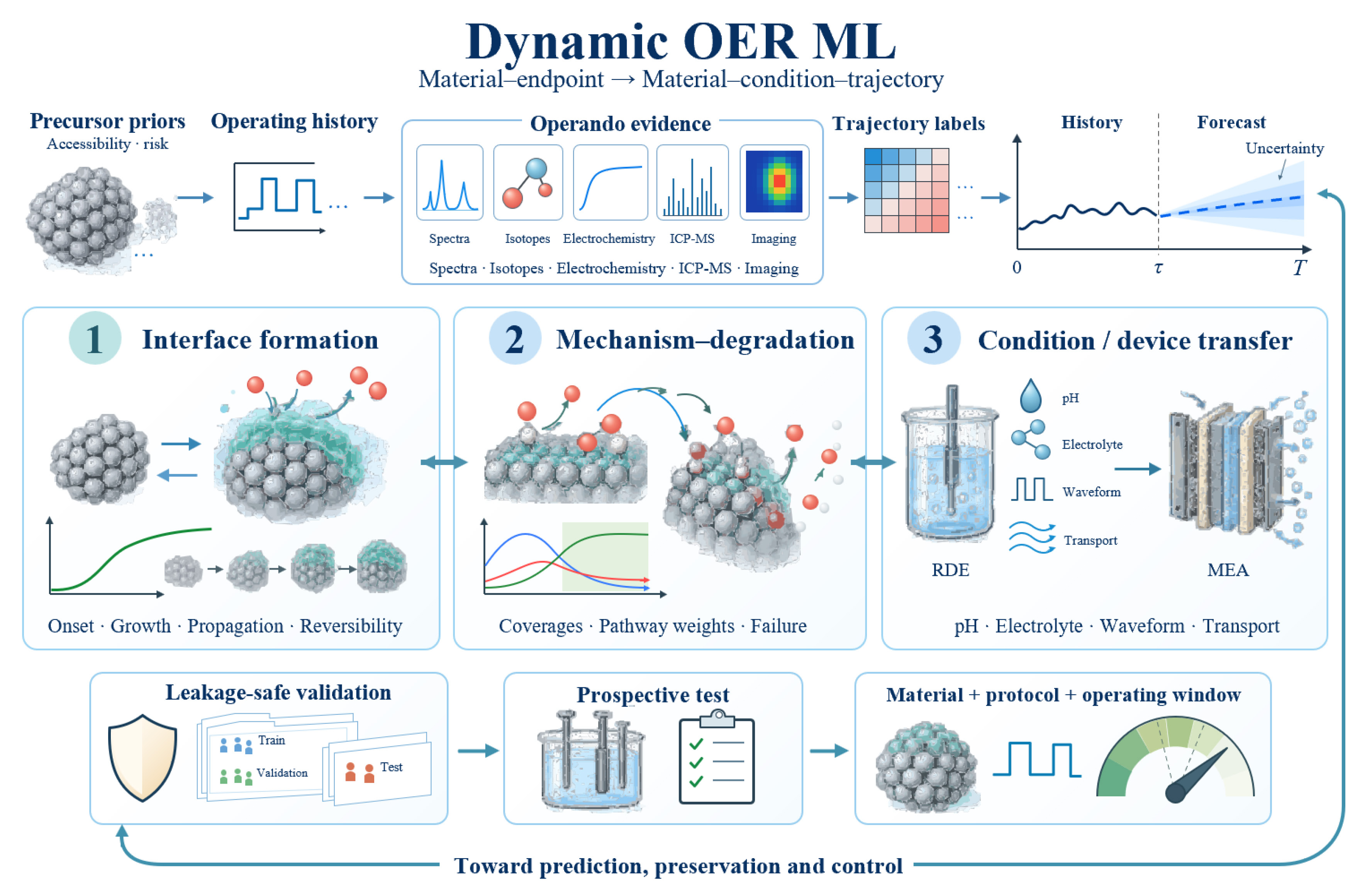
Efficient water electrolysis is limited not only by the sluggish kinetics of the oxygen evolution reaction (OER), but also by the dynamic reconstruction and degradation of catalysts under operating bias. Machine learning (ML) has accelerated OER catalyst screening by linking precursor composition, structural descriptors and adsorption energetics to endpoint activity, yet static endpoint models cannot determine when a working interface forms, how reaction pathways redistribute, or where stability costs accumulate during operation. This Review does not treat catalyst reconstruction or ML-assisted operando analysis as new concepts; instead, it formalizes their intersection as a supervised trajectory-learning problem. We define dynamic OER ML operationally as learning in which ordered operating history enters the prediction and the target contains at least one time-resolved state, transition event, pathway redistribution, degradation event or transfer trajectory. The field is organized around three learning targets: active-interface formation from precursors, coupled evolution of OER mechanisms and degradation routes, and transfer of material behavior across pH, electrolyte, potential program, transport and device boundaries. Static ML is repositioned as a source of precursor priors, whereas dynamic ML must learn state transitions, rates, latent working states, uncertainty and protocol-dependent transfer from time-resolved evidence. We further provide operational routes from raw operando signals to quantitative labels, target-specific evaluation metrics, baseline comparisons and leakage-safe validation rules. By shifting OER learning from material-endpoint ranking to material-condition-trajectory prediction, dynamic ML can support the prediction, preservation and control of real catalyst working states.
- Open Access
- Review
Dynamic Machine Learning for the Oxygen Evolution Reaction: From Static Catalyst Screening to Working-State Trajectory Learning
- Zihang Zhao 1,2,
- Keyi Xiang 1,2,3,
- Chengxu Zhang 1,
- Jue Hu 1,2,3,*
Author Information
Received: 06 Aug 2026 | Revised: 10 Sep 2026 | Accepted: 24 Sep 2026 | Published: 08 Oct 2026
Abstract
Graphical Abstract
Keywords
oxygen evolution reaction | dynamic machine learning | working-state trajectories | active-state reconstruction | mechanism–degradation coupling | trajectory-resolved datasets
References
- 1.
Yang, X.; Nielsen, C.P.; Song, S.; et al. Breaking the hard-to-abate bottleneck in China’s path to carbon neutrality with clean hydrogen. Nat. Energy 2022, 7, 955–965. https://doi.org/10.1038/s41560-022-01114-6.
- 2.
Terlouw, T.; Moretti, C.; Harpprecht, C.; et al. Global greenhouse gas emissions mitigation potential of existing and planned hydrogen projects. Nat. Energy 2025, 10, 1503–1515. https://doi.org/10.1038/s41560-025-01892-9.
- 3.
Algers, J.; Åhman, M.; Nilsson, L.J. Steel decarbonization—From optimization to transformation. Annu. Rev. Environ. Resour. 2025, 50, 433–454. https://doi.org/10.1146/annurev-environ-111523-101851.
- 4.
Canat, A.N.; Özkan, C. Supplying hydrogen for green steel through renewable energy sources: A case study of Türkiye. J. Clean. Prod. 2024, 450, 141961. https://doi.org/10.1016/j.jclepro.2024.141961.
- 5.
Ye, D.; Tsang, S.C.E. Prospects and challenges of green ammonia synthesis. Nat. Synth. 2023, 2, 612–623. https://doi.org/10.1038/s44160-023-00321-7.
- 6.
Ren, J.T.; Chen, L.; Wang, H.Y.; et al. Water electrolysis for hydrogen production: From hybrid systems to self-powered/catalyzed devices. Energy Environ. Sci. 2024, 17, 49–113. https://doi.org/10.1039/d3ee02467a.
- 7.
Shih, A.J.; Monteiro, M.C.O.; Dattila, F.; et al. Water electrolysis. Nat. Rev. Methods Primers 2022, 2, 84. https://doi.org/10.1038/s43586-022-00164-0.
- 8.
Gao, X.; Chen, Y.; Wang, Y.; et al. Next-generation green hydrogen: Progress and perspective from electricity, catalyst to electrolyte in electrocatalytic water splitting. Nano-Micro Lett. 2024, 16, 237. https://doi.org/10.1007/s40820-024-01424-2.
- 9.
Seh, Z.W.; Kibsgaard, J.; Dickens, C.F.; et al. Combining theory and experiment in electrocatalysis: Insights into materials design. Science 2017, 355, eaad4998. https://doi.org/10.1126/science.aad4998.
- 10.
Suntivich, J.; May, K.J.; Gasteiger, H.A.; et al. A perovskite oxide optimized for oxygen evolution catalysis from molecular orbital principles. Science 2011, 334, 1383–1385. https://doi.org/10.1126/science.1212858.
- 11.
Wu, L.; Guo, T.; Li, T. Machine learning-accelerated prediction of overpotential of oxygen evolution reaction of single-atom catalysts. iScience 2021, 24, 102398. https://doi.org/10.1016/j.isci.2021.102398.
- 12.
Li, Z.; Achenie, L.E.K.; Xin, H. An adaptive machine learning strategy for accelerating discovery of perovskite electrocatalysts. ACS Catal. 2020, 10, 4377–4384. https://doi.org/10.1021/acscatal.9b05248.
- 13.
Mao, X.; Wang, L.; Li, Y. Machine-learning-assisted discovery of high-efficient oxygen evolution electrocatalysts. J. Phys. Chem. Lett. 2023, 14, 170–177. https://doi.org/10.1021/acs.jpclett.2c02873.
- 14.
Esterhuizen, J.A.; Goldsmith, B.R.; Linic, S. Interpretable machine learning for knowledge generation in heterogeneous catalysis. Nat. Catal. 2022, 5, 175–184. https://doi.org/10.1038/s41929-022-00744-z.
- 15.
Mai, H.; Le, T.C.; Chen, D.; et al. Machine learning for electrocatalyst and photocatalyst design and discovery. Chem. Rev. 2022, 122, 13478–13515. https://doi.org/10.1021/acs.chemrev.2c00061.
- 16.
Bergmann, A.; Martinez-Moreno, E.; Teschner, D.; et al. Reversible amorphization and the catalytically active state of crystalline Co3O4 during oxygen evolution. Nat. Commun. 2015, 6, 8625. https://doi.org/10.1038/ncomms9625.
- 17.
Fabbri, E.; Nachtegaal, M.; Binninger, T.; et al. Dynamic surface self-reconstruction is the key of highly active perovskite nano-electrocatalysts for water splitting. Nat. Mater. 2017, 16, 925–931. https://doi.org/10.1038/nmat4938.
- 18.
Dionigi, F.; Zeng, Z.; Sinev, I.; et al. In-situ structure and catalytic mechanism of NiFe and CoFe layered double hydroxides during oxygen evolution. Nat. Commun. 2020, 11, 2522. https://doi.org/10.1038/s41467-020-16237-1.
- 19.
Mefford, J.T.; Akbashev, A.R.; Kang, M.; et al. Correlative operando microscopy of oxygen evolution electrocatalysts. Nature 2021, 593, 67–73. https://doi.org/10.1038/s41586-021-03454-x.
- 20.
Mefford, J.T.; Rong, X.; Abakumov, A.M.; et al. Water electrolysis on La1−xSrxCoO3−δ perovskite electrocatalysts. Nat. Commun. 2016, 7, 11053. https://doi.org/10.1038/ncomms11053.
- 21.
Geiger, S.; Kasian, O.; Ledendecker, M.; et al. The stability number as a metric for electrocatalyst stability benchmarking. Nat. Catal. 2018, 1, 508–515. https://doi.org/10.1038/s41929-018-0085-6.
- 22.
Su, H.; Zhou, W.; Zhou, W.; et al. In Situ spectroscopic observation of dynamic-coupling oxygen on atomically dispersed iridium electrocatalyst for acidic water oxidation. Nat. Commun. 2021, 12, 6118. https://doi.org/10.1038/s41467-021-26416-3.
- 23.
Jin, X.; Lee, T.; Park, J.; et al. pH-dependent mechanism of oxygen evolution in highly disordered RuO2 nanosheets. Nat. Commun. 2026, 17, 672. https://doi.org/10.1038/s41467-025-67318-y.
- 24.
Gao, L.; Cui, X.; Sewell, C.D.; et al. Recent advances in activating surface reconstruction for the high-efficiency oxygen evolution reaction. Chem. Soc. Rev. 2021, 50, 8428–8469. https://doi.org/10.1039/d0cs00962h.
- 25.
Zhao, Y.; Adiyeri Saseendran, D.P.; Huang, C.; et al. Oxygen Evolution/Reduction Reaction Catalysts: From In Situ Monitoring and Reaction Mechanisms to Rational Design. Chem. Rev. 2023, 123, 6257–6358. https://doi.org/10.1021/acs.chemrev.2c00515.
- 26.
Benavides-Hernández, J.; Dumeignil, F. From characterization to discovery: Artificial intelligence, machine learning and high-throughput experiments for heterogeneous catalyst design. ACS Catal. 2024, 14, 11749–11779. https://doi.org/10.1021/acscatal.3c06293.
- 27.
Ding, R.; Chen, J.; Chen, Y.; et al. Unlocking the potential: Machine learning applications in electrocatalyst design for electrochemical hydrogen energy transformation. Chem. Soc. Rev. 2024, 53, 11390–11461. https://doi.org/10.1039/d4cs00844h.
- 28.
Hu, J.; Guo, T.; Zhong, X.; et al. In Situ Reconstruction of High‐Entropy Heterostructure Catalysts for Stable Oxygen Evolution Electrocatalysis under Industrial Conditions. Adv. Mater. 2024, 36, 2310918. https://doi.org/10.1002/adma.202310918.
- 29.
Mei, Y.; Feng, Y.; Zhang, C.; et al. High-entropy alloy with Mo-coordination as efficient electrocatalyst for oxygen evolution reaction. ACS Catal. 2022, 12, 10808–10817. https://doi.org/10.1021/acscatal.2c02604.
- 30.
Zhang, C.; Qi, Q.; Mei, Y.; et al. Rationally reconstructed metal–organic frameworks as robust oxygen evolution electrocatalysts. Adv. Mater. 2023, 35, 2208904. https://doi.org/10.1002/adma.202208904.
- 31.
Wang, Y.; Tao, S.; Lin, H.; et al. Atomically targeting NiFe LDH to create multivacancies for OER catalysis with a small organic anchor. Nano Energy 2021, 81, 105606. https://doi.org/10.1016/j.nanoen.2020.105606.
- 32.
Qi, Q.; Zhang, C.; Hu, J. Triggered factors and structure-activity relationship in the dynamic reconstruction processing of MOF for the alkaline oxygen evolution reaction. Coord. Chem. Rev. 2025, 522, 216235. https://doi.org/10.1016/j.ccr.2024.216235.
- 33.
Qi, Q.; Zhang, Y.; Zhang, C.; et al. Halogen-modified iron-based metal–organic frameworks for remarkably improved electrocatalytic oxygen evolution. J. Phys. Chem. C 2024, 128, 1936–1945. https://doi.org/10.1021/acs.jpcc.3c06800.
- 34.
Gong, M.; Dai, H. A mini review of NiFe-based materials as highly active oxygen evolution reaction electrocatalysts. Nano Res. 2015, 8, 23–39. https://doi.org/10.1007/s12274-014-0591-z.
- 35.
McCrory, C.C.L.; Jung, S.; Ferrer, I.M.; et al. Benchmarking hydrogen evolving reaction and oxygen evolving reaction electrocatalysts for solar water splitting devices. J. Am. Chem. Soc. 2015, 137, 4347–4357. https://doi.org/10.1021/ja510442p.
- 36.
Anantharaj, S.; Ede, S.R.; Sakthikumar, K.; et al. Recent trends and perspectives in electrochemical water splitting with an emphasis on sulfide, selenide, and phosphide catalysts of Fe, Co, and Ni: A review. ACS Catal. 2016, 6, 8069–8097. https://doi.org/10.1021/acscatal.6b02479.
- 37.
Over, H. Surface chemistry of ruthenium dioxide in heterogeneous catalysis and electrocatalysis: From fundamental to applied research. Chem. Rev. 2012, 112, 3356–3426. https://doi.org/10.1021/cr200247n.
- 38.
Yu, S.; Zhang, Y.; Zhang, C.; et al. Stability regulation of metal–organic framework materials for electrocatalysis. J. Mater. Chem. A 2025, 13, 4814–4837. https://doi.org/10.1039/d4ta08090d.
- 39.
Yuan, J.; Qi, Q.; Wan, Q.; et al. Tungsten regulated medium-entropy heterostructure as a highly efficient electrocatalyst for oxygen evolution reaction. Dalton Trans. 2025, 54, 5293–5300. https://doi.org/10.1039/d5dt00258c.
- 40.
Yeo, B.S.; Bell, A.T. Enhanced activity of gold-supported cobalt oxide for the electrochemical evolution of oxygen. J. Am. Chem. Soc. 2011, 133, 5587–5593. https://doi.org/10.1021/ja200559j.
- 41.
Louie, M.W.; Bell, A.T. An investigation of thin-film Ni–Fe oxide catalysts for the electrochemical evolution of oxygen. J. Am. Chem. Soc. 2013, 135, 12329–12337. https://doi.org/10.1021/ja405351s.
- 42.
Han, F.; Andrejevic, N.; Li, M. A hidden dimension to explore new thermoelectrics. Joule 2018, 2, 16–18. https://doi.org/10.1016/j.joule.2017.12.014.
- 43.
Giordano, L.; Han, B.; Risch, M.; et al. pH dependence of OER activity of oxides: Current and future perspectives. Catal. Today 2016, 262, 2–10. https://doi.org/10.1016/j.cattod.2015.10.006.
- 44.
Wang, Z.; Zhang, C.; Zhang, Y.; et al. Ultrasound-assisted synthesis of high-entropy materials for enhanced oxygen evolution electrocatalysis. Metals 2024, 14, 384. https://doi.org/10.3390/met14040384.
- 45.
Zhu, Y.; Zhou, W.; Shao, Z. Perovskite/carbon composites: Applications in oxygen electrocatalysis. Small 2017, 13, 1603793. https://doi.org/10.1002/smll.201603793.
- 46.
Jain, A.; Ong, S.P.; Hautier, G.; et al. Commentary: The materials project: A materials genome approach to accelerating materials innovation. APL Mater. 2013, 1, 011002. https://doi.org/10.1063/1.4812323.
- 47.
Butler, K.T.; Davies, D.W.; Cartwright, H.; et al. Machine learning for molecular and materials science. Nature 2018, 559, 547–555. https://doi.org/10.1038/s41586-018-0337-2.
- 48.
Ward, L.; Agrawal, A.; Choudhary, A.; et al. A general-purpose machine learning framework for predicting properties of inorganic materials. npj Comput. Mater. 2016, 2, 16028. https://doi.org/10.1038/npjcompumats.2016.28.
- 49.
Chen, C.; Ye, W.; Zuo, Y.; et al. Graph networks as a universal machine learning framework for molecules and crystals. Chem. Mater. 2019, 31, 3564–3572. https://doi.org/10.1021/acs.chemmater.9b01294.
- 50.
Schmidt, J.; Marques, M.R.G.; Botti, S.; et al. Recent advances and applications of machine learning in solid-state materials science. npj Comput. Mater. 2019, 5, 83. https://doi.org/10.1038/s41524-019-0221-0.
- 51.
Trotochaud, L.; Young, S.L.; Ranney, J.K.; et al. Nickel–iron oxyhydroxide oxygen-evolution electrocatalysts: The role of intentional and incidental iron incorporation. J. Am. Chem. Soc. 2014, 136, 6744–6753. https://doi.org/10.1021/ja502379c.
- 52.
Friebel, D.; Louie, M.W.; Bajdich, M.; et al. Identification of highly active Fe sites in (Ni,Fe)OOH for electrocatalytic water splitting. J. Am. Chem. Soc. 2015, 137, 1305–1313. https://doi.org/10.1021/ja511559d.
- 53.
Wang, H.Y.; Hung, S.F.; Chen, H.Y.; et al. In Operando Identification of Geometrical-Site-Dependent Water Oxidation Activity of Spinel Co3O4. J. Am. Chem. Soc. 2016, 138, 36–39. https://doi.org/10.1021/jacs.5b10525.
- 54.
Zhou, J.; Wang, Y.; Su, X.; et al. Electrochemically accessing ultrathin Co (oxy)hydroxide nanosheets and operando identifying their active phase for the oxygen evolution reaction. Energy Environ. Sci. 2019, 12, 739–746. https://doi.org/10.1039/c8ee03208d.
- 55.
Kanan, M.W.; Nocera, D.G. In Situ Formation of an Oxygen-Evolving Catalyst in Neutral Water Containing Phosphate and Co2+. Science 2008, 321, 1072–1075. https://doi.org/10.1126/science.1162018.
- 56.
Chen, D.; Zhang, Y.; Feng, Y.; et al. Investigation into the stability of monometallic metal oxide electrocatalysts for hydrogen peroxide synthesis through the oxygen reduction reaction. J. Mater. Chem. A 2025, 13, 19105–19131. https://doi.org/10.1039/d5ta02600h.
- 57.
Qin, M.; Chen, J.; Zheng, X.; et al. Operando deciphering the activity origins for potential-induced reconstructed oxygen-evolving catalysts. Appl. Catal. B Environ. 2022, 316, 121602. https://doi.org/10.1016/j.apcatb.2022.121602.
- 58.
Choudhary, K.; Garrity, K.F.; Reid, A.C.E.; et al. The joint automated repository for various integrated simulations (JARVIS) for data-driven materials design. npj Comput. Mater. 2020, 6, 173. https://doi.org/10.1038/s41524-020-00440-1.
- 59.
Behler, J.; Parrinello, M. Generalized neural-network representation of high-dimensional potential-energy surfaces. Phys. Rev. Lett. 2007, 98, 146401. https://doi.org/10.1103/physrevlett.98.146401.
- 60.
Schütt, K.T.; Sauceda, H.E.; Kindermans, P.J.; et al. SchNet—A deep learning architecture for molecules and materials. J. Chem. Phys. 2018, 148, 241722. https://doi.org/10.1063/1.5019779.
- 61.
Seitz, L.C.; Dickens, C.F.; Nishio, K.; et al. A highly active and stable IrOx/SrIrO3 catalyst for the oxygen evolution reaction. Science 2016, 353, 1011–1014. https://doi.org/10.1126/science.aaf5050.
- 62.
Lopes, P.P.; Chung, D.Y.; Rui, X.; et al. Dynamically stable active sites from surface evolution of perovskite materials during the oxygen evolution reaction. J. Am. Chem. Soc. 2021, 143, 2741–2750. https://doi.org/10.1021/jacs.0c08959.
- 63.
Wu, T.; Sun, S.; Song, J.; et al. Iron-facilitated dynamic active-site generation on spinel CoAl2O4 with self-termination of surface reconstruction for water oxidation. Nat. Catal. 2019, 2, 763–772. https://doi.org/10.1038/s41929-019-0325-4.
- 64.
Qi, Q.; Tai, J.; Hu, J.; et al. Ligand Functionalized Iron‐Based Metal‐Organic Frameworks for Efficient Electrocatalytic Oxygen Evolution. ChemCatChem 2021, 13, 4976–4984. https://doi.org/10.1002/cctc.202101242.
- 65.
Gong, J.; Qi, Q.; Wang, Z.; et al. Controlled reconstruction of metal–organic frameworks via coordination environment tuning as oxygen evolution electrocatalysts. Dalton Trans. 2025, 54, 2991–2999. https://doi.org/10.1039/d4dt03348e.
- 66.
Nørskov, J.K.; Bligaard, T.; Rossmeisl, J.; et al. Towards the computational design of solid catalysts. Nat. Chem. 2009, 1, 37–46. https://doi.org/10.1038/nchem.121.
- 67.
Ulissi, Z.W.; Tang, M.T.; Xiao, J.; et al. Machine-Learning Methods Enable Exhaustive Searches for Active Bimetallic Facets and Reveal Active Site Motifs for CO2 Reduction. ACS Catal. 2017, 7, 6600–6608. https://doi.org/10.1021/acscatal.7b01648.
- 68.
Toyao, T.; Maeno, Z.; Takakusagi, S.; et al. Machine learning for catalysis informatics: Recent applications and prospects. ACS Catal. 2020, 10, 2260–2297. https://doi.org/10.1021/acscatal.9b04186.
- 69.
Liu, J.; Hu, Q.; Wang, Y.; et al. Achieving delafossite analog by in situ electrochemical self-reconstruction as an oxygen-evolving catalyst. Proc. Natl. Acad. Sci. USA 2020, 117, 21906–21913. https://doi.org/10.1073/pnas.2009180117.
- 70.
Song, S.; Zhou, J.; Su, X.; et al. Operando X-ray spectroscopic tracking of self-reconstruction for anchored nanoparticles as high-performance electrocatalysts towards oxygen evolution. Energy Environ. Sci. 2018, 11, 2945–2953. https://doi.org/10.1039/c8ee00773j.
- 71.
Kim, M.; Lee, B.; Ju, H.; et al. Reducing the Barrier Energy of Self‐Reconstruction for Anchored Cobalt Nanoparticles as Highly Active Oxygen Evolution Electrocatalyst. Adv. Mater. 2019, 31, 1901977. https://doi.org/10.1002/adma.201901977.
- 72.
Zhang, R.; Pan, L.; Guo, B.; et al. Tracking the Role of Defect Types in Co3O4 Structural Evolution and Active Motifs during Oxygen Evolution Reaction. J. Am. Chem. Soc. 2023, 145, 2271–2281. https://doi.org/10.1021/jacs.2c10515.
- 73.
Huang, Z.F.; Song, J.; Du, Y.; et al. Chemical and structural origin of lattice oxygen oxidation in Co–Zn oxyhydroxide oxygen evolution electrocatalysts. Nat. Energy 2019, 4, 329–338. https://doi.org/10.1038/s41560-019-0355-9.
- 74.
Kim, J.; Yin, X.; Tsao, K.C.; et al. Ca2Mn2O5 as Oxygen-Deficient Perovskite Electrocatalyst for Oxygen Evolution Reaction. J. Am. Chem. Soc. 2014, 136, 14646–14649. https://doi.org/10.1021/ja506254g.
- 75.
Lee, Y.; Suntivich, J.; May, K.J.; et al. Synthesis and Activities of Rutile IrO2 and RuO2 Nanoparticles for Oxygen Evolution in Acid and Alkaline Solutions. J. Phys. Chem. Lett. 2012, 3, 399–404. https://doi.org/10.1021/jz2016507.
- 76.
Hansen, H.A.; Viswanathan, V.; Nørskov, J.K. Unifying kinetic and thermodynamic analysis of 2 e– and 4 e– reduction of oxygen on metal surfaces. J. Phys. Chem. C 2014, 118, 6706–6718. https://doi.org/10.1021/jp4100608.
- 77.
Haase, F.T.; Bergmann, A.; Jones, T.E.; et al. Size effects and active state formation of cobalt oxide nanoparticles during the oxygen evolution reaction. Nat. Energy 2022, 7, 765–773. https://doi.org/10.1038/s41560-022-01083-w.
- 78.
Ledezma-Yanez, I.; Wallace, W.D.Z.; Sebastián-Pascual, P.; et al. Interfacial water reorganization as a pH-dependent descriptor of the hydrogen evolution rate on platinum electrodes. Nat. Energy 2017, 2, 17031. https://doi.org/10.1038/nenergy.2017.31.
- 79.
Willets, K.A. Probing nanoscale interfaces with electrochemical surface-enhanced Raman scattering. Curr. Opin. Electrochem. 2019, 13, 18–24. https://doi.org/10.1016/j.coelec.2018.10.005.
- 80.
Koper, M.T.M. Thermodynamic theory of multi-electron transfer reactions: Implications for electrocatalysis. J. Electroanal. Chem. 2011, 660, 254–260. https://doi.org/10.1016/j.jelechem.2010.10.004.
- 81.
Timoshenko, J.; Roldan Cuenya, B. In Situ/Operando Electrocatalyst Characterization by X-ray Absorption Spectroscopy. Chem. Rev. 2021, 121, 882–961. https://doi.org/10.1021/acs.chemrev.0c00396.
- 82.
Zagalskaya, A.; Alexandrov, V. Role of Defects in the Interplay between Adsorbate Evolving and Lattice Oxygen Mechanisms of the Oxygen Evolution Reaction in RuO2 and IrO2. ACS Catal. 2020, 10, 3650–3657. https://doi.org/10.1021/acscatal.9b05544.
- 83.
Roy, C.; Sebok, B.; Scott, S.B.; et al. Impact of nanoparticle size and lattice oxygen on water oxidation on NiFeOxHy. Nat. Catal. 2018, 1, 820–829. https://doi.org/10.1038/s41929-018-0162-x.
- 84.
Beall, C.E.; Fabbri, E.; Schmidt, T.J. Perovskite oxide based electrodes for the oxygen reduction and evolution reactions: The underlying mechanism. ACS Catal. 2021, 11, 3094–3114. https://doi.org/10.1021/acscatal.0c04473.
- 85.
Carmo, M.; Fritz, D.L.; Mergel, J.; et al. A comprehensive review on PEM water electrolysis. Int. J. Hydrogen Energy 2013, 38, 4901–4934. https://doi.org/10.1016/j.ijhydene.2013.01.151.
- 86.
Weiß, A.; Siebel, A.; Bernt, M.; et al. Impact of intermittent operation on lifetime and performance of a PEM water electrolyzer. J. Electrochem. Soc. 2019, 166, F487–F497. https://doi.org/10.1149/2.0421908jes.
- 87.
Schuler, T.; Schmidt, T.J.; Büchi, F.N. Polymer electrolyte water electrolysis: Correlating performance and porous transport layer structure: Part II. Electrochemical performance analysis. J. Electrochem. Soc. 2019, 166, F555–F565. https://doi.org/10.1149/2.1241908jes.
- 88.
Man, I.C.; Su, H.Y.; Calle‐Vallejo, F.; et al. Universality in oxygen evolution electrocatalysis on oxide surfaces. ChemCatChem 2011, 3, 1159–1165. https://doi.org/10.1002/cctc.201000397.
- 89.
Hong, W.T.; Welsch, R.E.; Shao-Horn, Y. Descriptors of Oxygen-Evolution Activity for Oxides: A Statistical Evaluation. J. Phys. Chem. C 2016, 120, 78–86. https://doi.org/10.1021/acs.jpcc.5b10071.
- 90.
Burke, M.S.; Zou, S.; Enman, L.J.; et al. Revised oxygen evolution reaction activity trends for first-row transition-metal (oxy)hydroxides in alkaline media. J. Phys. Chem. Lett. 2015, 6, 3737–3742. https://doi.org/10.1021/acs.jpclett.5b01650.
- 91.
Weng, B.; Song, Z.; Zhu, R.; et al. Simple descriptor derived from symbolic regression accelerating the discovery of new perovskite catalysts. Nat. Commun. 2020, 11, 3513. https://doi.org/10.1038/s41467-020-17263-9.
- 92.
Back, S.; Tran, K.; Ulissi, Z.W. Toward a design of active oxygen evolution catalysts: Insights from automated density functional theory calculations and machine learning. ACS Catal. 2019, 9, 7651–7659. https://doi.org/10.1021/acscatal.9b02416.
- 93.
Tran, R.; Lan, J.; Shuaibi, M.; et al. The Open Catalyst 2022 (OC22) dataset and challenges for oxide electrocatalysts. ACS Catal. 2023, 13, 3066–3084. https://doi.org/10.1021/acscatal.2c05426.
- 94.
Flores, R.A.; Paolucci, C.; Winther, K.T.; et al. Active learning accelerated discovery of stable iridium oxide polymorphs for the oxygen evolution reaction. Chem. Mater. 2020, 32, 5854–5863. https://doi.org/10.1021/acs.chemmater.0c01894.
- 95.
Bang, K.; Hong, D.; Park, Y.; et al. Machine learning-enabled exploration of the electrochemical stability of real-scale metallic nanoparticles. Nat. Commun. 2023, 14, 3004. https://doi.org/10.1038/s41467-023-38758-1.
- 96.
Abed, J.; Heras-Domingo, J.; Sanspeur, R.Y.; et al. Pourbaix machine learning framework identifies acidic water oxidation catalysts exhibiting suppressed ruthenium dissolution. J. Am. Chem. Soc. 2024, 146, 15740–15750. https://doi.org/10.1021/jacs.4c01353.
- 97.
Wexler, R.B.; Gautam, G.S.; Stechel, E.B.; et al. Factors governing oxygen vacancy formation in oxide perovskites. J. Am. Chem. Soc. 2021, 143, 13212–13227. https://doi.org/10.1021/jacs.1c05570.
- 98.
Lunger, J.R.; Karaguesian, J.; Chun, H.; et al. Towards atom-level understanding of metal oxide catalysts for the oxygen evolution reaction with machine learning. npj Comput. Mater. 2024, 10, 80. https://doi.org/10.1038/s41524-024-01273-y.
- 99.
Moon, J.; Beker, W.; Siek, M.; et al. Active learning guides discovery of a champion four-metal perovskite oxide for oxygen evolution electrocatalysis. Nat. Mater. 2024, 23, 108–115. https://doi.org/10.1038/s41563-023-01707-w.
- 100.
Mints, V.A.; Svane, K.L.; Rossmeisl, J.; et al. Exploring the high-entropy oxide composition space: Insights through comparing experimental with theoretical models for the oxygen evolution reaction. ACS Catal. 2024, 14, 6936–6944. https://doi.org/10.1021/acscatal.3c05915.
- 101.
Jiang, C.; He, H.; Guo, H.; et al. Transfer learning guided discovery of efficient perovskite oxide for alkaline water oxidation. Nat. Commun. 2024, 15, 6301. https://doi.org/10.1038/s41467-024-50605-5.
- 102.
Jenewein, K.J.; Torresi, L.; Haghmoradi, N.; et al. Navigating the unknown with AI: Multiobjective Bayesian optimization of non-noble acidic OER catalysts. J. Mater. Chem. A 2024, 12, 3072–3083. https://doi.org/10.1039/d3ta06651g.
- 103.
Zhang, Q.; Xiao, W.; Fu, H.C.; et al. Unraveling the mechanism of self-repair of NiFe-based electrocatalysts by dynamic exchange of iron during the oxygen evolution reaction. ACS Catal. 2023, 13, 14975–14986. https://doi.org/10.1021/acscatal.3c03804.
- 104.
Xu, S.; Chen, Z.; Qin, M.; et al. Developing new electrocatalysts for oxygen evolution reaction via high throughput experiments and artificial intelligence. npj Comput. Mater. 2024, 10, 194. https://doi.org/10.1038/s41524-024-01386-4.
- 105.
Kodera, M.; Sayama, K. An automatic robot system for machine learning–assisted high-throughput screening of composite electrocatalysts. Digit. Discov. 2023, 2, 1683–1687. https://doi.org/10.1039/d3dd00116d.
- 106.
Tabor, D.P.; Roch, L.M.; Saikin, S.K.; et al. Accelerating the discovery of materials for clean energy in the era of smart automation. Nat. Rev. Mater. 2018, 3, 5–20. https://doi.org/10.1038/s41578-018-0005-z.
- 107.
Haase, F.T.; Rabe, A.; Schmidt, F.P.; et al. Role of Nanoscale Inhomogeneities in Co2FeO4 Catalysts during the Oxygen Evolution Reaction. J. Am. Chem. Soc. 2022, 144, 12007–12019. https://doi.org/10.1021/jacs.2c00850.
- 108.
Ding, R.; Liu, J.; Hua, K.; et al. Leveraging data mining, active learning, and domain adaptation for efficient discovery of advanced oxygen evolution electrocatalysts. Sci. Adv. 2025, 11, eadr9038. https://doi.org/10.1126/sciadv.adr9038.
- 109.
Qian, H.; Wei, J.; Yu, C.; et al. In Situ quantification of the active sites, turnover frequency, and stability of Ni–Fe (oxy)hydroxides for the oxygen evolution reaction. ACS Catal. 2022, 12, 14280–14289. https://doi.org/10.1021/acscatal.2c03898.
- 110.
Diklić, N.; Clark, A.H.; Herranz, J.; et al. Potential Pitfalls in the Operando XAS Study of Oxygen Evolution Electrocatalysts. ACS Energy Lett. 2022, 7, 1735–1740. https://doi.org/10.1021/acsenergylett.2c00727.
- 111.
Wu, D.; Hu, L.; Liu, X.; et al. Time-resolved spectroscopy uncovers deprotonation-induced reconstruction in oxygen-evolution NiFe-based (oxy)hydroxides. Nat. Commun. 2025, 16, 726. https://doi.org/10.1038/s41467-025-56070-y.
- 112.
Yang, F.; Lopez Luna, M.; Haase, F.T.; et al. Spatially and chemically resolved visualization of Fe incorporation into NiO octahedra during the oxygen evolution reaction. J. Am. Chem. Soc. 2023, 145, 21465–21474. https://doi.org/10.1021/jacs.3c07158.
- 113.
Görlin, M.; Chernev, P.; Ferreira de Araújo, J.; et al. Oxygen evolution reaction dynamics, faradaic charge efficiency, and the active metal redox states of Ni–Fe oxide water splitting electrocatalysts. J. Am. Chem. Soc. 2016, 138, 5603–5614. https://doi.org/10.1021/jacs.6b00332.
- 114.
Batzner, S.; Musaelian, A.; Sun, L.; et al. E(3)-equivariant graph neural networks for data-efficient and accurate interatomic potentials. Nat. Commun. 2022, 13, 2453. https://doi.org/10.1038/s41467-022-29939-5.
- 115.
Lookman, T.; Balachandran, P.V.; Xue, D.; et al. Active learning in materials science with emphasis on adaptive sampling using uncertainties for targeted design. npj Comput. Mater. 2019, 5, 21. https://doi.org/10.1038/s41524-019-0153-8.
- 116.
Raccuglia, P.; Elbert, K.C.; Adler, P.D.F.; et al. Machine-learning-assisted materials discovery using failed experiments. Nature 2016, 533, 73–76. https://doi.org/10.1038/nature17439.
- 117.
Raissi, M.; Perdikaris, P.; Karniadakis, G.E. Physics-informed neural networks: A deep learning framework for solving forward and inverse problems involving nonlinear partial differential equations. J. Comput. Phys. 2019, 378, 686–707. https://doi.org/10.1016/j.jcp.2018.10.045.
- 118.
Shimakawa, H.; Kumada, A.; Sato, M. Prevention of leakage in machine learning prediction for polymer composite properties. J. Chem. Inf. Model. 2024, 64, 3621–3629. https://doi.org/10.1021/acs.jcim.3c01894.
- 119.
Witman, M.D.; Schindler, P. MatFold: Systematic insights into materials discovery models’ performance through standardized cross-validation protocols. Digit. Discov. 2025, 4, 625–635. https://doi.org/10.1039/d4dd00250d.
- 120.
Kapoor, S.; Narayanan, A. Leakage and the reproducibility crisis in machine-learning-based science. Patterns 2023, 4, 100804. https://doi.org/10.1016/j.patter.2023.100804.
- 121.
Kapoor, S.; Cantrell, E.M.; Peng, K.; et al. Reforms: Consensus-based recommendations for machine-learning-based science. Sci. Adv. 2024, 10, eadk3452. https://doi.org/10.1126/sciadv.adk3452.
- 122.
Deka, N.; Jones, T.E.; Falling, L.J.; et al. On the operando structure of ruthenium oxides during the oxygen evolution reaction in acidic media. ACS Catal. 2023, 13, 7488–7498. https://doi.org/10.1021/acscatal.3c01607.
- 123.
Liang, C.; Rao, R.R.; Svane, K.L.; et al. Unravelling the effects of active site density and energetics on the water oxidation activity of iridium oxides. Nat. Catal. 2024, 7, 763–775. https://doi.org/10.1038/s41929-024-01168-7.
- 124.
Jia, H.; Yao, N.; Yu, C.; et al. Unveiling the electrolyte cations dependent kinetics on CoOOH-catalyzed oxygen evolution reaction. Angew. Chem. Int. Ed. 2023, 62, e202313886. https://doi.org/10.1002/anie.202313886.
- 125.
Wang, Z.; Xiao, H. Fleeting-active-site-thrust oxygen evolution reaction by iron cations from the electrolyte. J. Am. Chem. Soc. 2024, 146, 29540–29550. https://doi.org/10.1021/jacs.4c09585.
- 126.
Zhao, J.; Zhang, Y.; Ye, Y.; et al. Remote iron dynamics of NiFe (oxy)hydroxides toward robust active sites in water oxidation. Nat. Commun. 2025, 16, 5601. https://doi.org/10.1038/s41467-025-60728-y.
- 127.
Choi, S.; Kim, S.J.; Han, S.; et al. Enhancing oxygen evolution reaction via a surface reconstruction-induced lattice oxygen mechanism. ACS Catal. 2024, 14, 15096–15107. https://doi.org/10.1021/acscatal.4c03594.
- 128.
Ji, Q.; Tang, B.; Zhang, X.; et al. Operando identification of the oxide path mechanism with different dual-active sites for acidic water oxidation. Nat. Commun. 2024, 15, 8089. https://doi.org/10.1038/s41467-024-52471-7.
- 129.
Wang, Z.; Goddard, W.A.; Xiao, H. Potential-dependent transition of reaction mechanisms for oxygen evolution on layered double hydroxides. Nat. Commun. 2023, 14, 4228. https://doi.org/10.1038/s41467-023-40011-8.
- 130.
Li, W.; Zhang, J.; Yang, C.; et al. Modulating iridium coordination to control the oxygen evolution reaction pathway. J. Am. Chem. Soc. 2025, 147, 40697–40707. https://doi.org/10.1021/jacs.5c13365.
- 131.
Ping, X.; Liu, Y.; Zheng, L.; et al. Locking the lattice oxygen in RuO2 to stabilize highly active Ru sites in acidic water oxidation. Nat. Commun. 2024, 15, 2501. https://doi.org/10.1038/s41467-024-46815-6.
- 132.
Wang, F.; Zou, P.; Zhang, Y.; et al. Activating lattice oxygen in high-entropy LDH for robust and durable water oxidation. Nat. Commun. 2023, 14, 6019. https://doi.org/10.1038/s41467-023-41706-8.
- 133.
He, Z.; Zhang, J.; Gong, Z.; et al. Activating lattice oxygen in NiFe-based (oxy)hydroxide for water electrolysis. Nat. Commun. 2022, 13, 2191. https://doi.org/10.1038/s41467-022-29875-4.
- 134.
Zhou, C.; Li, L.; Dong, Z.; et al. Pinning effect of lattice Pb suppressing lattice oxygen reactivity of Pb-RuO2 enables stable industrial-level electrolysis. Nat. Commun. 2024, 15, 9774. https://doi.org/10.1038/s41467-024-53905-y.
- 135.
Kasian, O.; Geiger, S.; Li, T.; et al. Degradation of iridium oxides via oxygen evolution from the lattice: Correlating atomic scale structure with reaction mechanisms. Energy Environ. Sci. 2019, 12, 3548–3555. https://doi.org/10.1039/c9ee01872g.
- 136.
Xu, J.; Jin, H.; Lu, T.; et al. IrOx·nH2O with lattice water–assisted oxygen exchange for high-performance proton exchange membrane water electrolyzers. Sci. Adv. 2023, 9, eadh1718. https://doi.org/10.1126/sciadv.adh1718.
- 137.
Qu, M.R.; Liu, H.; Feng, S.H.; et al. Temperature-dependent mechanism evolution on RhRu3Ox for acidic water oxidation. Nat. Commun. 2025, 16, 9261. https://doi.org/10.1038/s41467-025-64286-1.
- 138.
Liu, H.; Zhou, Q.; Yu, J.; et al. Lattice oxygen refilling for stable acidic water oxidation. ACS Catal. 2025, 15, 8511–8521. https://doi.org/10.1021/acscatal.5c01382.
- 139.
He, B.; Hosseini, P.; Priamushko, T.; et al. Atomic-scale insights into surface reconstruction and transformation in Co–Cr spinel oxides during the oxygen evolution reaction. Nat. Commun. 2025, 16, 9895. https://doi.org/10.1038/s41467-025-65626-x.
- 140.
Qian, F.; Cao, D.; Chen, S.; et al. High-entropy RuO2 catalyst with dual-site oxide path for durable acidic oxygen evolution reaction. Nat. Commun. 2025, 16, 6894. https://doi.org/10.1038/s41467-025-61763-5.
- 141.
Liang, X.; Yan, W.; Yu, Y.; et al. Electrocatalytic Water Oxidation Activity‐Stability Maps for Perovskite Oxides Containing 3d, 4d and 5d Transition Metals. Angew. Chem. Int. Ed. 2023, 62, e202311606. https://doi.org/10.1002/anie.202311606.
- 142.
Zheng, W.; Zhao, Y.; Jiang, K.; et al. Heteroatom dopants overcome the activity-stability trade-off in RuO2 for acidic oxygen evolution. Nat. Commun. 2025, 16, 6716. https://doi.org/10.1038/s41467-025-62036-x.
- 143.
Kim, J.; Kwon, I.S.; Lim, J.; et al. Machine-learning-guided tungsten single atoms promote oxyhydroxides for noble-metal-free water electrolysis. Nat. Commun. 2026, 17, 2344. https://doi.org/10.1038/s41467-026-68735-3.
- 144.
Wan, Z.; Wang, Q.D.; Liu, D.; et al. Data-driven machine learning model for the prediction of oxygen vacancy formation energy of metal oxide materials. Phys. Chem. Chem. Phys. 2021, 23, 15675–15684. https://doi.org/10.1039/d1cp02066h.
- 145.
Park, S.; Lee, N.; Park, J.O.; et al. Exploring the latent chemical space of oxygen vacancy formation energy by a machine learning ensemble. ACS Mater. Lett. 2024, 6, 66–72. https://doi.org/10.1021/acsmaterialslett.3c00636.
- 146.
Li, L.; Zhang, G.; Zhou, C.; et al. Lanthanide-regulating Ru-O covalency optimizes acidic oxygen evolution electrocatalysis. Nat. Commun. 2024, 15, 4974. https://doi.org/10.1038/s41467-024-49281-2.
- 147.
Pandya, R.; Dorchies, F.; Romanin, D.; et al. Concurrent oxygen evolution reaction pathways revealed by high-speed compressive Raman imaging. Nat. Commun. 2024, 15, 8362. https://doi.org/10.1038/s41467-024-52536-7.
- 148.
Usama, M.; Razzaq, S.; Hättig, C.; et al. Oxygen evolution reaction on IrO2(110) is governed by Walden-type mechanisms. Nat. Commun. 2025, 16, 6137. https://doi.org/10.1038/s41467-025-61367-z.
- 149.
van der Merwe, M.; Lee, Y.; Wibowo, R.E.; et al. Unravelling the mechanistic complexity of the oxygen evolution reaction and Ir dissolution in highly dimensional amorphous hydrous iridium oxides. Energy Environ. Sci. 2025, 18, 1214–1231. https://doi.org/10.1039/d4ee02839b.
- 150.
Wang, H.; Lin, C.; Tan, L.; et al. Atomic Ga triggers spatiotemporal coordination of oxygen radicals for efficient water oxidation on crystalline RuO2. Nat. Commun. 2025, 16, 3976. https://doi.org/10.1038/s41467-025-58346-9.
- 151.
Luo, X.; Zhao, H.; Tan, X.; et al. Fe-s dually modulated adsorbate evolution and lattice oxygen compatible mechanism for water oxidation. Nat. Commun. 2024, 15, 8293. https://doi.org/10.1038/s41467-024-52682-y.
- 152.
Zhang, K.; Liang, X.; Wang, Y.; et al. Support-tuned iridium reconstruction with crystalline phase dominating acidic oxygen evolution. Nat. Commun. 2025, 16, 8164. https://doi.org/10.1038/s41467-025-63541-9.
- 153.
Liu, S.; Sun, M.; Dai, L.; et al. Defect-interface coupling for stable lattice-oxygen-driven oxygen evolution at industrial current densities. Nat. Commun. 2026, 17, 2135. https://doi.org/10.1038/s41467-026-68730-8.
- 154.
Wu, H.; Chang, J.; Yu, J.; et al. Atomically engineered interfaces inducing bridging oxygen-mediated deprotonation for enhanced oxygen evolution in acidic conditions. Nat. Commun. 2024, 15, 10315. https://doi.org/10.1038/s41467-024-54798-7.
- 155.
Cao, X.; Miao, L.; Jia, W.; et al. Strain heterogeneity in RuO2 for efficient acidic oxygen evolution reaction in proton exchange membrane water electrolysis. Nat. Commun. 2025, 16, 6217. https://doi.org/10.1038/s41467-025-58570-3.
- 156.
Zhou, L.; Yang, M.; Liu, Y.; et al. Intrinsic metal-support interactions break the activity-stability dilemma in electrocatalysis. Nat. Commun. 2025, 16, 8739. https://doi.org/10.1038/s41467-025-63397-z.
- 157.
Kaufman, S.; Rosset, S.; Perlich, C.; et al. Leakage in data mining: Formulation, detection, and avoidance. ACM Trans. Knowl. Discov. Data 2012, 6, 1–21. https://doi.org/10.1145/2382577.2382579.
- 158.
Roberts, M.; Driggs, D.; Thorpe, M.; et al. Common pitfalls and recommendations for using machine learning to detect and prognosticate for COVID-19 using chest radiographs and CT scans. Nat. Mach. Intell. 2021, 3, 199–217. https://doi.org/10.1038/s42256-021-00307-0.
- 159.
Huang, J.; Clark, A.H.; Hales, N.; et al. Oxidation of interfacial cobalt controls the pH dependence of the oxygen evolution reaction. Nat. Chem. 2025, 17, 856–864. https://doi.org/10.1038/s41557-025-01784-1.
- 160.
Liang, C.; Katayama, Y.; Tao, Y.; et al. Role of electrolyte pH on water oxidation for iridium oxides. J. Am. Chem. Soc. 2024, 146, 8928–8938. https://doi.org/10.1021/jacs.3c12011.
- 161.
Wei, C.; Wang, Z.; Otani, K.; et al. Benchmarking electrocatalyst stability for acidic oxygen evolution reaction: The crucial role of dissolved ion concentration. ACS Catal. 2023, 13, 14058–14069. https://doi.org/10.1021/acscatal.3c03257.
- 162.
van der Heijden, O.; Eggebeen, J.J.J.; Trzesniowski, H.; et al. Li+ Cations Activate NiFeOOH for Oxygen Evolution in Sodium and Potassium Hydroxide. Angew. Chem. Int. Ed. 2024, 63, e202318692. https://doi.org/10.1002/anie.202318692.
- 163.
Chen, B.; Wang, P.; Shin, D.; et al. Effect of electrolyte ions on iridium oxide-based water oxidation catalysis. ACS Catal. 2025, 15, 16476–16482. https://doi.org/10.1021/acscatal.5c03970.
- 164.
Zhu, S.; Yang, R.; Li, H.J.W.; et al. Reconstructing hydrogen-bond network for efficient acidic oxygen evolution. Angew. Chem. Int. Ed. 2024, 63, e202319462. https://doi.org/10.1002/anie.202319462.
- 165.
Endrődi, B.; Trapp, C.A.; Szén, I.; et al. Challenges and opportunities of the dynamic operation of PEM water electrolyzers. Energies 2025, 18, 2154. https://doi.org/10.3390/en18092154.
- 166.
Papakonstantinou, G.; Algara-Siller, G.; Teschner, D.; et al. Degradation study of a proton exchange membrane water electrolyzer under dynamic operation conditions. Appl. Energy 2020, 280, 115911. https://doi.org/10.1016/j.apenergy.2020.115911.
- 167.
Maoulida, F.; Guilbert, D.; Camara, M.B.; et al. Dynamic electrical degradation of PEM electrolyzers under renewable energy intermittency: Mechanisms, diagnostics, and mitigation strategies—A comprehensive review. Renew. Sustain. Energy Rev. 2026, 225, 116170. https://doi.org/10.1016/j.rser.2025.116170.
- 168.
Li, A.; Ooka, H.; Kong, S.; et al. Oxygen evolution electrocatalysis resilient to voltage fluctuations. Nat. Sustain. 2025, 8, 1533–1540. https://doi.org/10.1038/s41893-025-01665-y.
- 169.
Veroneau, S.S.; Hartnett, A.C.; Ryu, J.; et al. A straightforward model for quantifying local pH gradients governing the oxygen evolution reaction. J. Am. Chem. Soc. 2024, 146, 28925–28931. https://doi.org/10.1021/jacs.4c09521.
- 170.
Kim, Y.J.; Lim, A.; Kim, J.M.; et al. Highly efficient oxygen evolution reaction via facile bubble transport realized by three-dimensionally stack-printed catalysts. Nat. Commun. 2020, 11, 4921. https://doi.org/10.1038/s41467-020-18686-0.
- 171.
Dastafkan, K.; Wang, S.; Song, S.; et al. Operando monitoring of gas bubble evolution in water electrolysis by single high-frequency impedance. EES Catal. 2023, 1, 998–1008. https://doi.org/10.1039/d3ey00182b.
- 172.
Geuß, M.; Löttert, L.; Böhm, T.; et al. Quantification of iridium dissolution at water electrolysis relevant conditions using a gas diffusion electrode half-cell setup. ACS Catal. 2024, 14, 11819–11831. https://doi.org/10.1021/acscatal.4c02159.
- 173.
Chan, A.L.; Yu, H.; Reeves, K.S.; et al. Identifying electrochemical processes by distribution of relaxation times in proton exchange membrane electrolyzers. J. Power Sources 2025, 628, 235850. https://doi.org/10.1016/j.jpowsour.2024.235850.
- 174.
Chen, Z.; Lin, Z.; Zhu, X.; et al. Adsorbed oxygen dynamics at forced convection interface in the oxygen evolution reaction. Nat. Commun. 2025, 16, 7949. https://doi.org/10.1038/s41467-025-63181-z.
- 175.
Knöppel, J.; Möckl, M.; Escalera-López, D.; et al. On the limitations in assessing stability of oxygen evolution catalysts using aqueous model electrochemical cells. Nat. Commun. 2021, 12, 2231. https://doi.org/10.1038/s41467-021-22296-9.
- 176.
Tran, H.P.; Nong, H.N.; Zlatar, M.; et al. Reactivity and Stability of Reduced Ir-Weight TiO2-Supported Oxygen Evolution Catalysts for Proton Exchange Membrane (PEM) Water Electrolyzer Anodes. J. Am. Chem. Soc. 2024, 146, 31444–31455. https://doi.org/10.1021/jacs.4c07002.
- 177.
Lee, J.K.; Anderson, G.; Tricker, A.W.; et al. Ionomer-free and recyclable porous-transport electrode for high-performing proton-exchange-membrane water electrolysis. Nat. Commun. 2023, 14, 4592. https://doi.org/10.1038/s41467-023-40375-x.
- 178.
Zhang, M.; An, W.; Liu, Q.; et al. Tunnel-structured IrOx unlocks catalytic efficiency in proton exchange membrane water electrolyzers. Nat. Commun. 2025, 16, 7608. https://doi.org/10.1038/s41467-025-62861-0.
- 179.
Weber, C.C.; Wrubel, J.A.; Gubler, L.; et al. How the porous transport layer interface affects catalyst utilization and performance in polymer electrolyte water electrolysis. ACS Appl. Mater. Interfaces 2023, 15, 34750–34763. https://doi.org/10.1021/acsami.3c04151.
- 180.
Yang, S.; Hou, B.; Xie, Z.; et al. Influence of the porous transport layer surface structure on overpotentials in PEM water electrolysis. Energies 2025, 18, 4396. https://doi.org/10.3390/en18164396.
- 181.
Mahajan, R.; Aleman, A.M.; Crago, C.F.; et al. A research database for experimental electrocatalysis: Advancing data sharing and reusability. J. Chem. Phys. 2025, 163, 124704. https://doi.org/10.1063/5.0280821.
- 182.
Jiang, X.; Wang, Y.; Jia, B.; et al. Using machine learning to predict oxygen evolution activity for transition metal hydroxide electrocatalysts. ACS Appl. Mater. Interfaces 2022, 14, 41141–41148. https://doi.org/10.1021/acsami.2c13435.
- 183.
Zlatar, M.; Escalera-López, D.; Rodríguez, M.G.; et al. Standardizing OER electrocatalyst benchmarking in aqueous electrolytes: Comprehensive guidelines for accelerated stress tests and backing electrodes. ACS Catal. 2023, 13, 15375–15392. https://doi.org/10.1021/acscatal.3c03880.
- 184.
Sauvé, E.R.; Tang, B.Y.; Razdan, N.K.; et al. Open circuit potential decay transients quantify interfacial pH swings during high current density hydrogen electrocatalysis. Joule 2024, 8, 728–745. https://doi.org/10.1016/j.joule.2024.01.004.
- 185.
Zhao, Y.; Cai, X.; Liu, S.; et al. Investigation of Metal-Doped IrO2 in Rotating Disk Electrode and Membrane Electrode Assembly Configurations for Acidic Oxygen Evolution Reaction. J. Phys. Chem. C 2024, 128, 17552–17562. https://doi.org/10.1021/acs.jpcc.4c04447.
- 186.
Wu, L.; Huang, W.; Li, D.; et al. Unveiling the structure and dissociation of interfacial water on RuO2 for efficient acidic oxygen evolution reaction. Angew. Chem. 2025, 137, e202413334. https://doi.org/10.1002/ange.202413334.
- 187.
Tao, Y.; Utsunomiya, T.; Yu, H.; et al. Multimodal operando characterization of cation effects at the iridium oxide–electrolyte interface for alkaline water oxidation. ACS Appl. Mater. Interfaces 2026, 18, 15699–15710. https://doi.org/10.1021/acsami.5c22249.
- 188.
Spitzenpfeil, H.; Neumann, M.; Hausen, N.; et al. Artificial Intelligence‐Assisted Experimental Optimization of Water Oxidation Catalysts. Chem. Ing. Tech. 2025, 97, 472–478. https://doi.org/10.1002/cite.202400156.
- 189.
Gong, M.; Na, Y. Localized oxygen evolution and transport analysis in PEM water electrolysis on local static pressure, temperature and current density. Int. J. Hydrogen Energy 2024, 68, 1240–1250. https://doi.org/10.1016/j.ijhydene.2024.04.273.
- 190.
Mohamed, A.; Ibrahem, H.; Kim, K. Machine learning-based simulation for proton exchange membrane electrolyzer cell. Energy Rep. 2022, 8, 13425–13437. https://doi.org/10.1016/j.egyr.2022.09.135.
- 191.
Sayed-Ahmed, H.; Keller, R.; Toldy, Á.I.; et al. Data-driven degradation analysis of proton exchange membrane electrolyzer stacks under dynamic load operation. Energy AI 2026, 25, 100790. https://doi.org/10.1016/j.egyai.2026.100790.
- 192.
Sayed-Ahmed, H.; Toldy, Á.I.; Santasalo-Aarnio, A. Dynamic operation of proton exchange membrane electrolyzers—Critical review. Renew. Sustain. Energy Rev. 2024, 189, 113883. https://doi.org/10.1016/j.rser.2023.113883.
- 193.
Zhong, G.; Xu, S.; Fang, B. Improved oxygen evolution reaction for high-current PEM water electrolysis. Chem Catal. 2024, 4, 100897. https://doi.org/10.1016/j.checat.2023.100897.
- 194.
Hasa, B.; Aryal, U.R.; Higashi, S.; et al. Porous transport layer influence on overpotentials in PEM water electrolysis at low anode catalyst loadings. Appl. Catal. B Environ. Energy 2025, 361, 124616. https://doi.org/10.1016/j.apcatb.2024.124616.
- 195.
Milosevic, M.; Dam, A.P.; Rogler, M.; et al. Experimental-modeling framework to unveil iridium degradation pathways during intermittent operation in PEMWE. Joule 2026, 10, 102309. https://doi.org/10.1016/j.joule.2025.102309.
- 196.
Kimmel, B.; Morawietz, T.; Biswas, I.; et al. Investigation of the degradation phenomena of a proton exchange membrane electrolyzer stack by successive replacement of aged components in single cells. ACS Sustain. Chem. Eng. 2025, 13, 4330–4340. https://doi.org/10.1021/acssuschemeng.4c07358.
- 197.
Wang, C.R.; Kwon, O.; Spencer, J.; et al. Predictors of membrane electrode assembly activity for iridium oxide catalysts in proton exchange membrane water electrolysis. ACS Catal. 2026, 16, 12984–12994. https://doi.org/10.1021/acscatal.6c00883.
- 198.
Chan, A.L.; Hayden, S.C.; Harvey, S.P.; et al. Mechanism-informed breakdown: Understanding degradation by controlling voltage-hold patterns in proton exchange membrane water electrolyzers. ACS Appl. Energy Mater. 2026, 9, 924–937. https://doi.org/10.1021/acsaem.5c03160.

This work is licensed under a Creative Commons Attribution 4.0 International License.
