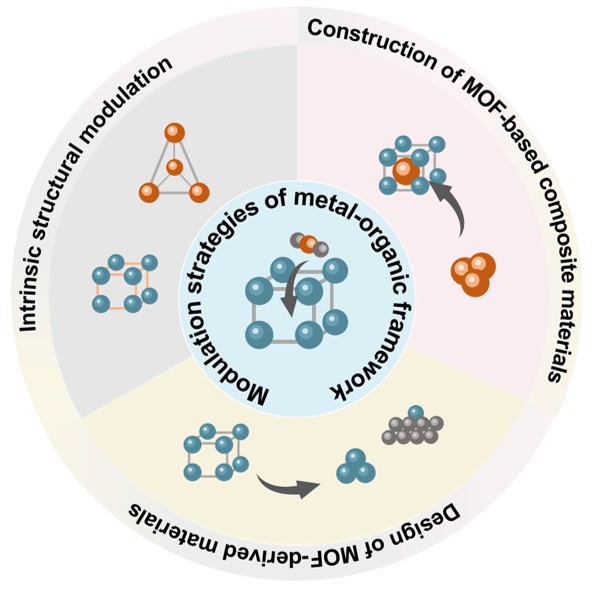
The electrochemical reduction of CO2 offers a promising route for realizing the artificial carbon cycle by producing value-added fuels and chemical feedstocks. In the past decade, metal-organic frameworks (MOF) have emerged as the promising platform for CO2 electrocatalyst design owing to their structural tunability, ultrahigh surface areas, and well-defined active sites. Many efforts have been devoted to the modulation of MOF-based catalysts for enhancing electrochemical CO2 reduction performance. In this review, we present a comprehensive survey of recent advances in the design and modulation strategies of MOF-based catalysts for CO2 electroreduction, covering intrinsic structural regulation, fabrication of MOF-based composite materials and design of MOF-derived materials. Furthermore, the prevailing challenges and future outlooks based on recent research advances are highlighted. These summarized findings and prospects afford critical references for the design of high-performance MOF-based catalysts and help further broaden the application prospect of electrocatalytic CO2 reduction.
- Open Access
- Review
Recent Progress on Modulation Strategies of Metal-Organic Framework-Based Catalysts for Electrochemical Carbon Dioxide Reduction
- Huitong Du 1,*,
- Ruixin Jia 1,
- Xinqi Zhou 1,
- Ziyan Shi 1,
- Tianyi Wu 1,
- Suitao Hua 1,
- Rui Liu 1,
- Zuming Liang 1,
- Weisu Kong 2,
- Feng Han 1,* and
- Chengxia Miao 1,*
Author Information
Received: 30 July 2026 | Revised: 28 October 2026 | Accepted: 05 November 2026 | Published: 26 November 2026
Abstract
Graphical Abstract
Keywords
metal-organic frameworks | CO2 reduction reaction | modulation strategy | electrocatalyst | catalytic performance
References
- 1.
Yang, Z.; Li, X.; Cui, X.; et al. Integrated Strategies Toward the Capture and Electrochemical Conversion of Low-Concentration Carbon Dioxide. Exploration 2025, 5, e20240006. https://doi.org/10.1002/exp.20240006.
- 2.
He, Z.; Xu, N.; Wang, Y.; et al. Electrode-resolved mechanisms governing performance and durability in zinc-air batteries. Chem. Eng. J. 2026, 527, 171444. https://doi.org/10.1016/j.cej.2025.171444.
- 3.
Zeng, Z.; Li, L.; Smith, K.S.; et al. Quantifying Individual Electrode Polarization and Understanding the Interactive Phenomenon in Proton Exchange Membrane Fuel Cells. J. Electrochem. Soc. 2025, 172, 114507. https://doi.org/10.1149/1945-7111/ae18fb.
- 4.
Zhu, W. Living bioreactive facades for visible carbon reduction in cities. Nat. Cities 2026, 3, 784–785. https://doi.org/10.1038/s44284-026-00502-3.
- 5.
Dou, H.; Li, Y.; Wang, D.; et al. Confinement-enhanced photocatalytic CO2 reduction: A comprehensive review of microstructural and electronic structural modulations. Prog. Nat. Sci. Mater. Int. 2026, 36, 752–784. https://doi.org/10.1016/j.pnsc.2026.06.008.
- 6.
Kwon, W.; Kim, D.; Lee, Y.; et al. Advancements in Understanding Catalyst Reconstruction During Electrochemical CO2 Reduction. Exploration 2025, 5, e20240019. https://doi.org/10.1002/exp.20240019.
- 7.
Liu, S.; Wang, H.; Wang, X.; et al. Bi2S3/In(OH)3 heterojunction for enhanced CO2 electroreduction to formic acid. Prog. Nat. Sci. Mater. Int. 2024, 34, 1167–1172. https://doi.org/10.1016/j.pnsc.2024.10.009.
- 8.
Xie, L.; Liu, Y.; Li, S.; et al. Phase and facet engineering for nanoscale catalyst discovery in electrochemical CO2 reduction. Nat. Synth. 2026, 5, 489–505. https://doi.org/10.1038/s44160-026-01025-4.
- 9.
Xue, J.; Yang, R.; Chen, Z. In-Situ/Operando Raman Spectroscopy Techniques for In-Depth Decoupling CO2 Reduction Reaction Mechanisms. Nano-Electrochem. Nano-Photochem. 2025, 1, 2. https://doi.org/10.53941/nenp.2025.100002.
- 10.
Du, H.; Fu, J.; Liu, L.X.; et al. Recent progress in electrochemical reduction of carbon monoxide toward multi-carbon products. Mater. Today 2022, 59, 182–199. https://doi.org/10.1016/j.mattod.2022.08.012.
- 11.
Kim, J.H.; Hong, S.H.; Ahn, S.H.; et al. Recent Progress in Photocathode Interface Engineering for Photoelectrochemical CO2 Reduction Reaction to C1 or C2+ Products. Exploration 2025, 5, 70010. https://doi.org/10.1002/exp.20240014.
- 12.
Du, H.; Liu, L.X.; Li, P.; et al. Enriching Reaction Intermediates in Multishell Structured Copper Catalysts for Boosted Propanol Electrosynthesis from Carbon Monoxide. ACS Nano 2023, 17, 8663–8670. https://doi.org/10.1021/acsnano.3c01516.
- 13.
Ameen, S.; Abrar, A.; Wang, S.; et al. Thiol-directed synthesis of high-loading Ag nanoparticles on carbon for efficient and stable CO2 electroreduction. Prog. Nat. Sci. Mater. Int. 2026, 36, 502–510. https://doi.org/10.1016/j.pnsc.2025.06.005.
- 14.
Huang, J.; Yu, M.; Li, L.; et al. Radiation-induced divergent structural evolution of Cu2(OH)2CO3 and its impact on CO2 electroreduction. Trans. Mater. Res. 2026, 2, 100205. https://doi.org/10.1016/j.tramat.2026.100205.
- 15.
Kong, W.; Zhu, D.; Zhang, Y.; et al. Electron Donor Coordinated Metal-Organic Framework to Enhance Photoelectrochemical Performance. Angew. Chem. Int. Ed. 2023, 62, e202308514. https://doi.org/10.1002/anie.202308514.
- 16.
Du, H.; Liu, L.X.; Cai, Y.; et al. In situ formed N-containing copper nanoparticles: A high-performance catalyst toward carbon monoxide electroreduction to multicarbon products with high faradaic efficiency and current density. Nanoscale 2022, 14, 7262–7268. https://doi.org/10.1039/d2nr01226j.
- 17.
Liu, J.; Burciaga, R.; Tang, S.; et al. Heterogeneous catalysis for the environment. Innov. Mater. 2024, 2, 100090. https://doi.org/10.59717/j.xinn-mater.2024.100090.
- 18.
Qin, C.; Li, X.; Wang, T.; et al. Metal-Organic Frameworks-Based Copper Catalysts for CO2 Electroreduction toward Multicarbon Products. Exploration 2025, 5, 270011. https://doi.org/10.1002/exp.70011.
- 19.
Wang, Z.; Wang, H.; Wang, P.; et al. Application of MOFs driven by various energy sources for degradation the organic pollutants in water: A review. Coord. Chem. Rev. 2024, 499, 215506. https://doi.org/10.1016/j.ccr.2023.215506.
- 20.
Xu, W.; Wu, Y.; Gu, W.; et al. Atomic-level design of metalloenzyme-like active pockets in metal–organic frameworks for bioinspired catalysis. Chem. Soc. Rev. 2024, 53, 137–162. https://doi.org/10.1039/d3cs00767g.
- 21.
Yao, S.; Liu, J.; Tan, J.; et al. Conductive MOF-Based NiZn Dual Atom Catalyst for Boosted Photoreduction of Diluted CO2: The Effects of Inert Sites. Adv. Funct. Mater. 2026, 36, e26031. https://doi.org/10.1002/adfm.202526031.
- 22.
Sun, N.; Shah, S.S.A.; Lin, Z.; et al. MOF-Based Electrocatalysts: An Overview from the Perspective of Structural Design. Chem. Rev. 2025, 125, 2703–2792. https://doi.org/10.1021/acs.chemrev.4c00664.
- 23.
Kong, W.; Liu, T.; Meng, X.; et al. Intrareticular Energy Transfer in Dual-Photosensitized Metal–Organic Frameworks to Enhance Photoelectrochemical Performance. J. Am. Chem. Soc. 2025, 147, 24976–24983. https://doi.org/10.1021/jacs.5c07699.
- 24.
Huang, D.S.; Wang, Y.; Tang, Y.; et al. Embedding a self-supporting MOF-based molecular sieve membrane into an electrolyzer for boosting electroreduction of CO2 in air and flue gas to HCOOH. Natl. Sci. Rev. 2025, 12, nwaf329. https://doi.org/10.1093/nsr/nwaf329.
- 25.
Li, M.; Li, C.; Shi, Y.; et al. Embedding Metallosalen Active Sites in Zr-MOF for Enhanced Selective Syngas Production from CO2 Photoreduction. Angew. Chem. Int. Ed. 2025, 64, e202510810. https://doi.org/10.1002/anie.202510810.
- 26.
Lim, H.K.; Kwon, Y.; Kim, H.S.; et al. Insight into the Microenvironments of the Metal–Ionic Liquid Interface during Electrochemical CO2 Reduction. ACS Catal. 2018, 8, 2420–2427. https://doi.org/10.1021/acscatal.7b03777.
- 27.
Tao, Z.; Rooney, C.L.; Liang, Y.; et al. Accessing Organonitrogen Compounds via C–N Coupling in Electrocatalytic CO2 Reduction. J. Am. Chem. Soc. 2021, 143, 19630–19642. https://doi.org/10.1021/jacs.1c10714.
- 28.
Cui, M.; Xu, B.; Shi, X.; et al. Metal–organic framework-derived single-atom catalysts for electrocatalytic energy conversion applications. J. Mater. Chem. A 2024, 12, 18921–18947. https://doi.org/10.1039/d4ta03518f.
- 29.
Ren, F.Y.; Hu, C.; Huang, W.B.; et al. Modulated Multicomponent Reaction Pathway by Pore-Confinement Effect in MOFs for Highly Efficient Catalysis of Low-Concentration CO2. Angew. Chem. Int. Ed. 2025, 64, e202503898. https://doi.org/10.1002/anie.202503898.
- 30.
Hu, H.; Liu, J.; Li, W.; et al. MOF-derived doped porous carbon-based catalysts for CO2 electroreduction: Design, mechanisms, and scale-up. Mater. Chem. Front. 2026, 10, 888–921. https://doi.org/10.1039/d5qm00888c.
- 31.
Li, P.; Yang, R.; Zhu, W. Quantum-dot-based catalysts for electrochemical CO2 reduction: Structure–selectivity relationships and design principles. J. Electroanal. Chem. 2026, 1015, 120234. https://doi.org/10.1016/j.jelechem.2026.120234.
- 32.
Wang, W.; Chen, D.; Li, F.; et al. Metal-organic-framework-based materials as platforms for energy applications. Chem 2024, 10, 86–133. https://doi.org/10.1016/j.chempr.2023.09.009.
- 33.
Pan, F.; Yang, X.; O’Carroll, T.; et al. Carbon Catalysts for Electrochemical CO2 Reduction toward Multicarbon Products. Adv. Energy Mater. 2022, 12, 2200586. https://doi.org/10.1002/aenm.202200586.
- 34.
Wang, G.; Ma, Y.; Wang, J.; et al. Metal functionalization of two-dimensional nanomaterials for electrochemical carbon dioxide reduction. Nanoscale 2023, 15, 6456–6475. https://doi.org/10.1039/d3nr00484h.
- 35.
Feaster, J.T.; Shi, C.; Cave, E.R.; et al. Understanding Selectivity for the Electrochemical Reduction of Carbon Dioxide to Formic Acid and Carbon Monoxide on Metal Electrodes. ACS Catal. 2017, 7, 4822–4827. https://doi.org/10.1021/acscatal.7b00687.
- 36.
Rodrigues Pinto, M.; Vos, R.E.; Nagao, R.; et al. Electrolyte Effects on Electrochemical CO2 Reduction Reaction at Sn Metallic Electrode. J. Phys. Chem. C 2024, 128, 21421–21429. https://doi.org/10.1021/acs.jpcc.4c06361.
- 37.
Zhao, K.; Liu, Y.; Quan, X.; et al. CO2 Electroreduction at Low Overpotential on Oxide-Derived Cu/Carbons Fabricated from Metal Organic Framework. ACS Appl. Mater. Interfaces 2017, 9, 5302–5311. https://doi.org/10.1021/acsami.6b15402.
- 38.
Shah, S.S.A.; Javed, M.S.; Najam, T.; et al. Metal oxides for the electrocatalytic reduction of carbon dioxide: Mechanism of active sites, composites, interface and defect engineering strategies. Coord. Chem. Rev. 2022, 471, 214716. https://doi.org/10.1016/j.ccr.2022.214716.
- 39.
Xiong, B.; Yang, Y.; Liu, J. HCOOH Electrosynthesis via Coelectrolytic Processes of CO2 Reduction and CH3OH Oxidation. J. Phys. Chem. C 2023, 127, 196–204. https://doi.org/10.1021/acs.jpcc.2c06031.
- 40.
Lv, X.; Liu, Q.; Wang, J.; et al. Grain refining enables mixed Cu+/Cu0 states for CO2 electroreduction to C2+ products at high current density. Appl. Catal. B Environ. 2023, 324, 122272. https://doi.org/10.1016/j.apcatb.2022.122272.
- 41.
Nitopi, S.; Bertheussen, E.; Scott, S.B.; et al. Progress and Perspectives of Electrochemical CO2 Reduction on Copper in Aqueous Electrolyte. Chem. Rev. 2019, 119, 7610–7672. https://doi.org/10.1021/acs.chemrev.8b00705.
- 42.
Nie, X.; Esopi, M.R.; Janik, M.J.; et al. Selectivity of CO2 Reduction on Copper Electrodes: The Role of the Kinetics of Elementary Steps. Angew. Chem. Int. Ed. 2013, 52, 2459–2462. https://doi.org/10.1002/anie.201208320.
- 43.
Peterson, A.A.; Abild-Pedersen, F.; Studt, F.; et al. How copper catalyzes the electroreduction of carbon dioxide into hydrocarbon fuels. Energy Environ. Sci. 2010, 3, 1311–1315. https://doi.org/10.1039/c0ee00071j.
- 44.
Wang, Y.; Han, P.; Lv, X.; et al. Defect and Interface Engineering for Aqueous Electrocatalytic CO2 Reduction. Joule 2018, 2, 2551–2582. https://doi.org/10.1016/j.joule.2018.09.021.
- 45.
Kibria, M.G.; Edwards, J.P.; Gabardo, C.M.; et al. Electrochemical CO2 Reduction into Chemical Feedstocks: From Mechanistic Electrocatalysis Models to System Design. Adv. Mater. 2019, 31, 1807166. https://doi.org/10.1002/adma.201807166.
- 46.
Xue, Y.; Guo, Y.; Cui, H.; et al. Catalyst Design for Electrochemical Reduction of CO2 to Multicarbon Products. Small Methods 2021, 5, 2100736. https://doi.org/10.1002/smtd.202100736.
- 47.
Ni, F.; Yang, H.; Wen, Y.; et al. N-modulated Cu+ for efficient electrochemical carbon monoxide reduction to acetate. Sci. China Mater. 2020, 63, 2606–2612. https://doi.org/10.1007/s40843-020-1440-6.
- 48.
Ma, W.; He, X.; Wang, W.; et al. Electrocatalytic reduction of CO2 and CO to multi-carbon compounds over Cu-based catalysts. Chem. Soc. Rev. 2021, 50, 12897–12914. https://doi.org/10.1039/d1cs00535a.
- 49.
Pérez-Gallent, E.; Figueiredo, M.C.; Calle-Vallejo, F.; et al. Spectroscopic Observation of a Hydrogenated CO Dimer Intermediate During CO Reduction on Cu(100) Electrodes. Angew. Chem. Int. Ed. 2017, 56, 3621–3624. https://doi.org/10.1002/anie.201700580.
- 50.
Mamaghani, A.H.; Liu, J.; Zhang, Z.; et al. Promises of MOF-Based and MOF-Derived Materials for Electrocatalytic CO2 Reduction. Adv. Energy Mater. 2024, 14, 2402278. https://doi.org/10.1002/aenm.202402278.
- 51.
Kim, H.; An, H.; Kim, J.; et al. Dynamic Interface Engineering via Mechanistic Understanding of Copper Reconstruction in Electrochemical CO2 Reduction Reaction. J. Am. Chem. Soc. 2026, 148, 6045–6056. https://doi.org/10.1021/jacs.5c16244.
- 52.
Sudhakaran, A.; Prasad, D.; Saxena, M.; et al. Advances in electrochemical CO2 reduction to CO for enabling A sustainable energy economy. Prog. Mater. Sci. 2026, 159, 101655. https://doi.org/10.1016/j.pmatsci.2026.101655.
- 53.
Xie, F.; Zhan, S.; You, Z.; et al. Dual Electric Fields Enrich and Stabilize Intermediates for Efficient Electrochemical CO2 Reduction to Multi-Carbon Products. Adv. Funct. Mater. 2026, 36, e17674. https://doi.org/10.1002/adfm.202517674.
- 54.
Xiao, Y.; Lai, X.; Feng, J.; et al. Self-Refreshing Bi-Based Active Sites for Efficient and Durable Electrochemical CO2 Reduction. Adv. Funct. Mater. 2026, 36, e23592. https://doi.org/10.1002/adfm.202523592.
- 55.
Martín, A.J.; Larrazábal, G.O.; Pérez-Ramírez, J. Towards sustainable fuels and chemicals through the electrochemical reduction of CO2: Lessons from water electrolysis. Green Chem. 2015, 17, 5114–5130. https://doi.org/10.1039/c5gc01893e.
- 56.
Hao, S.; Elgazzar, A.; Zhang, S.K.; et al. Acid-humidified CO2 gas input for stable electrochemical CO2 reduction reaction. Science 2025, 388. https://doi.org/10.1126/science.adr3834. Erratum in Science 2026, 391. https://doi.org/10.1126/science.aeh0747.
- 57.
Okatenko, V.; Loiudice, A.; Newton, M.A.; et al. Alloying as a Strategy to Boost the Stability of Copper Nanocatalysts during the Electrochemical CO2 Reduction Reaction. J. Am. Chem. Soc. 2023, 145, 5370–5383. https://doi.org/10.1021/jacs.2c13437.
- 58.
Álvarez-Gómez, J.M.; Varela, A.S. Review on Long-Term Stability of Electrochemical CO2 Reduction. Energy Fuels 2023, 37, 15283–15308. https://doi.org/10.1021/acs.energyfuels.3c01847.
- 59.
Hao, S.; Elgazzar, A.; Ravi, N.; et al. Improving the operational stability of electrochemical CO2 reduction reaction via salt precipitation understanding and management. Nat. Energy 2025, 10, 266–277. https://doi.org/10.1038/s41560-024-01695-4.
- 60.
Deng, W.; Zhang, L.; Li, L.; et al. Crucial Role of Surface Hydroxyls on the Activity and Stability in Electrochemical CO2 Reduction. J. Am. Chem. Soc. 2019, 141, 2911–2915. https://doi.org/10.1021/jacs.8b13786.
- 61.
Han, G.H.; Yoo, J.; Ha, J.; et al. How to Select Each Component of CO2 Electrolyzers. Exploration 2025, 5, 20240025. https://doi.org/10.1002/exp.20240025.
- 62.
Popović, S.; Smiljanić, M.; Jovanovič, P.; et al. Stability and Degradation Mechanisms of Copper-Based Catalysts for Electrochemical CO2 Reduction. Angew. Chem. 2020, 132, 14844–14854. https://doi.org/10.1002/ange.202000617.
- 63.
Lai, W.; Qiao, Y.; Wang, Y.; et al. Stability Issues in Electrochemical CO2 Reduction: Recent Advances in Fundamental Understanding and Design Strategies. Adv. Mater. 2023, 35, e2306288. https://doi.org/10.1002/adma.202306288.
- 64.
Xie, S.; Ma, W.; Wu, X.; et al. Photocatalytic and electrocatalytic transformations of C1 molecules involving C–C coupling. Energy Environ. Sci. 2021, 14, 37–89. https://doi.org/10.1039/d0ee01860k.
- 65.
Rabinowitz, J.A.; Kanan, M.W. The future of low-temperature carbon dioxide electrolysis depends on solving one basic problem. Nat. Commun. 2020, 11, 5231. https://doi.org/10.1038/s41467-020-19135-8.
- 66.
Jia, S.; Kong, L.X.; Guo, X.; et al. Construction of copper oxide/carbon nanocomposites derived from Cu-MOF and their application in electrochemical nitrite sensors. Mater. Today Chem. 2025, 45, 102707. https://doi.org/10.1016/j.mtchem.2025.102707.
- 67.
Sikdar, N.; Junqueira, J.R.C.; Dieckhöfer, S.; et al. A Metal–Organic Framework derived CuxOyCz Catalyst for Electrochemical CO2 Reduction and Impact of Local pH Change. Angew. Chem. Int. Ed. 2021, 60, 23427–23434. https://doi.org/10.1002/anie.202108313.
- 68.
Liu, C.; Zhang, X.D.; Huang, J.M.; et al. In Situ Reconstruction of Cu–N Coordinated MOFs to Generate Dispersive Cu/Cu2O Nanoclusters for Selective Electroreduction of CO2 to C2H4. ACS Catal. 2022, 12, 15230–15240. https://doi.org/10.1021/acscatal.2c04275.
- 69.
Zhang, Y.; Zhang, L.; Feng, X.; et al. Trinuclear Cu(I) Metal–Organic Framework Inspires the Activation of *CO2 Via Electrostatic Tension to Boost the Electrochemical Conversion of CO2-to-Methanol. Small 2025, 21, e05892. https://doi.org/10.1002/smll.202505892.
- 70.
Meng, J.; Wang, Y.; Jia, C.; et al. Ultra-stabilized Cu2+ sites in conductive MOF/t-Cu2O interface for benchmark CO2 reduction. Nano Energy 2025, 141, 111077. https://doi.org/10.1016/j.nanoen.2025.111077.
- 71.
Hinogami, R.; Yotsuhashi, S.; Deguchi, M.; et al. Electrochemical Reduction of Carbon Dioxide Using a Copper Rubeanate Metal Organic Framework. ECS Electrochem. Lett. 2012, 1, H17–H19. https://doi.org/10.1149/2.001204eel.
- 72.
Kumar, R.; Kumar, S.S.; Kulandainathan, M.A. Highly selective electrochemical reduction of carbon dioxide using Cu based metal organic framework as an electrocatalyst. Electrochem. Commun. 2012, 25, 70–73. https://doi.org/10.1016/j.elecom.2012.09.018.
- 73.
Dong, L.Z.; Lu, Y.F.; Wang, R.; et al. Porous copper cluster-based MOF with strong cuprophilic interactions for highly selective electrocatalytic reduction of CO2 to CH4. Nano Res. 2022, 15, 10185–10193. https://doi.org/10.1007/s12274-022-4681-z.
- 74.
Wang, Y.; Hou, P.; Wang, Z.; et al. Zinc Imidazolate Metal–Organic Frameworks (ZIF-8) for Electrochemical Reduction of CO2 to CO. ChemPhysChem 2017, 18, 3142–3147. https://doi.org/10.1002/cphc.201700716.
- 75.
Kang, X.; Zhu, Q.; Sun, X.; et al. Highly efficient electrochemical reduction of CO2 to CH4 in an ionic liquid using a metal–organic framework cathode. Chem. Sci. 2016, 7, 266–273. https://doi.org/10.1039/c5sc03291a.
- 76.
Zhan, T.; Huang, J.; Yang, Y.; et al. Regulating the Microenvironment of Zn-Based Metal-Organic Framework for Enhanced CO2 Electroreduction to Formate. ChemCatChem 2025, 17, e202401529. https://doi.org/10.1002/cctc.202401529.
- 77.
Birdja, Y.Y.; Pérez-Gallent, E.; Figueiredo, M.C.; et al. Advances and challenges in understanding the electrocatalytic conversion of carbon dioxide to fuels. Nat. Energy 2019, 4, 732–745. https://doi.org/10.1038/s41560-019-0450-y.
- 78.
Zhang, X.; Zhang, Y.; Li, Q.; et al. Highly efficient and durable aqueous electrocatalytic reduction of CO2 to HCOOH with a novel bismuth–MOF: Experimental and DFT studies. J. Mater. Chem. A 2020, 8, 9776–9787. https://doi.org/10.1039/d0ta00384k.
- 79.
Li, F.; Gu, G.H.; Choi, C.; et al. Highly stable two-dimensional bismuth metal-organic frameworks for efficient electrochemical reduction of CO2. Appl. Catal. B Environ. 2020, 277, 119241. https://doi.org/10.1016/j.apcatb.2020.119241.
- 80.
Qiu, X.F.; Zhu, H.L.; Huang, J.R.; et al. Highly Selective CO2 Electroreduction to C2H4 Using a Metal–Organic Framework with Dual Active Sites. J. Am. Chem. Soc. 2021, 143, 7242–7246. https://doi.org/10.1021/jacs.1c01466.
- 81.
Zhu, H.L.; Chen, H.Y.; Han, Y.X.; et al. A Porous π–π Stacking Framework with Dicopper(I) Sites and Adjacent Proton Relays for Electroreduction of CO2 to C2+ Products. J. Am. Chem. Soc. 2022, 144, 13319–13326. https://doi.org/10.1021/jacs.2c04670.
- 82.
Singh, A.K.; Gu, L.; Dutta Chowdhury, A.; et al. Exploring Ligand-Controlled C2 Product Selectivity in Carbon Dioxide Reduction with Copper Metal–Organic Framework Nanosheets. Inorg. Chem. 2023, 62, 8803–8811. https://doi.org/10.1021/acs.inorgchem.3c00118.
- 83.
Mao, X.; Gong, W.; Fu, Y.; et al. Computational Design and Experimental Validation of Enzyme Mimicking Cu-Based Metal–Organic Frameworks for the Reduction of CO2 into C2 Products: C–C Coupling Promoted by Ligand Modulation and the Optimal Cu–Cu Distance. J. Am. Chem. Soc. 2023, 145, 21442–21453. https://doi.org/10.1021/jacs.3c07108.
- 84.
Zhang, M.; Zhu, W.; Liu, Z.; et al. Selective Sieving Effect of Multi-Atomic Bismuth Interfaces for Efficient Formate Electrosynthesis and Evolution at Industrial Current Density. Angew. Chem. 2025, 137, e202510206. https://doi.org/10.1002/ange.202510206.
- 85.
Dou, S.; Song, J.; Xi, S.; et al. Boosting Electrochemical CO2 Reduction on Metal–Organic Frameworks via Ligand Doping. Angew. Chem. Int. Ed. 2019, 58, 4041–4045. https://doi.org/10.1002/anie.201814711.
- 86.
Lu, Y.; Zhong, H.; Li, J.; et al. sp-Carbon Incorporated Conductive Metal-Organic Framework as Photocathode for Photoelectrochemical Hydrogen Generation. Angew. Chem. Int. Ed. 2022, 61, e202208163. https://doi.org/10.1002/anie.202208163.
- 87.
Wang, M.; Dong, R.; Feng, X. Two-dimensional conjugated metal–organic frameworks (2D c-MOFs): Chemistry and function for MOFtronics. Chem. Soc. Rev. 2021, 50, 2764–2793. https://doi.org/10.1039/d0cs01160f. Correction in Chem. Soc. Rev. 2022, 51, 793–794.
- 88.
Yi, J.D.; Si, D.H.; Xie, R.; et al. Conductive Two-Dimensional Phthalocyanine-based Metal–Organic Framework Nanosheets for Efficient Electroreduction of CO2. Angew. Chem. Int. Ed. 2021, 60, 17108–17114. https://doi.org/10.1002/anie.202104564.
- 89.
Huang, Q.; Li, Q.; Liu, J.; et al. Disclosing CO2 Activation Mechanism by Hydroxyl-Induced Crystalline Structure Transformation in Electrocatalytic Process. Matter 2019, 1, 1656–1668. https://doi.org/10.1016/j.matt.2019.07.003.
- 90.
Jiang, X.; Li, H.; Xiao, J.; et al. Carbon dioxide electroreduction over imidazolate ligands coordinated with Zn(II) center in ZIFs. Nano Energy 2018, 52, 345–350. https://doi.org/10.1016/j.nanoen.2018.07.047.
- 91.
Al-Attas, T.A.; Marei, N.N.; Yong, X.; et al. Ligand-Engineered Metal–Organic Frameworks for Electrochemical Reduction of Carbon Dioxide to Carbon Monoxide. ACS Catal. 2021, 11, 7350–7357. https://doi.org/10.1021/acscatal.1c01506.
- 92.
Nwosu, U.; Siahrostami, S. Copper-based metal–organic frameworks for CO2 reduction: Selectivity trends, design paradigms, and perspectives. Catal. Sci. Technol. 2023, 13, 3740–3761. https://doi.org/10.1039/d3cy00408b.
- 93.
Liu, L.X.; Qin, C.; Deng, T.; et al. Cu MOF-based electrocatalysts for CO2 reduction to multi-carbon products. J. Mater. Chem. A 2024, 12, 26421–26438. https://doi.org/10.1039/d4ta05059b.
- 94.
Wang, L.; Jin, P.; Duan, S.; et al. In-situ incorporation of Copper(II) porphyrin functionalized zirconium MOF and TiO2 for efficient photocatalytic CO2 reduction. Sci. Bull. 2019, 64, 926–933. https://doi.org/10.1016/j.scib.2019.05.012.
- 95.
Xiao, J.; You, S.; Huang, H.; et al. Regulation of Cu-MOF reconstruction for enhanced CO2 electroreduction. Appl. Catal. B Environ. Energy 2025, 375, 125412. https://doi.org/10.1016/j.apcatb.2025.125412.
- 96.
Kung, C.W.; Audu, C.O.; Peters, A.W.; et al. Copper Nanoparticles Installed in Metal–Organic Framework Thin Films are Electrocatalytically Competent for CO2 Reduction. ACS Energy Lett. 2017, 2, 2394–2401. https://doi.org/10.1021/acsenergylett.7b00621.
- 97.
Nam, D.H.; Shekhah, O.; Ozden, A.; et al. High-Rate and Selective CO2 Electrolysis to Ethylene via Metal–Organic-Framework-Augmented CO2 Availability. Adv. Mater. 2022, 34, 2207088. https://doi.org/10.1002/adma.202207088.
- 98.
Xie, X.; Zhang, X.; Xie, M.; et al. Au-activated N motifs in non-coherent cupric porphyrin metal organic frameworks for promoting and stabilizing ethylene production. Nat. Commun. 2022, 13, 63. https://doi.org/10.1038/s41467-021-27768-6.
- 99.
Mukhopadhyay, S.; Shimoni, R.; Liberman, I.; et al. Assembly of a Metal–Organic Framework (MOF) Membrane on a Solid Electrocatalyst: Introducing Molecular-Level Control Over Heterogeneous CO2 Reduction. Angew. Chem. Int. Ed. 2021, 60, 13423–13429. https://doi.org/10.1002/anie.202102320.
- 100.
Zhang, Y.; Chen, Y.; Wang, X.; et al. Self-Polarization Triggered Multiple Polar Units Toward Electrochemical Reduction of CO2 to Ethanol with High Selectivity. Angew. Chem. 2023, 135, e202302241. https://doi.org/10.1002/ange.202302241.
- 101.
Jiang, X.; Wu, H.; Chang, S.; et al. Boosting CO2 electroreduction over layered zeolitic imidazolate frameworks decorated with Ag2O nanoparticles. J. Mater. Chem. A 2017, 5, 19371–19377. https://doi.org/10.1039/c7ta06114e.
- 102.
Li, X.; Guan, X.; Zhu, L.; et al. Electron transfer in catalysis: From fundamentals to strategies. Chem. Soc. Rev. 2025, 54, 11423–11467. https://doi.org/10.1039/d4cs00600c.
- 103.
Samaniyan, M.; Mirzaei, M.; Khajavian, R.; et al. Heterogeneous Catalysis by Polyoxometalates in Metal–Organic Frameworks. ACS Catal. 2019, 9, 10174–10191. https://doi.org/10.1021/acscatal.9b03439.
- 104.
Sun, M.L.; Wang, Y.R.; He, W.W.; et al. Efficient Electron Transfer from Electron-Sponge Polyoxometalate to Single-Metal Site Metal–Organic Frameworks for Highly Selective Electroreduction of Carbon Dioxide. Small 2021, 17, 2100762. https://doi.org/10.1002/smll.202100762.
- 105.
Zhang, Y.; Zhang, X.Y.; Sun, W.Y. In Situ Carbon-Encapsulated Copper-Doped Cerium Oxide Derived from MOFs for Boosting CO2-to-CH4 Electro-Conversion. ACS Catal. 2023, 13, 1545–1553. https://doi.org/10.1021/acscatal.2c05538.
- 106.
Yang, Z.; Wang, H.; Fei, X.; et al. MOF derived bimetallic CuBi catalysts with ultra-wide potential window for high-efficient electrochemical reduction of CO2 to formate. Appl. Catal. B Environ. 2021, 298, 120571. https://doi.org/10.1016/j.apcatb.2021.120571.
- 107.
Zhang, H.; Wang, T.; Wang, J.; et al. Surface-Plasmon-Enhanced Photodriven CO2 Reduction Catalyzed by Metal-Organic-Framework-Derived Iron Nanoparticles Encapsulated by Ultrathin Carbon Layers. Adv. Mater. 2016, 28, 3703–3710. https://doi.org/10.1002/adma.201505187.
- 108.
Ali, S.A.; Sadiq, I.; Ahmad, T. Synergizing Defect Chemistry and Single-Atom Catalysis: A Mechanistic Approach Toward Photochemical and Electrochemical CO2RR Applications. Adv. Energy Mater. 2026, 16, e06535. https://doi.org/10.1002/aenm.202506535.
- 109.
Li, M.; Wang, H.; Luo, W.; et al. Heterogeneous Single-Atom Catalysts for Electrochemical CO2 Reduction Reaction. Adv. Mater. 2020, 32, 2001848. https://doi.org/10.1002/adma.202001848.
- 110.
Wang, S.; Wang, L.; Wang, D.; et al. Recent advances of single-atom catalysts in CO2 conversion. Energy Environ. Sci. 2023, 16, 2759–2803. https://doi.org/10.1039/d3ee00037k.
- 111.
Han, A.; Wang, B.; Kumar, A.; et al. Recent Advances for MOF-Derived Carbon-Supported Single-Atom Catalysts. Small Methods 2019, 3, 1800471. https://doi.org/10.1002/smtd.201800471.
- 112.
Wen, M.; Sun, N.; Jiao, L.; et al. Microwave-Assisted Rapid Synthesis of MOF-Based Single-Atom Ni Catalyst for CO2 Electroreduction at Ampere-Level Current. Angew. Chem. Int. Ed. 2024, 63, e202318338. https://doi.org/10.1002/anie.202318338.
- 113.
Zhang, E.; Wang, T.; Yu, K.; et al. Bismuth Single Atoms Resulting from Transformation of Metal–Organic Frameworks and Their Use as Electrocatalysts for CO2 Reduction. J. Am. Chem. Soc. 2019, 141, 16569–16573. https://doi.org/10.1021/jacs.9b08259.
- 114.
Chen, Z.; Zhang, X.; Liu, W.; et al. Amination strategy to boost the CO2 electroreduction current density of M–N/C single-atom catalysts to the industrial application level. Energy Environ. Sci. 2021, 14, 2349–2356. https://doi.org/10.1039/d0ee04052e.
- 115.
Zhao, K.; Nie, X.; Wang, H.; et al. Selective electroreduction of CO2 to acetone by single copper atoms anchored on N-doped porous carbon. Nat. Commun. 2020, 11, 2455. https://doi.org/10.1038/s41467-020-16381-8.
- 116.
Zhao, D.; Yu, K.; Song, P.; et al. Atomic-level engineering Fe1N2O2 interfacial structure derived from oxygen-abundant metal–organic frameworks to promote electrochemical CO2 reduction. Energy Environ. Sci. 2022, 15, 3795–3804. https://doi.org/10.1039/d2ee00878e.
- 117.
Cao, T.; Dai, X.; Fu, Y.; et al. Coordination polymer-derived non-precious metal catalyst for propane dehydrogenation: Highly dispersed zinc anchored on N-doped carbon. Appl. Surf. Sci. 2023, 607, 155055. https://doi.org/10.1016/j.apsusc.2022.155055.
- 118.
Zhou, D.; Li, X.; Shang, H.; et al. Atomic regulation of metal–organic framework derived carbon-based single-atom catalysts for the electrochemical CO2 reduction reaction. J. Mater. Chem. A 2021, 9, 23382–23418. https://doi.org/10.1039/d1ta06915b.
- 119.
Hu, C.; Wang, Y.; Chen, J.; et al. Main-Group Metal Single-Atomic Regulators in Dual-Metal Catalysts for Enhanced Electrochemical CO2 Reduction. Small 2022, 18, 2201391. https://doi.org/10.1002/smll.202201391.
- 120.
Jiao, L.; Zhu, J.; Zhang, Y.; et al. Non-Bonding Interaction of Neighboring Fe and Ni Single-Atom Pairs on MOF-Derived N-Doped Carbon for Enhanced CO2 Electroreduction. J. Am. Chem. Soc. 2021, 143, 19417–19424. https://doi.org/10.1021/jacs.1c08050.
- 121.
Li, S.; Guan, A.; Yang, C.; et al. Dual-Atomic Cu Sites for Electrocatalytic CO Reduction to C2+ Products. ACS Mater. Lett. 2021, 3, 1729–1737. https://doi.org/10.1021/acsmaterialslett.1c00543.
- 122.
Jia, S.; Yang, L.; Wu, C.; et al. Machine Learning Reveals Role-Asymmetric Electronic Cooperation in Fe-Based Dual-Atom Catalysts. Adv. Mater. 2026, 38, e74833. https://doi.org/10.1002/adma.74833.
- 123.
Miao, J.; Zhang, Y.; Ren, G.; et al. Dual-atom catalysts with unique electronic structures for energy-related electrocatalysis. Sci. China Mater. 2026. https://doi.org/10.1007/s40843-026-4092-8.
- 124.
Zang, Y.; Liu, T.; Wei, P.; et al. Selective CO2 Electroreduction to Ethanol over a Carbon-Coated CuOx Catalyst. Angew. Chem. Int. Ed. 2022, 61, e202209629. https://doi.org/10.1002/anie.202209629.
- 125.
Cheng, Y.S.; Chu, X.P.; Ling, M.; et al. An MOF-derived copper@nitrogen-doped carbon composite: The synergistic effects of N-types and copper on selective CO2 electroreduction. Catal. Sci. Technol. 2019, 9, 5668–5675. https://doi.org/10.1039/c9cy01131e.
- 126.
Yang, F.; Deng, P.; Wang, Q.; et al. Metal–organic framework-derived cupric oxide polycrystalline nanowires for selective carbon dioxide electroreduction to C2 valuables. J. Mater. Chem. A 2020, 8, 12418–12423. https://doi.org/10.1039/d0ta03565c.
- 127.
Wu, J.X.; Zhu, X.R.; Liang, T.; et al. Sn(101) Derived from Metal–Organic Frameworks for Efficient Electrocatalytic Reduction of CO2. Inorg. Chem. 2021, 60, 9653–9659. https://doi.org/10.1021/acs.inorgchem.1c00946.
- 128.
Sun, X.; Lu, L.; Zhu, Q.; et al. MoP Nanoparticles Supported on Indium-Doped Porous Carbon: Outstanding Catalysts for Highly Efficient CO2 Electroreduction. Angew. Chem. Int. Ed. 2018, 57, 2427–2431. https://doi.org/10.1002/anie.201712221.
- 129.
Deng, P.; Yang, F.; Wang, Z.; et al. Metal–Organic Framework-Derived Carbon Nanorods Encapsulating Bismuth Oxides for Rapid and Selective CO2 Electroreduction to Formate. Angew. Chem. Int. Ed. 2020, 59, 10807–10813. https://doi.org/10.1002/anie.202000657.
- 130.
Yi, J.D.; Xie, R.; Xie, Z.L.; et al. Highly Selective CO2 Electroreduction to CH4 by In Situ Generated Cu2O Single-Type Sites on a Conductive MOF: Stabilizing Key Intermediates with Hydrogen Bonding. Angew. Chem. 2020, 132, 23849–23856. https://doi.org/10.1002/ange.202010601.
- 131.
Huo, H.; Wang, J.; Fan, Q.; et al. Cu-MOFs Derived Porous Cu Nanoribbons with Strengthened Electric Field for Selective CO2 Electroreduction to C2+ Fuels. Adv. Energy Mater. 2021, 11, 2102447. https://doi.org/10.1002/aenm.202102447.
- 132.
Cao, C.; Ma, D.D.; Gu, J.F.; et al. Metal–Organic Layers Leading to Atomically Thin Bismuthene for Efficient Carbon Dioxide Electroreduction to Liquid Fuel. Angew. Chem. Int. Ed. 2020, 59, 15014–15020. https://doi.org/10.1002/anie.202005577.
- 133.
Yuan, W.W.; Wu, J.X.; Zhang, X.D.; et al. In situ transformation of bismuth metal–organic frameworks for efficient selective electroreduction of CO2 to formate. J. Mater. Chem. A 2020, 8, 24486–24492. https://doi.org/10.1039/d0ta08092f.

This work is licensed under a Creative Commons Attribution 4.0 International License.