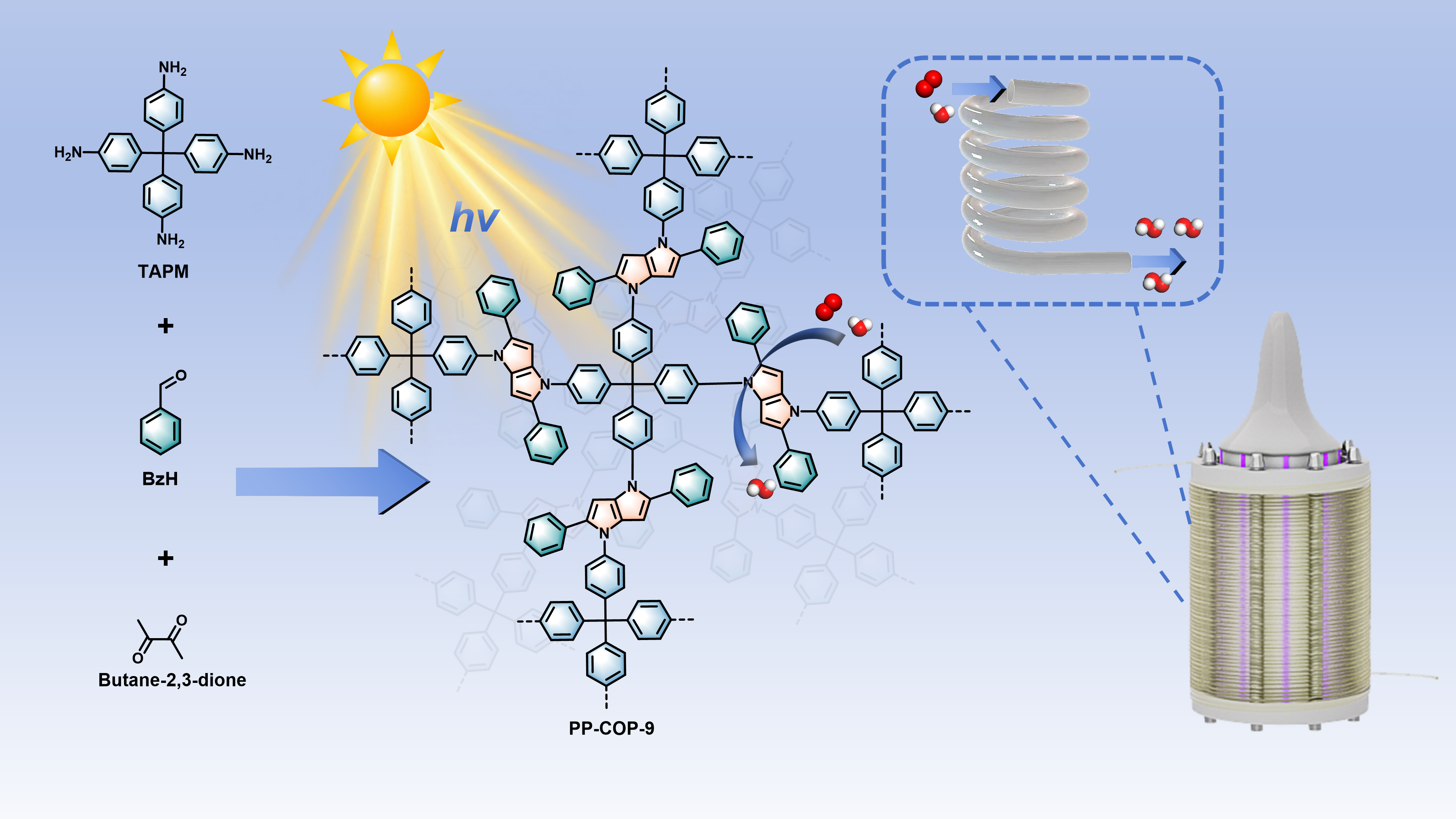
Photocatalytic hydrogen peroxide (H2O2) synthesis is often hindered by rapid charge recombination and sluggish oxygen activation. Herein, we report a three-dimensional pyrrolo[3,2-b]pyrrole-based covalent organic polymer (PP-COP-9) synthesized via a multicomponent cyclization strategy. The nonplanar 3D framework effectively regulates excited-state charge dynamics, achieving a high H2O2 production rate of 5269 μmol g−1 h−1 in pure water. By introducing benzyl alcohol as a hole scavenger, the rate surges to 118,936 μmol g−1 h−1, which is approximately 23 times higher than that in pure water due to efficient hole consumption and a favorable biphasic interface. Furthermore, PP-COP-9 demonstrates excellent stability and is successfully integrated into a continuous-flow photoreactor to maintain a stable H2O2 concentration of ~21.36 mM for 8 h. This work highlights the critical role of 3D framework engineering in boosting photocatalytic efficiency for practical H2O2 production.
- Open Access
- Article
Three-Dimensional Pyrrolo[3,2-b]pyrrole-Based Covalent Organic Polymers for Continuous H2O2 Production
- Xiaoyi Yue,
- Hao Chen,
- Shangrui Wu,
- Yingguo Li *,
- Danfeng Jiang,
- Xiao Chen and
- Chao Yu *
Author Information
Received: 05 September 2026 | Revised: 30 October 2026 | Accepted: 10 November 2026 | Published: 20 November 2026
Abstract
Graphical Abstract
Keywords
covalent organic polymers | 3D framework engineering | photocatalytic hydrogen peroxide (H2O2) synthesis | oxygen reduction reaction | continuous flow
References
- 1.
Liang, Y.; Wei, J.; Qiu, X.; et al. Homogeneous Oxygenase Catalysis. Chem. Rev. 2018, 118, 4912–4945. https://doi.org/10.1021/acs.chemrev.7b00193.
- 2.
Zhao, W.; Yan, P.; Li, B.; et al. Accelerated Synthesis and Discovery of Covalent Organic Framework Photocatalysts for Hydrogen Peroxide Production. J. Am. Chem. Soc. 2022, 144, 9902–9909. https://doi.org/10.1021/jacs.2c02666.
- 3.
Subramanian, G.; Prakash, H. Photo Augmented Copper-based Fenton Disinfection under Visible LED Light and Natural Sunlight Irradiation. Water Res. 2021, 190, 116719. https://doi.org/10.1016/j.watres.2020.116719.
- 4.
Yamanaka, I.; Murayama, T. Neutral H2O2 Synthesis by Electrolysis of Water and O2. Angew. Chem. Int. Ed. 2008, 47, 1900–1902. https://doi.org/10.1002/anie.200704431.
- 5.
Zhi, Q.; Liu, W.; Jiang, R.; et al. Piperazine-Linked Metalphthalocyanine Frameworks for Highly Efficient Visible-Light-Driven H2O2 Photosynthesis. J. Am. Chem. Soc. 2022, 144, 21328–21336. https://doi.org/10.1021/jacs.2c09482.
- 6.
Yuan, Y.; Chen, L.; Wan, Z.; et al. Electrocatalytic ORR–coupled ammoximation for efficient oxime synthesis. Sci. Adv. 2024, 10, eado1755. https://doi.org/10.1126/sciadv.ado1755.
- 7.
Yu, H.; Zhang, F.; Chen, Q.; et al. Vinyl-Group-Anchored Covalent Organic Framework for Promoting the Photocatalytic Generation of Hydrogen Peroxide. Angew. Chem. Int. Ed. 2024, 63, e202402297. https://doi.org/10.1002/anie.202402297.
- 8.
Burek, B.O.; Bormann, S.; Hollmann, F.; et al. Hydrogen peroxide driven biocatalysis. Green Chem. 2019, 21, 3232–3249. https://doi.org/10.1039/c9gc00633h.
- 9.
Fadaee, M.M.; Doyle, B.J.; Roberge, D.M.; et al. Liquid flow field and residence time distribution in a baffleless oscillatory flow coil reactor. Chem. Eng. J. 2024, 492, 151758. https://doi.org/10.1016/j.cej.2024.151758.
- 10.
Ma, H.; Zhang, Y.; Wu, Y.; et al. Regulation of charge carrier transportation in D–π–A type covalent organic frameworks for promoting photocatalytic H2O2 production. Chem. Sci. 2025, 16, 16668–16677. https://doi.org/10.1039/d5sc02875b.
- 11.
Wang, W.; Wang, L.; Sun, L.; et al. Se–Se bonds induced highly metallic 1T’ MoSe2.3 nanosheets cocatalysts towards boosted H2O2 photosynthesis over NH2-MIL-125 derived TiO2 nanotablets. Chem. Eng. J. 2023, 477, 146945. https://doi.org/10.1016/j.cej.2023.146945.
- 12.
Chai, X.; Gao, R.T.; Wang, L. Electron transport kinetics via ZnO with ultralow Fe dopant for stable oxygen reduction to H2O2. Chem. Eng. J. 2024, 484, 149527. https://doi.org/10.1016/j.cej.2024.149527.
- 13.
Jing, S.; Zhao, J.; Wang, A.; et al. Efficient photocatalytic production of H2O2 and photodegradation of tetracycline by CdS/square tubular g-C3N4 S-scheme heterojunction photocatalyst. Chem. Eng. J. 2024, 479, 147150. https://doi.org/10.1016/j.cej.2023.147150.
- 14.
Zhang, Q.; Wang, B.; Miao, H.; et al. Efficient photocatalytic H2O2 production over K+-intercalated crystalline g-C3N4 with regulated oxygen reduction pathway. Chem. Eng. J. 2024, 482, 148844. https://doi.org/10.1016/j.cej.2024.148844.
- 15.
Sun, C.; Shi, Y.; Unno, M.; et al. Hydrogen-Bond Engineered Porphyrin-Polyimide Aerogels for Sustainable Photocatalytic H2O2 Production from Water and O2. ACS Sustain. Chem. Eng. 2025, 13, 17422–17435. https://doi.org/10.1021/acssuschemeng.5c07062.
- 16.
Zhang, Y.; Lewis, R.J.; Li, Z.; et al. Direct Synthesis of H2O2 by Spatially Separate Hydrogen and Oxygen Activation Sites on Tailored Pt–Au Catalysts. Angew. Chem. Int. Ed. 2026, 65, e21118. https://doi.org/10.1002/anie.202521118.
- 17.
Kim, C.; Park, S.O.; Kwak, S.K.; et al. Concurrent oxygen reduction and water oxidation at high ionic strength for scalable electrosynthesis of hydrogen peroxide. Nat. Commun. 2023, 14, 5822. https://doi.org/10.1038/s41467-023-41397-1.
- 18.
Liu, R.; Chen, Y.; Yu, H.; et al. Linkage-engineered donor–acceptor covalent organic frameworks for optimal photosynthesis of hydrogen peroxide from water and air. Nat. Catal. 2024, 7, 195–206. https://doi.org/10.1038/s41929-023-01102-3.
- 19.
Kim, H.W.; Ross, M.B.; Kornienko, N.; et al. Efficient hydrogen peroxide generation using reduced graphene oxide-based oxygen reduction electrocatalysts. Nat. Catal. 2018, 1, 282–290. https://doi.org/10.1038/s41929-018-0044-2.
- 20.
Liu, Z.L.; Zhou, J.L.; Yuan, S.X.; et al. Asymmetry-Engineered g-C3N4 Nanosheets with Dual Electronic-Adsorption Modulation for High-Efficiency Solar-Driven H2O2 Synthesis. Adv. Funct. Mater. 2026, 36, e23126. https://doi.org/10.1002/adfm.202523126.
- 21.
Freese, T.; Meijer, J.T.; Feringa, B.L.; et al. An organic perspective on photocatalytic production of hydrogen peroxide. Nat. Catal. 2023, 6, 553–558. https://doi.org/10.1038/s41929-023-00980-x.
- 22.
Li, Y.; Chen, H.; Li, Z.; et al. Porous Functional Nanomaterials for Continuous Flow Catalysis. Nano-Micro Lett. 2026, 18, 300. https://doi.org/10.1007/s40820-026-02149-0.
- 23.
Choi, J.Y.; Check, B.; Fang, X.; et al. Photocatalytic Hydrogen Peroxide Production through Functionalized Semiconductive Metal-Organic Frameworks. J. Am. Chem. Soc. 2024, 146, 11319–11327. https://doi.org/10.1021/jacs.4c00681.
- 24.
Dong, T.; Xu, X.; Chen, L.; et al. Defective three-dimensional covalent organic frameworks for enhanced hydrogen peroxide photosynthesis and organic transformation. Nat. Commun. 2026, 17, 4505. https://doi.org/10.1038/s41467-026-71137-0.
- 25.
Huang, P.; Peng, Y.Y.; Wang, X.H.; et al. Charge-Distribution and Microenvironment Dual Regulation of Covalent Organic Frameworks for Enhancing Photocatalytic H2O2 and H2 Production. Adv. Mater. 2026, 38, e07849. https://doi.org/10.1002/adma.202507849.
- 26.
Luan, T.X.; Wei, Q.; Xin, C.; et al. Remarkably Enhancing H2O2 Photogeneration by Modulating Pore-Microenvironment of a Photoactive Covalent Organic Framework. Adv. Mater. 2026, 38, e15517. https://doi.org/10.1002/adma.202515517.
- 27.
Qin, L.; Yan, Y.; Wu, L.; et al. Spatial Confinement of Photogenerated Electrons at Catalytic Sites in Covalent Organic Frameworks for Efficient Photocatalytic H2O2 Production. Adv. Mater. 2026, 38, e73490. https://doi.org/10.1002/adma.73490.
- 28.
Nan, Q.; Ning, J.; Han, B.; et al. Boosting the photocatalytic H2O2 production of covalent organic frameworks with a heteroatom-locked acceptor and gas diffusion system. Chem. Sci. 2026, 17, 466–474. https://doi.org/10.1039/d5sc05346c.
- 29.
Zhu, S.; He, X.; Wang, L.; et al. Structural Dissimilation of Spirobifluorene-Based Conjugated Microporous Polymers for Efficient Overall Photoproduction of Hydrogen Peroxide. Adv. Funct. Mater. 2026, 36, e19832. https://doi.org/10.1002/adfm.202519832.
- 30.
Zhang, J.; Zhou, W.; Zhu, C.; et al. Regulating Built-in Electric Fields in Methylquinoline-Derived Vinylene-Linked Covalent Organic Frameworks for Enhanced Photocatalytic H2O2 Production. Angew. Chem. Int. Ed. 2026, 65, e24596. https://doi.org/10.1002/anie.202524596.
- 31.
Fu, M.; He, J.; Li, Y.; et al. Engineering Separated Dual O2 Reduction Cores into One Polymer Framework for Boosting Hydrogen Peroxide Production. Adv. Sci. 2025, 12, e08553. https://doi.org/10.1002/advs.202508553.
- 32.
Li, Y.; He, J.; Wang, C.; et al. Construction of pyrrolo[3,2-b]pyrrolyl-linked covalent organic polymers to promote continuous overall H2O2 production. Nano Energy 2024, 132, 110397. https://doi.org/10.1016/j.nanoen.2024.110397.
- 33.
Lan, W.; Liu, Q.; Jin, Y.; et al. Beyond Planar Architectures: Oxacalix[4]Arene-Bridged 3D Covalent Organic Frameworks with Saddle-Shaped π-Cavities for Efficient Hydrogen Peroxide Photogeneration and Non-Covalent C60 Confinement. Small 2025, 21, e07026. https://doi.org/10.1002/smll.202507026.
- 34.
Han, Y.; Huang, C.; Jin, Y.; et al. Enhanced photocatalytic H2O2 production via benzyl alcohol−boosted D−π−A covalent organic frameworks in industrial wastewater. Appl. Catal. B Environ. Energy 2026, 395, 126896. https://doi.org/10.1016/j.apcatb.2026.126896.
- 35.
Sun, T.; Wang, R.; Guan, R.; et al. Design strategies and application progress of covalent organic frameworks in photocatalytic oxidation reactions. Chem. Sci. 2026, 17, 1964–2000. https://doi.org/10.1039/d5sc08410e.
- 36.
Zheng, Y.; You, S.; Li, S.; et al. All-Conjugated Microporous Polymer Heterojunction with Hierarchical Hollow Sphere Architecture for Photocatalytic H2O2 Production. Adv. Funct. Mater. 2026, 36, e08538. https://doi.org/10.1002/adfm.202508538.
- 37.
Yang, K.; Chen, L.; Xiong, K.; et al. Bisite Sulfonate-Functionalized Covalent Organic Frameworks with Efficient and Dynamic Proton Transportation for Accelerating H2O2 Photosynthesis. Adv. Funct. Mater. 2026, 36, e20900. https://doi.org/10.1002/adfm.202520900.
- 38.
Long, Z.; Luo, K.; Wang, K.; et al. Covalent Organic Cage-Based Photocatalysts for Highly Efficient and Selective H2O2 Production. Adv. Mater. 2026, 38, e20264. https://doi.org/10.1002/adma.202520264.
- 39.
Xie, Z.; Chen, X.; Wang, W.; et al. Variation of Chemical Microenvironment of Pores in Hydrazone-Linked Covalent Organic Frameworks for Photosynthesis of H2O2. Angew. Chem. Int. Ed. 2024, 63, e202410179. https://doi.org/10.1002/anie.202410179.
- 40.
Feng, J.; Wei, Y.; Li, X.; et al. 3D-Printed COF/Zeolite Composites for Augmented Photocatalytic Hydrogen Peroxide Production. Angew. Chem. Int. Ed. 2025, 64, e202508226. https://doi.org/10.1002/anie.202508226.
- 41.
Gao, J.; Yin, C.; Tang, C.; et al. Ordered Ionic Nanochannels in Covalent Organic Frameworks for Photosynthesis of H2O2 From Ambient Air-Equilibrated Water. Angew. Chem. Int. Ed. 2026, 65, e7617241. https://doi.org/10.1002/anie.7617241.
- 42.
Zdražil, L.; Cadranel, A.; Zoppellaro, G.; et al. Enzyme-inspired single-atom photocatalysis for oxygen reduction to hydrogen peroxide. Nat. Commun. 2025, 16, 10949. https://doi.org/10.1038/s41467-025-67189-3.
- 43.
Zhu, X.; Chen, L.; Xiong, K.; et al. Extending Asymmetric π-Conjugation of Vinylene-Linked Covalent Organic Frameworks with Remodeled Redox Active Sites for H2O2 Photosynthesis and Aerobic Oxidations. J. Am. Chem. Soc. 2026, 148, 15099–15113. https://doi.org/10.1021/jacs.6c00731.
- 44.
Hu, S.Z.; Yue, M.N.; Liu, Y.; et al. Heterocycle-Linked Covalent Organic Frameworks with Indazole Units for Cooperative H2O2 Photosynthesis and Biomass Valorization. Angew. Chem. Int. Ed. 2026, 65, e8182546. https://doi.org/10.1002/anie.8182546.
- 45.
Liu, H.; Hou, Y.; Niu, X.; et al. Diphenoquinone-Based Covalent Organic Frameworks for Efficient H2O2 Production via Photothermal Synergistic Catalysis. Angew. Chem. Int. Ed. 2026, 65, e9372067. https://doi.org/10.1002/anie.9372067.
- 46.
Wang, Z.Q.; Zhu, Y.K.; Hu, Y.R.; et al. Local Electronic Modulation in Pillararene-Based Donor–Acceptor Conjugated Polymers for Selective Photocatalytic Oxygen Reduction. Angew. Chem. Int. Ed. 2026, 65, e9577048. https://doi.org/10.1002/anie.9577048.
- 47.
Lu, J.; Qi, W.; Gu, S.; et al. Dual Metal-Bridged 2D COF for High Performance of H2O2 Photosynthesis across Wide pH Range Activated by Dual Route Linkage. Angew. Chem. Int. Ed. 2026, 65, e9931408. https://doi.org/10.1002/anie.9931408.
- 48.
Peng, Y.; Yuan, L.; Liu, K.K.; et al. Photosynthesis of H2O2 using Phenothiazine-Based Covalent-Organic Frameworks Mimicking Coenzyme Q. Angew. Chem. Int. Ed. 2025, 64, e202423055. https://doi.org/10.1002/anie.202423055.
- 49.
Zhao, W.; Li, Z.; Ren, G.; et al. Triphenylene-Derived Polyimide Covalent Organic Frameworks for Efficient Photosynthesis of Hydrogen Peroxide. J. Am. Chem. Soc. 2026, 148, 20647–20656. https://doi.org/10.1021/jacs.6c01900.
- 50.
Tang, G.; Zhang, J.; Liang, G.; et al. Activating Triplet Excitons in COFs via Layer-Bridging Co Single Atoms for Photocatalytic H2O2 Production and Tandem C-N Coupling. Angew. Chem. Int. Ed. 2026, 65, e1580812. https://doi.org/10.1002/anie.1580812.
- 51.
Li, Y.; He, J.; Lu, G.; et al. De Novo construction of amine-functionalized metal-organic cages as heterogenous catalysts for microflow catalysis. Nat. Commun. 2024, 15, 7044. https://doi.org/10.1038/s41467-024-51431-5.
- 52.
Liu, F.; Hou, Y.; Wu, J.; et al. Spatially Manipulating Polar Centers of Covalent Organic Frameworks for Boosting Hydrogen Peroxide Photosynthesis and Water Purification. Angew. Chem. Int. Ed. 2026, 65, e2285238. https://doi.org/10.1002/anie.2285238.
- 53.
Chen, S.X.; Cao, X.; Wang, M.; et al. Stepwise Conjugation Extension of Covalent Organic Frameworks via Multicomponent Linkage Conversion for Optimized Photocatalytic Molecular Oxygen Activation. Angew. Chem. Int. Ed. 2026, 65, e9207753. https://doi.org/10.1002/anie.9207753.
- 54.
Li, Z.; Wang, Z.; Lan, D.; et al. Electronic Isolation Wall Engineering in Covalent Organic Frameworks for Enhancing Overall H2O2 Photosynthesis. ACS Catal. 2026, 16, 17456–17466. https://doi.org/10.1021/acscatal.6c05092.
- 55.
Lin, H.; Tan, G.; Ju, Y.; et al. Thiophene-Doped Fully Conjugated Covalent Organic Frameworks for Efficient Photocatalytic Hydrogen Peroxide Generation. CCS Chem. 2026, 8, 1393–1406. https://doi.org/10.31635/ccschem.025.202506161.
- 56.
Shu, C.; Yang, X.; Xie, P.; et al. Long-term photocatalytic hydrogen peroxide production by hydroquinone-buffered covalent organic frameworks. Chin. J. Catal. 2025, 73, 300–310. https://doi.org/10.1016/s1872-2067(25)64676-6.
- 57.
Jiang, P.; Huang, Y.; Jiang, X.; et al. Revealing the Mechanism of Exciton Spontaneous Separation at Room Temperature for Efficient Photocatalytic Hydrogen Peroxide Synthesis. Adv. Sci. 2025, 12, e03929. https://doi.org/10.1002/advs.202503929.
- 58.
Zhang, M.R.; Yuan, S.X.; Feng, Y.X.; et al. Heptazine-based conjugated microporous polymers for enhanced light absorption and charge separation in photocatalytic hydrogen peroxide production. J. Mater. Chem. A 2026, 14, 20173–20180. https://doi.org/10.1039/d6ta00689b. Correction in J. Mater. Chem. A 2026. https://doi.org/10.1039/d6ta90296k.
- 59.
Yan, H.; Jiang, J.; Huang, Y.; et al. Inter‐Ring Bonding Electron Donor Structure Triggers Efficient Two‐Electron Water Oxidation for Photocatalytic Hydrogen Peroxide Synthesis. Adv. Mater. 2026, 38, e07961. https://doi.org/10.1002/adma.202507961.
- 60.
Yang, J.; Zhao, Z.; Liu, X.; et al. Homologous heteropolyaromatic covalent organic frameworks for enhancing photocatalytic hydrogen peroxide production and aerobic oxidation. Nat. Commun. 2025, 16, 7654. https://doi.org/10.1038/s41467-025-62937-x.

This work is licensed under a Creative Commons Attribution 4.0 International License.