
Wireless motor drive (WMD) systems have been developed to address the problems of wire twists and motion limitations. Among various techniques, inductive power transfer (IPT)-based WMD systems have been widely adopted due to their high efficiency and power capacity. This review focuses on the circuit topologies and operating principles of IPT-based WMD systems. Existing WMD systems are categorized into two main architectures: cascaded and integrated structures. In cascaded structures, the IPT converter and the motor drive are implemented as separate stages. In contrast, integrated structures combine IPT and motor drive functions, typically through the use of multiple coils or matrix converters. The paper first examines various cascaded configurations, classified according to the voltage and current characteristics of the IPT output and the motor drive input. A comparative analysis between these topologies is then provided. Subsequently, the paper explores integrated structures, summarizing feasible multi-coil configurations and explaining the multiple frequency operation principle which is essential to such designs. Moreover, the application of matrix converters in WMD systems is reviewed, with a detailed discussion of their modulation strategies. Finally, based on the current state of research, the paper outlines existing challenges and proposes prospective directions for future development in the field.
- Open Access
- Review
An Overview of Wireless Motor Drive: From Cascaded Structure to Integrated Structure
- Xin Felix Chen 1,
- Yangbin Zeng 2,*,
- Chi K. Tse (IEEE Fellow) 1,
- C. Q. Jiang 1,
- Qianhong Chen 3,
- Ching-Ming Lai 4
Author Information
Received: 15 Jun 2026 | Revised: 25 Jul 2026 | Accepted: 28 Jul 2026 | Published: 04 Aug 2026
Abstract
Graphical Abstract
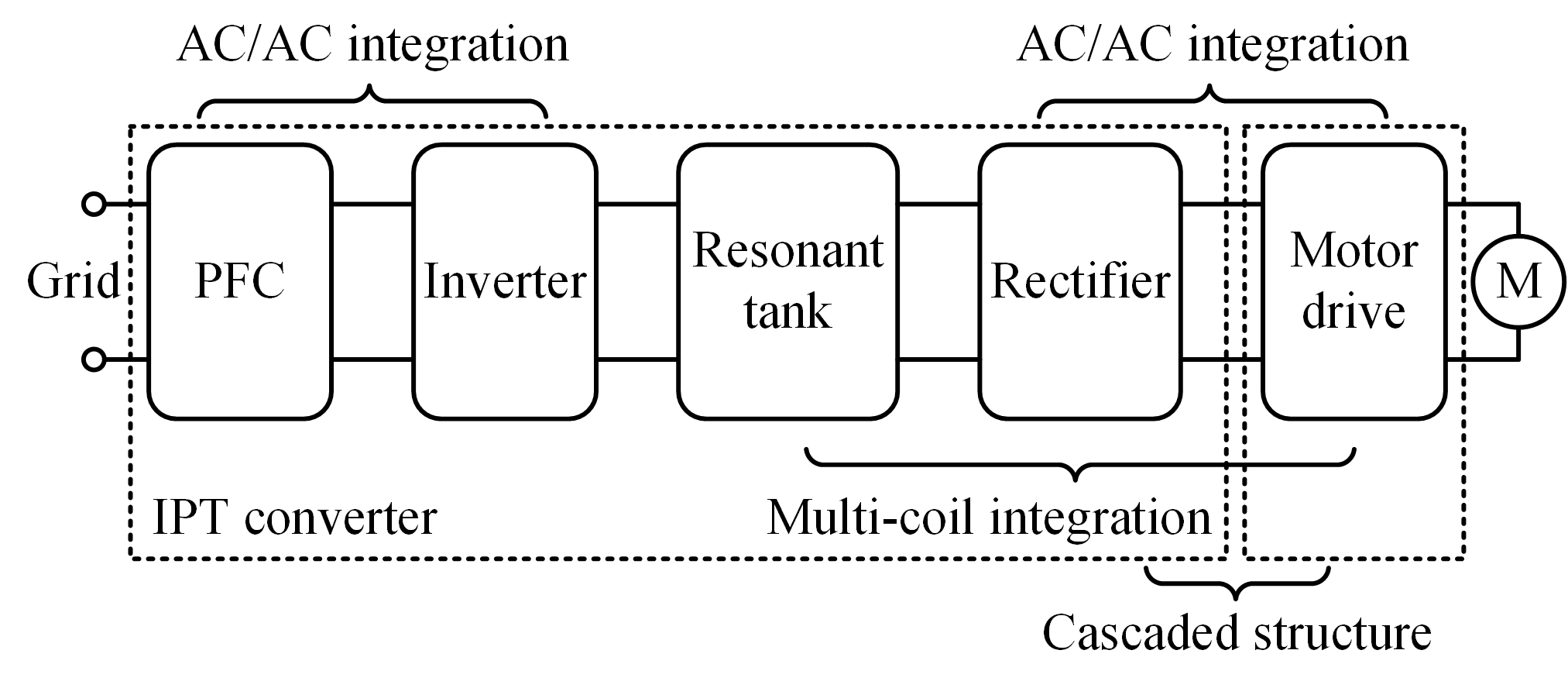
Keywords
cascaded structure | integrated structure | matrix converter | multi-coil | wireless motor drive
References
- 1.
Bosshard, R.; Kolar, J.W. Multi-Objective Optimization of 50 kW/85 kHz IPT System for Public Transport. IEEE J. Emerg. Sel. Top. Power Electron. 2016, 4, 1370–1382.
- 2.
Ahmad, A.; Alam, M.S.; Chabaan, R. A Comprehensive Review of Wireless Charging Technologies for Electric Vehicles. IEEE Trans. Transp. Electrif. 2018, 4, 38–63.
- 3.
Bagchi, A.C.; Kamineni, A.; Zane, R.A.; et al. Review and Comparative Analysis of Topologies and Control Methods in Dynamic Wireless Charging of Electric Vehicles. IEEE J. Emerg. Sel. Top. Power Electron. 2021, 9, 4947–4962.
- 4.
Chen, Q.; Wong, S.C.; Tse, C.K.; et al. Analysis, Design, and Control of a Transcutaneous Power Regulator for Artificial Hearts. IEEE Trans. Biomed. Circuits Syst. 2009, 3, 23–31.
- 5.
Knecht, O.; Kolar, J.W. Performance Evaluation of Series-Compensated IPT Systems for Transcutaneous Energy Transfer. IEEE Trans. Power Electron. 2019, 34, 438–451.
- 6.
Roy, S.; Azad, A.N.M.W.; Baidya, S.; et al. Powering Solutions for Biomedical Sensors and Implants Inside the Human Body: A Comprehensive Review on Energy Harvesting Units, Energy Storage, and Wireless Power Transfer Techniques. IEEE Trans. Power Electron. 2022, 37, 12237–12263.
- 7.
Jang, Y.; Jovanovic, M.M. A Contactless Electrical Energy Transmission System for Portable-Telephone Battery Chargers. IEEE Trans. Ind. Electron. 2003, 50, 520–527.
- 8.
Hui, S.Y.R.; Ho, W.C. A New Generation of Universal Contactless Battery Charging Platform for Portable Consumer Electronic Equipment. IEEE Trans. Power Electron. 2005, 20, 620–627.
- 9.
Hui, S.Y.R.; Zhong, W.; Lee, C.K. A Critical Review of Recent Progress in Mid-Range Wireless Power Transfer. IEEE Trans. Power Electron. 2014, 29, 4500–4511.
- 10.
Kikuchi, S.; Sakata, T.; Takahashi, E.; et al. Development of Wireless Power Transfer System for Robot Arm with Rotary and Linear Movement. In Proceedings of the 2016 IEEE International Conference on Advanced Intelligent Mechatronics (AIM), Banff, AB, Canada, 12–15 July 2016; pp. 1616–1621.
- 11.
Zhang, C.; Lin, D.; Hui, S.Y.R. Ball-Joint Wireless Power Transfer Systems. IEEE Trans. Power Electron. 2018, 33, 65–72.
- 12.
Matsumoto, H.; Shibako, Y.; Neba, Y. Contactless Power Transfer System for AGVs. IEEE Trans. Ind. Electron. 2018, 65, 251–260.
- 13.
Gunji, D.; Imura, T.; Fujimoto, H. Stability Analysis of Constant Power Load and Load Voltage Control Method for Wireless In-Wheel Motor. In Proceedings of the IEEE 9th International Conference on Power Electronics (ECCE Asia), Seoul, Korea, 1–5 June 2015; pp. 1944–1949.
- 14.
Sato, M.; Yamamoto, G.; Gunji, D.; et al. Development of Wireless In-Wheel Motor Using Magnetic Resonance Coupling. IEEE Trans. Power Electron. 2016, 31, 5270–5278.
- 15.
Sato, M.; Guidi, G.; Imura, T.; et al. Model for Loss Calculation of Wireless In-Wheel Motor Concept Based on Magnetic Resonant Coupling. In Proceedings of the IEEE 17th Workshop on Control and Modeling for Power Electronics, Trondheim, Norway, 27–30 June 2016; pp. 1–6.
- 16.
Fujimoto, H.; Shimizu, O.; Nagai, S.; et al. Development of Wireless In-Wheel Motors for Dynamic Charging: From 2nd to 3rd Generation. In Proceedings of the IEEE PELS Workshop on Emerging Technologies: Wireless Power Transfer, Seoul, Korea, 15–19 November 2020; pp. 56–61.
- 17.
Chen, X.F.; Tse, C.K.; Jiang, C.Q.; et al. Soft Switching Based Design of Wireless In-Wheel Motor Drive System with Series-Capacitor-Parallel Compensation. IEEE J. Emerg. Sel. Top. Ind. Electron. 2026, 14, 2655–2667.
- 18.
Chen, Y.; Gan, C.; Shi, H.; et al. Auxiliary-Circuit-Free Maximum Power Efficiency Tracking Scheme for Wireless Motor System with Source-Load Coupling. IEEE Trans. Ind. Electron. 2023, 70, 3414–3425.
- 19.
Chen, Y.; Gan, C.; Shi, H.; et al. DC-Link Voltage Control for Series-Parallel Wireless Motor without Communication Considering System Nonlinearity. In Proceedings of the IEEE 21st International Conference on Electrical Machines and Systems, Zhuhai, China, 5–8 November 2023; pp. 485–490.
- 20.
Chen, Y.; Gan, C.; Shi, H.; et al. Active Power Allocation Strategy for a Novel Wireless Open-Winding Motor System with Improved Antimisalignment Capability. IEEE Trans. Ind. Electron. 2023, 70, 12071–12081.
- 21.
Chen, Y.; Gan, C.; Shi, H.; et al. Efficiency Optimization and Resilience Improvement in Wireless Motor System with Flexible DC-Link Voltage Regulation. IEEE Trans. Energy Convers. 2023, 38, 1803–1814.
- 22.
Chen, S.; Ding, W.; Huo, L.; et al. Design of Double-LCC-Compensated Wireless PMSM System with Variable DC-Link Voltage Considering Efficiency Optimization and Dynamic Improvement. IEEE Trans. Power Electron. 2024, 39, 3186–3199.
- 23.
Dong, S.; Chen, Y.; Chen, X.; et al. Modeling and Stability Enhancement Method of Wireless Motor System Based on Damping Reconstruction Control. IEEE Trans. Power Electron. 2024, 39, 10651–10664.
- 24.
Jin, P.; Wang, H.; Xu, H.; et al. Stability Analysis for Three-Stage Serial PMSM Drive System Based on Bidirectional WPT. IEEE Trans. Ind. Electron. 2025, 72, 4526–4534.
- 25.
Huang, Y.; Gao, X.; Song, Z.; et al. A Novel Wireless Motor Based on Three-Phase Six-Stator-Winding PMSM. IEEE Trans. Ind. Electron. 2024, 71, 7590–7598.
- 26.
Liu, Y.; Wang, W.; Liu, S.; et al. A Compact Wireless Permanent Magnet Synchronous Motor System with Precise Speed and Position Control. IEEE Trans. Ind. Electron. 2024, 71, 11852–11863.
- 27.
Li, C.; Wang, Z.; Xu, Y. A Wireless-Power-Transfer-Based Three-Phase PMSM Drive System with Matrix Converter. IEEE Trans. Ind. Electron. 2023, 70, 2307–2317.
- 28.
Chen, X.F.; Tse, C.K.; Jiang, C.Q.; et al. Dual Matrix Converter Based Wireless Power Transfer System. IEEE Trans. Power Electron. 2025, 40, 18474–18488.
- 29.
Kim, J.H.; Lee, B.S.; Lee, J.H.; et al. Development of 1-MW Inductive Power Transfer System for a High-Speed Train. IEEE Trans. Ind. Electron. 2015, 62, 6242–6250.
- 30.
Xue, Z.; Chau, K.T.; Liu, W.; et al. Magnetic-Free Wireless Self-Direct Drive Motor System for Biomedical Applications with High-Robustness. IEEE Trans. Power Electron. 2024, 39, 2882–2891.
- 31.
Liu, W.; Chau, K.T.; Lee, C.H.T.; et al. Wireless Power and Drive Transfer for Piping Network. IEEE Trans. Ind. Electron. 2022, 69, 2345–2356.
- 32.
Liu, W.; Chau, K.T.; Wang, H.; et al. Long-Range Wireless Power Drive Using Magnetic Extender. IEEE Trans. Transp. Electrif. 2023, 9, 1897–1909.
- 33.
Jiang, C.; Chau, K.T.; Ching, T.W.; et al. Time-Division Multiplexing Wireless Power Transfer for Separately Excited DC Motor Drives. IEEE Trans. Magn. 2017, 53, 1–5.
- 34.
Jiang, C.; Chau, K.T.; Lee, C.H.T.; et al. A Wireless Servo Motor Drive with Bidirectional Motion Capability. IEEE Trans. Power Electron. 2019, 34, 12001–12010.
- 35.
Han, W.; Chau, K.T.; Hua, Z.; et al. Compact Wireless Motor Drive Using Orthogonal Bipolar Coils for Coordinated Operation of Robotic Arms. IEEE Trans. Magn. 2022, 58, 1–8.
- 36.
Liu, H.; Zhou, H.; Deng, Q.; et al. A Wireless DC Motor Drive Using LCCC-CCL Compensated Network with Bidirectional Motion Capability. IEEE Trans. Circuits Syst. I 2022, 69, 4714–4725.
- 37.
Ayaz, E.; Altun, O.; Polat, H.; et al. Concurrent Wireless Power Transfer and Motor Drive System with a Single Converter. IEEE J. Emerg. Sel. Top. Ind. Electron. 2023, 4, 409–418.
- 38.
Chen, X.F.; Tse, C.K.; Jiang, C.Q.; et al. Soft Switching Based Design of a Single-Stage Wireless DC Motor Drive System for Typical Mechanical Loads. IEEE Trans. Ind. Appl. 2024, 60, 8976–8987.
- 39.
Chen, X.F.; Tse, C.K.; Chen, Q. Electrolytic Capacitorless Wireless DC Motor Drive System with Delta-Sigma Modulation. In Proceedings of the IEEE Energy Conversion Congress and Exposition (ECCE), Phoenix, AZ, USA, 20–24 October 2024; pp. 2325–2327.
- 40.
Chen, X.F.; Tse, C.K.; Wang, X.; et al. Electrolytic Capacitor-Less Wireless Motor Drive System with Delta-Sigma Modulation. IEEE Trans. Ind. Electron. 2025, 72, 12355–12367.
- 41.
Babaki, A.; Vaez-Zadeh, S.; Zakerian, A.; et al. Analysis and Control of Wireless Motor Drives with a Single Inverter in Primary Side. IEEE Trans. Energy Convers. 2021, 36, 930–939.
- 42.
Wang, H.; Chau, K.T.; Lee, C.H.T.; et al. Design, Analysis, and Implementation of Wireless Shaded-Pole Induction Motors. IEEE Trans. Ind. Electron. 2021, 68, 6493–6503.
- 43.
Wang, H.; Chau, K.T.; Lee, C.H.T.; et al. Wireless Shaded-Pole Induction Motor with Half-Bridge Inverter and Dual-Frequency Resonant Network. IEEE Trans. Power Electron. 2021, 36, 13536–13545.
- 44.
Ayaz, E.; Altun, O.; Keysan, O. Carrier Phase Shift Method of SPWM for Concurrent Wired and Wireless Power Transfer Systems. IEEE Trans. Ind. Electron. 2023, 70, 8645–8654.
- 45.
Ayaz, E.; Altun, O.; Keysan, O. Variable Carrier Phase-Shift Method for Integrated Contactless Field Excitation System of Electrically Excited Synchronous Motors. IEEE Trans. Power Electron. 2023, 38, 13243–13253.
- 46.
Jin, P.; Chang, L.; Liu, Y.; et al. Design and Implementation of Novel Rotor Side Brushless Controller with Bidirectional Wireless Power Transmission for Doubly-Fed Machine. IEEE Trans. Ind. Electron. 2024, 71, 183–193.
- 47.
Ding, W.; Li, K.; Yuan, J.; et al. Wireless Power Transmission-Based In-Wheel Switched Reluctance Motor Drive System with an X-Type Converter. IEEE Trans. Energy Convers. 2023, 38, 450–462.
- 48.
Jiang, C.; Chau, K.T.; Liu, C.; et al. Design and Analysis of Wireless Switched Reluctance Motor Drives. IEEE Trans. Ind. Electron. 2019, 66, 245–254.
- 49.
Jiang, C.; Chau, K.T.; Liu, C.; et al. An LCC-Compensated Multiple-Frequency Wireless Motor System. IEEE Trans. Ind. Inf. 2019, 15, 6023–6034.
- 50.
Han, W.; Chau, K.T.; Hua, Z.; et al. An Integrated Wireless Motor System Using Laminated Magnetic Coupler and Commutative-Resonant Control. IEEE Trans. Ind. Electron. 2022, 69, 4342–4352.
- 51.
Wang, H.; Chau, K.T.; Lee, C.H.T.; et al. Design and Analysis of Wireless Resolver for Wireless Switched Reluctance Motors. IEEE Trans. Ind. Electron. 2023, 70, 2221–2230.
- 52.
Li, K.; Ding, W.; Yuan, J.; et al. A Decoupled Multichannel Based Wireless SRM System with Tunable Compensation Network and Multifrequency Pulse Density Control. IEEE Trans. Ind. Electron. 2024, 71, 1468–1480.
- 53.
Fang, L.; Zhou, H.; Hu, W.; et al. Design of Wireless Individual-Drive System for Variable-Reluctance Stepping Motor. IEEE Trans. Circuits Syst. II 2022, 69, 2141–2145.
- 54.
Wang, H.; Chau, K.T.; Liu, W.; et al. Design and Control of Wireless Permanent-Magnet Brushless DC Motors. IEEE Trans. Energy Convers. 2023, 38, 2969–2979.
- 55.
Madzharov, N.; Ilarionov, R.; Petkov, V.; et al. Inductive Power Transfer Systems for Rotating Applications. In Proceedings of the International Exhibition and Conference on Power Electronics, Intelligent Motion, Renewable Energy and Energy Management, Nuremberg, Germany, 5–7 June 2018; pp. 1–8.
- 56.
Abdolkhani, A.; Hu, A.P.; Nair, N.C.K. Modelling and Parameters Identification of Through-Hole Type Wind Turbine Contactless Sliprings. Engineering 2012, 4, 272–283.
- 57.
Abdolkhani, A.; Hu, A.P. Face to Face Through-Hole Contactless Slipring System for Rotary Applications. Int. J. Adv. Res. Electr. Electron. Instrum. Eng. 2013, 2, 4227–4286.
- 58.
He, G.; Chen, Q.; Ren, X.; et al. Modeling and Design of Contactless Sliprings for Rotary Applications. IEEE Trans. Ind. Electron. 2019, 66, 4130–4140.
- 59.
Papastergiou, K.D.; Macpherson, D.E. Contact-less Transfer of Energy by Means of a Rotating Transformer. In Proceedings of the IEEE International Symposium on Industrial Electronics, Dubrovnik, Croatia, 20–23 June 2005; pp. 1735–1740.
- 60.
Papastergiou, K.D.; Macpherson, D.E. An Airborne Radar Power Supply with Contactless Transfer of Energy—Part I: Rotating Transformer. IEEE Trans. Ind. Electron. 2007, 54, 2874–2884.
- 61.
Smeets, J.; Encica, L.; Lomonova, E.A. Comparison of Winding Topologies in a Pot Core Rotating Transformer. In Proceedings of the 12th International Conference on Optimization of Electrical and Electronic Equipment, Brasov, Romania, 20–22 May 2010; pp. 103–110.
- 62.
Abdolkhani, A.; Hu, A.P. A Novel Detached Magnetic Coupling Structure for Contactless Power Transfer. In Proceedings of the 37th Annual Conference of the IEEE Industrial Electronics Society, Melbourne, VIC, Australia, 7–10 November 2011; pp. 1103–1108.
- 63.
Bortis, D.; Fässler, L.; Looser, A.; et al. Analysis of Rotary Transformer Concepts for High-Speed Applications. In Proceedings of the 28th IEEE Applied Power Electronics Conference and Exposition, Long Beach, CA, USA, 17–21 March 2013; pp. 3262–3269.
- 64.
Abdolkhani, A.; Hu, A.P.; Nair, N.K.C. A Double Stator Through-Hole Type Contactless Slipring for Rotary Wireless Power Transfer Applications. IEEE Trans. Energy Convers. 2014, 29, 426–434.
- 65.
Raminosoa, T.; Wiles, R.H.; Wilkins, J. Novel Rotary Transformer Topology with Improved Power Transfer Capability for High-Speed Applications. IEEE Trans. Ind. Appl. 2020, 56, 277–286.
- 66.
Ditze, S.; Endruschat, A.; Schriefer, T.; et al. Inductive Power Transfer System with a Rotary Transformer for Contactless Energy Transfer on Rotating Applications. In Proceedings of the IEEE International Symposium on Circuits and Systems, Montreal, QC, Canada, 22–25 May 2016; pp. 1622–1625.
- 67.
Wang, N.; Zhao, Y.; Li, C.; et al. Design, Manufacture and Experimental Verification of Contactless Power Supply Coupler for Rotary Wireless Sensor Node of Water-Lubricated Bearing. IEEE Trans. Instrum. Meas. 2023, 72, 1–11.
- 68.
He, G.; Chen, Q.; Ren, X.; et al. LL-Delta Structure for CS Featuring High-PTC. IET Power Electron. 2019, 12, 2543–2550.
- 69.
Abdolkhani, A.; Hu, A.P. Improved Coupling Design of Contactless Slipring for Rotary Applications. IEEE J. Emerg. Sel. Top. Power Electron. 2015, 3, 288–295.
- 70.
Abdolkhani, A.; Hu, A.P. A Contactless Slipring System by Means of Axially Travelling Magnetic Field. In Proceedings of the IEEE Energy Conversion Congress and Exposition, Raleigh, NC, USA, 15–20 September 2012; pp. 1796–1803.
- 71.
Abdolkhani, A.; Hu, A.P. A Contactless Slipring System Based on Axially Travelling Magnetic Field. IEEE J. Emerg. Sel. Top. Power Electron. 2015, 3, 280–287.
- 72.
Abdolkhani, A.; Hu, A.P.; Covic, G.; et al. Contactless Slipring System Based on Rotating Magnetic Field Principle for Rotary Applications. In Proceedings of the IEEE Energy Conversion Congress and Exposition, Denver, CO, USA, 15–19 September 2013; pp. 2566–2573.
- 73.
Abdolkhani, A.; Hu, A.P.; Covic, G.A.; et al. Through-Hole Contactless Slipring System Based on Rotating Magnetic Field for Rotary Applications. IEEE Trans. Ind. Appl. 2014, 50, 3644–3655.
- 74.
Shin, J.; Shin, S.; Kim, Y.; et al. Design and Implementation of Shaped Magnetic-Resonance-Based Wireless Power Transfer System for Roadway-Powered Moving Electric Vehicles. IEEE Trans. Ind. Electron. 2014, 61, 1179–1192.
- 75.
Choi, S.Y.; Gu, B.W.; Jeong, S.Y.; et al. Advances in Wireless Power Transfer Systems for Roadway-Powered Electric Vehicles. IEEE J. Emerg. Sel. Top. Power Electron. 2015, 3, 18–36.
- 76.
Huh, J.; Lee, S.W.; Lee, W.Y.; et al. Narrow-Width Inductive Power Transfer System for Online Electrical Vehicles. IEEE Trans. Power Electron. 2011, 26, 3666–3679.
- 77.
Choi, S.Y.; Jeong, S.Y.; Gu, B.W.; et al. Ultraslim S-Type Power Supply Rails for Roadway-Powered Electric Vehicles. IEEE Trans. Power Electron. 2015, 30, 6456–6468.
- 78.
Wang, Z.; Cui, S.; Han, S.; et al. A Novel Magnetic Coupling Mechanism for Dynamic Wireless Charging System for Electric Vehicles. IEEE Trans. Veh. Technol. 2018, 67, 124–133.
- 79.
Miller, J.M.; Onar, O.C.; White, C.; et al. Demonstrating Dynamic Wireless Charging of an Electric Vehicle: The Benefit of Electrochemical Capacitor Smoothing. IEEE Power Electron. Mag. 2014, 1, 12–24.
- 80.
Guo, Y.; Wang, L.; Zhu, Q.; et al. Switching-On Modeling and Analysis of Dynamic Wireless Charging System Used for Electric Vehicles. IEEE Trans. Ind. Electron. 2016, 63, 658–6579.
- 81.
Tavakoli, R.; Pantic, Z. Analysis, Design, and Demonstration of a 25-kW Dynamic Wireless Charging System for Roadway Electric Vehicle. IEEE J. Emerg. Sel. Top. Power Electron. 2018, 6, 1378–1393.
- 82.
Liu, Y.; Mai, R.; Liu, D.; et al. Efficiency Optimization for Wireless Dynamic Charging System with Overlapped DD Coil Arrays. IEEE Trans. Power Electron. 2018, 33, 2832–2846.
- 83.
Gao, W.; Chen, Q.; Ren, X.; et al. An Elliptical Magnetic Field-Orientated Control for Interoperability and Misalignment Tolerance in Inductive Power Transfer. In Proceedings of the IEEE PELS Workshop on Emerging Technologies, Montreal, QC, Canada, 3–7 June 2018; pp. 1–6.
- 84.
Gao, J. Traveling Magnetic Field for Homogeneous Wireless Power Transmission. IEEE Trans. Power Del. 2007, 22, 507–514.
- 85.
Covic, G.A.; Boys, J.T.; Kissin, M.L.G.; et al. A Three-Phase Inductive Power Transfer System for Roadway-Powered Vehicles. IEEE Trans. Ind. Electron. 2007, 54, 3370–3378.
- 86.
Matsumoto, H.; Neba, Y.; Ishizaka, K.; et al. Model for a Three-Phase Contactless Power Transfer System. IEEE Trans. Power Electron. 2011, 26, 2676–2687.
- 87.
Li, Y.; Hu, J.; Lin, T.; et al. A New Coil Structure and Its Optimization Design with Constant Output Voltage and Constant Output Current for Electric Vehicle Dynamic Wireless Charging. IEEE Trans. Ind. Inf. 2019, 15, 5244–5256.
- 88.
Nagendra, G.R.; Covic, G.A.; Boys, J.T. Sizing of Inductive Power Pads for Dynamic Charging of EVs on IPT Highways. IEEE Trans. Transp. Electrif. 2017, 3, 405–417.
- 89.
Hou, J.; Chen, Q.; Zhang, Z.; et al. Analysis of Output Current Characteristics for Higher Order Primary Compensation in Inductive Power Transfer Systems. IEEE Trans. Power Electron. 2018, 33, 6807–6821.
- 90.
Zhang, Y.; Chen, Q.; Ren, X.; et al. Design of S/P Compensated IPT System Considering Parameter Variations in Consideration of ZVS Achievement. In Proceedings of the IEEE Energy Conversion Congress and Exposition, Milwaukee, WI, USA, 18–22 September 2016; pp. 1–6.
- 91.
Hou, J.; Chen, Q.; Wong, S.C.; et al. Analysis and Control of Series/Series-Parallel Compensated Resonant Converter for Contactless Power Transfer. IEEE J. Emerg. Sel. Top. Power Electron. 2015, 3, 124–136.
- 92.
Feng, H.; Cai, T.; Duan, S.; et al. An LCC-Compensated Resonant Converter Optimized for Robust Reaction to Large Coupling Variation in Dynamic Wireless Power Transfer. IEEE Trans. Ind. Electron. 2016, 63, 6591–6601.
- 93.
Mai, R.; Chen, Y.; Li, Y.; et al. Inductive Power Transfer for Massive Electric Bicycles Charging Based on Hybrid Topology Switching with a Single Inverter. IEEE Trans. Power Electron. 2017, 32, 5897–5906.
- 94.
Xu, F.; Wong, S.C.; Tse, C.K. Overall Loss Compensation and Optimization Control in Single-Stage Inductive Power Transfer Converter Delivering Constant Power. IEEE Trans. Power Electron. 2022, 37, 1146–1158.
- 95.
Chen, X.F.; Tse, C.K.; Jiang, C. Control and Soft Switching Analysis of a Single-Stage Wireless DC Motor Drive System. In Proceedings of the IEEE 11th International Conference on Power Electronics (ECCE Asia), Jeju Island, Korea, 22–25 May 2023; pp. 1018–1024.
- 96.
Lu, J.; Zhu, G.; Wang, H.; et al. Sensitivity Analysis of Inductive Power Transfer Systems with Voltage-Fed Compensation Topologies. IEEE Trans. Veh. Technol. 2019, 68, 4502–4513.
- 97.
Li, S.; Li, W.; Deng, J.; et al. A Double-Sided LCC Compensation Network and Its Tuning Method for Wireless Power Transfer. IEEE Trans. Veh. Technol. 2015, 64, 2261–2273.
- 98.
Schweizer, M.; Kolar, J.W. Design and Implementation of a Highly Efficient Three-Level T-Type Converter for Low-Voltage Applications. IEEE Trans. Power Electron. 2013, 28, 899–907.
- 99.
Huang, J.; Corzine, K.A. Extended Operation of Flying Capacitor Multilevel Inverters. IEEE Trans. Power Electron. 2006, 21, 140–147.
- 100.
Nabae, A.; Takahashi, I.; Akagi, H. A New Neutral-Point-Clamped PWM Inverter. IEEE Trans. Ind. Appl. 1981, IA-17, 518–523.
- 101.
Bruckner, T.; Bernet, S.; Guldner, H. The Active NPC Converter and Its Loss-Balancing Control. IEEE Trans. Ind. Electron. 2005, 52, 855–868.
- 102.
Hammond, P.W. A New Approach to Enhance Power Quality for Medium Voltage AC Drives. IEEE Trans. Ind. Appl. 1997, 33, 202–208.
- 103.
Akagi, H. Classification, Terminology, and Application of the Modular Multilevel Cascade Converter (MMCC). IEEE Trans. Power Electron. 2011, 26, 3119–3130.
- 104.
Wiechmann, E.P.; Aqueveque, P.; Burgos, R.; et al. On the Efficiency of Voltage Source and Current Source Inverters for High-Power Drives. IEEE Trans. Ind. Electron. 2008, 55, 1771–1782.
- 105.
Amorim Torres, R.; Dai, H.; Lee, W.; et al. Current-Source Inverter Integrated Motor Drives Using Dual-Gate Four-Quadrant Wide-Bandgap Power Switches. IEEE Trans. Ind. Appl. 2021, 57, 5183–5198.
- 106.
Wu, B.; Narimani, M. High-Power Converters and AC Drives; Wiley: Hoboken, NJ, USA, 2017.
- 107.
Chau, K.T. Electric Vehicle Machines and Drives: Design, Analysis and Application; Wiley-IEEE Press: Hoboken, NJ, USA, 2015.
- 108.
Ding, W.; Yang, S.; Hu, Y. Performance Improvement for Segmented-Stator Hybrid-Excitation SRM Drives Using an Improved Asymmetric Half-Bridge Converter. IEEE Trans. Ind. Electron. 2019, 66, 898–909.
- 109.
Barnes, M.; Pollock, C. Power Electronic Converters for Switched Reluctance Drives. IEEE Trans. Power Electron. 1998, 13, 1100–1111.
- 110.
Pollock, C.; Williams, B.W. Power Convertor Circuits for Switched Reluctance Motors with the Minimum Number of Switches. IEE Proc. B 1990, 137, 373–384.
- 111.
Mir, S.; Husain, I.; Elbuluk, M.E. Energy-Efficient C-Dump Converters for Switched Reluctance Motors. IEEE Trans. Power Electron. 1997, 12, 912–921.
- 112.
Krishnan, R.; Materu, P.N. Analysis and Design of a Low-Cost Converter for Switched Reluctance Motor Drives. IEEE Trans. Ind. Appl. 1993, 29, 320–327.
- 113.
Ray, W.F.; Lawrenson, P.J.; Davis, R.M.; et al. High-Performance Switched Reluctance Brushless Drives. IEEE Trans. Ind. Appl. 1986, IA-22, 722–730.
- 114.
Qu, X.; Jing, Y.; Han, H.; et al. Higher Order Compensation for Inductive Power-Transfer Converters with Constant-Voltage or Constant-Current Output Combating Transformer Parameter Constraints. IEEE Trans. Power Electron. 2017, 32, 394–405.
- 115.
Liu, Y.C.; Zhang, J.; Tse, C.K.; et al. General Pathways to Higher Order Compensation Circuits for IPT Converters via Sensitivity Analysis. IEEE Trans. Power Electron. 2021, 36, 9897–9906.
- 116.
Hou, J.; Chen, Q. Optimization of Current Source Inverter in Inductive Power Transfer Systems. In Proceedings of the 9th International Conference on Power Electronics (ECCE Asia), Nanjing, China, 29 November–2 December 2020; pp. 2969–2973.
- 117.
Xu, Y.; Wang, Z.; Liu, P.; et al. Current-Fed Isolated Three-Phase Matrix-Type Grid Inverter with Soft-Switching Capability. IEEE Trans. Ind. Electron. 2022, 69, 3292–3302.
- 118.
Kim, Y.J.; Ha, D.; Chappell, W.J.; et al. Selective Wireless Power Transfer for Smart Power Distribution in a Miniature-Sized Multiple-Receiver System. IEEE Trans. Ind. Electron. 2016, 63, 1853–1862.
- 119.
Zhang, Y.; Lu, T.; Zhao, Z.; et al. Selective Wireless Power Transfer to Multiple Loads Using Receivers of Different Resonant Frequencies. IEEE Trans. Power Electron. 2015, 30, 6001–6005.
- 120.
Xia, C.; Ren, S.; Chen, R.; et al. Inductive Power and Signal Synchronous Transmission Based on Parallel Paths of Fundamental Wave and Harmonic Wave. Autom. Electr. Power Syst. 2018, 42, 169–175. (In Chinese)
- 121.
Zhang, Z.; Li, X.; Pang, H.; et al. Multiple-Frequency Resonating Compensation for Multichannel Transmission of Wireless Power Transfer. IEEE Trans. Power Electron. 2021, 36, 5169–5180.
- 122.
Guo, M.; Chen, Q.; Chen, X.F.; et al. Analysis and Utilization of the Harmonic in Contactless Slipring System. In Proceedings of the 9th International Conference on Power Electronics (ECCE Asia), Nanjing, China, 29 November–2 December 2020; pp. 2997–3002.
- 123.
Li, H.L.; Hu, A.P.; Covic, G.A. A Direct AC-AC Converter for Inductive Power-Transfer Systems. IEEE Trans. Power Electron. 2012, 27, 661–668.
- 124.
Weerasinghe, S.; Madawala, U.K.; Thrimawithana, D.J. A Matrix Converter-Based Bidirectional Contactless Grid Interface. IEEE Trans. Power Electron. 2017, 32, 1755–1766.
- 125.
Samanta, S.; Rathore, A.K. A New Inductive Power Transfer Topology Using Direct AC-AC Converter with Active Source Current Waveshaping. IEEE Trans. Power Electron. 2018, 33, 5565–5577.
- 126.
Moghaddami, M.; Sarwat, A.I. Single-Phase Soft-Switched AC-AC Matrix Converter with Power Controller for Bidirectional Inductive Power Transfer Systems. IEEE Trans. Ind. Appl. 2018, 54, 3760–3770.
- 127.
Bac, N.X.; Vilathgamuwa, D.M.; Madawala, U.K. A Matrix Converter Based Inductive Power Transfer System. In Proceedings of the IEEE Conference on Power and Energy, Ho Chi Minh City, Vietnam, 12–14 December 2012; pp. 509–514.
- 128.
Xuan Bac, N.; Vilathgamuwa, D.M.; Madawala, U.K. A SiC-Based Matrix Converter Topology for Inductive Power Transfer System. IEEE Trans. Power Electron. 2014, 29, 4029–4038.
- 129.
Hayashi, Y.; Motoyama, H.; Takeshita, T. Wireless Power Transfer System Using Three-Phase to Single-Phase Matrix Converter. In Proceedings of the International Conference on Power Electronics (ECCE Asia), Niigata, Japan, 20–24 May 2018; pp. 356–362.
- 130.
Xiao, Y.; Liu, C. Direct Load Voltage Control for Electrolytic Capacitorless Wireless Power Transfer System without DC/DC Converter. IEEE Trans. Ind. Electron. 2021, 68, 8039–8048.
- 131.
Mirković, N.R.; Stojić, D.M.; Delgado, A.; et al. Novel Three Phase to Single Phase Matrix Converter Modulation Strategy for Bidirectional Inductive Power Transfer. IEEE Trans. Power Electron. 2023, 38, 14830–14846.
- 132.
Wei, Y.; Wu, F.; Wu, S.; et al. Improved Modulation Strategy for Three-Phase Matrix Converter-Based WPT System. IEEE Trans. Transp. Electrif. 2024, 10, 3396–3406.
- 133.
Moghaddami, M.; Anzalchi, A.; Sarwat, A.I. Single-Stage Three-Phase AC-AC Matrix Converter for Inductive Power Transfer Systems. IEEE Trans. Ind. Electron. 2016, 63, 6613–6622.
- 134.
Kolar, J.W.; Friedli, T.; Rodriguez, J.; et al. Review of Three-Phase PWM AC-AC Converter Topologies. IEEE Trans. Ind. Electron. 2011, 58, 4988–5006.
- 135.
Empringham, L.; Kolar, J.W.; Rodriguez, J.; et al. Technological Issues and Industrial Application of Matrix Converters: A Review. IEEE Trans. Ind. Electron. 2013, 60, 4260–4271.
- 136.
Jin, P.; Cao, C.; Guo, Y.; et al. A Novel SVM Strategy to Reduce Current Stress of 3-3 AC/AC HFLMC. IEEE Trans. Ind. Electron. 2026, 73, 6–15.
- 137.
Chen, X.F.; Tse, C.K.; Chen, Q. Improved Modulation Strategy for Single-Phase Integrated Wireless Charging System. In Proceedings of the IEEE 16th International Symposium on Power Electronics for Distributed Generation Systems (PEDG), Nanjing, China, 22–25 June 2025; pp. 1–6.
- 138.
Kumar, J.; Samanta, S. A Single-Stage Universal Input Wireless Inductive Power Transfer System with V2G Capability. IEEE J. Emerg. Sel. Top. Ind. Electron. 2024, 5, 1017–1029.
- 139.
Wang, R.; Wang, F.; Boroyevich, D.; et al. A High Power Density Single-Phase PWM Rectifier with Active Ripple Energy Storage. IEEE Trans. Power Electron. 2011, 26, 1430–1443.
- 140.
Wang, H.; Liu, Y.; Wang, H. On the Practical Design of a Two-Terminal Active Capacitor. IEEE Trans. Power Electron. 2019, 34, 10006–10020.
- 141.
She, X.; Huang, A.Q.; Burgos, R. Review of Solid-State Transformer Technologies and Their Application in Power Distribution Systems. IEEE J. Emerg. Sel. Top. Power Electron. 2013, 1, 186–198.
- 142.
Huber, J.E.; Kolar, J.W. Applicability of Solid-State Transformers in Today’s and Future Distribution Grids. IEEE Trans. Smart Grid 2019, 10, 317–326.
- 143.
Wang, J.; Li, Y.; Han, Y. Integrated Modular Motor Drive Design with GaN Power FETs. IEEE Trans. Ind. Appl. 2015, 51, 3198–3207.
- 144.
Jahns, T.M.; Sarlioglu, B. The Incredible Shrinking Motor Drive: Accelerating the Transition to Integrated Motor Drives. IEEE Power Electron. Mag. 2020, 7, 18–27.
- 145.
Casaucao Tenllado, I.; Triviño Cabrera, A.; Lin, Z. Simultaneous Wireless Power and Data Transfer for Electric Vehicle Charging: A Review. IEEE Trans. Transp. Electrif. 2024, 10, 4542–4570.
- 146.
Fan, Y.; Hu, H.; Sun, Y.; et al. A Simultaneous Wireless Power and Coil Inductance Insensitive Data Transfer System for Rotary Structures. IEEE Trans. Power Electron. 2024, 39, 6526–6536.
- 147.
Qiu, W.; Zhao, X.; Tyrrell, A.; et al. Application of Artificial Intelligence-Based Technique in Electric Motors: A Review. IEEE Trans. Power Electron. 2024, 39, 13543–13568.

This work is licensed under a Creative Commons Attribution 4.0 International License.

 Suite 4002 Level 4, 447 Collins Street, Melbourne, Victoria 3000, Australia
 General Inquiries: info@sciltp.com