
The journal Power Electronics Research and Applications Transactions (PERA Transactions) implements a rigorous and transparent peer review process to ensure the highest quality of publications, managed by the academic editor (Editor-in-Chief or an academic editor authorized by the Editor-in-Chief). We uphold that peer review should be efficient, thorough, and equitable for all participants. In PERA Transactions, the process involves a double-blind assessment by at least two independent reviewers, culminating in initial and final decisions by the academic editors. The academic editor is accountable for the academic integrity of the publication process and should ensure that any potential conflicts of interest are avoided.
The editorial process is summarized in the flowchart below.
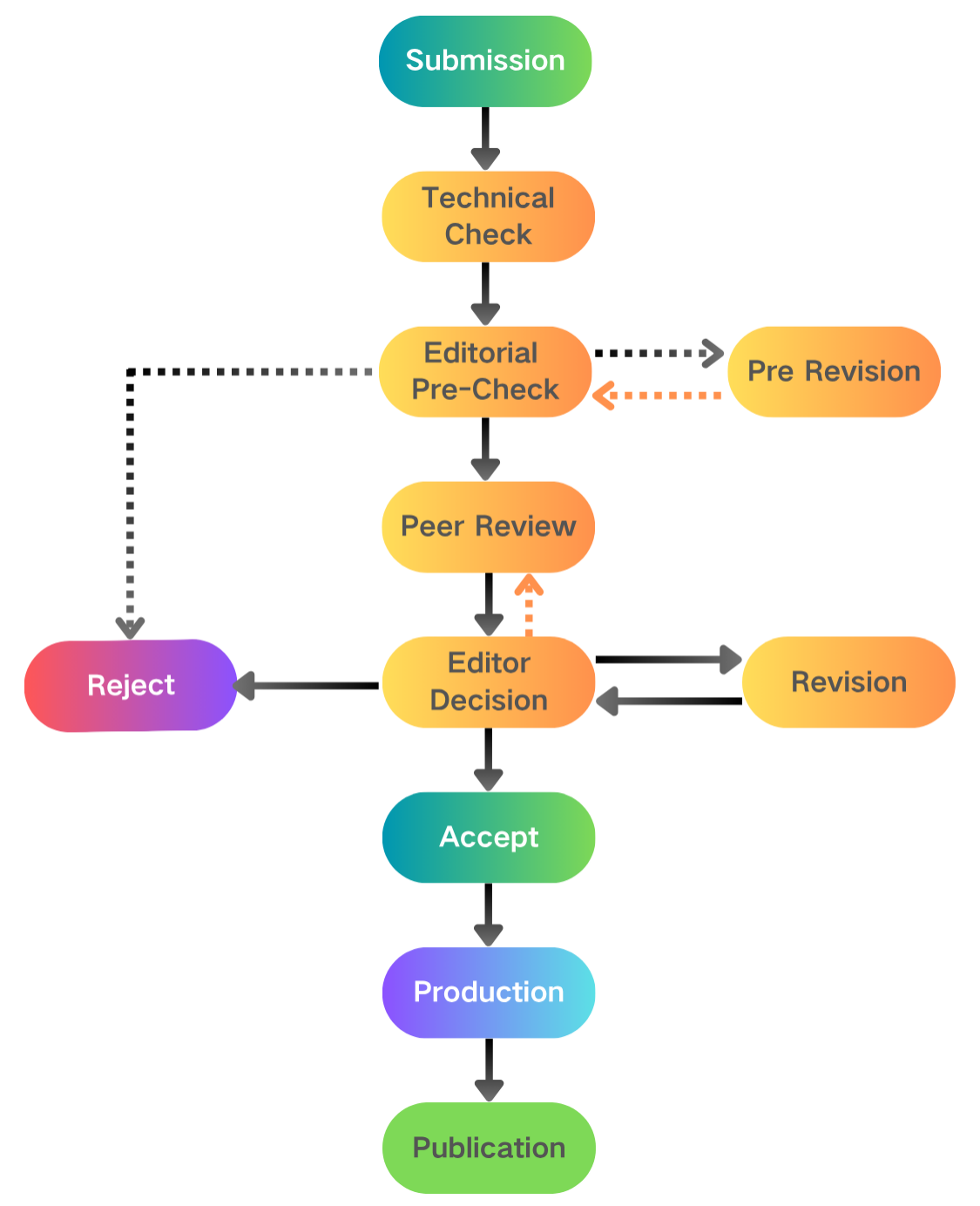
The PERA Transactions Editorial Process.
A Step-by-Step Guide to Article Publishing
1. Initial Submission
When you are ready to submit your manuscript, please use the journal’s online submission system. You will receive a notification together with a manuscript ID after successful submission.
2. Technical Pre-Check
We will ensure that your manuscript adheres to the journal’s guidelines for ethics, plagiarism, authorship, and copyright permissions, etc. We oversee this process to ensure that your manuscript contains everything our Academic editors and peer reviewers need to perform a fair and thorough assessment of your work.
3. Editorial Pre-Check
The Academic Editor (Usually the Editor-in-Chief or a member of the Editorial Board authorized by the Editor-in-Chief) will be notified of the submission and invited to conduct an editorial pre-check. During this phase, the EiC/Co-EiC will evaluate the manuscript’s alignment with the journal’s scope and its overall scientific rigor, including the relevance of references and the accuracy of the applied methodology. Based on this assessment, he may reject the manuscript, request revisions before peer review, or assign it to an Academic Editor to handle the peer review process.
4. Peer Review
The peer review process for PERA Transactions is double-blind, where the author remains unaware of the reviewer’s identity, and the reviewer is unaware of the identity of the authors. At least two review reports are collected for each manuscript. The peer review process not only acts as a filter to ensure only high-quality research is published but also provides feedback for authors to improve their work.
The Academic Editor selects reviewers based on their independence, expertise, recent related assessments, and ability to review within the required timeframe. Authors may suggest reviewers, although these suggestions may not always be followed. The editor will honor authors’ requests to exclude certain scientists from reviewing. Independent reviewers are typically selected from the global research community with great care.
These reviewers provide a critical evaluation of the manuscript’s validity and significance, offering their perspectives on its novelty, impact, and relevance to readers. Reviewers are advised to categorize their feedback into the following recommendations:
- Accept in Present Form
- Accept after Minor Revisions
- Reconsider after Major Revisions
- Reject
The reviewers’ recommendations are only visible to the Editor and Co-EiC/EiC and not the authors. Decisions regarding revision, acceptance, or rejection must always be well-substantiated. For transparency and clarity, the criteria for rejecting a paper are: a) lack of originality, meaning that exactly the same circuit/method, etc. was published previously. In such a case, it is the obligation of the reviewer to quote in detail the source, and the obligation of the Editor to check the complete similarity. b) mistakes in the development of the ideas, equations, etc., whose correction will change the conclusions of the paper completely, requiring the writing of a new paper.
Review reports are intended to guide the Academic Editor. Based on his own analysis, the Academic Editor consolidates all review reports received to reach a decision. The Editor will be careful to avoid contradictions between reviewers' recommendations, superfluous recommendations, or mistakes that could appear in the reviews. The Editor will decide if requests of the reviewers for citations of their papers are really necessary and will not include those not relevant in his consolidated review. Is his duty as Editor to clearly advise the authors on how to improve their paper, both regarding the content and the form, and particularly on how to put in evidence the original, innovative points of their research. The consolidated report together with the reviewers’ reports are transmitted to the Co-EiC/EiC in charge of the paper for his final approval. The Co-EiC/EiC in charge of the manuscript will verify the suitability of the reviewers, the reviews, and the consolidated report of the Editor. Occasionally, review reports may be edited to maintain anonymity and collegiality in the review process. Once approved, the EiC will forward the decision to the publisher together with the consolidated review report to be transmitted to the authors.
5. Revision
Authors are encouraged to thoroughly consider and address the Academic Editor’s comments. This process allows authors to improve their manuscripts accordingly. Authors can respond to editors’ comments, indicating changes made or justifying disagreements. A new cover letter with a point-by-point response to the editor’s comments should accompany the revised manuscript.
The Academic Editor will review this revised version and recommend revision/acceptance/rejection, or a second round of peer review.
6. Editor Decision Recommendation
The Academic Editor (usually the Editor-in-Chief or a member of the Editorial Board authorized by the Editor-in-Chief) recommends a decision when the initial or final peer review process is closed. The Academic Editor evaluates the suitability of reviewers, the adequacy of reviewers’ comments and authors’ responses, and the overall scientific quality of the paper. One of the following editorial options will be made by the academic editor, based on the reviewers’ recommendations and authors’ feedback:
- Accept in Present Form
- Minor Revision
- Major Revision
- Reject
Manuscripts are accepted only by the Academic Editor. The Academic Editor must disclose any potential conflicts of interest and alert the Editorial Office to any potential conflicts of interest. The Academic Editor's recommendation is forwarded to the Co-EiC or EiC.
7. Accept
Once the Editor-in-Chief or the Co-EiC authorized by him recommends “Accept in Present Form,” the manuscript will be accepted immediately, and all authors will receive a notification by email.
8. Production
The production team handles the production of all manuscripts. Authors will receive proofreading requests after the final editing of the manuscript. It is a necessary step to proofread the final version of the manuscript before publication online.
9. Publication Online
All articles are published online after proofreading approval by the authors.
The corresponding author's contact details will be featured online.
Update in June 2026

 Suite 4002 Level 4, 447 Collins Street, Melbourne, Victoria 3000, Australia
 General Inquiries: info@sciltp.com