
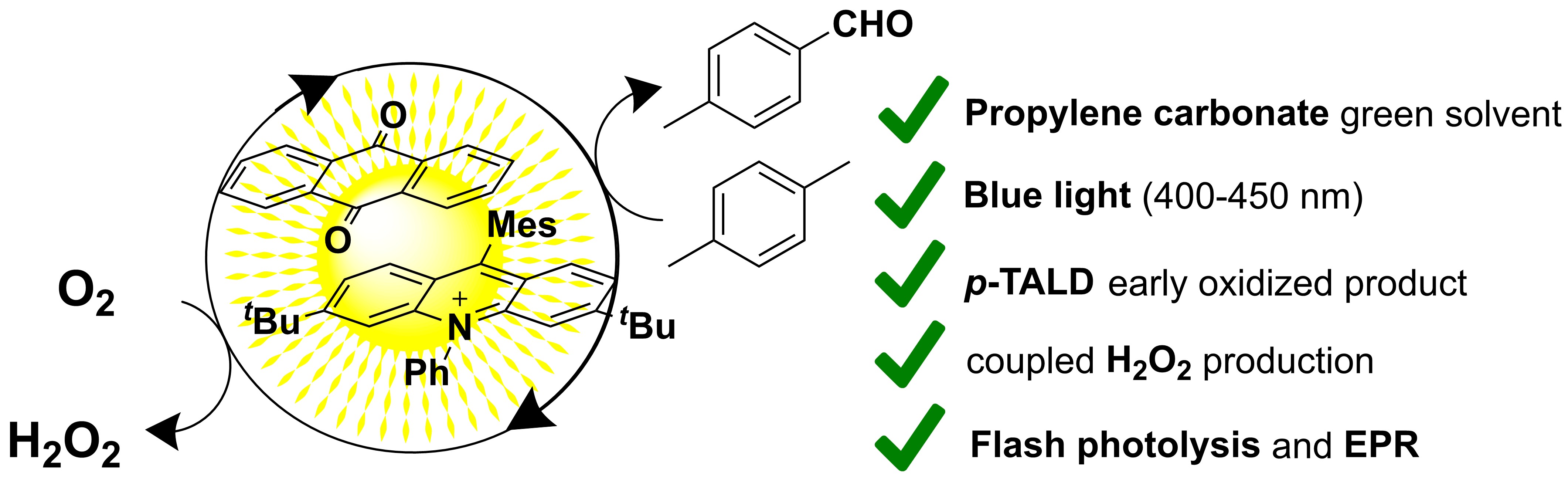
The aerobic photocatalytic oxidation of p-xylene to p-tolualdehyde (p-TALD) is reported here in propylene carbonate as a green solvent under visible light irradiation using organic photocatalysts, such as 9,10-anthraquinone (AQ) and 3,6-di-tert-butyl-9-mesityl-10-phenylacridinium (Acr+-1). Optimized conditions achieved up to 80–84% p-xylene conversion in 24 h, with p-TALD as the main product (up to 44% yield, 60% selectivity). The photooxidation is coupled to dioxygen reduction for H2O2 production, reaching concentrations up to 27 mM. Mechanistic investigation by laser flash photolysis and electron paramagnetic resonance spectroscopy revealed a non-innocent role of propylene carbonate, which promotes reductive quenching of 3*AQ, generating the radical anion AQ•– and dianion AQ2– reduced species of the photocatalyst. Upon aerobic oxidation, these are responsible for generation of reactive oxygen species such as superoxide radical anion (O2•–) and hydrogen peroxide (H2O2). The oxidation of p-xylene proceeds through a radical chain mechanism initiated by hydrogen atom transfer. The photocatalytic conditions were extended to other substrates bearing activated C–H bonds, demonstrating broad synthetic applicability.
- Open Access
- Article
Coupled Light-Driven p-Xylene Oxidation and H2O2 Production with Organic Photocatalysts in Propylene Carbonate
- Tao Wu 1,†,
- Arianna Gentilin 1,†,
- Federico Droghetti 2,
- Luca Morhart 1,3,
- Luka Ðorđević 1,*,
- Mirco Natali 2,*,
- Andrea Sartorel 1,*
Author Information
Received: 15 Jun 2026 | Revised: 13 Jul 2026 | Accepted: 24 Jul 2026 | Published: 04 Aug 2026
Abstract
Graphical Abstract
Keywords
organic photocatalyst | p-xylene | hydrogen peroxide | green solvent | reactive oxygen species
References
- 1.
Xiang, X.; Cheng, B.; Zhu, B.; et al. High-Entropy Alloy Nanocrystals Boosting Photocatalytic Hydrogen Evolution Coupled with Selective Oxidation of Cinnamyl Alcohol. Chin. J. Catal. 2025, 68, 326–335. https://doi.org/10.1016/S1872-2067(24)60167-1.
- 2.
Bhattacharjee, S.; Linley, S.; Reisner, E. Solar Reforming as an Emerging Technology for Circular Chemical Industries. Nat. Rev. Chem. 2024, 8, 87–105. https://doi.org/10.1038/s41570-023-00567-x.
- 3.
Barbieri, M.; Cappelletti, D.; Vaccarin, L.; et al. Supramolecular Dye Polymers for Aggregation-Induced Photocatalysis. Nat. Chem. 2026, 18, 1372–1382. https://doi.org/10.1038/s41557-026-02151-4.
- 4.
Li, X.; Xie, J.; Jiang, C.; et al. Review on Design and Evaluation of Environmental Photocatalysts. Front. Environ. Sci. Eng. 2018, 12, 14.
- 5.
Wang, H.; Li, X.; Zhao, X.; et al. A Review on Heterogeneous Photocatalysis for Environmental Remediation: From Semiconductors to Modification Strategies. Chin. J. Catal. 2022, 43, 178–214. https://doi.org/10.1016/S1872-2067(21)63910-4.
- 6.
Ahtasham, M.; Akram, S.; Lal, B.; et al. Advanced Photocatalysis as a Viable and Sustainable Wastewater Treatment Process: A Comprehensive Review. Environ. Res. 2024, 253, 118947. https://doi.org/10.1016/j.envres.2024.118947.
- 7.
Yang, Y.; Nalesso, M.; Basagni, A.; et al. Photocatalytic Oxidation of Glycerol with Red Light Employing Quinacridone Sensitized TiO2 Nanoparticles. J. Mater. Chem. A 2025, 13, 18436–18444. https://doi.org/10.1039/d5ta01970b.
- 8.
Stone, A.E.B.S.; Fortunato, A.; Wang, X.; et al. Photocatalytic Semi-Hydrogenation of Acetylene to Polymer-Grade Ethylene with Molecular and Metal–Organic Framework Cobaloximes. Adv. Mater. 2025, 37, 2408658. https://doi.org/10.1002/adma.202408658.
- 9.
Uekert, T.; Kuehnel, M.F.; Wakerley, W.; et al. Plastic Waste as a Feedstock for Solar-Driven H2 Generation. Energy Environ. Sci. 2018, 11, 2853–2857. https://doi.org/10.1039/c8ee01408f.
- 10.
Oh, S.; Stache, E.E. Chemical Upcycling of Commercial Polystyrene via Catalyst-Controlled Photooxidation. J. Am. Chem. Soc. 2022, 144, 5745–5749. https://doi.org/10.1021/jacs.2c01411.
- 11.
De Abreu, A.L.; Taton, D.; Bassani, D.M. Reassessing the Photochemical Upcycling of Polystyrene Using Acridinium Salts. Angew. Chem. Int. Ed. 2025, 64, e202418680. https://doi.org/10.1002/anie.202418680.
- 12.
Skolia, E.; Mountanea, O.G.; Kokotos, C.G. Photochemical Aerobic Upcycling of Polystyrene Plastics. ChemSusChem 2024, 17, e202400174. https://doi.org/10.1002/cssc.202400174.
- 13.
Tacchi, E.; Rossi, G.; Natali, M.; et al. Aqueous Photocatalytic Glycerol Oxidation to Formic Acid Coupled to H2O2 Production with an Anthraquinone Dye. Adv. Sustain. Syst. 2025, 9, 2400538. https://doi.org/10.1002/adsu.202400538.
- 14.
Tacchi, E.; Anxolabéhère-Mallart, E.; Aukauloo, A.; et al. Catalytic Oxygen Atom Transfer Through Photochemical and Electrochemical Activation of O2 or H2O. Angew. Chem. Novit 2025, 1, e70007. https://doi.org/10.1002/anov.70007.
- 15.
Tacchi, E.; Rossi, G.; Sartorel, A. Photocatalytic Oxidation of Alcohols with Organic Dyes: From Homogeneous Systems to Sensitized Materials. Chem. Eur. J. 2025, 31, e202501124. https://doi.org/10.1002/chem.202501124.
- 16.
Agarwal, R.G.; Coste, S.C.; Groff, B.D.; et al. Free Energies of Proton-Coupled Electron Transfer Reagents and Their Applications. Chem. Rev. 2022, 122, 1–49. https://doi.org/10.1021/acs.chemrev.1c00521.
- 17.
Sun, X.; Feng, Z.; Wang, S.; et al. Insight into the Role of TiO2 Facets in Photocatalytic Selective Oxidation of p-Xylene. ACS Catal. 2024, 14, 5356–5365. https://doi.org/10.1021/acscatal.4c00543.
- 18.
Lu, Y.; Yu, S.; Jin, J.; et al. Photocatalytic Conversion of p-Xylene into p-Tolualdehyde with near 100% Selectivity via a Novel Hydroxyl Radical-Mediated Oxygenation Route. J. Am. Chem. Soc. 2025, 147, 34891–34900. https://doi.org/10.1021/jacs.5c10960.
- 19.
Li, Z.; Dong, Y.; Zeng, Y.; et al. A Continuous-Flow Photocatalytic System for Highly Selective Oxidation of p-Xylene to Terephthalic Acid by Decatungstate Catalyst. Chin. J. Catal. 2024, 66, 282–291. https://doi.org/10.1016/S1872-2067(24)60134-8.
- 20.
Jiang, D.; Zhang, Q.; Yang, L.; et al. Regulating Effects of Anthraquinone Substituents and Additives in Photo-Catalytic Oxygenation of p-Xylene by Molecular Oxygen under Visible Light Irradiation. Renew. Energy 2021, 174, 928–938. https://doi.org/10.1016/j.renene.2021.04.100.
- 21.
Ohkubo, K.; Mizushima, K.; Iwata, R.; et al. Simultaneous Production of p-Tolualdehyde and Hydrogen Peroxide in Photocatalytic Oxygenation of p-Xylene and Reduction of Oxygen with 9-Mesityl-10-Methylacridinium Ion Derivatives. Chem. Commun. 2010, 46, 601–603. https://doi.org/10.1039/b920606j.
- 22.
Alberti, M.; Rossi, G.; Boucherabine, D.; et al. Photoactive Fe(III)Pyclen Complexes for Light-Driven Aerobic Oxidation of p-Xylene. Dalton Trans. 2026, 55, 1716–1726. https://doi.org/10.1039/d5dt02534f.
- 23.
Prudlik, A.; Matei, A.; Scherkus, A.; et al. On the Use of Propylene Carbonate and Dimethyl Carbonate as Green Solvents in Organic Electrosynthesis. Green Chem. 2025, 27, 4280–4288. https://doi.org/10.1039/d4gc06199c.
- 24.
Hou, H.; Zeng, X.; Zhang, X. Production of Hydrogen Peroxide by Photocatalytic Processes. Angew. Chem. Int. Ed. 2020, 59, 17356–17376. https://doi.org/10.1002/anie.201911609.
- 25.
Josephy, P.D.; Eling, T.; Mason, R.P. The Horseradish Peroxidase-Catalyzed Oxidation of 3,5,3′,5′-Tetramethylbenzidine. Free Radical and Charge-Transfer Complex Intermediates. J. Biol. Chem. 1982, 257, 3669–3675. https://doi.org/10.1016/s0021-9258(18)34832-4.
- 26.
Đorđević, L.; Jaynes, T.J.; Sai, H.; et al. Mechanical and Light Activation of Materials for Chemical Production. Adv. Mater. 2025, 37, 2418137. https://doi.org/10.1002/adma.202418137.
- 27.
Stoll, S.; Schweiger, A. EasySpin, a Comprehensive Software Package for Spectral Simulation and Analysis in EPR. J. Magn. Reson. 2006, 178, 42–55. https://doi.org/10.1016/j.jmr.2005.08.013.
- 28.
Zhang, W.; Gacs, J.; Arends, I.W.C.E.; et al. Selective Photooxidation Reactions Using Water-Soluble Anthraquinone Photocatalysts. ChemCatChem 2017, 9, 3821–3826. https://doi.org/10.1002/cctc.201700779.
- 29.
Xu, G.; Liang, Y.; Chen, F. Continuously Photocatalytic Production of H2O2 with High Concentrations Using 2-Ethylanthraquinone as Photocatalyst. J. Mol. Catal. A: Chem. 2016, 420, 66–72. https://doi.org/10.1016/j.molcata.2016.04.009.
- 30.
Gryszel, M.; Schlossarek, T.; Wurthner, F.; et al. Water-Soluble Cationic Perylene Diimide Dyes as Stable Photocatalysts for H2O2 Evolution. ChemPhotoChem 2023, 7, e202300070. https://doi.org/10.1002/cptc.202300070.
- 31.
Margrey, K.A.; McManus, J.B.; Bonazzi, S.; et al. Predictive Model for Site-Selective Aryl and Heteroaryl C–H Functionalization via Organic Photoredox Catalysis. J. Am. Chem. Soc. 2017, 139, 11288–11299. https://doi.org/10.1021/jacs.7b06715.
- 32.
Roth, H.G.; Oliver, S.F.; Campeau, L.; et al. Acridinium-Based Photocatalysts: A Sustainable Option in Photoredox Catalysis. J. Org. Chem. 2016, 81, 7244–7249. https://doi.org/10.1021/acs.joc.6b01240.
- 33.
Hulme, B.E.; Land, E.J.; Phillips, G.O. Pulse Radiolysis of 9,10-Anthraquinones. J. Chem. Soc., Faraday Trans. 1 1972, 68, 2003–2012. https://doi.org/10.1039/F19726802003.
- 34.
Hayano, S.; Fujihira, M. The Protonation of Aromatic Hydrocarbon Radical Anions. I. A Comparison of Methods and a Study of the Mechanism. Bull. Chem. Soc. Jpn. 1971, 44, 1496–1503.
- 35.
Kausche, T.; Sauberlich, J.; Trobitzsch, E.; et al. Photoreduction of 9,10-Anthraquinone by Triethylamine: A Fourier-Transform EPR Study. Chem. Phys. 1996, 208, 375–390.
- 36.
Gan, H.; Whitten, D.G. A Sterically Controlled Recyclable System: Reversible Photoredox Reactions between Anthraquinone and Hindered Tertiary Amines. J. Am. Chem. Soc. 1993, 115, 8031–8037.
- 37.
Cle, J.; Siri, D.; Karoui, H.; et al. Assignment of the EPR Spectrum of 5,5-Dimethyl-1-Pyrroline N-Oxide (DMPO) Superoxide Spin Adduct. J. Org. Chem. 2005, 70, 1198–1203.
- 38.
Villamena, F.A.; Locigno, E.J.; Rockenbauer, A.; et al. Theoretical and Experimental Studies of the Spin Trapping of Inorganic Radicals by 5,5-Dimethyl-1-Pyrroline N-Oxide (DMPO). 1. Carbon Dioxide Radical Anion. J. Phys. Chem. A 2006, 110, 13253–13258.
- 39.
Horsewill, S.J.; Sharrock, K.M.M.; Fehér, P.P.; et al. Counterintuitive Photochemistry of an Isolated Acridinyl Radical: ConPET via Preassembly, Solvated Electrons or a Long-Lived Excited State? Angew. Chem. Int. Ed. 2025, 64, e202506701. https://doi.org/10.1002/anie.202506701.
- 40.
MacKenzie, I.A.; Wang, L.; Onuska, N.P.R.; et al. Discovery and Characterization of an Acridine Radical Photoreductant. Nature 2020, 580, 76–80. https://doi.org/10.1038/s41586-020-2131-1.
- 41.
Oxley, J.C.; Brady, J.; Wilson, S.A.; et al. The Risk of Mixing Dilute Hydrogen Peroxide and Acetone Solutions. J. Chem. Health Saf. 2011, 19, 27–33. https://doi.org/10.1016/j.jchas.2011.07.010.
- 42.
Attanasio, D.; Suber, L. Aerobic and Anaerobic Photooxidation of p-Xylene in the Presence of Phosphotungstic Acid and Its Tetrabutyl Ammonium Salt. Inorg. Chem. 1989, 28, 3779–3781.
- 43.
Yuan, F.; Cao, P.; Sun, W.; et al. A Green Oxidation Process of p-Xylene to Terephthalic Acid through the UV Irradiation-Enhanced Ozonation Process. Ind. Eng. Chem. Res. 2024, 63, 8208–8215. https://doi.org/10.1021/acs.iecr.4c00895.


This work is licensed under a Creative Commons Attribution 4.0 International License.

 Suite 4002 Level 4, 447 Collins Street, Melbourne, Victoria 3000, Australia
 General Inquiries: info@sciltp.com