
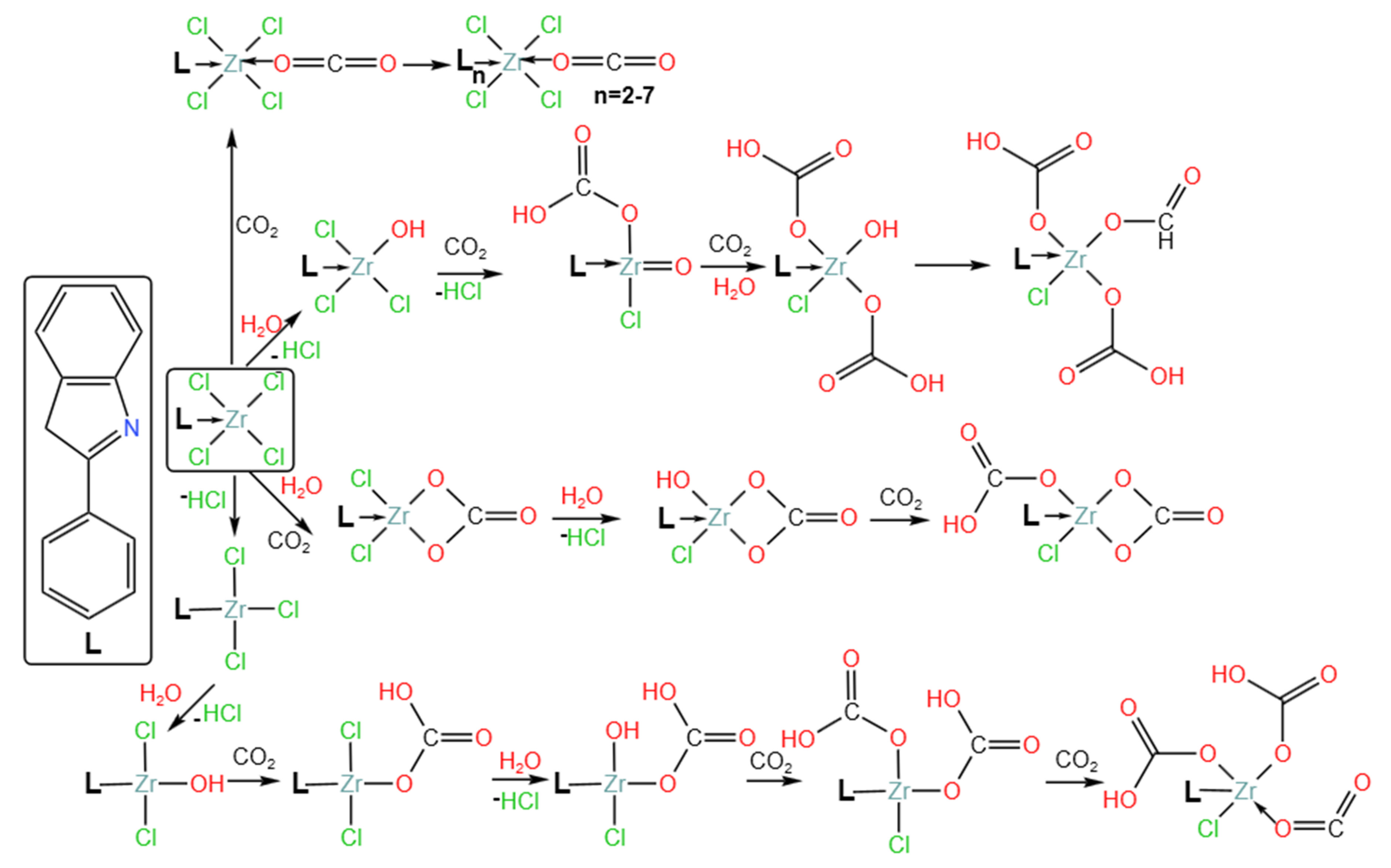
Hydrolyzed 2-phenylindole (PI)–ZrCl4 systems exhibit progressive atmospheric CO2 capture and molecular evolution under ambient light, air, and moisture, providing insight into the evolution of self-organizing zirconium coordination networks. MALDI-TOF, FTIR, and NMR analyses reveal the progressive formation of coordinated CO2 adducts together with carbonate-, bicarbonate-, and formate-containing zirconium species, demonstrating continuous evolution of oxygenated carbon environments during prolonged exposure. Time-dependent incorporation of secondary and tertiary CO2 units into zirconium-bound intermediates, accompanied by the emergence of oxygenated PI oligomer series and multinuclear zirconium assemblies, indicates progressive molecular evolution in which precursor and descendant species coexist, allowing sequential CO2 incorporation and network growth to be followed. The results further suggest that ligand oligomerization contributes to carbon retention and stabilization within the evolving zirconium matrix rather than serving solely as a deactivation pathway. In contrast to hydrolyzed titanium systems, which support formaldehyde-mediated carbon growth and carbon-chain propagation, the zirconium ensembles remain dominated by CO2 capture, carbonate stabilization, and oxygenated carbon accumulation. This behavior defines a distinct functional boundary between photocatalytic carbon capture and reactive artificial photosynthesis. The hydrolyzed PI–ZrCl4 ensembles therefore represent a dynamic photochemical platform in which hydrolysis, CO2 coordination, carbonate formation, oligomer evolution proceed cooperatively under ambient conditions. These findings establish hydrolyzed zirconium–indole systems as a dynamically evolving atmospheric CO2 capture platform whose behavior complements previously reported titanium systems. Moreover, combining the complementary properties of titanium and zirconium may provide a route toward integrating efficient atmospheric CO2 capture with subsequent photochemical carbon-conversion pathways.
- Open Access
- Article
Photochemical Atmospheric CO2 Capture and Accumulation in Hydrolyzed Zirconium–Indole Systems
Author Information
Received: 09 Jun 2026 | Revised: 13 Jul 2026 | Accepted: 04 Aug 2026 | Published: 24 Aug 2026
Abstract
Graphical Abstract
Keywords
photocatalytic CO2 capture | atmospheric CO2 utilization | zirconium photochemistry | artificial photosynthesis | carbonate complexes | oxygenated carbon accumulation | hydrolyzed zirconium ensembles
References
- 1.
Kondratenko, E.V.; Mul, G.; Baltrusaitis, J.; et al. Status and Perspectives of CO2 Conversion into Fuels and Chemicals. Energy Environ. Sci. 2013, 6, 3112–3135.
- 2.
Appel, A.M.; Bercaw, J.E.; Bocarsly, A.B.; et al. Frontiers, Opportunities, and Challenges in Biochemical and Chemical Catalysis of CO2 Fixation. Chem. Rev. 2013, 113, 6621–6658.
- 3.
Aresta, M.; Dibenedetto, A.; Angelini, A. The Changing Paradigm in CO2 Utilization. J. CO2 Util. 2013, 3–4, 65–73.
- 4.
Desmons, S.; Bonin, J.; et al. Four-Electron Reduction of CO2: From Formaldehyde and Acetal Synthesis to Complex Transformations. Chem. Sci. 2024, 15, 15023–15086.
- 5.
Pica, M.; Donnadio, A.; Casciola, M. From Microcrystalline to Nanosized α-Zirconium Phosphate: Synthetic Approaches and Applications of an Old Material with a Bright Future. Coord. Chem. Rev. 2018, 374, 218–235.
- 6.
Clearfield, A. Role of Ion Exchange in Solid-State Chemistry. Chem. Rev. 1988, 88, 125–148.
- 7.
Daliran, S.; Oveisi, A.R.; Kung, C.-W.; et al. Defect-Enabling Zirconium-Based Metal–Organic Frameworks for Energy and Environmental Remediation Applications. Chem. Soc. Rev. 2024, 53, 6244–6294.
- 8.
Schneider, J.; Matsuoka, M.; Takeuchi, M.; et al. Understanding TiO2 Photocatalysis: Mechanisms and Materials. Chem. Rev. 2014, 114, 9919–9986.
- 9.
Li, M.; Zhang, H.; Li, C.; et al. Zirconium-Based Metal–Organic Frameworks for Photocatalytic CO2 Reduction. Precis. Chem. 2025, 3, 424–450.
- 10.
Liu, L.; Zhao, H.; Andino, J.M.; et al. Photocatalytic CO2 Reduction with H2O on TiO2: Comparison of Anatase, Rutile, and Brookite Polymorphs and Exploration of Surface Chemistry. ACS Catal. 2012, 2, 1817–1828.
- 11.
Habisreutinger, S.N.; Schmidt-Mende, L.; Stolarczyk, J.K. Photocatalytic Reduction of CO2 on TiO2 and Other Semiconductors. Angew. Chem. Int. Ed. 2013, 52, 7372–7408.
- 12.
Fujishima, A.; Honda, K. Electrochemical Photolysis of Water at a Semiconductor Electrode. Nature 1972, 238, 37–38.
- 13.
Paraskevas, M.S.; Arzoumanidis, G.G. Artificial Photosynthesis: Visible Light-Activated TiOCl2/2-Phenyl Indole Complexes for Atmospheric CO2 and H2O Capture and Long-Chain Organic Products Generation. Fine Chem. Eng. 2024, 5, 369–394.
- 14.
Arzoumanidis, G.G.; Paraskevas, M.S. C6 to C17 Organic Products from Artificial Photosynthesis Catalyzed by 2-Phenylindole Titanium Tetrachloride Complex: The Synergism of Hydroxyl Radicals. Fine Chem. Eng. 2024, 6, 139–150.
- 15.
Arzoumanidis, G.G.; Paraskevas, M.S. Redox-Active Titanium–2-Phenylbenzoxazole Solids as Light-Responsive Materials for Photocatalysis under Ambient Conditions. ACS Appl. Energy Mater. 2025, 8, 10899–10911.
- 16.
Arzoumanidis, G.G.; Paraskevas, M.S. A Universal Framework for Ligand-Directed Artificial Photosynthesis by Hydrolyzed Titanium Complexes. ChemRxiv 2025. https://doi.org/10.26434/chemrxiv-2025-c2jj4.
- 17.
Rahman, F.; Sawaguchi, K.; Motswaiso, F.; et al. Novel Binary Ti–Zr, Ti–Ce, and Zr–Ce Oxides as Dual-Function Adsorbents and Reaction Accelerators for CO2 Capture and Ethylene Urea Synthesis. Sci. Rep. 2025, 15, 33567.
- 18.
Gates, B.C. Supported Metal Clusters: Synthesis, Structure, Catalysis. Chem. Rev. 1995, 95, 511–522.
- 19.
Freund, H.-J.; Nilius, N.; Risse, T.; et al. A Fresh Look at an Old Nano-Technology: Catalysis. Phys. Chem. Chem. Phys. 2014, 16, 8148–8167.


This work is licensed under a Creative Commons Attribution 4.0 International License.

 Suite 4002 Level 4, 447 Collins Street, Melbourne, Victoria 3000, Australia
 General Inquiries: info@sciltp.com