
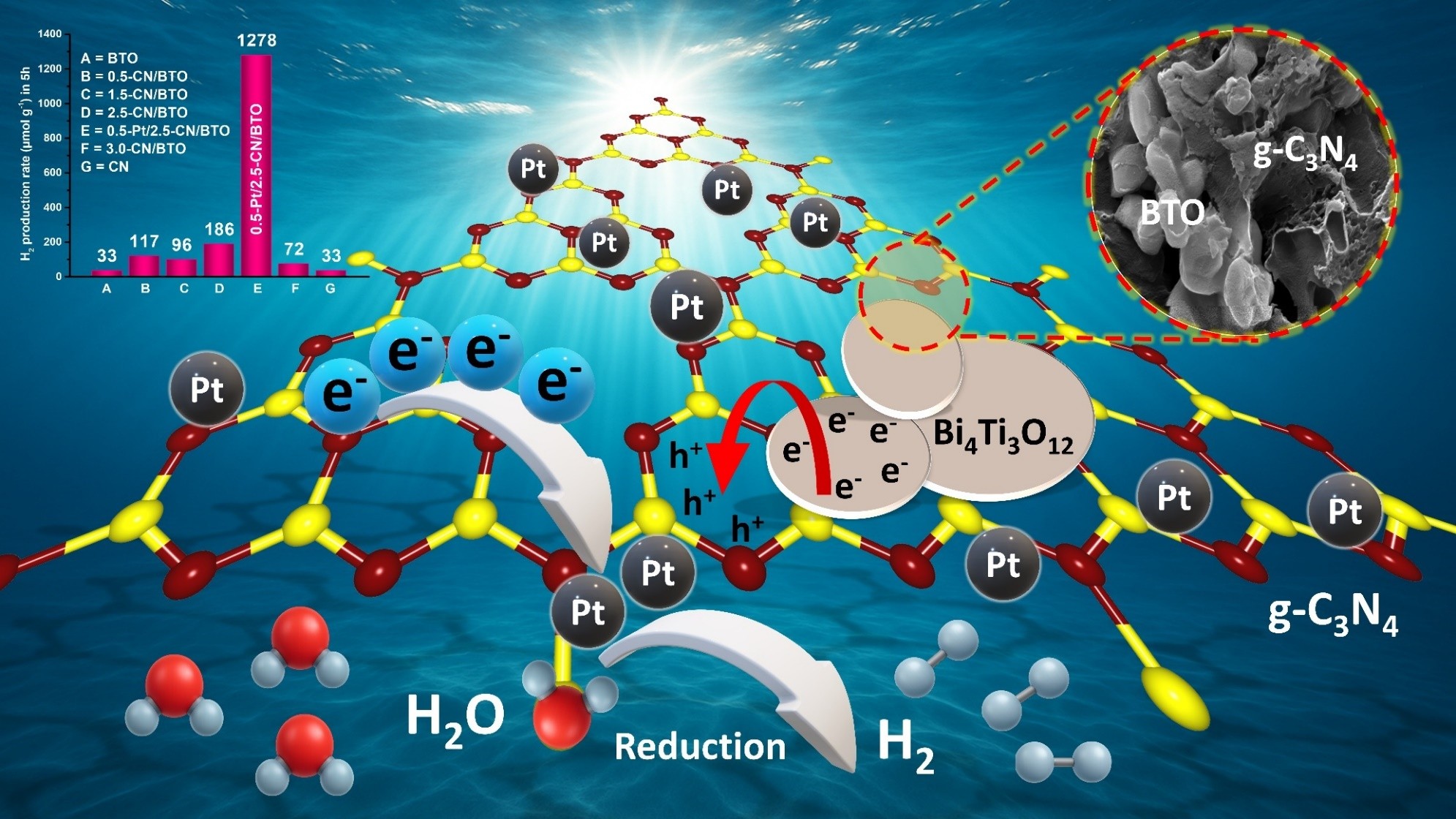
Efficient photocatalytic H2 evolution requires coordinated control of light absorption, interfacial charge transfer, and surface reduction kinetics. Here, g-C3N4/Bi4Ti3O12 (CN/BTO) heterojunctions were constructed by in-situ thermal coupling and subsequently modified through in-situ photodeposition of Pt. Among the investigated compositions, 2.5-CN/BTO showed the highest activity before Pt addition. Structural, optical, and electrochemical analyses indicate effective coupling between CN and layered BTO, while EPR measurements and band-position analysis are consistent with a direct Z-scheme charge-transfer pathway. Pt nanoparticles were found preferentially on CN-rich regions, supporting electron accumulation at the CN side of the heterostructure during photocatalysis. Pt incorporation increased the H2 production to 1278 μmol g−1 during the first 5 h, approximately 39 times that of pristine CN and BTO under the same conditions. Reuse tests revealed a pronounced loss of activity after the first cycle, followed by a slower decline, with H2 production of 360, 351, and 300 μmol g−1 over 5 h in cycles 2–4. Post-reaction analyses indicate structural and surface modification of the CN component, accompanied by localized Pt clustering, whereas the crystalline BTO phase remains largely preserved. The study therefore establishes the beneficial role of CN/BTO interfacial coupling and Pt cocatalysis in promoting H2 evolution, while revealing the structural evolution that limits sustained photocatalytic performance.
- Open Access
- Article
Pt-Loaded Z-Scheme g-C3N4/Bi4Ti3O12 Heterostructure for Enhanced Photocatalytic H2 Evolution
Author Information
Received: 20 Jun 2026 | Revised: 13 Aug 2026 | Accepted: 20 Aug 2026 | Published: 11 Sep 2026
Abstract
Graphical Abstract
Keywords
Aurivillius bismuth titanate | layered perovskite titanate | g-C3N4 | heterojunction | photocatalytic H2 evolution
References
- 1.
Liang, F.Y.; Huang, H.W.; Chen, Y.C.; et al. Enhanced Solar-Driven Photocatalysis with CuTCPP/g-C3N4 for Hydrogen Production and Environmental Remediation. Energy Fuels 2025, 39, 6533–6548. https://doi.org/10.1021/acs.energyfuels.5c00254.
- 2.
Liu, S.; Wang, M.; Wang, S.; et al. Construction of Porphyrin-Based Two-Dimensional Covalent Organic Frameworks for Photocatalytic Hydrogen Production. Catal. Sci. Technol. 2024, 14, 4236–4244. https://doi.org/10.1039/d4cy00531g.
- 3.
Qiu, C.; Xu, M.; Han, S.; et al. Building Monolayer Ti0.91O2 Nanosheets to Enhance Hydrogen Production for Photocatalytic Water Splitting. Catal. Sci. Technol. 2025, 15, 5827–5836. https://doi.org/10.1039/d5cy00577a.
- 4.
Vidhya, C.; Meera, B.; Nair, R.B.; et al. Enhanced Photocatalytic Hydrogen Evolution through Suppressed Electron–Hole Recombination in Cs2AgBiBr6-NC/g-C3N4 Nanocomposites. Catal. Sci. Technol. 2024, 14, 746–757. https://doi.org/10.1039/d3cy01494k.
- 5.
Ma, D.; Zhang, Z.; Zou, Y.; et al. The Progress of g-C3N4 in Photocatalytic H2 Evolution: From Fabrication to Modification. Coord. Chem. Rev. 2024, 500, 215489. https://doi.org/10.1016/j.ccr.2023.215489.
- 6.
Yin, Z.; Zhen, W.; Ning, X.; et al. Stability Enhancement of an Integrated ZnO/Zn3As2/SrTiO3 Photocatalyst for Photocatalytic Overall Water Splitting. Catal. Sci. Technol. 2025, 15, 4259–4265. https://doi.org/10.1039/d5cy00427f.
- 7.
Xie, L.; Zhu, P.; Xu, J.; et al. Highly Efficient Bi4Ti3O12/g-C3N4/BiOBr Dual Z-Scheme Heterojunction Photocatalysts with Enhanced Visible Light-Responsive Activity for the Degradation of Antibiotics. Langmuir 2022, 38, 9532–9545. https://doi.org/10.1021/acs.langmuir.2c00907.
- 8.
Tang, Q.; Wu, J.; Chen, X.Z.; et al. Tuning Oxygen Vacancies in Bi4Ti3O12 Nanosheets to Boost Piezo-Photocatalytic Activity. Nano Energy 2023, 108, 108202. https://doi.org/10.1016/j.nanoen.2023.108202.
- 9.
Casadio, S.; Gondolini, A.; Sangiorgi, N.; et al. Highly Transparent Bi4Ti3O12 Thin-Film Electrodes for Ferroelectric-Enhanced Photoelectrochemical Processes. Sustain. Energy Fuels 2023, 7, 1107–1118. https://doi.org/10.1039/d2se01372j.
- 10.
Xie, Z.; Tang, X.; Shi, J.; et al. Excellent Piezo-Photocatalytic Performance of Bi4Ti3O12 Nanoplates Synthesized by Molten-Salt Method. Nano Energy 2022, 98, 107247. https://doi.org/10.1016/j.nanoen.2022.107247.
- 11.
Jia, G.; Sun, F.; Zhou, T.; et al. Charge Redistribution of a Spatially Differentiated Ferroelectric Bi4Ti3O12 Single Crystal for Photocatalytic Overall Water Splitting. Nat. Commun. 2024, 15, 4746. https://doi.org/10.1038/s41467-024-49168-2.
- 12.
Liu, Z.; An, Y.; Zhang, W.; et al. Au Nanoparticles Modified Oxygen-Vacancies-Rich Bi4Ti3O12 Heterojunction for Efficient Photocatalytic NO Removal with High Selectivity. J. Alloys Compd. 2023, 942, 169018. https://doi.org/10.1016/j.jallcom.2023.169018.
- 13.
Lei, R.; Fu, X.; Chen, N.; et al. Cocatalyst Engineering to Weaken the Charge Screening Effect over Au–Bi4Ti3O12 for Piezocatalytic Pure Water Splitting. Catal. Sci. Technol. 2022, 12, 7361–7368. https://doi.org/10.1039/d2cy01422j.
- 14.
Chaturvedi, P.; Jiamprasertboon, A.; Keller, V.; et al. Pt-Decorated Bi4Ti3O12/CeO2 Heterojunction for Highly Selective CO2 Photoreduction to Methane. ChemCatChem 2026, 18, e00011. https://doi.org/10.1002/cctc.202600011.
- 15.
Xu, Q.; Zhang, Y.; Lu, D.; et al. Bi Nanoparticle/Bi4Ti3O12 Nanosheet/g-C3N4 Nanowire Heterojunction for the Piezocatalytic H2O2 Production. ACS Appl. Nano Mater. 2024, 7, 17379–17390. https://doi.org/10.1021/acsanm.4c02365.
- 16.
Liu, Y.; Zhu, G.; Gao, J.; et al. A Novel CeO2/Bi4Ti3O12 Composite Heterojunction Structure with an Enhanced Photocatalytic Activity for Bisphenol A. J. Alloys Compd. 2016, 688, 487–496. https://doi.org/10.1016/j.jallcom.2016.07.054.
- 17.
Wu, P.; Wu, Y.; Shi, Z.; et al. Z-Scheme Heterojunction CdIn2S4/BiVO4 with a Spherical Structure for Photocatalytic CO2 Reduction. ACS Appl. Nano Mater. 2025, 8, 5979–5991. https://doi.org/10.1021/acsanm.5c00076.
- 18.
Zeng, D.; Li, Y. Precisely Loading Pt on Tb4O7/CN Heterojunction for Efficient Photocatalytic Overall Water Splitting: Design and Mechanism. Appl. Catal. B Environ. 2024, 342, 123393. https://doi.org/10.1016/j.apcatb.2023.123393.
- 19.
Bao, S.; Tan, Q.; Wang, S.; et al. TpBD COF@ZnIn2S4 Nanosheets: A Novel S-Scheme Heterojunction with Enhanced Photoreactivity for Hydrogen Production. Appl. Catal. B Environ. 2023, 330, 122624. https://doi.org/10.1016/j.apcatb.2023.122624.
- 20.
Ge, W.; Liu, K.; Deng, S.; et al. Z-Scheme g-C3N4/ZnO Heterojunction Decorated by Au Nanoparticles for Enhanced Photocatalytic Hydrogen Production. Appl. Surf. Sci. 2023, 607, 155036. https://doi.org/10.1016/j.apsusc.2022.155036.
- 21.
Zhao, K.; Gan, N.; Cui, M.N.; et al. A Novel Organic/Inorganic NH2-UiO-66/ZnO Heterojunction for Enhanced Photocatalytic H2O2 Production in Pure Water. Chem. Commun. 2025, 61, 16214–16217. https://doi.org/10.1039/d5cc04650e.
- 22.
Tan, C.E.; Lee, J.T.; Su, E.C.; et al. Facile Approach for Z-Scheme Type Pt/g-C3N4/SrTiO3 Heterojunction Semiconductor Synthesis via Low-Temperature Process for Simultaneous Dyes Degradation and Hydrogen Production. Int. J. Hydrogen Energy 2020, 45, 13330–13339. https://doi.org/10.1016/j.ijhydene.2020.03.034.
- 23.
Liu, C.; Zhu, H.; Zhu, Y.; et al. Ordered Layered N-Doped KTiNbO5/g-C3N4 Heterojunction with Enhanced Visible Light Photocatalytic Activity. Appl. Catal. B Environ. 2018, 228, 54–63. https://doi.org/10.1016/j.apcatb.2018.01.074.
- 24.
Liu, C.; Han, Z.; Feng, Y.; et al. Ultrathin Z-Scheme 2D/2D N-Doped HTiNbO5 Nanosheets/g-C3N4 Porous Composites for Efficient Photocatalytic Degradation and H2 Generation under Visible Light. J. Colloid Interface Sci. 2021, 583, 58–70. https://doi.org/10.1016/j.jcis.2020.09.018.
- 25.
Šalipur, H.; Manojlović, D.; Milošević, K.; et al. Unraveling the Solar and Visible Light-Induced Deactivation Mechanism of Pt-Decorated Carbon/TiO2 Nanocomposite in Photocatalytic Hydrogen Production. J. Environ. Chem. Eng. 2024, 12, 112862. https://doi.org/10.1016/j.jece.2024.112862.
- 26.
Zhang, K.; Wang, R.; Zhong, X.; et al. Preparation and Application of a Novel S-Scheme Nanoheterojunction Photocatalyst (LaNi0.6Fe0.4O3/g-C3N4). ACS Omega 2024, 9, 28422–28436. https://doi.org/10.1021/acsomega.4c02333.
- 27.
Ma, X.; Luo, B.; Zeng, Z.; et al. Significantly Enhanced Photocatalytic Hydrogen Generation over a 2D/2D Z-Scheme La2NiO4/g-C3N4 Hybrid Free of Noble Metal Cocatalyst. ACS Appl. Energy Mater. 2021, 4, 10721–10730. https://doi.org/10.1021/acsaem.1c01716.
- 28.
Li, C.Q.; Guo, R.F.; Yi, W.J.; et al. Visible-Light-Driven Inactivation of Bacteria and H2 Generation Catalyzed by Oxygen-Vacancy-Rich One-Dimensional/Two-Dimensional W18O49/g-C3N4 Z-Scheme Heterostructures. ACS Appl. Mater. Interfaces 2024, 16, 17432–17441. https://doi.org/10.1021/acsami.3c18143.
- 29.
Kangutkar, R.S.; Walko, P.; Dhepe, P.L.; et al. Photocatalytic Hydrogen Evolution by MoO3@g-C3N4 and MoO3@f-MWCNT Nanocomposites in Deionized and Natural Seawater under Visible Light. ACS Appl. Nano Mater. 2025, 8, 7175–7189. https://doi.org/10.1021/acsanm.5c00297.
- 30.
Song, T.; Zhang, X.; Yang, P. Bifunctional Nitrogen-Doped Carbon Dots in g-C3N4/WOx Heterojunction for Enhanced Photocatalytic Water-Splitting Performance. Langmuir 2021, 37, 4236–4247. https://doi.org/10.1021/acs.langmuir.1c00210.
- 31.
Chen, Q.; Huang, J.; Chu, D.; et al. Work Function Engineering of Carbon-Coated Antiperovskite Ni3ZnC0.7/g-C3N4 Mott–Schottky Heterojunctions for Accelerating Photocatalytic Hydrogen Evolution. ACS Sustainable Chem. Eng. 2025, 13, 17298–17308. https://doi.org/10.1021/acssuschemeng.5c06158.
- 32.
Zhang, K.; Wang, R.; Jiang, F. Fe-Doped Metal Complex (LaCo0.9Fe0.1O3) and g-C3N4 Formed a Nanoheterojunction for the Photocatalytic Decomposition of Water. ACS Omega 2023, 8, 18090–18105. https://doi.org/10.1021/acsomega.3c01393.
- 33.
Chandrabose, V.; Bhasuran, M.; Nair, R.B.; et al. Lead-Free Halide Double-Perovskite Nanocrystals on Ag-Modified g-C3N4 for Enhanced Hydrogen Evolution via Synergistic Photoexcitation and Electron Injection. ACS Appl. Energy Mater. 2025, 8, 4574–4585. https://doi.org/10.1021/acsaem.5c00213.
- 34.
Zou, Y.; Li, S.; Zheng, D.; et al. Extended Light Absorption and Accelerated Charge Migration in Ultrathin Twisted Carbon Nitride Nanoplates for Efficient Solar Hydrogen Production. Sci. China Chem. 2024, 67, 2215–2223. https://doi.org/10.1007/s11426-024-2076-3.
- 35.
Hao, Y.; Liu, J.; Sun, Q.; et al. Vacuum-Assisted Structural Defect Repair of Melon-Based Carbon Nitride Nanosheets to Achieve High-Efficiency Photocatalytic Overall Water Splitting. Chem. Eng. J. 2026, 528, 172306. https://doi.org/10.1016/j.cej.2025.172306.
- 36.
Cui, Z.; Yang, H.; Zhao, X. Enhanced Photocatalytic Performance of g-C3N4/Bi4Ti3O12 Heterojunction Nanocomposites. Mater. Sci. Eng. B 2018, 229, 160–172. https://doi.org/10.1016/j.mseb.2017.12.037.
- 37.
Gao, H.; Zhao, X.; Zhang, H.; et al. Construction of 2D/0D/2D Face-to-Face Contact g-C3N4@Au@Bi4Ti3O12 Heterojunction Photocatalysts for Degradation of Rhodamine B. J. Electron. Mater. 2020, 49, 5248–5259. https://doi.org/10.1007/s11664-020-08243-2.
- 38.
Shi, H.; Fu, J.; Jiang, W.; et al. Construction of g-C3N4/Bi4Ti3O12 Hollow Nanofibers with Highly Efficient Visible-Light-Driven Photocatalytic Performance. Colloids Surf. A 2021, 615, 126063. https://doi.org/10.1016/j.colsurfa.2020.126063.
- 39.
Guo, Y.; Li, J.; Gao, Z.; et al. A Simple and Effective Method for Fabricating Novel p-n Heterojunction Photocatalyst g-C3N4/Bi4Ti3O12 and Its Photocatalytic Performances. Appl. Catal. B Environ. 2016, 192, 57–71. https://doi.org/10.1016/j.apcatb.2016.03.054.
- 40.
Cao, A.H.; Su, X.T.; Zhang, M.; et al. Static Internal Electric Field in Heterojunctions Composed of O–C3N4 Nanosheets Decorated with NH2-MIL-101(Cr) Nanoparticles for Photocatalytic Hydrogen Evolution. ACS Appl. Nano Mater. 2025, 8, 14841–14849. https://doi.org/10.1021/acsanm.5c02685.
- 41.
Liu, F.; Li, P.; Du, Z.; et al. Polarization-Induced Internal Electric Field-Dominated S-Scheme KNbO3–CuO Heterojunction for Photoreduction of CO2 with High CH4 Selectivity. ACS Appl. Mater. Interfaces 2024, 16, 69418–69429. https://doi.org/10.1021/acsami.4c16163.
- 42.
Abdallah, S.S.; Maridevaru, M.C.; Al Marzouqi, F.; et al. Synergistic Interfacial Engineering of Green TiO2@g-C3N4 for Noble-Metal-Free Photocatalytic H2 Generation under Natural Sunlight. ACS Omega 2025, 10, 60422–60434. https://doi.org/10.1021/acsomega.5c07670.
- 43.
Li, Y.; Pang, X.; Zhao, Q.; et al. Controlled Synthesis of Nitro-Terminated Oligothiophene/Crystallinity-Improved g-C3N4 Heterojunctions for Enhanced Visible-Light Catalytic H2 Production. ACS Appl. Mater. Interfaces 2023, 15, 5365–5377. https://doi.org/10.1021/acsami.2c21849.
- 44.
Bi, Z.X.; Guo, R.T.; Ji, X.Y.; et al. Direct Z-Scheme CoS/g-C3N4 Heterojunction with NiS Co-Catalyst for Efficient Photocatalytic Hydrogen Generation. Int. J. Hydrogen Energy 2022, 47, 34430–34443. https://doi.org/10.1016/j.ijhydene.2022.08.028.
- 45.
Qin, Y.; Li, H.; Lu, J.; et al. Synergy between van der Waals Heterojunction and Vacancy in ZnIn2S4/g-C3N4 2D/2D Photocatalysts for Enhanced Photocatalytic Hydrogen Evolution. Appl. Catal. B Environ. 2020, 277, 119254. https://doi.org/10.1016/j.apcatb.2020.119254.
- 46.
Chaturvedi, P.; Bharwal, A.K.; Keller, V.; et al. KCa2Nb3O10-Carbon Doped g-C3N4 2D-2D Heterostructure for Gas-Phase Solar-Light Driven CO2 Photoreduction Using Water Vapor as a Reducing Agent. ACS Appl. Energy Mater. 2026, 9, 3743–3764. https://doi.org/10.1021/acsaem.5c03656.
- 47.
Liu, Y.; Zhu, G.; Gao, J.; et al. Enhanced Photocatalytic Activity of Bi4Ti3O12 Nanosheets by Fe3+-Doping and the Addition of Au Nanoparticles: Photodegradation of Phenol and Bisphenol A. Appl. Catal. B Environ. 2017, 200, 72–82. https://doi.org/10.1016/j.apcatb.2016.06.069.
- 48.
Murugadoss, G.; Kumar, D.D.; Kumar, M.R.; et al. Silver Decorated CeO2 Nanoparticles for Rapid Photocatalytic Degradation of Textile Rose Bengal Dye. Sci. Rep. 2021, 11, 1080. https://doi.org/10.1038/s41598-020-79993-6.
- 49.
Dutta, D.P.; Tyagi, A.K. Facile Sonochemical Synthesis of Ag Modified Bi4Ti3O12 Nanoparticles with Enhanced Photocatalytic Activity under Visible Light. Mater. Res. Bull. 2016, 74, 397–407. https://doi.org/10.1016/j.materresbull.2015.11.005.
- 50.
Fang, W.; Cui, Q.; Lu, Q.; et al. Accelerated Electron Mobility in Layered KCa2Nb3O10 via Adsorption-Photodeposition Ag Nanoparticles at the Layer Side. ACS Mater. Lett. 2024, 6, 3505–3513. https://doi.org/10.1021/acsmaterialslett.4c00911.
- 51.
Liu, M.H.; Takahashi, Y. Boosting Photocatalytic Hydrogen Production of CdS/BiVO4 Nanoplates by Transferring in-Plane Plasmon Resonant Energy of Gold Nanoparticles. Catal. Sci. Technol. 2024, 14, 1756–1759. https://doi.org/10.1039/d3cy01785k.
- 52.
Zhou, X.; Li, Y.; Xing, Y.; et al. Effects of the Preparation Method of Pt/g-C3N4 Photocatalysts on Their Efficiency for Visible-Light Hydrogen Production. Dalton Trans. 2019, 48, 15068–15073. https://doi.org/10.1039/c9dt02938a.
- 53.
Deng, J.; Xu, X.; Su, B.; et al. Structural Amine-Induced Interfacial Electrical Double Layers for Efficient Photocatalytic H2 Evolution. Mater. Horiz. 2025, 12, 5702–5709. https://doi.org/10.1039/d5mh00426h.
- 54.
Chen, Z.; Jiang, H.; Jin, W.; et al. Enhanced Photocatalytic Performance over Bi4Ti3O12 Nanosheets with Controllable Size and Exposed {001} Facets for Rhodamine B Degradation. Appl. Catal. B Environ. 2016, 180, 698–706. https://doi.org/10.1016/j.apcatb.2015.07.022.
- 55.
Zhao, W.; Jin, Y.; Gao, C.H.; et al. A Simple Method for Fabricating p-n Junction Photocatalyst CuFe2O4/Bi4Ti3O12 and Its Photocatalytic Activity. Mater. Chem. Phys. 2014, 143, 952–962. https://doi.org/10.1016/j.matchemphys.2013.10.026.
- 56.
Hailili, R.; Li, Z. Synergizing Photocatalysis with Aurivillius-Phase Bi4Ti3O12: Current Insights and Emerging Trends. J. Mater. Chem. A 2025, 13, 16345–16381. https://doi.org/10.1039/d4ta07986h.
- 57.
Leelavathi, H.; Abirami, N.; Muralidharan, R.; et al. Sunlight-Assisted Degradation of Textile Pollutants and Phytotoxicity Evaluation Using Mesoporous ZnO/g-C3N4 Catalyst. RSC Adv. 2021, 11, 26800–26812. https://doi.org/10.1039/d1ra03806k.
- 58.
Xiao, G.; Xu, S.; Li, P.; et al. Visible-Light-Driven Activity and Synergistic Mechanism of TiO2@g-C3N4 Heterostructured Photocatalysts Fabricated through a Facile and Green Procedure for Various Toxic Pollutants Removal. Nanotechnology 2018, 29, 315601. https://doi.org/10.1088/1361-6528/aac304.
- 59.
Zhang, C.; Wang, Y.; Zhang, X.; et al. Millimeter-Level Nitrogen Modified Activated Carbon Spheres Assisted Bi4Ti3O12 Composites for Bifunctional Adsorption/Photoreduction of CO2. Chem. Eng. J. 2021, 417, 128218. https://doi.org/10.1016/j.cej.2020.128218.
- 60.
Cao, A.; Zhang, M.; Su, X.; et al. In Situ Fabrication of NiS2-Decorated Graphitic Carbon Nitride/Metal–Organic Framework Nanostructures for Photocatalytic H2 Evolution. ACS Appl. Nano Mater. 2022, 5, 5416–5424. https://doi.org/10.1021/acsanm.2c00417.
- 61.
Hammoud, L.; Marchal, C.M.; Caps, V.R.; et al. Influence of Low Level of Non-Metal Doping on g-C3N4 Performance for H2 Production from Water under Solar Light Irradiation. Int. J. Hydrogen Energy 2024, 51, 285–300. https://doi.org/10.1016/j.ijhydene.2023.03.284.
- 62.
Zheng, Q.; Fu, J.; Wu, G.; et al. In-Situ Construction of Atomic-Level Fe–O Bond Bridges within Fe2N/g-C3N4 Heterojunction for Efficient Visible-Light-Driven Photocatalytic H2 Production. Langmuir 2024, 40, 22211–22221. https://doi.org/10.1021/acs.langmuir.4c02777.
- 63.
Makuła, P.; Pacia, M.; Macyk, W. How to Correctly Determine the Band Gap Energy of Modified Semiconductor Photocatalysts Based on UV–Vis Spectra. J. Phys. Chem. Lett. 2018, 9, 6814–6817. https://doi.org/10.1021/acs.jpclett.8b02892.
- 64.
Huang, L.; Li, B.; Su, B.; et al. Fabrication of Hierarchical Co3O4@CdIn2S4 p-n Heterojunction Photocatalysts for Improved CO2 Reduction with Visible Light. J. Mater. Chem. A 2020, 8, 7177–7183. https://doi.org/10.1039/d0ta01817a.
- 65.
Song, C.; Nguyen, P.A.; Pham, T.T.; et al. Catalytic Deactivation Behavior over Pt/g-C3N4 in Photocatalytic H2 Evolution via Changes in Catalytic Properties of Pt Cocatalyst and g-C3N4 Surface. Catalysts 2026, 16, 29. https://doi.org/10.3390/catal16010029.
- 66.
Bao, J.; Chen, Y.; Li, W.; et al. Engineering of Hierarchical Z-Scheme ZnSe/Fe2O3 Heterojunction Cubic Nanocages for Enhanced CO2 to CO Photoconversion. J. Mater. Chem. A 2025, 13, 5365–5373. https://doi.org/10.1039/d4ta08619h.
- 67.
Bian, J.; Zhang, Z.; Feng, J.; et al. Energy Platform for Directed Charge Transfer in the Cascade Z-Scheme Heterojunction: CO2 Photoreduction without a Cocatalyst. Angew. Chem. Int. Ed. 2021, 60, 20906–20914. https://doi.org/10.1002/anie.202106929.
- 68.
Shang, Q.; Fang, Y.; Yin, X.; et al. Structure Modulation of g-C3N4 in TiO2{001}/g-C3N4 Hetero-Structures for Boosting Photocatalytic Hydrogen Evolution. RSC Adv. 2021, 11, 37089–37102. https://doi.org/10.1039/d1ra07691d.
- 69.
Liu, J.; Fan, X.; Liu, X.; et al. Synthesis of Cubic-Shaped Pt Particles with (100) Preferential Orientation by a Quick, One-Step and Clean Electrochemical Method. ACS Appl. Mater. Interfaces 2017, 9, 18856–18864. https://doi.org/10.1021/acsami.7b04267.
- 70.
Suyana, P.; Sneha, K.R.; Nair, B.N.; et al. A Facile One Pot Synthetic Approach for C3N4–ZnS Composite Interfaces as Heterojunctions for Sunlight-Induced Multifunctional Photocatalytic Applications. RSC Adv. 2016, 6, 17800–17809. https://doi.org/10.1039/c5ra27427c.
- 71.
Maček Kržmanc, M.; Daneu, N.; Čontala, A.; et al. SrTiO3/Bi4Ti3O12 Nanoheterostructural Platelets Synthesized by Topotactic Epitaxy as Effective Noble-Metal-Free Photocatalysts for pH-Neutral Hydrogen Evolution. ACS Appl. Mater. Interfaces 2021, 13, 370–381. https://doi.org/10.1021/acsami.0c16253.
- 72.
Khan, N.; Jo Prada, E.; Bajiri, M.A.M.; et al. Solar Hydrogen Evolution Boosted by Cu and Pt Single-Atom Sites Anchored on g-C3N4 via Magnetron Sputtering Deposition. ACS Nanosci. Au 2026, 6, 596–605. https://doi.org/10.1021/acsnanoscienceau.6c00011.
- 73.
Fu, Y.; Lu, Q.; Wang, J.; et al. Pulsed Laser Synthesis of Free-Standing Pt Single Atoms in an Ice Block for Enhancing Photocatalytic Hydrogen Evolution of g-C3N4. Nanoscale Adv. 2025, 7, 2474–2482. https://doi.org/10.1039/d5na00043b.
- 74.
He, K.; Xie, J.; Yang, Z.; et al. Earth-Abundant WC Nanoparticles as an Active Noble-Metal-Free Co-Catalyst for the Highly Boosted Photocatalytic H2 Production over g-C3N4 Nanosheets under Visible Light. Catal. Sci. Technol. 2017, 7, 1193–1202. https://doi.org/10.1039/c7cy00029d.
- 75.
Kudo, A.; Hijii, S. H2 or O2 Evolution from Aqueous Solutions on Layered Oxide Photocatalysts Consisting of Bi3+ with 6s2 Configuration and d0 Transition Metal Ions. Chem. Lett. 1999, 28, 1103–1104. https://doi.org/10.1246/cl.1999.1103.
- 76.
Zhang, Y.; Chen, Z.; Lu, Z. A Facile Method for the Preparation of Colored Bi4Ti3O12−x Nanosheets with Enhanced Visible-Light Photocatalytic Hydrogen Evolution Activity. Nanomaterials 2018, 8, 261. https://doi.org/10.3390/nano8040261.


This work is licensed under a Creative Commons Attribution 4.0 International License.

 Suite 4002 Level 4, 447 Collins Street, Melbourne, Victoria 3000, Australia
 General Inquiries: info@sciltp.com