
Photophysics of 1,2-dicarbonyl compounds-benzil being a classic example-exhibiting multiple emissions has been the subject of extensive investigation over the past decades, targeting principally to their interesting, so called, cis-trans photoisomerization. Despite a host of explorations, several issues remained obscured, such as assignment of the high energy fluorescence observed in benzil and α-naphthil, as well as the possible coexistence of multiple conformers in the photoexcited states. The present account, mostly based on a series of our own experiments combining indigenous as well as state-of-the-art steady-state and time-resolved spectroscopic techniques, supported by quantum chemical calculations, offers an in-depth exploration of the complex photophysics of a series of 1,2-dicarbonyl compounds namely, benzil, α-naphthil, 2,2′-pyridil, α-furil, and 9,9′-anthril. The pioneering and ground-breaking features of the report include assignment of the high energy fluorescence of benzil and α-naphthil to originate from the respective S2 states, a challenge to Kasha’s rule; and coexistence of multiple conformers in the lowest excited singlet as well as triplet states. Interestingly, these characteristics are not found to be general behavior of the 1,2-dicarbonyl family but are very much specific to the individual molecular systems, as validated from the potential energy profiles simulated from the DFT and TDDFT based quantum chemical calculations. While unravelling the complex photophysics involving photoisomerization processes of the molecular systems in the series and capturing the intricate excited-state dynamics therein with enhanced clarity, we have cunningly adopted our pioneering experimental technique of freezing the solutions at 77 K independently in the presence and absence of the exciting radiation. Overall, this vivid and progressive account presents a pivotal step forward in understanding the photophysics of 1,2-dicarbonyl compounds.
- Open Access
- Article
S2 Emission and Conformational Landscapes: System Specific Excited-State Photophysics in 1,2-Dicarbonyls
- Pronab Kundu 1, *,
- K. N. Venkataravana 1,
- Nitin Chattopadhyay 2, 3, 4, *
Author Information
Received: 16 Jun 2025 | Revised: 19 Aug 2025 | Accepted: 27 Aug 2025 | Published: 29 Aug 2025
Abstract
Graphical Abstract
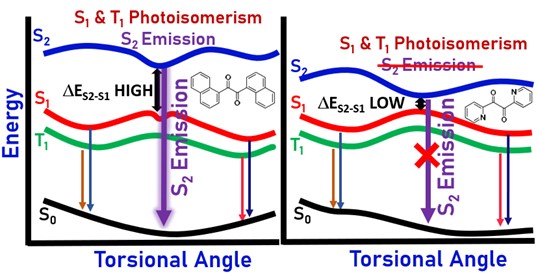
S2 emission selectively observed in benzil and α-naphthil (left panel), but absent in 2,2'-pyridil, α-furil, and 9,9'-anthril (right panel), governed by the system-specific S2–S1 energy gaps.
Keywords
S2 emission | Kasha’s rule | 1,2-dicarbonyls | photophysics | photoisomerization
References
- 1.Lakowicz, J.R. Principles of Fluorescence Spectroscopy, 3rd ed.; Springer: New York, NY, USA, 2006.
- 2.Rohatgi-Mukherjee, K.K. Fundamentals of Photochemistry; Wiley Eastern: New Delhi, India, 1992.
- 3.Mataga, N. Photochemical Charge Transfer Phenomena–Picosecond Laser Photolysis Studies. Pure Appl. Chem. 1984, 56, 1255.
- 4.Kundu, P.; Banerjee, D.; Maiti, G.; et al. Dehydrogenation Induced Inhibition of Intramolecular Charge Transfer in Substituted Pyrazoline Analogue. Phys. Chem. Chem. Phys. 2017, 19, 11937.
- 5.Kundu, P.; Ghosh, S.; Karmakar, R.; et al. Impact of Structural Modification on the Photophysical Response of Benzoquinoline Fluorophores. J. Fluoresc. 2016, 26, 845.
- 6.Chattopadhyay, N.; Chowdhury, M. Equilibrium pK* of Carbazole Studied by the Deprotonation Reaction in Ammoniacal Aqueous Media. J. Photochem. 1987, 38, 301.
- 7.Mishra, A.K.; Dogra, S.K. Prototropic Equilibria in Lowest Excited Singlet State of 2-Hydroxybenzimidazole 2-(3H) benzimidazolone. J. Photochem. 1985, 29, 435.
- 8.Formosinho, S.J.; Arnaut, L.G. Excited-state Proton Transfer Reactions II. Intramolecular Reactions. J. Photochem. Photobiol. A 1993, 75, 21.
- 9.Sengupta, P.K.; Kasha, M. Excited State Proton-transfer Spectroscopy of 3-Hydroxyflavone and Quercetin. Chem. Phys. Lett. 1979, 68, 382.
- 10.Lewis, G.N.; Magel, T.T.; Lipkin, D. The Absorption and Re-emission of Light by cis- and trans-Stilbenes and the Efficiency of their Photochemical Isomerization. J. Am. Chem. Soc. 1940, 62, 2973.
- 11.Mallick, A.; Purkayastha, P.; Chattopadhyay, N. Photoprocesses of Excited Molecules in Confined Liquid Environments: An Overview. J. Photochem. Photobiol. C Photochem. Rev. 2007, 8, 109–127.
- 12.Chowdhury, N.K.; El-Sayed, M.A. Molecular Origin of the Optical Rotatory Dispersion of the Benzil Crystal. J. Chem. Phys. 1967, 47, 1133.
- 13.Rubin, M.B. In Photochemistry and Organic Synthesis; Springer: Berlin/Heidelberg, Germany, 1985; Volume 129.
- 14.Bera, S.C.; Mukherjee, R.; Chowdhury, M. Spectra of Benzil. J. Chem. Phys. 1969, 51, 754.
- 15.Brown, C.J.; Sadanaga, R. The Crystal Structure of Benzil. Acta Crystallogr. 1965, 18, 158.
- 16.Cumper, C.W.N.; Thurston, A.P. Electric Dipole Moments and Molecular Conformations of Benzophenones, Benzils, Benzhydrols, and Benzoins. J. Chem. Soc. Perkin Trans. 1972, 2, 106.
- 17.Morantz, D.J.; Wright, A.J.C. Structures of the Excited States of Benzil and Related Dicarbonyl Molecules. J. Chem. Phys. 1971, 54, 692.
- 18.Evans, T.R.; Leermakers, P.A. Emission Spectra and Excited-state Geometry of Alpha-diketones. J. Am. Chem. Soc. 1967, 89, 4380.
- 19.Das, G.; Mohapatra, K.; Bhattacharya, J.; et al. Flash Photolysis of Benzils. J. Photochem. Photobiol. A 1987, 40, 47.
- 20.Bertoti, A.R.; Netto-Ferreira, J.C. Absolute Rate Constants for the Reaction of Benzil and 2,2′-Furil Triplet with Substituted Phenols in the Ionic Liquid 1-Butyl-3-methylimidazolium Hexafluorophosphate: A Nanosecond Laser Flash Photolysis Study. Appl. Chem. 2024, 4, 224–235.
- 21.Santosh, C.; Mishra, P.C. Electronic Spectra of Benzil in Solution and Thin Film. J. Photochem. Photobiol. A 1990, 51, 245.
- 22.Bhattacharya, B.; Jana, B.; Bose, D.; et al. Multiple Emissions of Benzil at Room Temperature and 77 K and Their Assignments from Ab-initio Quantum Chemical Calculations. J. Chem. Phys. 2011, 134, 044535.
- 23.Kasha, M. Characterization of Electronic Transitions in Complex Molecules. Discuss. Faraday Soc. 1950, 9, 14.
- 24.Beer, M.; Longuet-Higgins, H.C. Anomalous Light Emission of Azulene. J. Chem. Phys. 1955, 23, 1390.
- 25.Bajema, L.; Gouterman, M.; Rose, C.B. Porphyrins XXIII: Fluorescence of the Second Excited Singlet and Quasiline Structure of Zinc Tetrabenzporphin. J. Mol. Spectrosc. 1971, 39, 421.
- 26.Hui, M.H.; de Mayo, P.; Suau, R.; et al. Thione Photochemistry: Fluorescence from Higher Excited States. Chem. Phys. Lett. 1975, 31, 257.
- 27.Chattopadhyay, N.; Barroso, M.; Serpa, C.; et al. Photophysics of 3-hydroxyflavone in supercritical CO2: A probe to study the microheterogeneity of the environment. Chem. Phys. Lett. 2004, 387, 263.
- 28.Cho, D.W.; Fujitsuka, M.; Ryu, J.H.; et al. S2 Emission from Chemically Modified BODIPYs. Chem. Commun. 2012, 48, 3424.
- 29.Zhang, X.; Loh, K.P.; Sullivan, M.B.; et al. Aggregation Dependent S1 and S2 Dual Emissions of Thiophene−Acrylonitrile−Carbazole Oligomer. Cryst. Growth Des. 2008, 8, 2543.
- 30.Chattopadhyay, N.; Serpa, C.; Arnaut, L.G.; et al. Coexistence of two Triplets for the TICT Probe DMABN in Polar Solvents: An Experimental Evidence. Helv. Chim. Acta 2002, 85, 19.
- 31.Jana, B.; Chattopadhyay, N. Multiple Emissions of α-Naphthil: Fluorescence from S2 State. J. Phys. Chem. A 2012, 116, 7836.
- 32.Kundu, P.; Chattopadhyay, N. Photophysics of α-furil at Room Temperature and 77 K: Spectroscopic and Quantum Chemical Studies. J. Chem. Phys. 2016, 144, 234317.
- 33.Kundu, P.; Ghosh, S.; Chattopadhyay, N. Exploration of Photophysics of 2,2′-Pyridil at Room Temperature and 77 K: A Combined Spectroscopic and Quantum Chemical Approach. Photochem. Photobiol. Sci. 2017, 16, 159.
- 34.Kundu, P.; Chattopadhyay, N. Photophysics of Anthril in Fluids and Glassy Matrixes. J. Phys. Chem. A 2018, 122, 5545.
- 35.Arnett, J.; McGlynn, S.P. Photorotamerism of Aromatic α-Dicarbonyls. J. Phys. Chem. 1975, 79, 626.
- 36.Chan, I.Y.; Heath, B.A. An ENDOR Study of the Geometry of the Lowest Triplet State of Benzil. J. Chem. Phys. 1979, 71, 1070.
- 37.Roy, D.S.; Bhattacharyya, K.; Bera, S.C.; et al. Conformational Relaxation in the Excited Electronic States of Benzil and Naphthyl. Chem. Phys. Lett. 1980, 69, 134.
- 38.Bhattacharyya, K.; Ray, D.S.; Chowdhury, M. Fluorescence from Relaxed and Unrelaxed Excited State of Benzil. J. Lumin. 1980, 22, 95.
- 39.Bhattacharyya, K.; Chowdhury, M. Solvent Shift and Excited State Geometries of Benzil. J. Photochem. 1986, 33, 61.
- 40.Chakarabarty, A.; Purkayastha, P.; Chattopadhyay, N. Laser Induced Optoacoustic Spectroscopy of Benzil: Evaluation of Structural Volume Change upon Photoisomerization. J. Photochem. Photobiol. A 2008, 198, 256.
- 41.Sarkar, D.; Chakrabarty, A.; Chattopadhyay, N. Structural Volume Change upon Photoisomerization of 2,2′-Furil: A Photoacoustic Calorimetric Study. Indian J. Chem. Sect. A 2009, 48, 45.
- 42.Singh, A.K.; Palit, D.K.; Mittal, J.P. Conformational Relaxation Dynamics in the Excited Electronic States of Benzil in Solution. Chem. Phys. Lett. 2002, 360, 443.
- 43.Chattopadhyay, N.; Serpa, C.; Silva, M.I.; et al. Benzil Fluorescence and Phosphorescence Emissions: A Pertinent Probe for the Kinematic Behaviour and Microheterogeneity of Supercritical CO2. Chem. Phys. Lett. 2001, 347, 361.
- 44.Das, K.K.; Majumdar, D. Ground and Excited States of Benzil: A Theoretical Study. J. Mol. Struct. Theochem. 1993, 288, 55.
- 45.Pawelka, Z.; Koll, A.; Zeegers-Huyskens, T. Solvent Effect on the Conformation of Benzil. J. Mol. Struct. 2001, 597, 57.
- 46.Tétreault, N.; Muthyala, R.S.; Liu, R.S.H.; et al. Control of the Photophysical Properties of Polyatomic Molecules by Substitution and Solvation: The Second Excited Singlet State of Azulene. J. Phys. Chem. A 1999, 103, 2524.
- 47.Strickler, S.J.; Berg, R.A. Relationship Between Absorption Intensity and Fluorescence Lifetime of Molecules. J. Chem. Phys. 1962, 37, 814.
- 48.Herkstroeter, W.G.; Lamola, A.A.; Hammond, G.S. Mechanisms of Photochemical Reactions in Solution. XXVIII.1 Values of Triplet Excitation Energies of Selected Sensitizers. J. Am. Chem. Soc. 1964, 86, 4537.
- 49.Debnath, R.; Bera, S.C. Emission Spectra of α-naphthil. J. Phys. Chem. 1980, 84, 2623.
- 50.Sen, D.; Manna, B.K.; Bera, S.C. Flash Photolysis of α-Naphthil in the Temperature Range 77 to 320 K. J. Photochem. Photobiol. A 1991, 60, 101.
- 51.Sen, D.; Manna, B.K.; Bera, S.C. Spectra and Conformation of α-Naphthil. J. Mol. Struct. 1992, 271, 45.
- 52.Shimada, R.; Goodman, L. Polarization of Aromatic Carbonyl Spectra. J. Chem. Phys. 1965, 43, 2027.
- 53.Bernal, I. Molecular Configuration of Benzil and α-Pyridil. Nature 1963, 200, 1318.
- 54.Ashida, T. The Crystal Structure of 2,2′-Pyridil, a Refinement. Acta Crystallogr. Sect. B: Struct. Crystallogr. Cryst. Chem. 1970, 26, 454.
- 55.Barassin, J. Sur La Configuration Moleculaire De Quelques Derives De La Pyridine Et Du Phenyl-N Succinimide. 1. Introduction. Ann. Chim. 1963, 8, 637.
- 56.Migchels, P.; Maes, G.; Zeegers-Huyskens, T.; et al. Infrared and Ultraviolet Investigation of the Conformation and Proton Acceptor Ability of 2,2′-Pyridil. J. Mol. Struct. 1989, 193, 223.
- 57.Inone, H.; Nagaya, K. Hydrogen Bonding and Conformational Change of 2,2′-Pyridil in Polyhydric Solvents. J. Chem. Soc. Perkin Trans. 2 1983, 2, 1581.
- 58.Sarkar, A.; Chakravorti, S. Photo-rotamerism of 2,2′-Pyridil in Different Environments: A Guest for Geometry in Excited States. J. Lumin. 1996, 69, 161.
- 59.Sarkar, S.K.; Ghoshal, S.K.; Kastha, G.S. Effect of Ring aza Substitution on the Luminescence of Aromatic Ketones. Luminescence of Isomeric Acetylpyridines. Proc. Indian Acad. Sci. Chem. Sci. 1983, 92, 47.
- 60.Bera, S.C.; Mukherjee, R.K.; Mukherjee, D.; et al. n→π* Transition of 2, 2′-Pyridil. J. Chem. Phys. 1971, 55, 5826.
- 61.Warwick, D.A.; Wells, C.H. Perturbation of Singlet—Triplet Transitions in Aromatic Carbonyl Compounds. Spectrochim. Acta 1968, 24, 589.
- 62.Koti, A.S.R.; Periasamy, N. Application of Time Resolved Area Normalized Emission Spectroscopy to Multicomponent Systems. J. Chem. Phys. 2001, 115, 7094.
- 63.Koti, A.S.R.; Krishna, M.M.G.; Periasamy, N. Time-resolved Area-normalized Emission Spectroscopy (TRANES): A Novel Method for Confirming Emission from two Excited States. J. Phys. Chem. A 2001, 105, 1767.
- 64.Koti, A.S.R.; Periasamy, N. Time Resolved Area Normalized Emission Spectroscopy (TRANES) of DMABN Confirms Emission from two States. Res. Chem. Intermed. 2002, 28, 831.
- 65.Sandroff, C.J.; Chan, I.Y. Triplet Emission from Furil in Different Crystalline Environments: Optical and ODMR Studies. Chem. Phys. Lett. 1983, 97, 60.
- 66.Biswas, S.C.; Ray, S.; Podder, A. Molecular Configuration of α-Furil. Chem. Phys. Lett. 1987, 134, 541.
- 67.Lopes, S.; Gómez-Zavaglia, A.; Fausto, R. Matrix Isolation and low Temperature Solid State FTIR Spectroscopic Study of α-Furil. Phys. Chem. Chem. Phys. 2006, 8, 1794.
- 68.Singh, A.K.; Palit, D.K. Excited-state Dynamics and Photophysics of 2, 2′-Furil. Chem. Phys. Lett. 2002, 357, 173.
- 69.Becker, H.D.; Sorensen, H.; Hammarberg, E. 9,9′-Anthril (di-9-anthrylethanedione). Tetrahedron Lett. 1989, 30, 989.

How to Cite
Kundu, P.; Venkataravana, K. N.; Chattopadhyay, N. S2 Emission and Conformational Landscapes: System Specific Excited-State Photophysics in 1,2-Dicarbonyls. Photochemistry and Spectroscopy 2025, 1 (1), 1. https://doi.org/10.53941/ps.2025.100001.
RIS
BibTex
Copyright & License

Copyright (c) 2025 by the authors.
This work is licensed under a Creative Commons Attribution 4.0 International License.
Article Metrics
297
Article Views
1
Citations
Contents
References

 Suite 4002 Level 4, 447 Collins Street, Melbourne, Victoria 3000, Australia
 General Inquiries: info@sciltp.com