
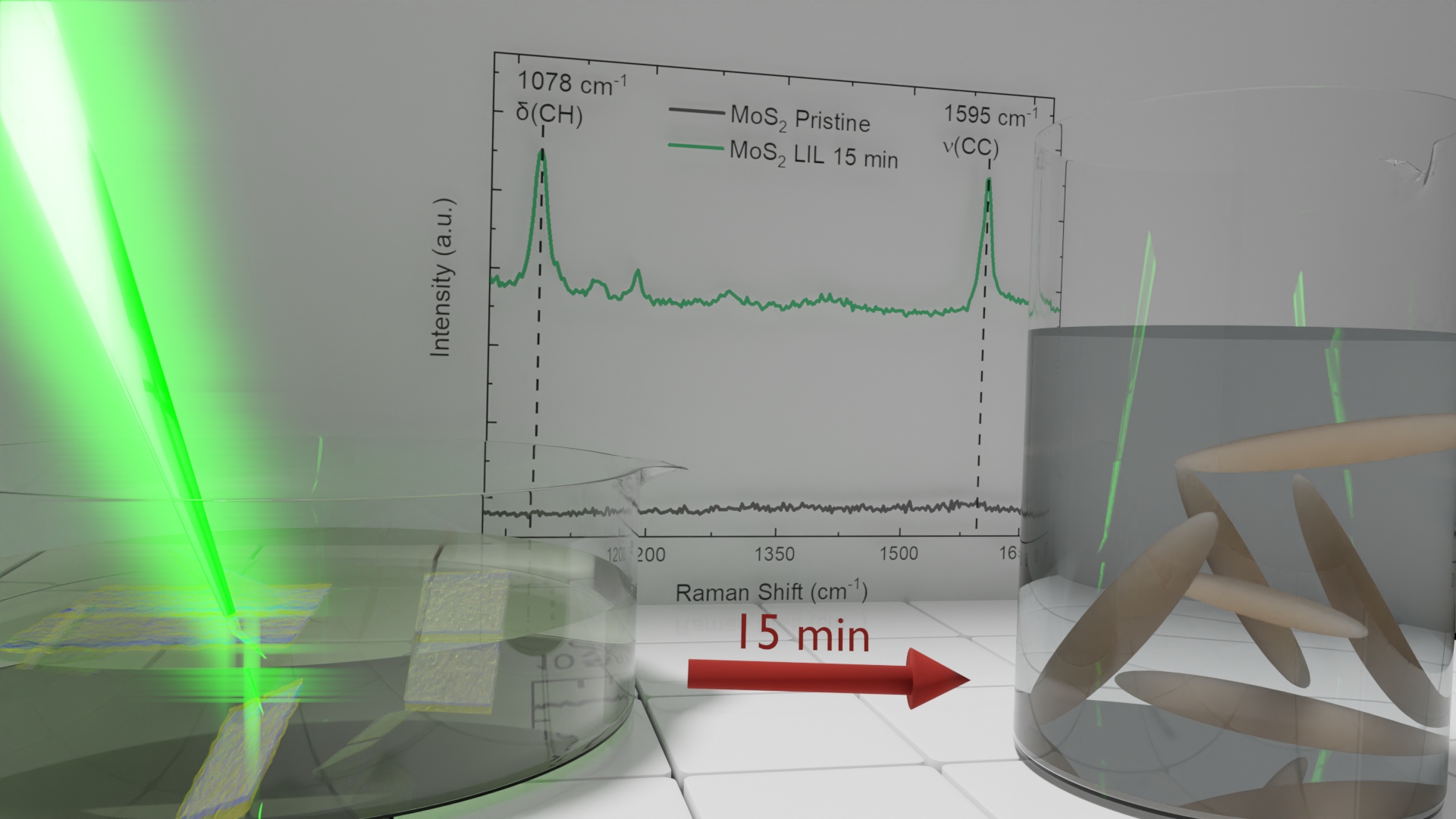
Surface-enhanced Raman scattering (SERS) offers exceptional molecular sensitivity, but the instability and poor reproducibility of noble metal substrates limit its practical use. Here, we investigate low-cost, non-plasmonic alternatives based on two-dimensional molybdenum disulfide (MoS2). We introduce a reagent-free, pulsed-laser irradiation in liquid protocol to controllably engineer defects and induce the metallic 1T phase within MoS2, thereby tailoring its electronic structure through sulfur vacancies. Laser-modified MoS2 displays markedly enhanced SERS activity relative to unmodified 2H-MoS2; the enhancement correlates with increased density of defect sites and the presence of the conducting 1T phase, which together promote more efficient substrate-adsorbate charge transfer. By using 4-mercaptobenzoic acid (4-MBA) as a probe molecule, laser-modified MoS2 shows a SERS enhancement factor of ≈105 compared with pristine 2H-MoS2 under 532 nm excitation. The experimental results were further validated by density functional theory calculations, which show a better match of the energy level of MoS2 1T with our probe molecule, supporting the ongoing research aimed at designing novel SERS substrates. Our results demonstrate that phase and defect engineering in 2D materials provide a robust route to reproducible, non-plasmonic SERS substrates, offering a scalable alternative to noble metals for sensitive chemical and biosensing applications.
- Open Access
- Article
Defect-Engineering in MoS2 Layers for Surface Enhanced Raman Scattering †
- Antonio Brancato 1,
- Marcello Condorelli 1, 2, *,
- Vittorio Scardaci 1,
- Enza Fazio 3,
- Giuseppe Forte 4,
- Luisa D'urso 1,
- Giuseppe Compagnini 1, 2
Author Information
Received: 03 Nov 2025 | Revised: 05 Dec 2025 | Accepted: 09 Dec 2025 | Published: 29 Jan 2026
Abstract
Graphical Abstract
Keywords
nanomaterials | defect engineering | Raman scattering | SERS | laser modification
References
- 1.
Schmidt, M.M.; Brolo, A.G.; Lindquist, N.C. Single-Molecule Surface-Enhanced Raman Spectroscopy: Challenges, Opportunities, and Future Directions. ACS Nano 2024, 18, 25930–25938. https://doi.org/10.1021/ACSNANO.4C09483.
- 2.
Matikainen, A.; Nuutinen, T.; Itkonen, T.; et al. Atmospheric oxidation and carbon contamination of silver and its effect on surface-enhanced Raman spectroscopy (SERS). Sci. Rep. 2016, 6, 37192. https://doi.org/10.1038/srep37192.
- 3.
Zhao, X.; Wang, Y.; Liu, Y.; et al. Gradient Nanostructures and Machine Learning Synergy for Robust Quantitative Surface-Enhanced Raman Scattering. Adv. Sci. 2025, 12, 2501793. https://doi.org/10.1002/ADVS.202501793.
- 4.
Ozdemir, R.; Hukum, K.O.; Usta, H.; et al. Organic and inorganic semiconducting materials-based SERS: Recent developments and future prospects. J. Mater. Chem. C Mater. 2024, 12, 15276–15309. https://doi.org/10.1039/D4TC02391A.
- 5.
Krajczewski, J.; Michałowska, A.; Čtvrtlík, R.; et al. The battle for the future of SERS—TiN vs. Au thin films with the same morphology. Appl. Surf. Sci. 2023, 618, 156703. https://doi.org/10.1016/J.APSUSC.2023.156703.
- 6.
Lan, L.; Gao, Y.; Fan, X.; et al. The origin of ultrasensitive SERS sensing beyond plasmonics. Front. Phys. 2021, 16, 43300. https://doi.org/10.1007/S11467-021-1047-Z.
- 7.
Rani, D.; Patel, S.; Austeria, P.M.; et al. Surface-Enhanced Raman Spectroscopy (SERS) Chemical Enhancement in the Vibronically Coupled Langmuir Layer of Mixed Dichalcogenide 1T-MoSSe with Adsorbed R6G. J. Phys. Chem. C 2023, 127, 3131–3141. https://doi.org/10.1021/ACS.JPCC.2C08705.
- 8.
Liu, H.; Li, Q.; Ma, Y.; et al. Study of charge transfer contribution in Surface-Enhanced Raman scattering (SERS) based on indium oxide nanoparticle substrates. Spectrochim. Acta A Mol. Biomol. Spectrosc. 2023, 303, 123168. https://doi.org/10.1016/J.SAA.2023.123168.
- 9.
Zheng, Z.; Cong, S.; Gong, W.; et al. Semiconductor SERS enhancement enabled by oxygen incorporation. Nat. Commun. 2017, 8, 1993. https://doi.org/10.1038/S41467-017-02166-Z.
- 10.
Zhang, M.; Wang, Y.; Ma, Y.; et al. Study of charge transfer effect in Surface-Enhanced Raman scattering (SERS) by using Antimony-doped tin oxide (ATO) nanoparticles as substrates with tunable optical band gaps and free charge carrier densities. Spectrochim. Acta Part A Mol. Biomol. Spectrosc. 2021, 264, 120288. https://doi.org/10.1016/J.SAA.2021.120288.
- 11.
Gan, X.; Lee, L.Y.S.; Wong, K.Y.; et al. 2H/1T Phase Transition of Multilayer MoS2 by Electrochemical Incorporation of S Vacancies. ACS Appl. Energy Mater. 2018, 1, 4754–4765. https://doi.org/10.1021/ACSAEM.8B00875.
- 12.
Sun, S.; Zheng, J.; Sun, R.; et al. Defect-Rich Monolayer MoS2 as a Universally Enhanced Substrate for Surface-Enhanced Raman Scattering. Nanomaterials 2022, 12, 896. https://doi.org/10.3390/NANO12060896.
- 13.
Nair, P.R.; Ramirez, C.R.S.; Pinilla, M.A.G.; et al. Black titanium dioxide nanocolloids by laser irradiation in liquids for visible light photo-catalytic/electrochemical applications. Appl. Surf. Sci. 2023, 623, 157096. https://doi.org/10.1016/J.APSUSC.2023.157096.
- 14.
Fazio, E.; Gökce, B.; De Giacomo, A.; et al. Nanoparticles Engineering by Pulsed Laser Ablation in Liquids: Concepts and Applications. Nanomaterials 2020, 10, 2317. https://doi.org/10.3390/NANO10112317.
- 15.
Kresse, G.; Furthmüller, J. Efficient iterative schemes for ab initio total-energy calculations using a plane-wave basis set. Phys. Rev. B 1996, 54, 11169. https://doi.org/10.1103/PhysRevB.54.11169.
- 16.
Kresse, G.; Joubert, D. From ultrasoft pseudopotentials to the projector augmented-wave method. Phys. Rev. B 1999, 59, 1758. https://doi.org/10.1103/PhysRevB.59.1758.
- 17.
Perdew, J.P.; Burke, K.; Ernzerhof, M. Generalized Gradient Approximation Made Simple. Phys. Rev. Lett. 1996, 77, 3865. https://doi.org/10.1103/PhysRevLett.77.3865.
- 18.
Dion, M.; Rydberg, H.; Schröder, E.; et al. Density Functional for General Geometries. Phys. Rev. Lett. 2004, 92, 246401. https://doi.org/10.1103/PhysRevLett.92.246401.
- 19.
Román-Pérez, G.; Soler, J.M. Efficient Implementation of a van der Waals Density Functional: Application to Double-Wall Carbon Nanotubes. Phys. Rev. Lett. 2009, 103, 096102. https://doi.org/10.1103/PhysRevLett.103.096102.
- 20.
Tang, W.; Sanville, E.; Henkelman, G. A grid-based Bader analysis algorithm without lattice bias. J. Phys. Condens. Matter 2009, 21, 084204. https://doi.org/10.1088/0953-8984/21/8/084204.
- 21.
Luo, T.; Chen, X.; Wang, L.; et al. Green laser irradiation-stimulated fullerene-like MoS2 nanospheres for tribological applications. Tribol. Int. 2018, 122, 119–124. https://doi.org/10.1016/J.TRIBOINT.2018.02.040.
- 22.
Compagnini, G.; Sinatra, M.G.; Messina, G.C.; et al. Monitoring the formation of inorganic fullerene-like MoS2 nanostructures by laser ablation in liquid environments. Appl. Surf. Sci. 2012, 258, 5672–5676. https://doi.org/10.1016/J.APSUSC.2012.02.053.
- 23.
Ibrahim, K.; Novodchuk, I.; Mistry, K.; et al. Laser-Directed Assembly of Nanorods of 2D Materials. Small 2019, 15, 1904415. https://doi.org/10.1002/SMLL.201904415.
- 24.
Zamharir, S.G.; Karimzadeh, R.; Aboutalebi, S.H. Laser-assisted tunable optical nonlinearity in liquid-phase exfoliated MoS2 dispersion. Appl Phys A Mater Sci Process 2018, 124, 692. https://doi.org/10.1007/S00339-018-2115-2.
- 25.
Mosleh, A.; Alher, M.A.; Cousar, L.; et al. Transmission spectra of some transition metal dichalcogenides. II. Group VIA: trigonal prismatic coordination. J. Phys. C: Solid. State Phys. 1972, 5, 3540. https://doi.org/10.1088/0022-3719/5/24/016.
- 26.
Kong, G.; Du, X.; Cai, X.; et al. Recycling Molybdenum Oxides from Waste Molybdenum Disilicides: Oxidation Experimental Study and Photocatalytic Properties. Oxid. Met. 2019, 92, 1–12. https://doi.org/10.1007/S11085-019-09909-X.
- 27.
Stavrou, M.; Chazapis, N.; Nikoli, E.; et al. Crystalline Phase Effects on the Nonlinear Optical Response of MoS2 and WS2 Nanosheets. ACS Appl. Nano Mater. 2023, 5, 16674–16686. https://doi.org/10.1021/acsanm.2c03709.
- 28.
Han, B.; Hu, Y.H. MoS2 as a co-catalyst for photocatalytic hydrogen production from water. Energy Sci. Eng. 2016, 4, 285–304. https://doi.org/10.1002/ESE3.128.
- 29.
Khan, Y.; Obaidulla, S.M.; Habib, M.R.; et al. Anomalous photoluminescence quenching in DIP/MoS2 van der Waals heterostructure: Strong charge transfer and a modified interface. Appl. Surf. Sci. 2020, 530, 147213. https://doi.org/10.1016/J.APSUSC.2020.147213.
- 30.
Li, H.; Zhang, Q.; Yap, C.C.R.; et al. From Bulk to Monolayer MoS2: Evolution of Raman Scattering. Adv. Funct. Mater. 2012, 22, 1385–1390. https://doi.org/10.1002/ADFM.201102111.
- 31.
Chang, H.P.; Hofmann, M.; Hsieh, Y.P.; et al. Correlation of grain orientations and the thickness of gradient MoS2 films. RSC Adv. 2021, 11, 34269–34274. https://doi.org/10.1039/D1RA05982C.
- 32.
Ye, F.; Chang, D.; Ayub, A.; et al. Synthesis of Two-Dimensional Plasmonic Molybdenum Oxide Nanomaterials by Femtosecond Laser Irradiation. Chem. Mater. 2021, 33, 4510–4521. https://doi.org/10.1021/ACS.CHEMMATER.1C00732.
- 33.
Yin, Y.; Miao, P.; Zhang, Y.; et al. Significantly Increased Raman Enhancement on MoX2 (X = S, Se) Monolayers upon Phase Transition. Adv. Funct. Mater. 2017, 27, 1606694. https://doi.org/10.1002/ADFM.201606694.
- 34.
Li, B.; Jiang, L.; Li, X.; et al. Preparation of Monolayer MoS2 Quantum Dots using Temporally Shaped Femtosecond Laser Ablation of Bulk MoS2 Targets in Water. Sci. Rep. 2017, 7, 11182. https://doi.org/10.1038/S41598-017-10632-3.
- 35.
Tran, H.N.; Park, S.; Wibowo, F.T.A.; et al. 17% Non-Fullerene Organic Solar Cells with Annealing-Free Aqueous MoOx. Adv. Sci. 2020, 7, 2002395. https://doi.org/10.1002/ADVS.202002395.
- 36.
Xu, Q.; Li, X.; Wu, L.; et al. Enlarged Interlayer Spacing of Marigold-Shaped 1T-MoS2 with Sulfur Vacancies via Oxygen-Assisted Phosphorus Embedding for Rechargeable Zinc-Ion Batteries. Nanomaterials 2023, 13, 1185. https://doi.org/10.3390/NANO13071185.
- 37.
Mouloua, D.; Rajput, N.S.; Lejeune, M.; et al. Giant Photodegradation Rate Enabled by Vertically Grown 1T/2H MoS2 Catalyst on Top of Silver Nanoparticles. Adv. Energy Sustain. Res. 2024, 5, 2400213. https://doi.org/10.1002/AESR.202400213.
- 38.
Gu, C.; Li, D.; Zeng, S.; et al. Synthesis and defect engineering of molybdenum oxides and their SERS applications. Nanoscale 2021, 13, 5620–5651. https://doi.org/10.1039/D0NR07779H.
- 39.
Ho, C.H.; Lee, S. SERS and DFT investigation of the adsorption behavior of 4-mercaptobenzoic acid on silver colloids. Colloids Surf. A Physicochem. Eng. Asp. 2015, 474, 29–35. https://doi.org/10.1016/J.COLSURFA.2015.03.004.
- 40.
Le Ru, E.C.; Etchegoin, P.G. Quantifying SERS enhancements. MRS Bull. 2013, 38, 631–640. https://doi.org/10.1557/MRS.2013.158.
- 41.
Pramanik, A.; Gao, Y.; Gates, K.; et al. Giant Chemical and Excellent Synergistic Raman Enhancement from a 3D MoS2−xOx−Gold Nanoparticle Hybrid. ACS Omega 2019, 4, 11112–11118. https://doi.org/10.1021/acsomega.9b00866.
- 42.
Yin, Y.; Li, C.; Yan, Y.; et al. MoS2-Based Substrates for Surface-Enhanced Raman Scattering: Fundamentals, Progress and Perspective. Coatings 2022, 12, 360. https://doi.org/10.3390/COATINGS12030360.
- 43.
Er, E.; Hou, H.-L.; Criado, A.; et al. High-Yield Preparation of Exfoliated 1T-MoS 2 with SERS Activity. Chem. Mater. 2019, 31, 5725–5734. https://doi.org/10.1021/acs.chemmater.9b01698.
- 44.
Shim, S.; Stuart, C.M.; Mathies, R.A. Resonance Raman cross-sections and vibronic analysis of rhodamine 6G from broadband stimulated Raman spectroscopy. Chemphyschem 2008, 9, 697–699. https://doi.org/10.1002/CPHC.200700856.
- 45.
Angeloni, L.; Smulevich, G.; Marzocchi, M.P. Resonance Raman spectrum of crystal violet. J. Raman Spectrosc. 1979, 8, 305–310. https://doi.org/10.1002/JRS.1250080603.


This work is licensed under a Creative Commons Attribution 4.0 International License.

 Suite 4002 Level 4, 447 Collins Street, Melbourne, Victoria 3000, Australia
 General Inquiries: info@sciltp.com