
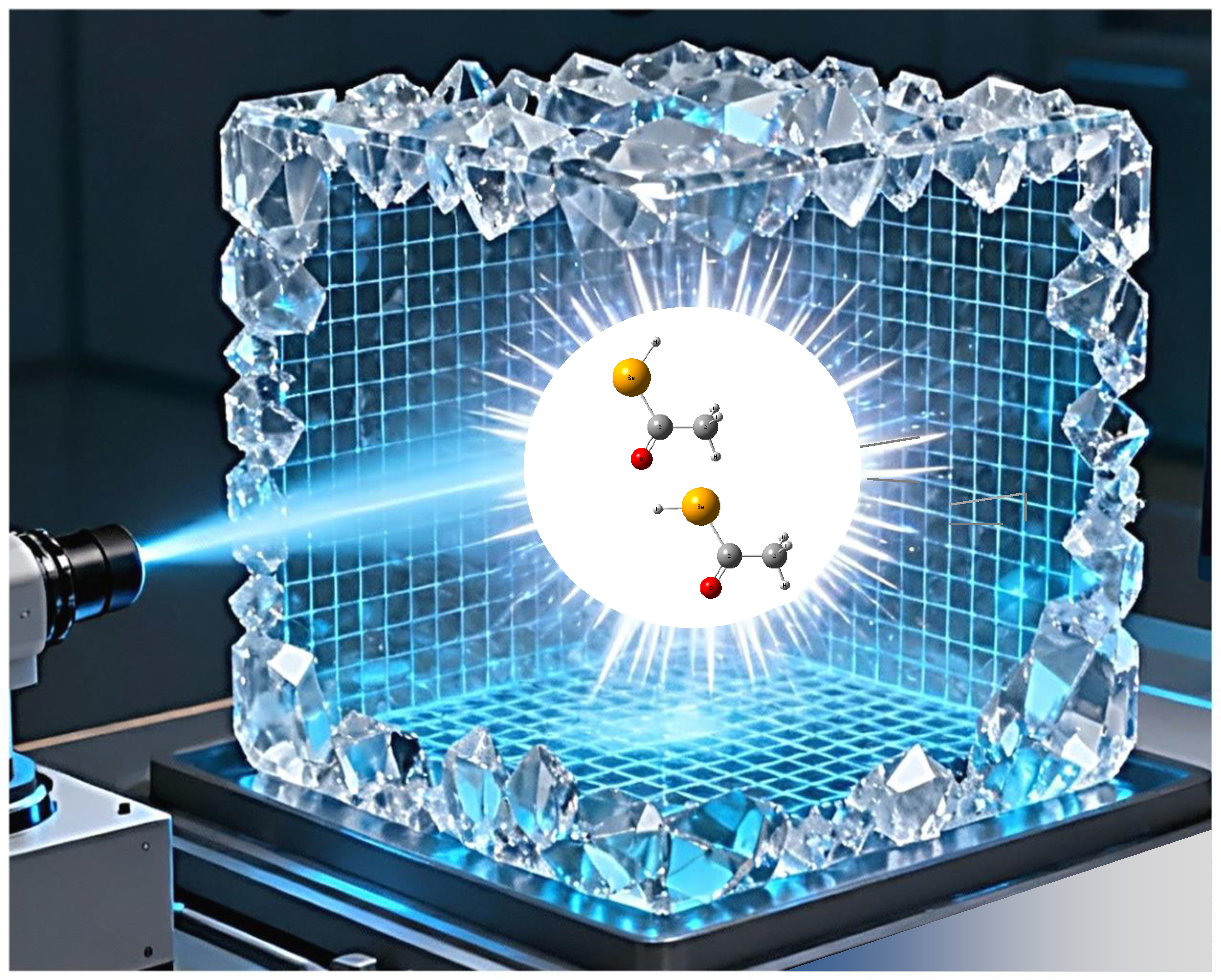
Matrix-isolation spectroscopy is a powerful and versatile technique in physical and analytical chemistry, enabling the detailed study of highly reactive and transient species under cryogenically stabilized conditions. By trapping molecules within an inert, rigid solid matrix—typically argon, nitrogen, or krypton at temperatures as low as a few Kelvin—this method effectively quenches thermal energy, suppressing diffusion and preventing chemical decay. This review highlights the application of this foundational technique in La Plata to explore multifaceted research centred on the generation, isolation, and characterization of novel molecular entities, elucidating their fundamental properties, reaction mechanisms, and reactivity. We present examples spanning the isolation of novel compounds, detailed conformational studies, the formation and analysis of molecular complexes, and the elucidation of photochemical mechanisms. The synergy between matrix-isolation FTIR spectroscopy and computational chemistry is emphasised as a basis for validating experimental findings and advancing molecular-level understanding.
- Open Access
- Review
A La Plata Journey through Frozen Molecules: Matrix Isolation Spectroscopy Studies †
Author Information
Received: 08 Dec 2025 | Revised: 30 Dec 2025 | Accepted: 06 Jan 2026 | Published: 03 Mar 2026
Abstract
Graphical Abstract
Keywords
matrix-Isolation | FTIR spectroscopy | photochemistry | novel compounds | molecular complexes | reactive intermediates | conformational equilibria
References
- 1.
Whittle, E.; Dows, D.A.; Pimentel, G.C. Matrix Isolation Method for the Experimental Study of Unstable Species. J. Chem. Phys. 1954, 22, 1943–1943.
- 2.
Fausto, R. Low Temperature Molecular Spectroscopy; NATO-ASI Series C483; Kluwer: Amsterdam, The Netherlands, 1996.
- 3.
Varetti, E.L.; Pimentel, G.C. Isomeric forms of dinitrogen trioxide in a nitrogen matrix. J. Chem. Phys. 1971, 55, 3813–3821.
- 4.
Willner, H. Das Infrarotspektrum von matrixisoliertem SFCl. Z. Naturforsch. B 1984, 39, 314–316.
- 5.
Della Védova, C.O.; Mack, H.-G. A matrix photochemistry study on (fluorocarbonyl)sulfenyl bromide: The precursor of sulfur bromide fluoride. Inorg. Chem. 1993, 32, 948–950.
- 6.
Romano, R.M.; Della Védova, C.O.; Downs, A.J.; et al. Matrix Photochemistry of syn-(Chlorocarbonyl)sulfenyl Bromide, syn-ClC(O)SBr: Precursor to the Novel Species anti-ClC(O)SBr, syn-BrC(O)SCl, and BrSCl. J. Am. Chem. Soc. 2001, 123, 5794–5801.
- 7.
Romano, R.M.; Della Védova, C.O.; Downs, A.J. Matrix Photochemistry of the Chlorocarbonyl Sulfenyl Compounds ClC(O)SY, with Y = Cl or CH3. J. Phys. Chem. A 2004, 108, 7179–7187.
- 8.
Romano, R.M.; Della Védova, C.O.; Downs, A.J. Methanesulfenyl Fluoride, CH3SF, a Missing Link in the Family of Sulfenyl Halides: Formation and Characterization through the Matrix Photochemistry of Methyl Thiofluoroformate, FC(O)SCH3. Chem. Eur. J. 2007, 13, 8185–8192.
- 9.
Rodríguez Pirani, L.S.; Erben, M.F.; Willner, H.; et al. FC(O)SCH2CH3: Spectroscopic and Computational Investigations. J. Phys. Chem. A 2014, 118, 11193–11203.
- 10.
Gómez Castaño, J.A.; Romano, R.M.; Beckers, H.; et al. Preparation and Properties of Two Novel Selenoacetic Acids: HCF2C(O)SeH and ClCF2C(O)SeH. Inorg. Chem. 2012, 51, 2608–2615.
- 11.
Gómez Castaño, J.A.; Romano, R.M.; Beckers, H.; et al. Formation of the Matrix-Isolated Difluoromethylselanes XCF2SeH (X = H, Cl) Through Photolysis of Selenoacetic Acids, XCF2C(O)SeH. Eur. J. Inorg. Chem. 2013, 2013, 4585–4594.
- 12.
Gómez Castaño, J.A.; Romano, R.M., Beckers, H.; et al. Selenoacetic Acid, CH3C(O)SeH: Preparation, Characterization, and Conformational Properties. Angew. Chem. Int. Ed. 2008, 47, 10114–10118.
- 13.
Gómez Castaño, J.A.; Romano, R.M., Beckers, H.; et al. Trifluoroselenoacetic acid, CF3C(O)SeH: Preparation and Properties Inorg. Chem. 2010, 49, 9972–9977.
- 14.
Juncal, L.C.; Cozzarín, M.V.; Romano, R.M. Conformational and spectroscopic study of xanthogen ethyl formates, ROC(S)SC(O)OCH2CH3. Isolation of CH3CH2OC(O)SH. Spectrochim. Acta A 2015, 139, 346–355.
- 15.
Romano, R.M.; Della Védova, C.O.; Downs, A.J. (Bromocarbonyl) sulfenyl bromide, BrC(O)SBr: A novel carbonyl sulfenyl compound formed by the photochemical reaction between Br2 and OCS isolated together in an Ar matrix. Chem. Comm. 2001, 2638–2639. https://doi.org/10.1039/B108218C.
- 16.
Tobón, Y.A.; Nieto, L.I.; Romano, R.M.; et al. Photochemical Reaction Channels of OCS with Cl2, ICl, or IBr Isolated Together in an Argon Matrix: Isolation of syn-Iodocarbonylsulfenyl Bromide. J. Phys. Chem. A 2006, 110, 2674–2681.
- 17.
Picone, A.; Della Védova, C.O.; Willner, H.; et al. Experimental and theoretical characterization of molecular complexes formed between OCS and XY molecules (X, Y = F, Cl and Br) and their role in photochemical matrix reactions. Phys. Chem. Chem. Phys. 2010, 12, 563–571.
- 18.
Tobón, Y.A.; Romano, R.M.; Della Védova, C.O.; et al. Formation of New Halogenothiocarbonylsulfenyl Halides, XC(S)SY, Through Photochemical Matrix Reactions Starting from CS2 and a Dihalogen Molecule XY (XY = Cl2, Br2 or BrCl). Inorg. Chem. 2007, 46, 4692–4703.
- 19.
Custodio Castro, M.T.; Della Védova, C.O.; Willner, H.; et al. Ar-Matrix Studies of the Photochemical Reaction between CS2 and ClF: Prereactive Complexes and Bond Isomerism of the Photoproducts. Photochem 2022, 2, 765–778.
- 20.
Gómez Castaño, J.A.; Romano, R.M.; Willner, H.; et al. Preparation of the novel XC(O)SeX species (X = Cl, Br) through matrix photochemical reactions of OCSe with Cl2 and Br2 at cryogenic temperatures. Inorg. Chim. Acta 2008, 361, 540–550.
- 21.
Gómez Castaño, J.A.; Romano, R.M.; Della Védova, C.O.; et al. Photochemical reaction of OCSe with ClF in argon matrix: A light-driven formation of XC(O)SeY (X, Y = F or Cl) species. J. Phys. Chem. A 2017, 121, 2878–2887.
- 22.
Cozzarín, M.V.; Romano, R.M.; Willner, H.; et al. Matrix isolation of the elusive fluorocarbonylsulfenyl fluoride molecule FC(O)SF. J. Phys. Chem. A 2013, 117, 855–862.
- 23.
Gómez Castaño, J.A.; Picone, A.L.; Romano, R.M.; et al. Early Barriers in the Matrix Photochemical Formation of syn–anti Randomized FC(O)SeF from the OCSe:F2 Complex. Chem. Eur. J. 2007, 13, 9355–9361.
- 24.
Bava, Y.B.; Cozzarín, M.V.; Della Védova, C.O.; et al. Preparation of FC(S)SF, FC(S)SeF and FC(Se)SeF through matrix photochemical reactions of F2 with CS2, SCSe, and CSe2. Phys. Chem. Chem. Phys. 2021, 23, 20892–20900.
- 25.
Romano, R.M.; Della Védova, C.O.; Downs, A.J.; et al. New Members of an Old Family: Isolation of IC(O)Cl and IC(O)Br and Evidence for the Formation of Weakly Bound Br•···CO. Inorg. Chem. 2005, 44, 3241–3248.
- 26.
Mack, H.-G.; Oberhammer, H.; Della Védova, C.O. Conformational properties and gas-phase structure of (fluorocarbonyl) sulfenyl chloride, FC(O)SCl; electron diffraction, vibrational analysis, and ab initio calculations. J. Phys. Chem. 1991, 95, 4238–4241.
- 27.
Romano, R.M.; Della Védova, C.O.; Boese, R. Structural analysis, matrix Raman spectra, syn–anti photoisomerization and pre-resonance Raman effect of fluorocarbonylsulfenyl chloride, FC(O)SCl. J. Mol. Struct. 1999, 513, 101–108.
- 28.
Romano, R.M.; Della Védova, C.O.; Downs, A.J.; et al. Structural and vibrational properties of ClC(O)SY compounds with Y = Cl and CH3. New J. Chem. 2003, 27, 514–519.
- 29.
Erben, M.F.; Della Védova, C.O.; Romano, R.M.; et al. Anomeric and Mesomeric Effects in Methoxycarbonylsulfenyl Chloride, CH3OC(O)SCl: An Experimental and Theoretical Study. Inorg. Chem. 2002, 41, 1064–1071.
- 30.
Spaltro, A.; Peluas, M.G.; Della Védova, C.O.; et al. Conformational Analysis of Trifluoroacetyl Triflate, CF3C(O)OSO2CF3: Experimental Vibrational and DFT Investigation. Spectrosc. J. 2024, 2, 68–81.
- 31.
Spaltro, A.; Leone, M.I.; Castillo Ortiz, D.F.; et al. Effect of UV-visible radiation on the conformational equilibrium of matrix-isolated 1,1,3–trichlorotrifluoroacetone. J. Mol. Struct. 2024, 1327, 141277.
- 32.
Ramos, L.A.; Ulic, S.E.; Romano, R.M.; et al. Vibrational spectra, crystal structures, constitutional and rotational isomerism of FC(O)SCN and FC(O)NCS. Inorg. Chem. 2010, 49, 11142–11157.
- 33.
Ramos, L.A.; Ulic, S.E.; Romano, R.M.; et al. Spectroscopic characterization and constitutional and rotational isomerism of ClC(O)SCN and ClC(O)NCS. J. Phys. Chem. A 2013, 117, 2383–2399.
- 34.
Ramos, L.A.; Ulic, S.E.; Romano, R.M.; et al. Matrix Photochemical Study and Conformational Analysis of CH3C(O)NCS and CF3C(O)NCS. J. Phys. Chem. A 2014, 118, 697–707.
- 35.
Cozzarín, M.V.; Tong, S.; Ge, M.; et al. Preparation and Spectroscopic Studies of FC(O)SSCl. Eur. J. Inorg. Chem. 2016, 36, 5568–5574.
- 36.
Cozzarín, M.V.; Romano, R.M. Unimolecular Photochemical Mechanisms of FC(O)SSCl Isolated in Solid Ar. Chem. Select 2017, 2, 4092–4098.
- 37.
Tobón, Y.A.; Cozzarín, M.V.; Wang, W.-G.; et al. Vibrational and Valence Photoelectron Spectroscopies, Matrix Photochemistry and Conformational Studies of ClC(O)SSCl. J. Phys. Chem. A 2011, 115, 10203–10210.
- 38.
Custodio Castro, M.T.; Della Védova, C.O.; Romano, R.M. Exploring Conformational Preferences in XC(W)ZY Molecules With X, Y = F, Cl, Br and W, Z = O, S, Se: Unraveling the Influence of Conjugative and Anomeric Interactions. J. Phys. Org. Chem. 2024, 37, e4654.
- 39.
Della Védova, C.O.; Downs, A.J.; Novikov, V.P.; et al. Fluorocarbonyl Trifluoromethanesulfonate, FC(O)OSO2CF3: Structure and Conformational Properties in the Gaseous and Condensed Phases. Inorg. Chem. 2004, 43, 4064–4071.
- 40.
Della Védova, C.O.; Downs, A.J.; Moschioni, E.; et al. Chlorocarbonyl Trifluoromethanesulfonate, ClC(O)OSO2CF3: Structure and Conformational Properties in the Gaseous and Condensed Phases. Inorg. Chem. 2004, 43, 8143–8149.
- 41.
Trautner, F.; Della Védova, C.O.; Romano, R.M.; et al. Gas Phase structure and conformational properties of chlorocarbonyl trifluoromethanesulfonate, ClC(O)OSO2CF3. J. Mol. Struct. 2006, 784, 272–275.
- 42.
Tobón, Y.A.; Cozzarín, M.V.; Della Védova, C.O.; et al. Experimental and Theoretical Studies on Bis(Chlorocarbonyl)trisulfane, ClC(O)SSSC(O)Cl. J. Mol. Struct. 2009, 930, 37–42.
- 43.
Tobón, Y.A.; Romano, R.M.; Hey-Hawkins, E.; et al. A comprehensive study of (CH3)2CHOC(S)SC(O)OCH3 using matrix isolation technique, X-ray analysis, spectroscopic studies and theoretical calculations. J. Phys. Org. Chem. 2009, 22, 815–822.
- 44.
Berrueta Martínez, Y.; Reuter, C.G.; Vishnevskiy, Y.V.; et al. Structural Analysis of Perfluoropropanoyl Fluoride in the Gas, Liquid and Solid Phases. J. Phys. Chem. A, 2015, 120, 2420–2430.
- 45.
Arce, V.B.; Czarnowski, J.; Romano, R.M. Bromodifluoroacetyl fluoride, CF2BrC(O)F: Experimental and theoretical studies. J. Mol. Struct. 2006, 825, 32–37.
- 46.
Arce, V.B.; Della Védova, C.O.; Downs, A.J.; et al. Trichloromethyl Chloroformate (“Diphosgene”), ClC(O)OCCl3: Structure and Conformational Properties in the Gaseous and Condensed Phases. J. Org. Chem. 2006, 71, 3423–3428.
- 47.
Della Védova, C.O.; Romano, R.M.; Stammler, H.-G.; et al; Perfluoropropionic Acid (CF3CF2C(O)OH): Three Conformations and Dimer Formation. Molecules 2025, 30, 1887.
- 48.
Romano, R.M.; Della Védova, C.O.; Downs, A. Matrix photochemistry of CH3C(O)SX molecules with X = H, CH3, and C(O)CH3: Formation of ketene in another decomposition channel of sulfenyl carbonyl compounds. J. Phys. Chem. A 2002, 106, 7235–7244.
- 49.
Arango Hoyos, B.E.; Romano, R.M. Experimental and theoretical conformational studies on diallyl sulfide. J. Mol. Struct. 2019, 1182, 54–62.
- 50.
Ramos, L.A.; Ulic, S.E.; Romano, R.M.; et al. Chlorodifluoroacetyl Cyanide, ClF2CC(O)CN: Synthesis, Structure, and Spectroscopic Characterization. Inorg. Chem. 2011, 50, 9650–9659.
- 51.
Tobon, Y.A.; Di Loreto, H.E.; Della Védova, C.O.; et al. Matrix isolation study of ethyl chloroformate, ClC(O)OCH2CH3. J. Mol. Struct. 2008, 881, 139–145.
- 52.
Moreno Betancourt, A.; Schwabedissen, J.; Romano, R.M.; et al. Disulfuryl dichloride S2O5Cl2—A conformational and polymorphism chameleon. Chem. Eur. J. 2018, 24, 10409–10421.
- 53.
Romano, R.M.; Moreno Betancourt, A.; Della Védova, C.O.; et al. Preparation and properties of chlorosulfuryl chloroformiate, ClC(O)OSO2Cl. Inorg. Chem. 2018, 57, 14834–14842.
- 54.
Ramos, L.A.; Ulic, S.E.; Romano, R.M.; et al. Chlorodifluoroacetyl isocyanate, ClF2CC(O)NCO: Preparation and structural and spectroscopic studies. J. Phys. Chem. A 2012, 116, 11586–11595.
- 55.
Ramos, L.A.; Ulic, S.E.; Romano, R.M.; et al. Chlorodifluoroacetyl Isothiocyanate, ClF2CC(O)NCS: Preparation and Structural and Spectroscopic Studies. J. Phys. Chem. A 2013, 117, 5597–5606.
- 56.
Cánneva, A.; Erben, M.F.; Romano, R.M.; et al. The Structure and Conformation of (CH3)3CSNO. Chem. Eur. J. 2015, 21, 10436–10442.
- 57.
Ramos, L.A.; Ulic, S.E.; Romano, R.M.; et al. Dimers of Perhaloacetyl Cyanides: CClF2C(O)OC(CN)2CClF2 and CF3C(O)OC(CN)2CF3. Preparation, Properties, and Spectroscopy. J. Phys. Chem. A 2014, 118, 1721–1729.
- 58.
Gómez Castaño, J.A.; Romano, R.M.; Salamanca, A.R.; et al. Vibrational spectra, conformational properties and argon matrix photochemistry of diacetyl diselenide, CH3C(O)Se2C(O)CH3. J. Phys. Org. Chem. 2016, 29, 636–644.
- 59.
Robles, N.L.; Antognini, A.F.; Romano, R.M. Formation of XNCO Species (X = F, Cl) through Matrix-Isolation Photochemistry of XSO2NCO Molecules. J. Photochem. Photobiol. A 2011, 223, 194–201.
- 60.
Romano, R.M.; Downs, A.J. Matrix-Isolated Van der Waals Complexes Formed between CO and Dihalogen Molecules XY with X, Y = Cl, Br, or I. J. Phys. Chem. A 2003, 107, 5298–5305.
- 61.
Romano, R.; Picone, A.; Downs, A.J. Matrix-Isolated van der Waals Complexes Formed between CS2 and Dihalogen Molecules XY, Where XY = Cl2, Br2, BrCl, ICl, or IBr. J. Phys. Chem. A 2006, 110, 12129–12135.
- 62.
Picone, A.; Romano, R.M. Infrared matrix-isolation studies of the CS2···HCl molecular complex. J. Mol. Struct. 2010, 978, 187–190.
- 63.
Gómez Castaño, J.A.; Fantoni, A.; Romano, R.M. Matrix isolation FTIR study of carbon dioxide: Reinvestigation of the CO2 dimer and CO2···N2 complex. J. Mol. Struct. 2008, 881, 68–75.
- 64.
Custodio-Castro, M.T.; Coussan, S.; Mascetti, J.; et al. Molecular-Level Insights of Interaction between Bromomethane and Water: Infrared Matrix-Isolation and Theoretical Studies. J. Phys. Chem. A 2025, 129, 6082–6093.
- 65.
Spaltro, A.; Leone, M.I.; Della Védova, C.O.; et al. A New Step in Understanding the Process of Lithium Battery Manufacturing Process. Analysis of the CH3CN–PF5 Species in Matrices at Cryogenic Temperatures. Phys. Chem. Chem. Phys. 2026, 28, 1420–1428.
- 66.
Leone, M.I.; Custodio Castro, M.T.; Spaltro, A.; et al. CEQUINOR, La Plata, Argentina. 2026, manuscript in preparation.
- 67.
Gómez-Castaño, J.A.; Romano, R.M. Matrix isolation studies of carbonyl selenide, OCSe: Evidence of the formation of dimeric species, (OCSe)2. J. Vib. Spectrosc. 2013, 70, 28–35.
- 68.
Bava, Y.B.; Tamone, L.M.; Juncal, L.C.; et al. Experimental and theoretical IR study of methyl thioglycolate, CH3OC(O)CH2SH, in different phases: Evidence of a dimer formation. J. Mol. Struct. 2017, 1139, 160–165.
- 69.
Tamone, L.M.; Picone, A.L.; Romano, R.M. New insights into the Ar-matrix-isolation FTIR spectroscopy and photochemistry of dichloroacetyl chloride, ClC(O)CHCl2: Influence of O2 and comparison with gas-phase photochemistry. J. Photochem. Photobiol. 2021, 6, 100019.
- 70.
Sobanska, S.; Houjeij, H.; Coussan, S.; et al. Infrared matrix-isolation and theoretical studies of interactions between CH3I and water. J. Mol. Struct. 2021, 1236, 130342.
- 71.
Custodio Castro, M.T.; Leone, M.I.; Tamone, L.M.; et al. CEQUINOR, La Plata, Argentina. 2026, manuscript in preparation.
- 72.
Dugarte, N.Y.; Erben, M.F.; Romano, R.M.; et al. Matrix Photochemistry at Low Temperatures and Spectroscopic Properties of γ-Butyrothiolactone. J. Phys. Chem. A 2010, 114, 9462–9470.
- 73.
Dugarte, N.Y.; Erben, M.F.; Romano, R.M.; et al. Matrix Photochemistry, Photoelectron Spectroscopy, Solid-Phase Structure, and Ring Strain Energy of β-Propiothiolactone. J. Phys. Chem. A 2009, 113, 3662–3672.
- 74.
Cayón, V.M.; Erben, M.F.; Romano, R.M.; et al. Structure, Conformational Properties and Matrix Photochemistry of S-(tert-butyl)trifluorothioacetate CF3C(O)SC(CH3)3. New J. Chem. 2020, 44, 14568–14577.
- 75.
Cayón, V.M.; Erben, M.F.; Romano, R.M.; et al. Spectroscopic and Structural Studies on Phenyl and Pentafluorophenyl Trifluorothioacetate, and Pentafluorophenyl Trifluoroacetate, CF3C(O)SC6H5, CF3C(O)SC6F5 and CF3C(O)OC6F5. Phys. Chem. Chem. Phys. 2023, 25, 9394–9403.
- 76.
Bava, Y.B.; Tamone, L.M.; Juncal, L.C.; et al. Gas-phase and matrix-isolation photochemistry of methyl thioglycolate, CH3OC(O)CH2SH: Influence of the presence of molecular oxygen in the photochemical mechanisms. J. Photochem. Photobiolog. A 2017, 344, 101–107.
- 77.
Custodio-Castro, M.T.; Romano, R.M.; Mascetti, J.; et al. Photochemistry of CH3I···(H2O)n Complexes: From CH3I···H2O to CH3I in Interaction with Water Ices and Atmospheric Implication. ACS Earth Space Chem. 2024, 8, 992–999.
- 78.
Romano, R.M.; Della Védova, C.O.; Beckers, H.; et al. Photochemistry of SO2/Cl2/O2 Gas Mixtures: Synthesis of the New Peroxide ClSO2OOSO2Cl. Inorg. Chem. 2009, 48, 1906–1910.


This work is licensed under a Creative Commons Attribution 4.0 International License.

 Suite 4002 Level 4, 447 Collins Street, Melbourne, Victoria 3000, Australia
 General Inquiries: info@sciltp.com