
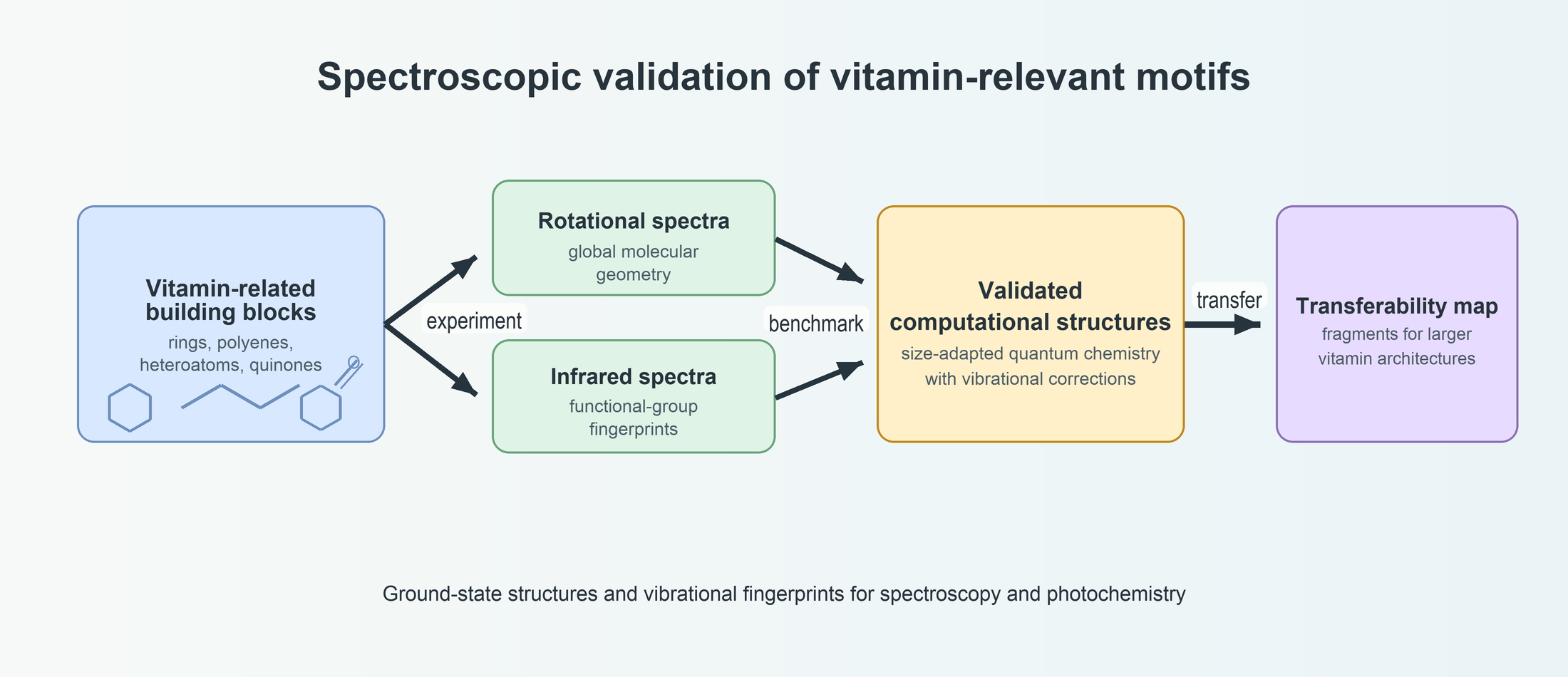
Vitamin-relevant molecular motifs combine heteroatom networks, hydrogen bonds, conjugated polyenes, saturated and fused rings, benzopyran units, and quinone cores. We present an integrated gas-phase validation strategy in which high-resolution rotational spectroscopy and infrared spectroscopy test complementary observables of the same computed structures. Ground-state rotational constants, after anharmonic vibrational correction, provide a quantitative structural anchor through the global mass distribution; gas-phase infrared spectra and tabulated vapor-phase band envelopes probe the local force fields responsible for diagnostic functional-group and fingerprint signatures. Compact fragments are benchmarked against explicitly correlated references, while larger motifs are treated with bond-corrected double-hybrid geometries and validated directly against experiment. The scope is deliberately reference-oriented. Rather than attempting to reproduce physiological condensed-phase environments, the work establishes isolatedmolecule benchmarks for tractable vitamins and transferable building blocks for larger, more flexible, or environment-dependent vitamin systems. The protocol is applied to complete vitamin molecules, nicotinic acid and ascorbic acid, and to vitamin-relevant fragments for the vitamin A, vitamin D, vitamin E, and vitamin K families: cyclohexanone, cis-1,3,5-hexatriene, 2-decalone, isochroman, benzoquinone, and naphthoquinone. The rotational benchmark confirms sub-percent accuracy for transferable non-hydrogen-bonded motifs, while the infrared comparisons validate carboxyl, ketone, polyene, and quinone fingerprints. For vitamin C, validation is structural and rotational because no isolated gas-phase infrared spectrum is available. Together, the rotational and infrared tests define a spectroscopic transferability map that separates intrinsic molecular structure from environmental perturbations and provides calibration targets for lower-cost quantum-chemical protocols and molecular-dynamics force fields.
- Open Access
- Article
From Gas-Phase Spectra to Transferable Vitamin Building Blocks: Rotational and Infrared Benchmarks
Author Information
Received: 01 Jun 2026 | Revised: 18 Jun 2026 | Accepted: 23 Jun 2026 | Published: 16 Jul 2026
Abstract
Graphical Abstract
Keywords
rotational spectroscopy | infrared spectroscopy | anharmonicity | molecular structure | vitamins | Pisa Composite Schemes
References
- 1.
Uriarte, I.; Melandri, S.; Maris, A.; et al. Shapes, Dynamics, and Stability of β-Ionone and Its Two Mutants Evidenced by High-Resolution Spectroscopy in the Gas Phase. J. Phys. Chem. Lett. 2018, 9, 1497–1502. https://doi.org/10.1021/acs.jpclett.8b00256.
- 2.
Pena, I.; Daly, A.M.; Cabezas, C.; et al. Disentangling the Puzzle of Hydrogen Bonding in Vitamin C. J. Phys. Chem. Lett. 2013, 4, 65–69. https://doi.org/10.1021/jz301947g.
- 3.
Navarro, A.; Lopez Gonzalez, J.J.; Garcıa Fernandez, A.; et al. Structural and Vibrational Study of Isochroman. Chem. Phys. 2005, 313, 279–291. https://doi.org/10.1016/j.chemphys.2005.01.014.
- 4.
Bec, K.B.; Grabska, J.; Huck, C.W.; et al. Anharmonicity and Spectra–Structure Correlations in MIR and NIR Spectra of Crystalline Menadione (Vitamin K3). Molecules 2021, 26, 6779. https://doi.org/10.3390/molecules26226779.
- 5.
Alonso, J.L.; Lopez, J.C. Microwave Spectroscopy of Biomolecular Building Blocks. In Gas-Phase IR Spectroscopy and Structure of Biological Molecules; Springer: Berlin/Heidelberg, Germany, 2015; Volume 364, pp. 335–401. https://doi.org/10.1007/128 2014 601.
- 6.
Domingos, S.R.; P´erez, C.; Schnell, M. Sensing Chirality with Rotational Spectroscopy. Annu. Rev. Phys. Chem. 2018, 69, 499–519. https://doi.org/10.1146/annurev-physchem-052516-050629.
- 7.
Loru, D.; Sun, W.; Gougoula, E.; et al. Structure and Dynamics of Microhydrated Complexes Revealed with Rotational Spectroscopy. Annu. Rev. Phys. Chem. 2026, 77, 397–416. https://doi.org/10.1146/annurev-physchem-082324-102016.
- 8.
Rijs, A.M.; Oomens, J. (Eds.) Gas-Phase IR Spectroscopy and Structure of Biological Molecules; Topics in Current Chemistry; Springer International Publishing: Cham, Switzerland, 2015; Volume 364.
- 9.
Bakels, S.; Gaigeot, M.P.; Rijs, A.M. Gas-Phase Infrared Spectroscopy of Neutral Peptides: Insights from the Far-IR and THz Domain. Chem. Rev. 2020, 120, 3233–3260. https://doi.org/10.1021/acs.chemrev.9b00547.
- 10.
Fausto, R.; Borba, A.; G´omez-Zavaglia, A. Light Induced Reactions in Cryogenic Matrices (Highlights 2013–2014). In Photochemistry; Fasani, E.; Albini, A., Eds.; The Royal Society of Chemistry: Cambridge, UK, 2015; Volume 43, pp. 20–82.
- 11.
Magyarfalvi, G.; Tarczay, G.; Vass, E. Vibrational Circular Dichroism. WIREs Comput. Mol. Sci. 2011, 1, 403–425. https://doi.org/10.1002/wcms.39.
- 12.
Demaison, J.; Boggs, J.E.; Cs´asz´ar, A.G. (Eds.) Equilibrium Molecular Structures: From Spectroscopy to Quantum Chemistry; CRC Press: Boca Raton, FL, USA, 2011.
- 13.
Puzzarini, C.; Stanton, J.F.; Gauss, J. Quantum-Chemical Calculation of Spectroscopic Parameters for Rotational Spectroscopy. Int. Rev. Phys. Chem. 2010, 29, 273–367.
- 14.
Puzzarini, C.; Stanton, J.F. Connections Between the Accuracy of Rotational Constants and Equilibrium Molecular Structures. Phys. Chem. Chem. Phys. 2023, 25, 1421–1429.
- 15.
Pulay, P.; Meyer, W.; Boggs, J.E. Cubic Force Constants and Equilibrium Geometry of Methane From Hartree–Fock and Correlated Wavefunctions. J. Chem. Phys. 1978, 68, 5077–5085.
- 16.
Mendolicchio, M.; Barone, V. Unbiased Comparison Between Theoretical and Experimental Molecular Structures and Properties: Toward an Accurate Reduced-Cost Evaluation of Vibrational Contributions. J. Chem. Theory Comput. 2024, 20, 2842–2857.
- 17.
Mendolicchio, M.; Barone, V. Accurate Vibrational and Ro-vibrational Contributions to the Properties of Large Molecules by a New Engine Employing Curvilinear Internal Coordinates and Vibrational Perturbation Theory to Second Order. J. Chem. Theory Comput. 2024, 20, 8378–8395.
- 18.
Barone, V.; Di Grande, S.; Puzzarini, C. Gas-phase computational spectroscopy: the challenge of the molecular bricks of life. Ann. Rev. Phys. Chem. 2023, 74, 29–52.
- 19.
Barone, V. Quantum Chemistry Meets High-Resolution Spectroscopy for Characterizing the Molecular Bricks of Life in the Gas-Phase. Phys. Chem. Chem. Phys. 2024, 26, 5802–5821.
- 20.
Barone, V.; Di Grande, S.; Puzzarini, C. Toward Accurate yet Effective Computations of Rotational Spectroscopic Parameters for Biomolecule Building Blocks. Molecules 2023, 28, 913.
- 21.
Barone, V.; Fuse, M.; Lazzari, F.; et al. Benchmark Structures and Conformational Landscapes of Amino Acids in the Gas Phase: a Joint Venture of Machine Learning, Quantum Chemistry, and Rotational Spectroscopy. J. Chem. Theory Comput. 2023, 19, 1243–1260.
- 22.
Barone, V. From Perception to Prediction and Interpretation: Enlightening the Gray Zone of Molecular Bricks of Life with the Help of Machine Learning and Quantum Chemistry. WIREs Comput. Mol. Sci. 2025, 15, e70000.
- 23.
Di Grande, S.; Barone, V. Toward Accurate Quantum Chemical Methods for Molecules of Increasing Dimension: the New Family of Pisa Composite Schemes. J. Phys. Chem. A 2024, 128, 4886–4900.
- 24.
Crisci, L.; Lazzari, F.; Barone, V. Composite Gradient Schemes for Accurate Molecular Geometries: A Flexible Interface and Hierarchical Optimization Workflow. J. Phys. Chem. Lett. 2025, 16, 7376–7382.
- 25.
Crisci, L.; Lazzari, F.; Barone, V. Accurate, Affordable and Unsupervised: Analytical F12 Gradients Driven by Generalized Internal Coordinates. J. Phys. Chem. Lett. 2025, 16, 9985–9992.
- 26.
Barone, V. PCS/Bonds: Pick your Molecule and Get Its Accurate Structure and Rotational Constants at DFT Cost. J. Chem. Phys. 2023, 159, 081102.
- 27.
Mendolicchio, M.; Uribe, L.; Lazzari, F.; et al. Computational Efficiency Meets Spectroscopic Accuracy: An Unsupervised Workflow for Equilibrium Geometries and Vibrational Effects in Gas-Phase Prebiotic Molecules. Phys. Chem. Chem. Phys. 2025, 27, 16383–16397.
- 28.
Barone, V.; Crisci, L.; Lazzari, F. The Road to Affordable Accuracy beyond Small Molecules: From Energetics toward Molecular Structure. Acc. Chem. Res. 2026, 59, 270–284. https://doi.org/10.1021/acs.accounts.5c00718.
- 29.
Barone, V.; Ceselin, G.; Lazzari, F.; et al. Toward Spectroscopic Accuracy for the Structures of Large Molecules at DFT Cost: Refinement and Extension of the Nano-LEGO Approach. J. Phys. Chem. A 2023, 127, 5183–5192.
- 30.
Peterson, K.A.; Adler, T.B.; Werner, H.J. Systematically Convergent Basis Sets for Explicitly Correlated Wavefunctions: The Atoms H, He, B–Ne, and Al–Ar. J. Chem. Phys. 2008, 128, 084102.
- 31.
Peterson, K.A.; Dunning Jr., T.H. Accurate Correlation Consistent Basis Sets for Molecular Core–Valence Correlation Effects: The Second Row Atoms Al–Ar, and the First Row Atoms B–Ne Revisited. J. Chem. Phys. 2002, 117, 10548–10560.
- 32.
Yousaf, K.E.; Peterson, K.A. Optimized Auxiliary Basis Sets For Explicitly Correlated Methods. J. Chem. Phys. 2008, 129, 184108.
- 33.
Yousaf, K.E.; Peterson, K.A. Optimized Complementary Auxiliary Basis Sets For Explicitly Correlated Methods: aug-ccpVnZ Orbital Basis Sets. Chem. Phys. Lett. 2009, 476, 303–307.
- 34.
Santra, G.; Sylvetsky, N.; Martin, J.M. Minimally Empirical Double-Hybrid Functionals Trained Against the GMTKN55 Database. J. Phys. Chem. A 2019, 123, 5129–5143.
- 35.
Dunning, T.H. Gaussian Basis Sets for Use in Correlated Molecular Calculations. I. The Atoms Boron Through Neon and Hydrogen. J. Chem. Phys. 1989, 90, 1007–1023. https://doi.org/10.1063/1.456153.
- 36.
Cordero, B.; Gomez, V.; Platero-Prats, A.E.; et al. Covalent Radii Revisited. Dalton Trans. 2008, pp. 2832–2838.
- 37.
Frisch, M.J.; Trucks, G.W.; Schlegel, H.B.; et al. Gaussian 16, Revision C.01; Gaussian Inc.: Wallingford, CT, USA, 2016.
- 38.
Werner, H.J.; Knowles, P.J.; Manby, F.R.; et al. The Molpro Quantum Chemistry Package. J. Chem. Phys. 2020, 152, 144107.
- 39.
Mata, S.; Pena, I.; Cabezas, C.; et al. A Broadband Fourier-Transform Microwave Spectrometer with Laser Ablation Source: The Rotational Spectrum of Nicotinic Acid. J. Mol. Spectrosc. 2012, 280, 91–96.
- 40.
National Institute of Standards and Technology. NIST ChemistryWebBook, NIST Standard Reference Database Number 69. Available online: https://webbook.nist.gov/chemistry/ (accessed on 1 June 2026).
- 41.
Alonso, J.L. Microwave Spectrum of Cyclohexanone. J. Mol. Struct. 1981, 73, 63–69.
- 42.
Wachsmuth, D.; Jahn, M.K.; Blanco, S.; et al. Inversion of Bicyclic Decanes: Rotational Spectra of the Trans and Double Cis Conformations of 2-Decalone. ChemPhysChem 2017, 18, 3620–3624. https://doi.org/10.1002/cphc.201700848.
- 43.
Craig, N.C.; Chen, Y.; Fuson, H.A.; et al. Microwave Spectra of the Deuterium Isotopologues of cis-Hexatriene and a Semiexperimental Equilibrium Structure. J. Phys. Chem. A 2013, 117, 9391–9400. https://doi.org/10.1021/jp311035c.
- 44.
Lippincott, E.R.; Kenney, T.E. The Vibrational Spectra and Geometric Configuration of cis-1,3,5-Hexatriene. J. Am. Chem. Soc. 1962, 84, 3641–3648.
- 45.
Rakovic, D.; Stepanyan, S.A.; Gribov, L.A.; et al. The Solution of the Inverse Spectroscopic Problem for the IR Spectra of trans- and cis-Hexatrienes. J. Mol. Struct. 1982, 90, 363–377.
- 46.
Wang, X.; Zheng, Y.; Xu, X.; et al. Rotational Spectrum of Isochroman. J. Mol. Struct. 2022, 1254, 132322. https://doi.org/10.1016/j.molstruc.2021.132322.
- 47.
Saxena, S.; Panchagnula, S.; Sanz, M.E.; et al. Structural Changes Induced by Quinones: High-Resolution Microwave Study of 1,4-Naphthoquinone. ChemPhysChem 2020, 21, 2579–2584. https://doi.org/10.1002/cphc.202000665.


This work is licensed under a Creative Commons Attribution 4.0 International License.

 Suite 4002 Level 4, 447 Collins Street, Melbourne, Victoria 3000, Australia
 General Inquiries: info@sciltp.com