
Addressing the enduring gap between theory and practice in renewable energy education is essential to accelerating electrification in low- access regions such as Uganda, where, despite strong policy commitments (Vision 2040; National Development Plan III), national and rural electrification rates were 47% and 35%, respectively, in 2022. This study evaluated the effectiveness of a makerspace- based training model in developing practical competencies aligned with local energy needs. A longitudinal mixed- methods design was used to assess three consecutive training interventions conducted in 2024, 2025, and 2026, involving a total of 42 engineering participants. All participants completed the post- training survey and were included in the final analysis. The interventions utilised Arduino-based microcontroller platforms and open-source tools, progressing from fundamental digital applications to the control of hybrid energy systems. The survey findings showed consistently high participant satisfaction (mean score: 9.1/10) and strong perceived relevance, with the vast majority rating the training as highly relevant to the Maker Movement. Across all three cohorts, participants reported high confidence in their practical skills, with most evaluations falling within the excellent or good categories, and only a few responses indicating areas requiring further improvement. Community engagement indicators were equally encouraging: 100% of participants indicated they would recommend the course, and 92.8% expressed interest in advanced follow-up training, indicating strong acceptance of the makerspace approach and its potential to enhance applied competencies in this institutional context. To translate these gains into sectoral outcomes, future work will pursue multi‑institutional, comparative or quasi‑experimental studies with independent external evaluation and longitudinal tracking linked to deployment and electrification indicators, alongside expanded coverage of advanced power electronics, control, and grid integration.
- Open Access
- Article
Strengthening Renewable Energy Education through Maker Spaces: A Case Study in Uganda
- Rafat Al Afif 1,*,
- Antonia Biebighäuser 1,
- Florian Pröll 1,
- Nikoleta Nikisianli 1,
- Hillary Kasedde 2,
- John Baptist Kirabira 2,
- Christoph Pfeifer 1
Author Information
Received: 29 Mar 2026 | Revised: 30 Jun 2026 | Accepted: 14 Jul 2026 | Published: 19 Aug 2026
Abstract
Graphical Abstract
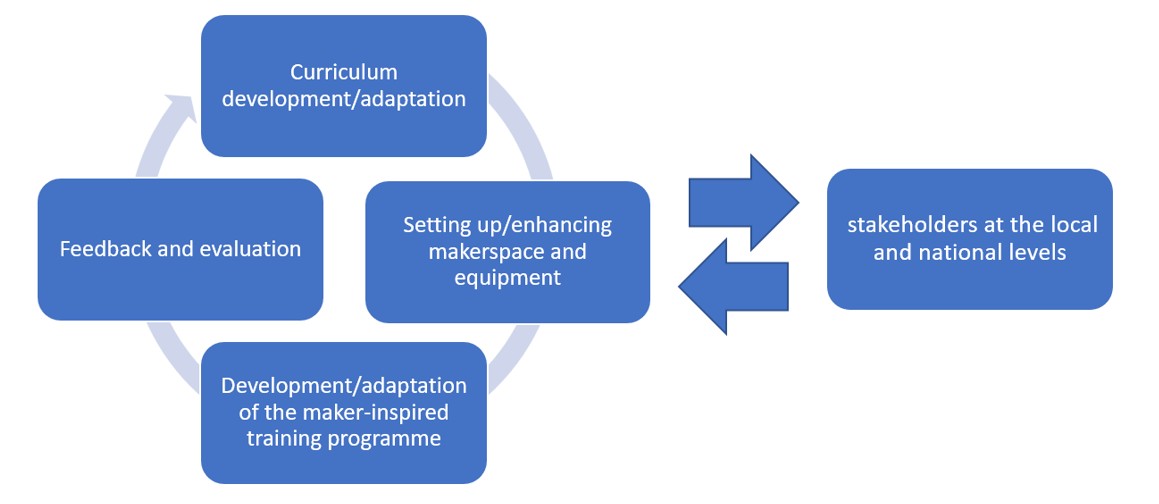
Keywords
renewable energy education | makerspace | hybrid renewable energy system control | rural electrification
References
- 1.
AEP. Uganda | Africa Energy Portal. Available online: https://africa-energy-portal.org/aep/country/uganda (accessed on 20 June 2025).
- 2.
Almajali, M.; Al Afif, R.; Maaith, O. Makerspace, Higher Education and Technical Institutions. Ind. High. Educ. 2023, 37, 155–164. https://doi.org/10.1177/09504222221114058.
- 3.
Chaleta, E.; Saraiva, M.; Leal, F.; et al. Higher Education and Sustainable Development Goals (Sdg)—Potential Contribution of the Undergraduate Courses of the School of Social Sciences of the University of Évora. Sustainability 2021, 13, 1828. https://doi.org/10.3390/su13041828.
- 4.
Wang, J.C.; Wang, T.H. Learning Effectiveness of Energy Education in Junior High Schools: Implementation of Action Research and the Predict–Observe–Explain Model to STEM Course. Heliyon 2023, 9, e14058. https://doi.org/10.1016/j.heliyon.2023.e14058.
- 5.
Abdurrahman, A.; Maulina, H.; Nurulsari, N.; et al. Impacts of Integrating Engineering Design Process into STEM Makerspace on Renewable Energy Unit to Foster Students’ System Thinking Skills. Heliyon 2023, 9, e15100. https://doi.org/10.1016/j.heliyon.2023.e15100.
- 6.
project288-PHRE Uganda. Available online: https://oead.at/de/kooperationen/internationale-hochschulkooperationen/austrian-partnership-programme-in-higher-education-research-for-development-appear/projects/current-projects/project288-phre-uganda (accessed on 20 June 2025).
- 7.
Kurucz, E.; Spencer-Mueller, E.K.; Hands, C.; et al. Co-Constructing Educational Innovations for an Uncertain Future: Design Thinking and Developmental Evaluation in the School Reform Process. Eval. Program Plan. 2025, 111, 102559. https://doi.org/10.1016/J.EVALPROGPLAN.2025.102559.
- 8.
Lu, S.Y.; Wu, C.L.; Huang, Y.M. Evaluation of Disabled STEAM-Students’ Education Learning Outcomes and Creativity under the UN Sustainable Development Goal: Project-Based Learning Oriented STEAM Curriculum with Micro:bit. Sustainability 2022, 14, 679. https://doi.org/10.3390/su14020679.
- 9.
Yang, W.; Liang, L.; Xiang, S.; et al. Making a Makerspace in Early Childhood Education: Effects on Children’s STEM Thinking Skills and Emotional Development. Think. Ski. Creat. 2025, 56, 101754. https://doi.org/10.1016/j.tsc.2025.101754.
- 10.
Sheridan, K.; Halverson, E.R.; Litts, B.; et al. Learning in the Making: A Comparative Case Study of Three Makerspaces. Harv. Educ. Rev. 2014, 84, 505–531. https://doi.org/10.17763/haer.84.4.brr34733723j648u
- 11.
Krawczak, P.; Baldino, L.; Caballero, F.G.; et al. Editorial: Women in Science: Materials 2021. Front. Mater. 2023, 10, 1129648. https://doi.org/10.3389/fmats.2023.1129648.
- 12.
United Nations Development Programme (UNDP). Uganda Gender Analysis; UNDP: New York, NY, USA, 2020. Available online: https://climatepromise.undp.org/sites/default/files/research_report_document/undp-ndcsp-uganda-gender-analysis.pdf (accessed on 20 June 2026).
- 13.
BLOG: The Role of Uganda’s Energy Transition Plan in Gender Equality | ChimpReports. Available online: https://chimpreports.com/blog-the-role-of-ugandas-energy-transition-plan-in-gender-equality/ (accessed on 20 June 2025).
- 14.
Bevan, B.; Gutwill, J.P.; Petrich, M.; et al. Learning through STEM-Rich Tinkering: Findings from a Jointly Negotiated Research Project Taken up in Practice. Sci. Educ. 2015, 99, 98–120. https://doi.org/10.1002/sce.21151.
- 15.
Strobel, J.; van Barneveld, A. When Is PBL More Effective? A Meta-Synthesis of Meta-Analyses Comparing PBL to Conventional Classrooms. Interdiscip. J. Probl. Based Learn. 2009, 3, 44–58. https://doi.org/10.7771/1541-5015.1046.
- 16.
Hsieh, S.W.; Jang, Y.R.; Hwang, G.J.; et al. Effects of Teaching and Learning Styles on Students’ Reflection Levels for Ubiquitous Learning. Comput. Educ. 2011, 57, 1194–1201. https://doi.org/10.1016/j.compedu.2011.01.004.
- 17.
Rizki, I.A.; Mirsa, F.R.; Islamiyah, A.N.; et al. Ethnoscience-Enhanced Physics Virtual Simulation and Augmented Reality with Inquiry Learning: Impact on Students’ Creativity and Motivation. Think. Ski. Creat. 2025, 57, 101846. https://doi.org/10.1016/J.TSC.2025.101846.
- 18.
Martin, L. The Promise of the Maker Movement for Education. J. Pre-Coll. Eng. Educ. Res. 2015, 5, 30–39. https://doi.org/10.7771/2157-9288.1099.
- 19.
Freeman, S.; Eddy, S.L.; McDonough, M.; et al. Active Learning Increases Student Performance in Science, Engineering, and Mathematics. Proc. Natl. Acad. Sci. USA 2014, 111, 8410–8415. https://doi.org/10.1073/pnas.1319030111.
- 20.
Federal Ministry for the Environment, Nature Conservation, Building and Nuclear Safety (BMUB). Renewable Energy Capacity Building within the International Climate Initiative (IKI); BMUB: Berlin, Germany, 2017. Available online: https://www.international-climate-initiative.com/en/iki media/publication/renewable_energy_capacity_building_within_the_international_climate_initiative_iki/ (accessed on 20 June 2026).
- 21.
Ackers, L. Moving People and Knowledge: Scientific Mobility in the European Union1. Int. Migr. 2005, 43, 99–131. https://doi.org/10.1111/j.1468-2435.2005.00343.x.
- 22.
Gaillard, J.F. North-South Research Partnership: Is Collaboration Possible between Unequal Partners? Knowl. Policy 1994, 7, 31–63. https://doi.org/10.1007/BF02692761.
- 23.
Sovacool, B.K.; Drupady, I.M. Energy Access, Poverty, and Development; Routledge: Oxfordshire, UK, 2016. https://doi.org/10.4324/9781315579535.
- 24.
Pane, J.F.; Steiner, E.D.; Baird, M.D.; et al. Continued Progress Promising Evidence on Personalized Learning. 2015. Available online: https://www.rand.org/pubs/research_reports/RR1365.html (accessed on 20 June 2026).
- 25.
Fidan, I.; Canfield, S.; Motevalli, V.; et al. iMakerSpace Best Practices for Shaping the 21st Century Workforce. Technologies 2021, 9, 32. https://doi.org/10.3390/technologies9020032.
- 26.
Cloete N, Bailey T, Maassen P. Universities and Economic Development in Africa: Pact, Academic Core and Coordination; African Minds: Cape Town, South Africa, 2012.
- 27.
Catlow, C.R.A.; Pickett J. Science and Innovation in Sub-Saharan Africa: An introduction. Interface Focus 2024, 14, 20240020. https://doi.org/10.1098/rsfs.2024.0020.
- 28.
Hemmerich, A.; Deilami, N.; Ngo, T.-A.; et al. Fostering Inclusive Learning in Engineering through Equity-Based Design Education. In Proceedings of the Canadian Engineering Education Association (CEEA), Edmonton, AB, Canada, 15–19 June 2024. https://doi.org/10.24908/pceea.2024.18550.
- 29.
Banerjee, A. Transforming the Rhetoric of Just Energy Transition Partnerships into Reality: The Devil Lies in the Details. PLOS Sustain. Transform. 2024, 3, e0000121. https://doi.org/10.1371/journal.pstr.0000121.
- 30.
Cavaletto, G.M.; Miglietta, A. Cooperative and Competitive Learning as Transformative Factors of Educational Processes for Extracurricular Skill Enhancement. Front. Educ. 2024, 9, 1388937. https://doi.org/10.3389/feduc.2024.1388937.
- 31.
Ali, A.; Almutairi, K.; Malik, M.Z.; et al. Review of Online and Soft Computing Maximum Power Point Tracking Techniques under Non-Uniform Solar Irradiation Conditions. Energies 2020, 13, 3256. https://doi.org/10.3390/en13123256.


This work is licensed under a Creative Commons Attribution 4.0 International License.

 Suite 4002 Level 4, 447 Collins Street, Melbourne, Victoria 3000, Australia
 General Inquiries: info@sciltp.com