
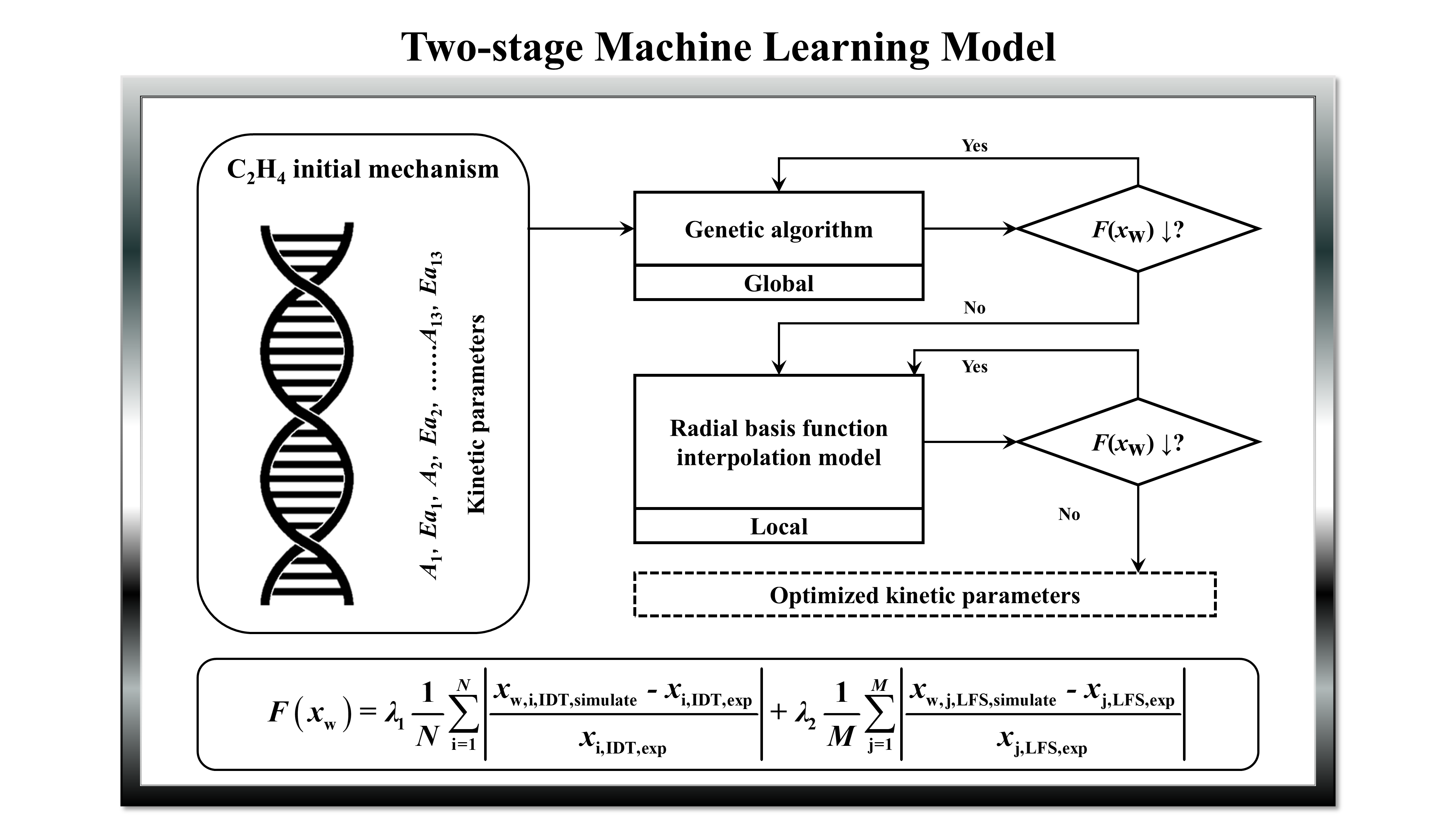
To address the dual challenges of high computational costs in detailed ethylene kinetic mechanisms and insufficient prediction accuracy in minimized ethylene kinetic mechanism, a two-stage machine learning model integrating genetic algorithm (GA) and radial basis function (RBF) interpolation was developed. The kinetic parameters in the minimized ethylene kinetic mechanism are optimized by the developed model using experimental data of ignition delay times (IDT) and laminar flame speeds (LFS). The two-stage model combines global parameter exploration with local refinement, balancing efficiency and accuracy. Results demonstrate that the optimized mechanism significantly reduces prediction error for both ignition delays and flame speeds, while improving accuracy in key species concentration distribution. This study validates the two-stage optimization method for kinetic mechanism refinement, providing a high-precision ethylene mechanism for scramjet numerical simulation.
- Open Access
- Article
Optimization of Kinetic Mechanism for Ethylene Combustion Based on Machine Learning
- Yuxin He,
- Houjun Zhang,
- Yao Nian,
- You Han *
Author Information
Received: 04 Aug 2025 | Revised: 22 Sep 2025 | Accepted: 13 Oct 2025 | Published: 23 Oct 2025
Abstract
Graphical Abstract
Keywords
machine learning | optimization | ethylene combustion | chemical kinetics
References
- 1.Prisell, E. The scramjet: A solution for hypersonic aerodynamic propulsion. In Proceedings of the 41st AIAA/ASME/SAE/ASEE Joint Propulsion Conference & Exhibit, Tucson, AZ, USA, 10–13 July 2005; American Institute of Aeronautics and Astronautics: Tucson, AZ, USA, 2005.
- 2.Liu, X. Scramjet technology. Aerosp. Technol. 2003, 2, 38–42.
- 3.Berglund, M.; Fedina, E.; Fureby, C.; et al. Finite rate chemistry large-eddy simulation of self-ignition in supersonic combustion ramjet. AIAA J. 2010, 48, 540–550.
- 4.Baurle, R.A.; Edwards, J.R. Hybrid reynolds-averaged/large-eddy simulations of a coaxial supersonic freejet experiment. AIAA J. 2010, 48, 551–571.
- 5.Liu, Y.; He, X.; Feng, L.; et al. Numerical simulation of the interaction between shock train and combustion in three-dimensional M12-02 scramjet model. Int. J. Hydrogen Energy 2022, 47, 8026–8036.
- 6.Feng, Y.; Luo, S.; Song, J.; et al. Numerical investigation on the combustion characteristics of powder fuel under different regulation parameters. Aerosp. Sci. Technol. 2023, 142, 108608.
- 7.Konnov, A.A. On the role of excited species in hydrogen combustion. Combust. Flame 2015, 162, 3755–3772.
- 8.Miller, J.A.; Sivaramakrishnan, R.; Tao, Y.; et al. Combustion chemistry in the twenty-first century: Developing theory-informed chemical kinetics models. Prog. Energy Combust. Sci. 2021, 83, 100886.
- 9.Turányi, T. Applications of sensitivity analysis to combustion chemistry. Reliab. Eng. Syst. Saf. 1997, 57, 41–48.
- 10.Sutherland, J.C.; Parente, A. Combustion modeling using principal component analysis. Proc. Combust. Inst. 2009, 32, 1563–1570.
- 11.Turányi, T.; Bérces, T.; Vajda, S. Reaction rate analysis of complex kinetic systems. Int. J. Chem. Kinet. 2004, 21, 83–99.
- 12.Liao, A.; Li, Y.; Mao, Y.; et al. Combustion mechanism construction based on minimized reaction network: Combustion of jp-10. Chem. J. Chin. Univ. 2023, 44, 51–59.
- 13.Xia, W.; Yu, H.; Wang, S.; et al. Combustion mechanism construction based on minimized reaction network: Combustion of aromatic hydrocarbon. Chem. J. Chin. Univ. 2023, 44, 149–160.
- 14.Wang, H.; Sheen, D.A. Combustion kinetic model uncertainty quantification, propagation and minimization. Prog. Energy Combust. Sci. 2015, 47, 1–31.
- 15.Sun, W.; Lin, S.; Zhang, H.; et al. A reduced combustion mechanism of ammonia/diesel optimized with multi-objective genetic algorithm. Def. Technol. 2024, 34, 187–200.
- 16.Wu, Y.; Li, J.; Tang, X.; et al. Optimization of simplified combustion mechanism of n-butanol based on shuffled frog leaping algorithm. Fuel 2024, 357, 129810.
- 17.Li, J.; Huang, X.; Fang, X.; et al. Construction of simplified combustion mechanism of diesel from direct coal liquefaction-pode3. Fuel 2022, 313, 122660.
- 18.Zeppieri, S.P.; Klotz, S.D.; Dryer, F.L. Modeling concepts for larger carbon number alkanes: A partially reduced skeletal mechanism for n-decane oxidation and pyrolysis. Proc. Combust. Inst. 2000, 28, 1587–1595.
- 19.Wang, Q.-D.; Wang, J.-B.; Li, J.-Q.; et al. Reactive molecular dynamics simulation and chemical kinetic modeling of pyrolysis and combustion of n-dodecane. Combust. Flame 2011, 158, 217–226.
- 20.Wu, K.; Yao, W.; Fan, X. Development and fidelity evaluation of a skeletal ethylene mechanism under scramjet-relevant conditions. Energy Fuels 2017, 31, 14296–14305.
- 21.Wan, Z.; Zheng, Z.; Wang, Y.; et al. A shock tube study of ethylene/air ignition characteristics over a wide temperature range. Combust. Sci. Technol. 2019, 192, 2297–2305.
- 22.Shao, J.; Davidson, D.F.; Hanson, R.K. A shock tube study of ignition delay times in diluted methane, ethylene, propene and their blends at elevated pressures. Fuel 2018, 225, 370–380.
- 23.Mathieu, O.; Goulier, J.; Gourmel, F.; et al. Experimental study of the effect of cf3i addition on the ignition delay time and laminar flame speed of methane, ethylene, and propane. Proc. Combust. Inst. 2015, 35, 2731–2739.
- 24.Kalitan, D.M.; Hall, J.M.; Petersen, E.L. Ignition and oxidation of ethylene-oxygen-diluent mixtures with and without silane. J. Propul. Power 2005, 21, 1045–1056.
- 25.Deng, F.; Pan, Y.; Sun, W.; et al. Comparative study of the effects of nitrous oxide and oxygen on ethylene ignition. Energy Fuels 2017, 31, 14116–14128.
- 26.Colket, M.B.; Spadaccini, L.J. Scramjet fuels autoignition study. J. Propul. Power 2001, 17, 315–323.
- 27.Egolfopoulos, F.N.; Zhu, D.L.; Law, C.K. Experimental and numerical determination of laminar flame speeds: Mixtures of c2-hydrocarbons with oxygen and nitrogen. Symp. (Int.) Combust. 1991, 23, 471–478.
- 28.Hassan, M.I.; Aung, K.T.; Kwon, O.C.; et al. Properties of laminar premixed hydrocarbon/air flames at various pressures. J. Propul. Power 1998, 14, 479–488.
- 29.Konnov, A.A.; Dyakov, I.V.; De Ruyck, J. The effects of composition on the burning velocity and no formation in premixed flames of c2h4+o2+n2. Exp. Therm Fluid Sci. 2008, 32, 1412–1420.
- 30.Kumar, K.; Mittal, G.; Sung, C.; et al. An experimental investigation of ethylene/o2/diluent mixtures: Laminar flame speeds with preheat and ignition delays at high pressures. Combust. Flame 2008, 153, 343–354.
- 31.Ravi, S.; Sikes, T.G.; Morones, A.; et al. Comparative study on the laminar flame speed enhancement of methane with ethane and ethylene addition. Proc. Combust. Inst. 2015, 35, 679–686.
- 32.Huo, J.; Shu, T.; Ren, Z.; et al. Extrapolation of laminar ethylene/air flame speeds at elevated pressures with flame chemistry analysis. J. Propul. Power 2019, 35, 424–431.
- 33.Lubrano Lavadera, M.; Brackmann, C.; Konnov, A.A. Experimental and modeling study of laminar burning velocities and nitric oxide formation in premixed ethylene/air flames. Proc. Combust. Inst. 2021, 38, 395–404.
- 34.Ma, S.; Zhang, X.; Dmitriev, A.; et al. Revisit laminar premixed ethylene flames at elevated pressures: A mass spectrometric and laminar flame propagation study. Combust. Flame 2021, 230, 111422.
- 35.Wang, L.; Hou, R.; Zhang, Z.; et al. Laminar flame speed measurement and combustion mechanism optimization for ethylene–air mixtures. Asia-Pac. J. Chem. Eng. 2024, 19, e3060.
- 36.Cong, T.L.; Emma, B.; and Dagaut, P. Oxidation of ethylene and propene in the presence of co2 and h2o: Experimental and detailed kinetic modeling study. Combust. Sci. Technol. 2010, 182, 333–349.
- 37.Jallais, S.; Bonneau, L.; Auzanneau, M.; et al. An experimental and kinetic study of ethene oxidation at a high equivalence ratio. Ind. Eng. Chem. Res. 2002, 41, 5659–5667.
- 38.Lopez, J.G.; Rasmussen, C.L.; Alzueta, M.U.; et al. Experimental and kinetic modeling study of c2h4 oxidation at high pressure. Proc. Combust. Inst. 2009, 32, 367–375.
- 39.Su, B.; Papp, M.; Zsély, I.G.; et al. Comparison of the performance of ethylene combustion mechanisms. Combust. Flame 2024, 260, 113201.
- 40.Mechanical and Aerospace Engineering (Combustion Research) University of California at San Diego, San Diego Mechanism. Available online: https://web.eng.ucsd.edu/mae/groups/combustion/mechanism.html (accessed on 16 March 2024).
- 41.Pang, G.A.; Davidson, D.F.; Hanson, R.K. Experimental study and modeling of shock tube ignition delay times for hydrogen–oxygen–argon mixtures at low temperatures. Proc. Combust. Inst. 2009, 32, 181–188.
- 42.Combustion Dynamics, Sichuan, Cds, Center for Combustion Dynamics, Sichuan University. Available online: http://cds.scu.edu.cn/ (accessed on 16 July 2024).
- 43.Cao, S.; Zhang, H.; Liu, H.; et al. Optimization of kinetic mechanism for hydrogen combustion based on machine learning. Front. Chem. Sci. Eng. 2024, 18, 136.
- 44.Cao, S.; Huang, J.; Li, W.; et al. Optimization of kinetic mechanism for methane combustion based on machine learning. Chem. J. Chin. Univ. 2024, 45, 20240296.
- 45.Ihme, M.; Chung, W.T.; Mishra, A.A. Combustion machine learning: Principles, progress and prospects. Prog. Energy Combust. Sci. 2022, 91, 101010.
- 46.Holland, J.H. Genetic algorithms and the optimal allocation of trials. SIAM J. Comput. 1973, 2, 88–105.
- 47.Varatharajan, B.; Williams, F.A. Ethylene ignition and detonation chemistry, part 1: Detailed modeling and experimental comparison. J. Propul. Power 2002, 18, 344–351.
- 48.Brown, C.J.; Thomas, G.O. Experimental studies of shock-induced ignition and transition to detonation in ethylene and propane mixtures. Combust. Flame 1999, 117, 861–870.
- 49.Weber, B.W.; Kumar, K.; Zhang, Y.; et al. Autoignition of n-butanol at elevated pressure and low-to-intermediate temperature. Combust. Flame 2011, 158, 809–819.
- 50.Baigmohammadi, M.; Patel, V.; Nagaraja, S.; et al. Comprehensive experimental and simulation study of the ignition delay time characteristics of binary blended methane, ethane, and ethylene over a wide range of temperature, pressure, equivalence ratio, and dilution. Energy Fuels 2020, 34, 8808–8823.
- 51.Zhou, C.-W.; Li, Y.; Burke, U.; et al. An experimental and chemical kinetic modeling study of 1,3-butadiene combustion: Ignition delay time and laminar flame speed measurements. Combust. Flame 2018, 197, 423–438.
- 52.Bagheri, G.; Ranzi, E.; Pelucchi, M.; et al. Comprehensive kinetic study of combustion technologies for low environmental impact: Mild and oxy-fuel combustion of methane. Combust. Flame 2020, 212, 142–155.
- 53.Usc Mech Version ii. High-Temperature Combustion Reaction Model of h2/co/c1-c4 Compounds. Available online: http://ignis.usc.edu/USC_Mech_II.html (accessed on 16 March 2024).
How to Cite
He, Y.; Zhang, H.; Nian, Y.; Han, Y. Optimization of Kinetic Mechanism for Ethylene Combustion Based on Machine Learning. Smart Chemical Engineering 2025, 1 (1), 3. https://doi.org/10.53941/sce.2025.100003.
RIS
BibTex
Copyright & License

Copyright (c) 2025 by the authors.
This work is licensed under a Creative Commons Attribution 4.0 International License.
Article Metrics
182
Article Views
0
Citations
Contents
References

 Suite 4002 Level 4, 447 Collins Street, Melbourne, Victoria 3000, Australia
 General Inquiries: info@sciltp.com